Museums & Institutions
Is Chinese Censorship Reaching Inside Britain’s Museums?
A report reveals the V&A altered exhibition catalogues at the request of Chinese censors, raising concerns over foreign influence.

A report reveals the V&A altered exhibition catalogues at the request of Chinese censors, raising concerns over foreign influence.
Jo Lawson-Tancred
 ShareShare This Article
Experts are voicing their concern about the influence of Chinese censorship on the U.K.’s cultural institutions after a new report revealed that London’s V&A museum removed content from its exhibition catalogues at the request of Beijing.
The V&A agreed to remove images of historic maps and a photograph of the former head of Soviet Russia, Vladimir Lenin, from two catalogues after they were flagged by Chinese censors, according to a report in the Guardian. Several leading U.K. institutions, including Tate and the British Museum, reduce production costs by working with printers in China, and must therefore comply with the standards of Beijing’s General Administration of Press and Publication (GAPP). The latest finding sheds light on the widespread phenomenon of “transnational repression,” which sees foreign authoritarian states enforce censorship beyond their borders.
The V&A has said that the requested edits were “minor.”
Yet, this kind of influence is part of a much wider “pattern,” according to Sam Dunning, director of U.K.-China Transparency. “It’s disturbing,” he said in a phone call.
The V&A decides where to print its books on “a case-by-case basis,” the V&A spokesperson said. “We sometimes print in China but maintain close editorial oversight.”
One of the affected catalogues is for the “Music is Black” exhibition, which opens at the new V&A East museum this Friday. An introduction by the museum’s director Gus Casely-Hayford was originally going to be illustrated by a 1930s map showing the trade routes of the British empire that was rejected by GAPP.
“Our suggestion is to delete this map or use another image,” the Chinese printers, C&C Offset Printing, told the V&A, according to an email obtained by the Guardian.
“It’s a historic map showing British colonial rule so nothing to do with China,” a V&A employee wrote in an internal email that was also released in response to the Guardian’s freedom of information request.
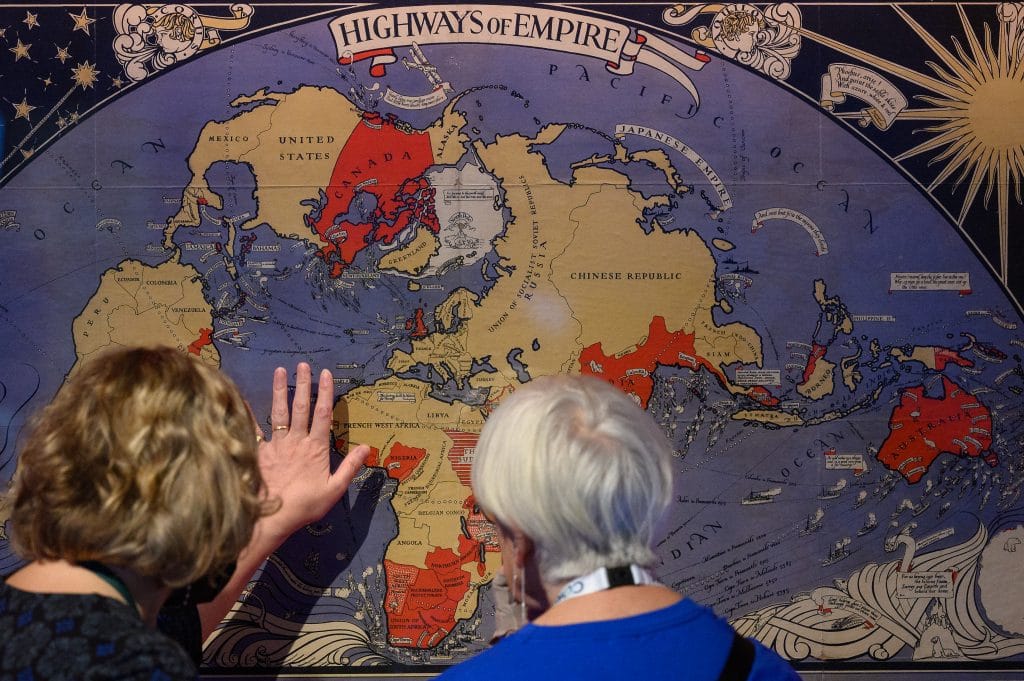
Two people look at the detail within “Highways of Empire” (1927) by Leslie MacDonald Gill as it is displayed during the “London: Port City” exhibition at the Museum of London Docklands, on October 21, 2021. Photo: Leon Neal/ Getty Images.
Maps are strictly regulated in China, meaning only licensed firms can legally create maps of Chinese geography, including the territories that Beijing claims.
The printing of the catalogue was delayed until the museum replaced the map with a photograph of people arriving from the West Indies to the English port city of Southampton.
Another map and a photograph of Lenin were removed from the 2021 catalogue “Fabergé: Romance to Revolution.” In an internal email from the time, a V&A employee noted that “the list of restrictions is ever changing.”
“We were comfortable making these minor edits, as they did not affect the narrative, and would obviously pull production if we felt any requested change was problematic,” the V&A spokesperson said.
“It starts with minor edits,” said Dunning. “Ultimately, if you start compromising on independence to a minor degree, the line may move.”
The claim that edits required of the V&A by GAPP are “minor” has been called into question by Jessica Ní Mhainín, a spokesperson for Index on Censorship. In an email, she argued that historical maps are “important records of how societies understand geography, power and the past.”
Ní Mhainín warned that “economic dependence on China can drive self-censorship,” adding that cultural institutions like the V&A have a responsibility in “defending their independence and safeguarding intellectual freedom and free expression.”
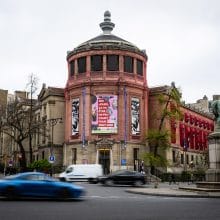
Transnational repression is a growing threat to cultural institutions internationally. Last year, the state-run Musée Guimet in Paris was sued by four pro-Tibetan groups for allegedly attempting to erase Tibet’s cultural identity from its displays. Lawyers representing the groups said it was difficult not to see this as “a deliberate choice by the Guimet Museum to comply with Chinese lobbying demands, which are keenly relayed in France.”