Art World
Cai Guo-Qiang’s Fireworks in Tibet Spark Outrage Over Environmental and Cultural Harm
This artist's controversial display was produced by outdoor brand Arc'teryx.

This artist's controversial display was produced by outdoor brand Arc'teryx.
Cheung Hok Hang
 ShareShare This Article
Artist Cai Guo-Qiang has set off an explosion on Chinese social media, but not in the way he intended.
On Friday, September 19, dozens of art insiders, lifestyle influencers, and media gathered against the serene backdrop of the Himalayan ridgelines in Shigatse of Tibet, for Cai’s latest spectacle. Titled Rising Dragon, the firework display stretched across mountains at altitudes between 4,600 and 5,050 meters. According to the artist, it was his way to “bring energy, awe, blessings and hope to the world.”
But once videos of the performance surfaced online, the backlash was immediate. Netizens, environmental scientists, and activists denounced the work for threatening one of the planet’s most fragile ecosystems and for showing cultural insensitivity, as the Tibetan plateau and its mountains are sacred in Tibetan Buddhism.
The controversy escalated quickly. Hashtags related to the event shot to the top of trending lists across Chinese social media, and within hours, promotional videos posted by Cai’s studio and its sponsor, Chinese-owned Canadian-headquartered outdoor brand Arc’teryx, were quietly deleted.
Outdoor brand Arc’teryx and internationally renowned Chinese artist Cai Guoqiang issued apologies on Sunday after a fireworks display in the Himalayas of Southwest China’s Xizang Autonomous Region on Friday evening, co-organized by Arc’teryx and Cai, triggered an outcry among… pic.twitter.com/6reMvVebkY
— Global Times (@globaltimesnews) September 21, 2025
By Sunday, both the artist’s studio and Arc’teryx had issued public apologies. In his statement, Cai emphasized that the fireworks were made of biodegradable materials that had passed environmental checks for the 2022 Beijing Winter Olympics and complied with pollution standards in Japan and Europe. He added that precautions had been taken to protect wildlife, with salt bricks used to divert animals and herds relocated in advance.
Arc’teryx, meanwhile, distanced itself from the project, saying the event was “out of line” with the brand’s values and that it was addressing the matter directly with the “local artist involved” and its China team.
The apologies did little to quell public anger. Environmental scientists warned that the damage could be irreversible, given the plateau’s fragile ecosystem. They pointed out that standards designed for urban settings do not apply at such high altitudes, where low temperatures, thin oxygen, strong winds, and high UVA exposure mean the region lacks the microorganisms needed to break down materials. What might biodegrade in a city within days could take decades or even centuries in the plateau.
Adding to the uproar, lawyers have raised concerns of negligence, questioning how such an event was approved without any environmental assessment. State media outlets CCTV and Xinhua also weighed in, publishing reports and op-eds condemning the performance as a potential violation of the Qinghai-Tibet Plateau Ecological Protection Law, China’s first legislation dedicated to safeguarding the plateau and its surroundings, signaling strong disapproval from the government. By Monday, both the local administration and the Communist Party branch had announced an investigation.
The inspiration for Cai’s fireworks in Tibet traces back to his 1989 work Ascending Dragon: Project for Extraterrestrails No 2, which was created while the artist resided in Japan and marked his foray from the East into the Western art world. That project envisioned a firework display over Mont Sainte-Victoire—the mountain portrait in a series of paintings by Impressionist Paul Cézanne—framing it as a dialogue with Cézanne and Western civilization. Cai had originally sought to realize the piece both at Mount Fuji, in Japan, and at Mont Sainte-Victoire in France, but was reportedly denied permission by local authorities due to environmental concerns.
The project was eventually brought to the Himalayas with sponsorship from Arc’teryx. In 2023, the Canadian outdoor brand collaborated with Chinese sound artist Dadawa on Asking Mountain, a performance staged at Namjagbarwa peak in Tibet’s Pemako region, which received wide online praise.
Cai’s Rising Dragon was presented as a continuation of this strategy to reposition the brand from technical gear to luxury by working with artists. Arc’teryx has pursued this shift since its parent company, Amer Sports, was acquired by Chinese sportswear giant Anta Group in 2019. But the backlash this time was swift. Many consumers have vowed to boycott Arc’teryx, and Anta’s stock price dropped more than 2.43 percent on the Hong Kong exchange on Monday, wiping out roughly $849 million in market value.
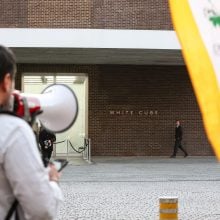
Meanwhile, many online users have launched petitions urging White Cube in London to cancel Cai’s upcoming solo exhibition, slated to open September 26, and are calling for protests at the gallery.
It is also not the first time Cai, one of China’s most famous living artists, has faced public backlash. In December 2024, a drone performance in his hometown of Quanzhou ended in chaos when drones, unregistered with local authorities, were shot down en masse during the event. Just four months earlier, his daytime firework display at the third edition of PST Art in Los Angeles also sparked outrage, as ash from pyrotechnics rained down on spectators while noise and potential pollution disrupted nearby neighborhoods without warning.
Some art lovers compared the stunt to the works of photographer Thomas Jackson, known for creating suspended installations in nature using mass-produced materials that can be easily recycled after shooting. “When art is backed by capitalism, we should think even harder about how to pursue aesthetics and creativity while also protecting the nature we rely on,” one critic said.