Museums & Institutions
Paris Museum Sued for ‘Erasing’ Tibet from Gallery Name
Respected Tibetologists had previously raised the alarm over the removal of non-Han cultures in wall texts.
Respected Tibetologists had previously raised the alarm over the removal of non-Han cultures in wall texts.
Jo Lawson-Tancred
 ShareShare This Article
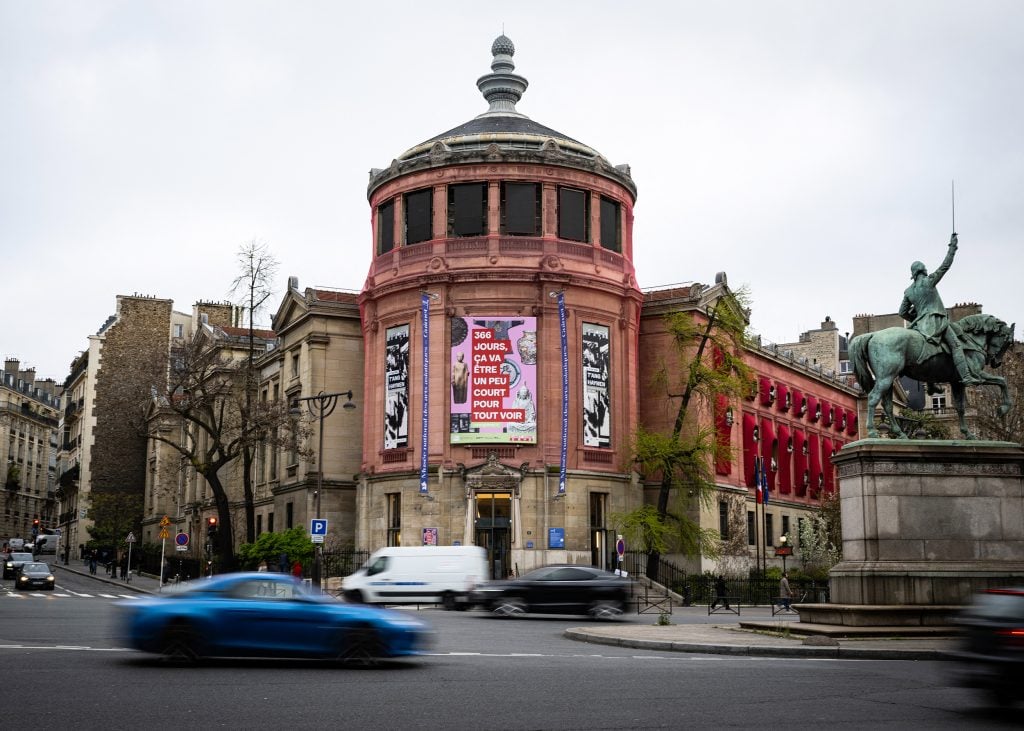
Four pro-Tibetan groups in France have filed a legal complaint against Paris’s state-run Musée Guimet, accusing it of attempting to erase Tibet’s cultural identity by renaming its Nepal-Tibet gallery to “Himalayan world” and removing references to “Tibetan art.” The groups argue the changes blur Tibet’s distinct heritage and align with political efforts to diminish its recognition amid tensions with Beijing.
The lawsuit is the latest development in complaints against French museums for removing references of Tibet from their displays.
Musée Guimet—one of the largest collections of Asian art outside of Asia—recently renamed its Nepal-Tibet gallery as “Himalayan world,” which the groups claim is “sowing confusion about Tibet’s cultural distinctiveness with the political aim of erasing Tibet’s existence,” according to AFP, which first reported the news of the lawsuit.
“Replacing the name of the gallery ‘Tibet-Nepal’ with the expression ‘Himalayan World’ is not justified from a scientific perspective, culturally, or pedagogically, and contributes to the erasure of Tibet,” said Lily Ravon and William Bourdon, who are lawyers representing the groups.
They also allege that the museum has eliminated mentions of “Tibetan art” from its collection, amid ongoing tensions between pro-Tibetan groups and Beijing over the preservation of the region’s traditional Buddhist identity. The French associations argue in the legal complaint that the changes at Guimet breach the museum’s statutory mission to contribute to “education, training and research.”
“Given that four of the five members of the museum’s board of directors are known to be close to the Chinese government,” Ravon and Bourdon said in an email, “it is difficult not to see this as a partisan-driven move and a deliberate choice by the Guimet Museum to comply with Chinese lobbying demands, which are keenly relayed in France.”
The museum said in a statement that the decision to rename the “Nepal-Tibet” gallery as “Himalayan World” is in “no way a response to external pressures” and reflects a desire to better represent the historical and cultural reality of the collections on display.
“This geographical area is a melting pot of civilizations and mutual influences that far exceed current or past political borders,” the statement read. “This choice is not intended to make any culture invisible, much less to deny Tibetan identity, but rather to highlight the richness of cultural interactions in this vast and complex space.” The museum further claimed that other institutions such as the Metropolitan and Rubin Museums in New York and the Smithsonian in Washington, D.C. also frequently use the term “Himalaya” to encompasses Tibetan and Nepalese art and their cultural environments.
Beijing remains highly sensitive to challenges over Tibetan identity and its sovereignty over the region, and the controversy over how Tibet is being represented in French museums started in 2024, coinciding with the 60th anniversary of France-China diplomatic ties. Last September, a group of predominantly French researchers and scientists have published an open letter in Le Monde expressing concern that France’s cultural institutions were enabling “sinicization,” or the assimilation of non-Chinese groups into Chinese culture. They allege that Musée du quai Branly and the Musée Guimet acquiesced to use language that “reflects Beijing’s wishes regarding the rewriting of history and the planned erasure of non-Han people.”
According to the open letter’s authors, the Musée du Quai Branly, where the collection is principally made up of so-called “ethnographic objects” and indigenous art from outside Europe, has reclassified its Tibetan objects as originating from the “Xizang Autonomous Region.” This change, they say, “clearly shows the desire that Tibet, occupied and colonized since 1950, must be erased from maps and consciences, in the present as in the past.”
Around the same time, the Guimet Museum replaced the gallery labels with “Himalayan world” where Nepal-Tibet had previously been cited.
A spokesperson for the Musée du quai Branly said the museum still uses the name Tibet in the plates for the permanent collections and has never stopped using this name in its work on the collections; the thesaurus used to classify the collections conserved by the museum includes both terms (Tibet and China). They added that the collection records currently available online are “not the most up-to-date versions” due to an ongoing technical update, and may be misleading, which the museum claims had previously been explained to one of the signatories on the open letter.
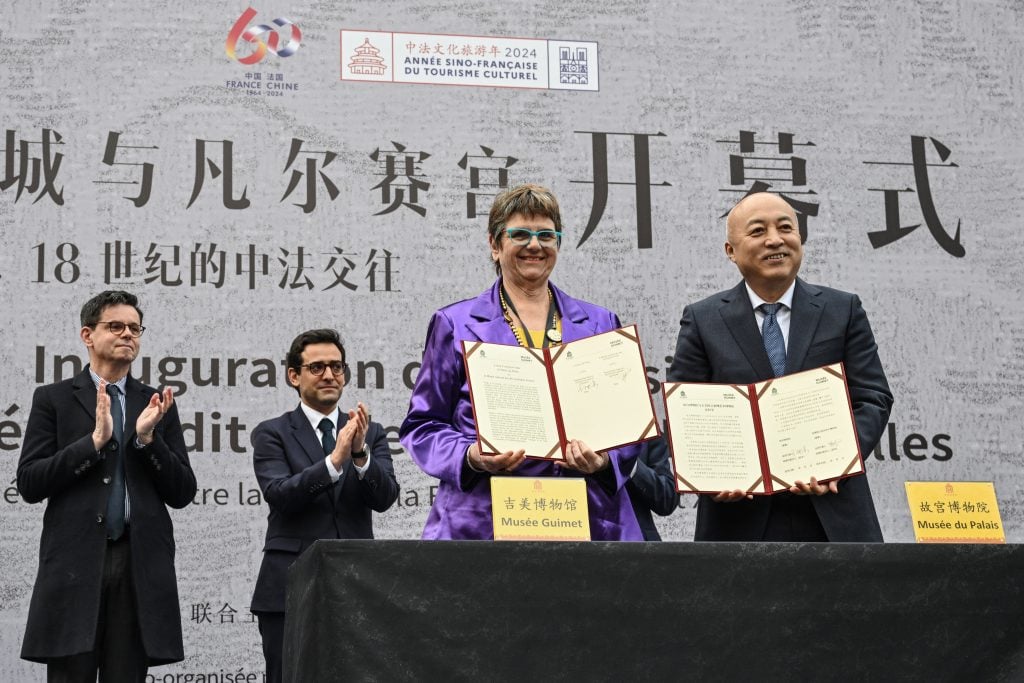
Yannick Lintz, president of the Guimet Museum, and Palace Museum director Wang Xudong, pose after signing documents while President of Chateau de Versailles Christophe Leribault and France’s Foreign Minister Stephane Sejourne look on during the opening ceremony of “The Forbidden City and the Palace of Versailles” exhibition, which celebrates the 60th anniversary of the establishment of diplomatic relations between France and China, at the Forbidden City in Beijing on April 1, 2024. Photo: Jade Gao / Pool / AFP via Getty Images.
“The Musée du quai Branly – Jacques Chirac carries out its missions with complete independence and scientific freedom,” the spokesperson said in an email in September. “It is therefore in control of the content of its programs, exhibitions and all its activities. Its professional integrity and institutional autonomy are in no way jeopardized by financial or political interests.”
In response to the open letter, a spokesperson for the Musée Guimet said that recent events “constitute a glaring denial of the unfounded accusations leveled at the museum,” noting that over the past few months, the museum has presented an exhibition about Alexandra David Néel’s travels to Tibet, to mark the centenary of her entry into Lhasa. The show was accompanied by a very successful conference at the museum on her journey in Tibet. The spokesperson also noted that the artifacts in the rooms titled “Himalayan World” belong to a cultural area covering both Tibet and Nepal and “in no way does the use of this term signify the erasure of the terms ‘Tibet’ or ‘Tibetan.'”
Among the signatories on the original letter were several respected Tibetologists, including Jean-Luc Achard, Stéphane Arguillère, Katia Buffetrille, and Fernand Meyer. Another of the signatories is Jacques Bacot, a dealer of furniture from the 17th, 18th, and 19th centuries. He shares a name with, and may perhaps be related to, another Jacques Bacot (1877–1965), a legendary French Tibetologist who donated his collection of paintings and bronzes to Musée Guimet in 1912.
The letter’s authors praised the Nantes History Museum for explicitly refusing any Chinese interference in their exhibition about Genghis Khan, which opened in 2023. The museum backed out of a possible loan of objects from China after its “ran into Chinese censorship,” which apparently aimed for “the name of Genghis Khan to be erased, as well as Mongolian history and culture.”
Margaret Carrigan contributed reporting.
This story was originally published on September 6, 2024. It was updated on July 3, 2025 with news of the lawsuit brought against Musée Guimet. Statements from the plaintiffs’ lawyers and the Musée Guimet were added on July 4, 2025.