Law & Politics
IMLS Spared in Legal Battle—But Threat of Budget Cuts Looms
The threat to the IMLS, NEA, and NEH continues as Congress looks to the 2027 fiscal year budget.

The threat to the IMLS, NEA, and NEH continues as Congress looks to the 2027 fiscal year budget.
Sarah Cascone
 ShareShare This Article
The American Federation of State, County and Municipal Employees union (AFSCME) and the American Library Association (ALA) have successfully fended off President Donald Trump’s efforts to eliminate the Institute of Museum and Library Services (IMLS).
Last week, the U.S. Department of Justice reached a settlement in the lawsuit filed last April by the two organizations, agreeing to leave IMLS intact and allowing it to continue its work supporting libraries and museums across the country. But the imperiled agency is not out of the woods yet, as the administration’s proposed 2027 federal budget once again seeks to eliminate the IMLS.
Funding for the cultural sector has long been under threat by Trump. In both his terms, the president’s annual budget proposals have unsuccessfully looked to strip funding for the IMLS, as well as the National Endowment for the Arts and the National Endowment for the Humanities.
But Trump tried a different tactic after retaking office in 2025. On March 14, he issued an executive order eliminating the IMLS. The Department of Government Efficiency (DOGE) arrived days later, and the entire staff was put on administrative leave by the month’s end, leaving the status of the agency’s grants—and its future—in jeopardy.
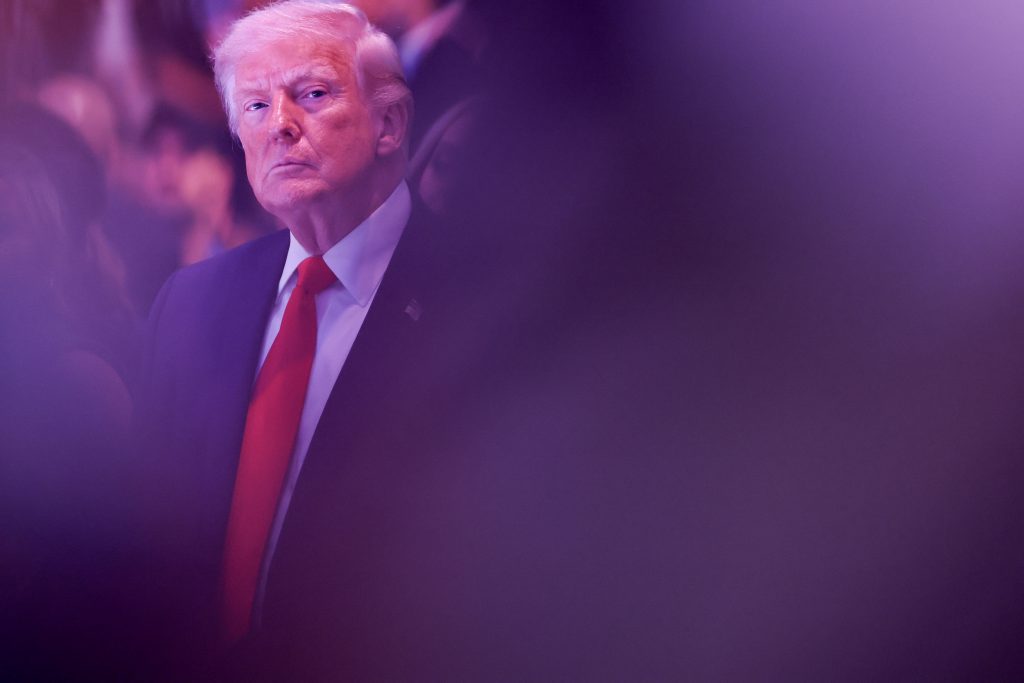
U.S. President Donald in April, 2026. Photo by Carmen Mandato/Getty Images.
In response, 21 states filed a lawsuit, Rhode Island v. Trump, against the administration, arguing that only Congress had the authority to eliminate federal agencies. The ALA v. Sonderling lawsuit from ALA and AFSCME, the largest union of cultural workers in the country, came next. (There was also a lawsuit to block major cuts at the NEH.)
In May, the courts issued a preliminary injunction against the IMLS shutdown in the state case, and a temporary restraining order preventing the termination of IMLS staff in the ALA case. In November, a court struck down the attempt to dismantle the agency as unlawful and unconstitutional. The IMLS then reinstated all previously terminated grants. The administration initially moved to appeal the verdict, but withdrew that appeal last week, shortly before the settlement in the other case.
Trump’s 2026 budget proposal would have eliminated the IMLS’s budget, but Congress approved preserving funding levels at $291.8 million. Congress also approved $207 million each in funding for the NEA and NEH, despite the president’s renewed push to eliminate the agencies.
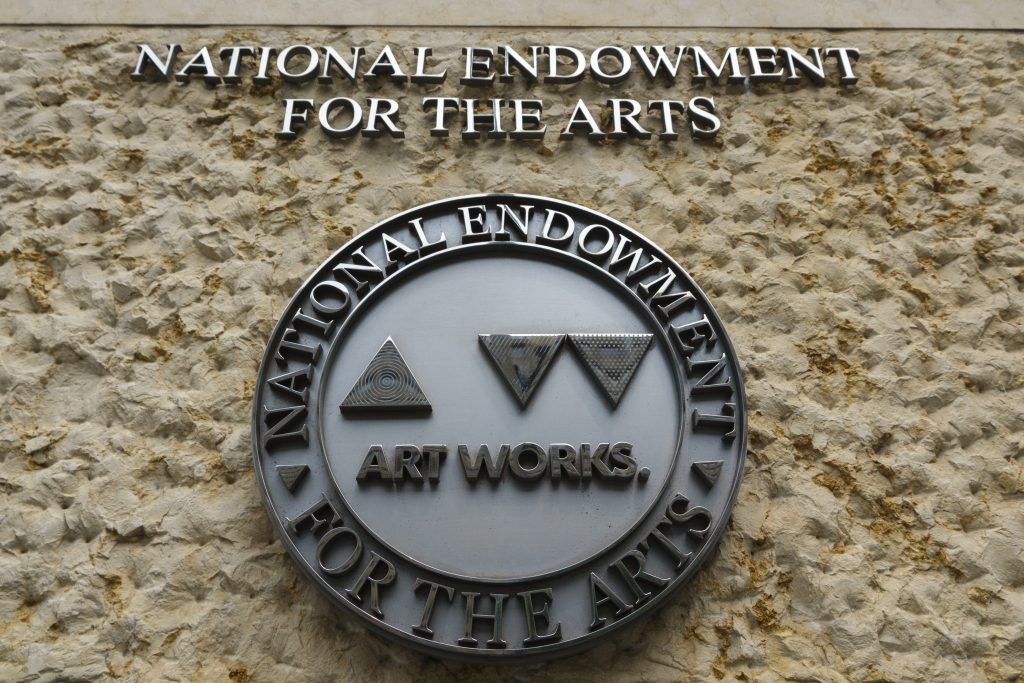
The National Endowment for the Arts sign outside of its headquarters at Constitution Center in Washington, D.C. Photo by Kevin Carter/Getty Images.
But if Trump has failed to zero out arts funding, he has successfully changed the priorities of these agencies. Gone are the NEA’s Challenge America grants, dedicated to underserved communities. Current IMLS guidelines cite the importance of following Trump’s executive orders looking to ban “woke” ideologies at the Smithsonian Institution.
And funds for these cultural agencies have been redirected to projects celebrating the 250th anniversary of the founding of United States, including a $14.1 million IMLS grant to traveling Freedom Truck exhibitions organized by evangelicals. (This was part of the ALA lawsuit, as IMLS funding is designed to go to state and local organizations, not federal programs.)
The president’s new budget proposal has made his priorities clear. He wants to increase defense spending by $445 billion, a 44-percent increase to $1.5 trillion, with a total budget of $2.2 trillion. Domestic spending would fall to $660 billion, a $73 billion or 10 percent decrease from 2026.
And rather than zeroing out the NEA, NEH, and IMLS budgets, as he has suggested in years past, Trump wants to allot the agencies $29 million, $38 million, and $6 million, respectively, to permanently wind down operations.
The American Alliance of Museums is circulating an open letter from museums and other related organizations urging Congressional leaders to fund the NEA, the NEH, and the IMLS’s Office of Museum Services (OMS) for 2027.
“Continued funding and policy support will ensure museums remain accessible, innovative, and impactful for all Americans,” the letter stated. “Every state is home to museums that explore nature, science, history, culture, and art, yet their full impact is often overlooked. Americans strongly support museums, and with that public support, we encourage lawmakers to invest in these vital institutions.”
The Americans for the Arts Action Fund is encouraging members of the public to send messages to their representatives calling for continued cultural funding.
But cultural institutions are far from the only agencies on the chopping block. Trump has proposed cuts of $15 billion for clean energy initiatives, $8.5 billion for K-12 programs, $5 billion for the National Institutes of Health, $5.6 billion for NASA, and $4.2 billion for the Environmental Protection Agency.
Congress has a deadline of September 30 to pass a budget, or face another full-scale government shutdown. (A partial one is currently in effect as Congress has yet to approve appropriations for ICE under the Department of Homeland Security’s 2026 funding; the nation’s cultural institutions are not affected.) Trump hopes to use budget reconciliation legislation, which requires a simple majority—which requires no Democrat votes—to pass an initial $350 billion for defense by June 1.