Law & Politics
NEA’s New Grant Rules Imperil Funding for Arts Programs in Underserved Communities
The NEA has canceled its Challenge American grants, many recipients of which served children and rural communities.

The NEA has canceled its Challenge American grants, many recipients of which served children and rural communities.
Sarah Cascone
 ShareShare This Article
This is the National Endowment for the Arts under President Donald Trump: NEA grants aimed at underserved communities are out, and projects celebrating the upcoming 250th anniversary of the founding of United State of America are in.
The NEA issued an update on its grant guidelines for the 2026 fiscal year yesterday, noting that the changes were being made “in response to recent directives.” The same day of his inauguration, Trump issued an executive order “ending radical and wasteful government DEI programs and preferencing,” calling such efforts discriminatory.
It stands as no surprise, therefore, that the NEA’s announcement abruptly cancelled its Challenge America grants, which were aimed at small arts organizations in the hope of “extend[ing] the reach of the arts to underserved groups/communities,” according to the original announcement. It was likely the word “underserved” that triggered Trump’s ire, as it is often used in the context of DEI issues.
Organizations who were hoping for a $10,000 Challenge America grant are instead eligible to apply under the broader Grants for Arts Projects category. (The deadline for that, originally February 13, has been extended to March 11, with a second application period that runs through July 10, and any extant Challenge America proposals must be resubmitted.)

A previously distributed National Endowment for the Arts info graphic soliciting applications for 2026 grants, including the Challenge America program cancelled under President Donald Trump. Image by the NEA.
But there are new guidelines for Grants for Art Projects as well.
Now, applicants must meet a new “five-year history of arts programming” requirement. And they have been instructed to propose funding for initiatives that “celebrate and honor the 250th anniversary of the signing of the Declaration of Independence,” the announcement said. “Under the updated guidelines, the NEA continues to encourage projects that celebrate the nation’s rich artistic heritage and creativity by honoring the semiquincentennial of the United States of America (America250).”
That change also is linked to a Trump executive order, issued January 29 and titled “celebrating America’s 250th birthday.” In it, the president appointed the chair of both the NEA and the National Endowment for the Humanities to an official White House Task Force on Celebrating America’s 250th Birthday. (Trump, who will chair the committee, has yet to fill either position.)
In some ways, it is perhaps heartening that Trump seems to see some future for the NEA even as he continues to slash government spending—an effort largely led by Elon Musk as head of the new Department of Government Efficiency, also established by executive order.
During Trump’s first term, he repeatedly attempted to eliminate the entire budget for both the NEA and the NEH. But if he wants the head of both organizations to help plan America’s birthday bash, and to dole out funding for related events across the nation, it seems neither is currently on the chopping block. (The NEA’s federal appropriation for the 2024 fiscal year was $207 million.)
The planned semiquincentennial celebrations will also revive Trump’s planned National Garden of American Heroes, a relic of his first term. During his final days in office in 2021, Trump released an executive order naming 244 figures—not all of whom were American—he intended to honor in the garden. The latest executive order looks to expand that number to 250.
How the sudden institution of a patriotic theme for NEA grant recipients will affect the nation’s institutions—and whether there will be a mad dash to redo applications to be about America250—remains to be seen.
For the current fiscal year, $36.79 million in funding will be distributed to 1,474 organizations across all 50 states, as well as Puerto Rico and Washington, D.C. Only 11 of them mentioned America250 programming in their grant purpose, and based on the descriptions list, it appears three of those have DEI-themed overtones.
The Bach Collegium San Diego received $25,000 to record a Spanish translation of Handel’s Messiah. The Iris Music Project Inc. in Columbia, Maryland, is staging “chamber ensemble performances in underserved healthcare communities.” And then there’s White Snake Projects in Brookline, Massachusetts, a self-described “activist opera company” which is hosting the premiere of Requiem for America, a musical history of the U.S. giving voice to Native Americans.
But if those projects sound at odds with the Trump administration’s stated values, take a look at some of the Challenge America grant projects that were funded this year—and are at risk of missing out moving forward.
In New York City, BronxArtSpace got a grant for community art exhibitions, and the Brooklyn Children’s Theatre for free children’s musical theater classes.
In Allentown, Pennsylvania, the Da Vinci Discovery Center of Science and Technology wanted money for its STEM and dance programs for middle schoolers. Colorado’s Fraser Valley Arts was planning a plein air painting festival, and Kids In Concert in Suquamish, Washington, was running a musical theater camp.
And how is this for radical? The city of Johnson City, Tennessee, wanted to put their Challenge America grant toward “an outdoor sculpture exhibition in public parks.” Healing in Arts in Kentwood, Michigan, meanwhile, organized a series of mosaic workshops.
Many of the grants were geared toward youth and children, or supporting the work of emerging creatives. Others were for rural communities. The Lexington Arts Council, a Michigan town of less than 2,000 people on the shores of Lake Huron, held a classical musical festival. And Minneapolis’s Zenon Dance Company and School staged a dance tour to the state’s rural towns.
In total, there were 272 Challenge America grant recipients selected from 563 applications, adding up to $2.72 million in funding. (There will be a second round of awardees announced this spring, unaffected by the cancellation for 2026.) The recipients are all small, local organizations—reading through the list, I am not sure I recognized any of them.
The broader Grants for Art Projects, by comparison, is open to the nation’s biggest and most prestigious institutions. New York’s Metropolitan Museum of Art, for instance, gets tens of thousands of dollars every year, most recently to the tune of $55,000 for the registrar costs for “Flight into Egypt: Black Artists and Ancient Egypt, 1876–Now” (on view through February 17).
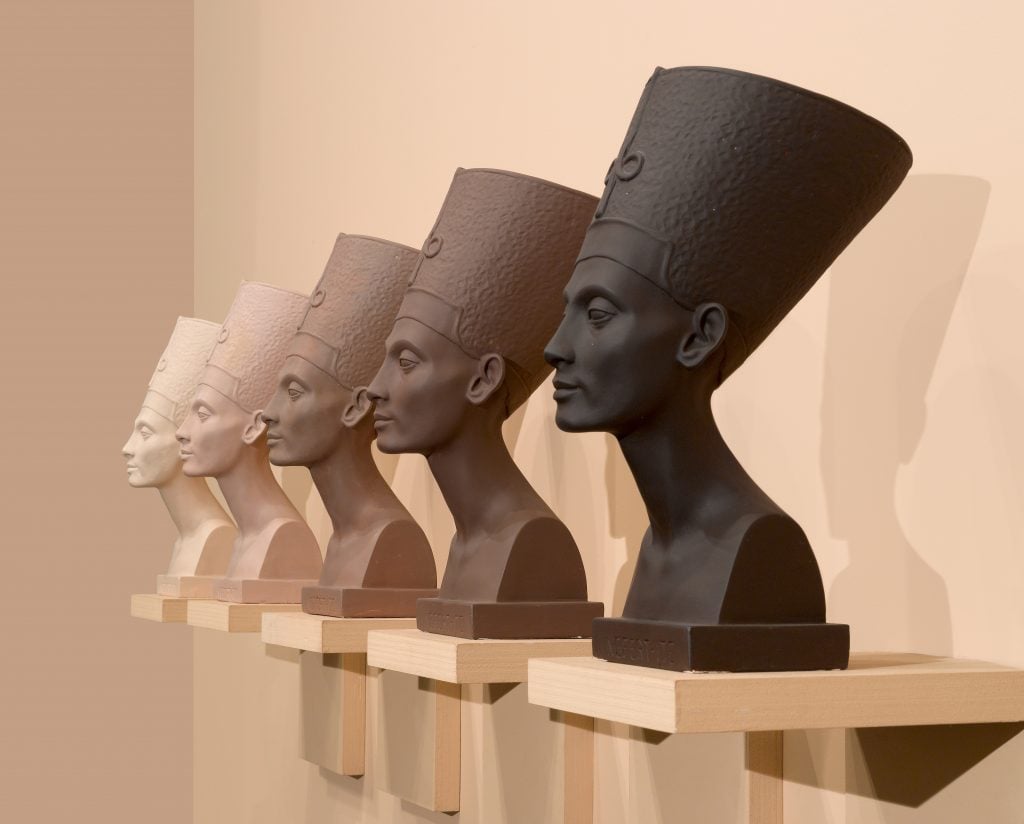
Fred Wilson, Grey Area (Brown Version), 1993. Collection of the Brooklyn Museum, bequest of William K. Jacobs, Jr. and bequest of Richard J. Kempe, by exchange. Photo courtesy of Metropolitan Museum of Art, New York.
Once again, I imagine that exhibition would more likely to rankle Trump’s sensibilities than say, the youth-led public art project from Brooklyn’s Red Hook Art Project supported by a 2025 Challenge America Grant.
But it is the smaller organizations that no longer have a dedicated grant category, and are presumably more likely to get lost in a sea of applications for awards next year. (There were 2,195 applications and 1,127 awardees in the most recent round.)
And it isn’t just the NEA that is pulling the rug out from under grant applicants because of Trump’s “directives.”
The Citizen Diplomacy Action Fund is a competition with a $10,000 prize, open to alumni of U.S. government sponsored exchange programs such as a Fulbright.
In an email, on February 1, just days before the February 5 application deadline, applicants received an email informing them that it would not accept submissions for two of the five previously announced themes for the award.
The cut themes, which can still be seen on the State Department website, were “Protecting the Environment” and “Human Rights, Refugees, and Migrants.” And there were also changes to the three remaining themes. Gone was the second half of “Strengthening Democratic Institutions and Fighting Disinformation”; the first half of “Bolstering Community Through Arts, Sports, Language, and Technology” was now “Promoting Peace.” The final theme was tweaked from “Promoting English Language” to “Promoting English Language Learning.”