Law & Politics
All the Ways the Trump Administration Has Altered America’s Cultural Landscape
Here's how the Trump administration drastically reshaped the arts landscape in 2025.

Here's how the Trump administration drastically reshaped the arts landscape in 2025.
Margaret Carrigan &
Sarah Cascone &
Brian Boucher
 ShareShare This Article
Since his return to the White House on January 20, 2025 President Donald Trump signed more than 150 executive orders—26 on day one alone—many of which have sent shockwaves through the art world. From sweeping restrictions on Diversity, Equity, and Inclusion (DEI) initiatives to deep cuts at key federal agencies, the effects are already reshaping how cultural institutions and artists operate. At the center of this upheaval was a now-disbanded Department of Government Efficiency (DOGE), led by Elon Musk, which gutted agencies like the Institute of Museum and Library Services (IMLS) and imposed aggressive oversight on institutions such as the Smithsonian.
Meanwhile, abrupt policy shifts are rippling through logistics and trade, prompting shifting how art dealers, auction houses, and other art market actors both in the U.S. and abroad to rethink their business strategies.
These moves aren’t just symbolic—they’re transforming the infrastructure of American culture. Experts say we are entering uncharted territory. “There is no precedent for the moment we are in,” said Marilyn Jackson, president of the American Alliance of Museums.
Throughout 2025, we tracked the policies, flashpoints, and protests that are reshaping the arts landscape. Here’s what you need to know so far.
For an overview of Trump’s first 100 days in office, click here.
Quickly jump to a section:
December 22: White House Pressures Smithsonian to Comply With Review or Risk Funding Loss
The White House has ordered the Smithsonian Institution to comply with a federal review, warning that failure to do so could result in a withholding of funding.
In a December 18 letter addressed to the institution’s secretary Lonnie G. Bunch III, officials referenced an August directive instructing the Smithsonian’s museums to submit a range of materials—including descriptions of current exhibitions, plans for upcoming shows and programs, and internal guidelines for exhibition development—for “a comprehensive internal review.” According to the letter, the materials submitted in September “fell far short of what was requested.”
The White House has now given the Smithsonian until December 30 to turn in additional material, including programming related to America’s 250th anniversary, wall labels and didactics, governance documents, and an index of exhibitions planned for 2026–2029. Federal funds allocated to the institution, the missive added, will only be made available upon compliance with the request and in accordance with President Trump’s March 25 executive order promoting the restoration of “Western and American values.”
Signed by Vince Haley, director of the White House Domestic Policy Council, and Russell Vought, director of the Office of Management and Budget, the letter stressed the urgency of the request, noting that the Smithsonian is “well positioned to play an important role during the historic yearlong celebration of our Nation’s 250th birthday.” It continued: “The American people will have no patience for any museum that is diffident about America’s founding or otherwise uncomfortable conveying a positive view of American history—one that is justifiably proud of our country’s accomplishments and record.”
The Smithsonian Institution told Artnet News it had no comment. —M.C.
December 20: Trump Slaps His Name on the Kennedy Center

The John F. Kennedy Memorial Center for the Performing Arts in Washington, D.C., has added President Trump’s name to the building, December 19, 2025. Photo: Marvin Joseph / The Washington Post via Getty Images.
Signage on the John F. Kennedy Center for the Performing Arts was updated after its board of trustees voted on Thursday, December 18, to rename the venue after both the former president and President Trump. The vote comes months after Trump was “unanimously” elected chairman of the center, with a reconstituted board that includes several of his allies.
The name on the building’s facade now reads: The Donald J. Trump and The John F. Kennedy Memorial Center for the Performing Arts. The center’s social media accounts were similarly renamed.
Historians, however, have pointed out that such a name change violates a 1964 law passed by Congress, which designated the center as a living memorial to Kennedy and prohibits the installation of “additional memorials or plaques.” Kerry Kennedy, a lawyer and the niece of the former president, decried the new signage in a post on X, saying: “Three years and one month from today, I’m going to grab a pickax and pull those letters off that building.” —M.C.
December 19: Mary Anne Carter Re-Appointed to Lead NEA

NEA chairperson Mary Anne Carter. Photo courtesy of the National Endowment for the Arts.
Mary Anne Carter, who led the National Endowment of the Arts during President Trump’s first term, will serve as chairman of the agency for a second time, the NEA announced on Friday.
“I look forward to the many celebrations that will take place in 2026 in honor of America’s 250th anniversary, as well as to the agency’s continued research into the powerful role the arts play in healing—from illness to trauma to natural disasters,” Carter said in a statement.
Carter previously served as a policy advisor to Florida Governor Rick Scott and later founded and led the consulting firm MAC Research. According to the New York Times, she also held a senior advisory position at the NEA under the current Trump administration. She succeeds Maria Rosario Jackson, who served as NEA chair for four years under President Biden and stepped down following Trump’s return to office.
Carter is assuming leadership of the NEA at a moment of heightened political scrutiny. The agency has faced significant budget cuts under the current administration, which has resulted in the termination of numerous grants and a shift in funding priorities toward projects emphasizing patriotic and heritage themes. In May, President Trump once again proposed eliminating the NEA—as well as the National Endowment for the Humanities and Institute of Museum and Library Services—a move he had also advanced during his first term. —M.C.
December 17: Trump Disparages Democrats in New Plaques for White House Presidential Portraits

Portraits with new plaques of explanatory text are seen on the Presidential Walk of Fame on the Colonnade of the White House in Washington, D.C., 2025. Photo: Brendan Smialowski / AFP via Getty Images.
President Trump updated the so-called “Presidential Walk of Fame” with plaques that seemingly reflect personal opinions of his predecessors. Installed beneath presidential portraits along the White House colonnade, the unusual additions use highly partisan and provocative language to summarize the legacy of each leader, often echoing the tone of Trump’s social media posts, including derogatory nicknames and lots of exclamation marks.
The changes are part of Trump’s broader effort to curate the White House to his taste and underscore his ongoing effort to reshape historical narratives to suit his political agenda.
Democrat presidents are often disparaged in the new wall texts. A plaque added under Joe Biden’s portrait, for instance, claims “Sleepy Joe was, by far, the worst President in American History” and alleges he took office “as a result of the most corrupt Election ever.” Barack Obama is labeled “one of the most divisive political figures,” while Bill Clinton’s accomplishments are minimized in favor of Republican-led efforts. Clinton’s plaque also highlights Trump’s victory over presidential candidate Hillary Clinton in 2016.
Alternatively, presidents Trump admires, like Ronald Reagan, are celebrated. Reagan’s plaque praises his communication skills and notes that he was “a fan” of Trump. —M.C.
December 12: Lawsuit Seeks to Halt Construction on Trump’s White House Ballroom

An excavator sits on the rubble after the East Wing of the White House was demolished on October 28, 2025 in Washington, D.C. The demolition is part of U.S. President Donald Trump’s plan to build a ballroom on the eastern side of the White House. Photo: Alex Wong/Getty Images.
The National Trust for Historic Preservation filed a lawsuit in federal court in Washington, D.C., looking to stop construction on President Donald Trump’s White House Ballroom on Friday.
“No president is legally allowed to tear down portions of the White House without any review whatsoever—not President Trump, not President Joe Biden, and not anyone else,” the lawsuit said, as reported by the BBC. The plaintiff, a private nonprofit dedicated to historic preservation in the nation’s capital, is calling on the court to block construction until the construction project goes through “the legally mandated review processes,” including a public comment period.
It is the first legal challenge to the widely criticized project, which the White House originally maintained would be a “much-needed and exquisite addition” to the existing East Wing. Instead, Trump rolled out the wrecking ball, rapidly razing the building during the government shutdown.
At the time, the trust published an open letter calling for a halt to the demolition. When that failed to gain results, the organization turned to the legal system. The suit argued that Trump needed to get authorization from Congress, which under the Constitution oversees property belonging to the nation, and that he needed to file plans with the National Capital Planning Commission and do an environmental assessment of the project. Construction is allegedly underway without these necessary steps.
In response to the lawsuit, the White House issued a statement insisting that “President Trump has full legal authority to modernize, renovate, and beautify the White House—just like all of his predecessors did.”
The project has ballooned in scale since Trump first announced it, with the projected cost—supposedly footed entirely by private donors including tech giants Meta and Amazon—soaring to as much as $350 million, with the ability to seat as many as 1,000 guests. The White House also quietly replaced the original architect, the boutique D.C. firm of McCrery Architects, with a larger firm, Shalom Baranes. —S.C.
December 3: IMLS Restores Museum and Library Grants Cut by Trump Administration
The Institute of Museum and Library Services (IMLS), which distributes federal funding to libraries and museums across the U.S., has reinstated all grants previously terminated by the Trump Administration, following a federal court ruling that deemed the administration’s actions unlawful. A brief statement from the agency on Wednesday, December 3, confirmed that all earlier termination notices are now void.
The move comes after 21 state attorneys general sued the administration, resulting in a preliminary injunction issued by a Rhode Island District Court in November. The IMLS provided $266 million in grant funding to museums and libraries across the country in 2024.
American Library Association president Sam Helmick told NPR that the reinstatement a “massive win,” but warned that the fight for sustained funding continues, urging the public to advocate for cultural resources.
IMLS had been targeted for cuts by Elon Musk’s Department of Government Efficiency (DOGE) in March. In November, DOGE was disbanded by the White House eight months ahead of scheduled end in July 2026, although former employees have taken new roles in administration, according to Wired. —M.C.
Read more: DOGE Has Decimated the Institute of Museum and Library Services
November 24: Senate to Investigate Kennedy Center Spending Under Trump’s Chairmanship

President Donald Trump looks down from the presidential box in the Opera House at the John F. Kennedy Center for the Performing Arts on March 17, 2025 in Washington, D.C. Trump fired the center’s president, removed the bipartisan board of Biden appointees, and named himself institution’s chairman. Photo: Chip Somodevilla/Getty Images.
Senator Sheldon Whitehouse of Rhode Island, a Democrat, has accused President Trump of using the Kennedy Center in Washington, D.C., the nation’s premier performing arts venue, to “dole out political favors,” reports the New York Times. In a letter on Thursday, he said that the Senate’s Environment and Public Works Committee would be investigating how the center’s $268 million budget is being spent.
Since retaking office, Trump purged Democratic appointees from the prestigious performing art center’s board, which subsequently elected him as its chairman. He tapped Richard Grenell, who in his first term served as ambassador to Germany, as the center’s president. Grennell has spoken about removing “woke propaganda” from Kennedy Center programming, and has prioritized religious events.
According to Democrats, this has been detrimental to the center’s bottom line. The American Conservative Union Foundation, for instance, was supposed to pay $42,000 for a day-long summit on “ending Christian persecution” last month, but was only charged $20,007.
November 24 marks the beginning of a nearly three-week rental to international soccer’s governing body, FIFA, for the 2026 World Cup draw. The event has forced the relocation, postponement, or cancelation of some planned holiday programming—but the Kennedy Center waived the $5 million bill, according to the Washington Post. FIFA will name the winner of the inaugural FIFA Peace Prize during the draw—an award created after Trump did not receive this year’s Nobel Peace Prize. —S.C.
November 12: Federal Museums Reopen After Longest-Ever Government Shutdown

A sign marks the entrance to the Smithsonian Arts and Industries Building located along the National Mall on August 20, 2025, in Washington, DC. Photo:J. David Ake/Getty Images.
The Smithsonian announced it will reopen the National Museum of American History, the National Air and Space Museum, and the Steven F. Udvar-Hazy Center on Friday, November 14 now that President Trump has signed a spending bill ending the longest-ever U.S. government shutdown. All other museums, research centers, and the National Zoo will reopen on a rolling basis by Monday, November 17.
The federal museum network closed on Sunday, October 12 after using up prior-year budget appropriations to remain open an additional 12 days after the shutdown went into effect on October 1.
Washington D.C.’s National Gallery of Art, which is federally funded but not a part of the Smithsonian, will reopen in full on Saturday, November 15 and will premiere “The Stars We Do Not See: Australian Indigenous Art” exhibition, which was delayed due to the shutdown. Its West Building and Sculpture Garden will be open beginning November 14.
The U.S. government shutdown—the longest in history—ended after 42 days when Congress passed a compromise bill brokered by Republicans and moderate Democrats. Signed by President Trump, the deal funds operations through January but leaves unresolved the extension of tax credits for Affordable Care Act plans, a key Democratic demand. The House passed the bill 222–209 after the Senate approved it earlier in the week. —M.C.
October 28: White House Fires Independent Commission of Fine Arts

An excavator works to clear rubble after the East Wing of the White House was demolished on October 23, 2025. Photo: Eric Lee/Getty Images.
President Trump has dismissed all six members of the independent Commission of Fine Arts, the agency responsible for overseeing federal design and preservation projects in Washington, D.C., clearing a path for his ambitious building plans—including a new $300 million White House ballroom and a proposed triumphal arch near the Lincoln Memorial. The commission, established by Congress in 1910, had been entirely appointed by President Biden, with some members’ terms extending to 2028. A White House official told the Washington Post that a new panel more aligned with Trump’s vision will be named.
The move comes as Trump moves swiftly on construction projects, including the demolition of the White House’s East Wing—despite previous assurances it would remain untouched. The president has also proposed the building of a new triumphal arch near the Lincoln Memorial, a project that would typically undergo a years-long approval process under the Commemorative Works Act of 1986, involving both the Commission of Fine Arts and the National Capital Planning Commission. —M.C.
October 22: National Trust for Historic Preservation Calls for Pause on White House Wing Demolition

Exterior rendering of the proposed White House East Wing Ballroom expansion. Photo: courtesy of McCrery Architects/White House.
President Donald Trump has begun demolition work on the East Wing of the White House to make way for a $200 million privately funded ballroom, drawing criticism from preservationists and architects. The National Trust for Historic Preservation issued an open letter urging federal agencies to pause the project until formal review processes are completed. Critics, including the Society of Architectural Historians and the American Institute of Architects fear the 90,000-square-foot addition will overpower the historic structure, which spans just 55,000 square feet.
The work has begun without approval from the National Capital Planning Commission, which oversees government buildings. The panel’s head, Will Scharf—appointed by Trump in July and also the White House staff secretary—said at public commission meeting that permission is needed only for construction, not for demolition, but that the White House had not yet submitted its renovation plans. Changes to the building also must go through the Advisory Council on Historic Preservation, the D.C. State Historic Preservation Office, and the Office of Management and Budget.
Designed by McCrery Architects—a D.C. firm that specializes in religious buildings—the neoclassical ballroom would be the most significant alteration to the White House since the Truman administration. Trump argues it will fulfill a long-standing presidential desire for a large event space, capable of hosting up to 650 guests for seated dinners, although Trump has touted an even larger capacity of 999. Currently, large gatherings are held in temporary tents. When the wing was announced in July, Trump insisted the ballroom would not “interfere with the current building” and would be “near it but not touching it.” Once the wrecking ball came out, he explained that “in order to do it properly, we had to take down the existing structure.” —S.C.
October 14: Trump Proposes Triumphal Arch for America’s 250th Anniversary

A model of President Donald Trump’s proposed triumphal arch to commemorate the country’s 250th anniversary. Photo: by Kevin Dietsch/Getty Images.
President Trump unveiled plans to build a “triumphal arch” in Washington, D.C., at the entrance to Arlington National Cemetery, modeled after unbuilt plans from 1902 to honor Ulysses S. Grant. Unveiled during a White House dinner for donors to a new $200 million ballroom, Trump said the monument would fill a visual gap across from the Lincoln Memorial. The proposed monument is being designed by architect Nicolas Leo Charbonneau of Sacred Architecture Studio at Harrison Design—a firm that touts its Catholic influence—the so-called Independence Arch features a golden statue of a winged woman, dubbed “Lady Liberty” by Trump.
When asked who the arch honors, Trump replied, “me,” prompting critics to nickname it the Arc de Trump, a play on Paris’s Arc de Triomphe. Comparisons have been drawn to Nazi architect Albert Speer’s unrealized German Arch of Triumph. The project would require a 24-step federal approval process and faces skepticism over its timeline and funding. Trump hopes to finish it by the U.S. semiquincentennial, but officials say that’s unlikely. The funding source remains unclear, though Trump hinted donor overflow for the ballroom might help. —S.C.
October 7: Trump May Put His Own Face on a $1 Coin

A proposed commemorative coin honoring President Donald Trump as part of the celebrations for America’s 250th birthday. Image: courtesy of the U.S. Treasury Department.
The U.S. Treasury is facing backlash over a proposed $1 coin featuring President Trump—despite an 1866 law banning living people from appearing on U.S. currency. The design, shared online by U.S. Treasurer Brandon Beach, shows Trump’s profile on one side and him raising a fist beside the words “Fight, fight, fight” on the other. Officials claim the coin is legal under the 2020 Circulating Collectible Coin Redesign Act, which called for minting new coins for 2026 to mark America’s 250th anniversary. Critics dispute that, citing language explicitly forbidding portraits of living persons. The only precedent: Calvin Coolidge’s 1926 sesquicentennial half dollar. —S.C.
October 6: National Gallery of Art Closes Indefinitely Amid Government Shutdown

National Gallery of Art in Washington, D.C. Photo: Shutterstock.
The National Gallery of Art in Washington, D.C., is closed indefinitely as a result of the shutdown of the federal government that began at 12:01 a.m. on Wednesday, October 1. The museum announced on Instagram on Saturday that starting on Sunday, “the National Gallery will be temporarily closed and all programs will be canceled until further notice.” It directs the public to a link tree for further information; none is available at time of publishing.
The museum welcomed 3.8 million visitors in 2023, some 18 percent more than in 2022, when it was the most-visited museum in America, per figures from the Art Newspaper, which noted that that was the first time since 2008 that the D.C. museum edged out New York’s Metropolitan Museum of Art as the nation’s most popular institution.
The national network of museums that are part of the Smithsonian Institution, meanwhile, will remain open until October 11, according to the Institution’s website at time of publishing; it had previously announced on X that it would be open through “at least” Monday, October 6, using still-available funds from the prior year. The Smithsonian oversees 21 institutions, including museums and research centers, in addition to the National Zoo. The Institution noted, with some caveats since it is free and thus cannot count visitors based on ticket sales, that it saw some 16.8 million visits in 2024.
“If the government shutdown continues past October 11,” reads an announcement on its website, “the Smithsonian will close to the public.” —Brian Boucher
October 2: Museum Director Forced Out Following Clash Over Trump Gift for King Charles

Todd Arrington. Courtesy of the National Archives.
Todd Arrington, the director of the Eisenhower Presidential Library and Museum in Kansas, was ousted from his role after he declined to give President Trump a sword from the collection to give as a gift to British monarch King Charles during a state visit to the U.K. in September.
Arrington declined the request earlier this year, on the grounds that the World War II-era sword, which belonged to former president Dwight D. Eisenhower, is property of the U.S. government, which the library is obligated by federal law to preserve for the American public, according to the Substack newsletter The Last Campaign. Trump ultimately presented a replica sword to King Charles.
In a statement to the New York Times, Arrington confirmed he was pressured to resign on September 29, and told only that he “could no longer be trusted with confidential information.” Sources also suggested his ouster may have been tied to tensions with the National Archives, of which the presidential library and museum are a part, after he shared internal plans for a new education center with staff. Arrington, who was appointed to the directorship in 2024 and had served nearly 30 years in government, said he was shocked by his removal. —M.C.
October 1: Smithsonian to Temporarily Remain Open Amid Government Shutdown
The Smithsonian museums will remain open temporarily amid a U.S. government shutdown that started on Wednesday, October 1. Government funding was cut off when President Trump’s Republican Party failed to agree with opposition Democrats on a spending bill by the deadline, forcing some—but not all—services to come to a temporary halt.
The Smithsonian’s contingency plans state that the institution will “use available prior-year appropriations to remain open as long as funding permits.” When that funding is exhausted, the network of institutions will shut down federally funded activities, including closing museum budgets to the public. On Tuesday afternoon, the Smithsonian announced that it has enough prior-year funding to keep all museums and facilities open to the public “at least through Monday, October 6.”
During the last government shutdown in December 2018, funding lasted until January 1, 2019, when all Smithsonian locations closed, with most reopening later that month once federal support was restored.
Although budget standoffs are a fixture of U.S. politics, this one is unusually fraught because Trump has spent the past nine months sharply downsizing the federal government—and has hinted that the current impasse could give him a chance to push those cuts even further.—M.C.
September 19: Art Organizations Prevail in Legal Battle Over NEA Grants

The National Endowment for the Arts headquarters in Washington, D.C. Photo: Graeme Sloan / Sipa USA / Alamy Live News.
A federal judge in Rhode Island has ruled in favor of four arts organizations challenging a National Endowment for the Arts (NEA) policy that discouraged grant funding for projects promoting “gender ideology.” The ruling by U.S. District Judge William Smith declared the NEA’s grant review process unconstitutional, citing it as a “viewpoint-based restriction on private speech” that violates the First Amendment.
The policy stemmed from a Trump executive order issued in January 2025, prompting the NEA to update its compliance rules to bar grantees from supporting gender-related ideologies. The ACLU filed the lawsuit on behalf of the groups, including Rhode Island Latino Arts and National Queer Theater. Although the NEA quickly dropped its requirement that applicants formally pledge not to “promote gender ideology,” eligibility criteria remained unchanged.
The court found the policy “arbitrary and capricious” under the Administrative Procedure Act due to its vague definition and lack of connection to artistic merit. The ruling was hailed as a victory for artistic and expressive freedom. “This is an important victory for freedom of speech and artistic freedom,” Vera Eidelman, senior staff attorney with the ACLU’s Speech, Privacy & Technology Project, said in a statement. —M.C.
Read More: Civil Rights Group Scores Win in Fight Over Trump’s Art Grant Restrictions
September 16: Trump Orders Information on Slavery Removed From National Parks

Harpers Ferry National Historical Park, West Virginia. Photo: David Underwood / UCG / Universal Images Group via Getty Images.
President Trump has ordered the removal of signage and exhibits related to slavery from multiple national parks, reports the Washington Post. The materials removed include a historically significant 1863 photograph, The Scourged Back, showing the extensive scarring on the back of Peter Gordon, who escaped slavery. Attributed to two photographers, McPherson and Oliver, the photo became a powerful tool for the abolitionist movement. The removal is in line with Trump’s March executive order requiring the Interior Department to scrub information supporting what it calls a “corrosive ideology.”
Trump also ordered information be removed from Harpers Ferry National Historical Park, in West Virginia, where abolitionist John Brown led a raid, and from the President’s House Site in Philadelphia, where Washington lived and kept enslaved people. “This represents an enormous increase in federal power and control over the things we learn,” Jonathan Zimmerman, a University of Pennsylvania professor, told the Post, adding that it is “brought to you by the team that says education should be state and local.”
In August, Trump had posted to Truth Social that he was ordering a review of Smithsonian museum displays that, in his view, focused too much on “how bad Slavery was.” —B.B.
September 3: Smithsonian Asserts Authority Over Programming
The Smithsonian has responded to the Trump administration’s directive to review its exhibitions and submit programming for federal oversight by asserting its institutional independence. In a letter to staff on September 3, Secretary Lonnie G. Bunch III said that the museum network had agreed to set up a team to review turning over materials to the White House, as requested, but to do so as an autonomous institution, without interference from the executive branch of government.
“I take my responsibility to steward the institution on behalf of the American people very seriously,” Bunch’s letter said, according to the New York Times. “Our independence is paramount.”
The Trump administration had previously demanded programming details from eight of the Smithsonian’s 21 museums within 75 days, aiming to remove “divisive or ideologically driven language.” —M.C.
August 28: Smithsonian Latino Exhibition Quietly Shutters Until Spring 2026

Parts of the American Latino exhibition of the National Museum are seen at the Molina Family Latino Gallery in Washington, D.C. ahead of its opening in June 2022. Photo: Astrid Riecken For The Washington Post via Getty Images.
The Smithsonian’s Molina Family Latino Gallery at the National Museum of American History has quietly closed until Spring 2026. The news follows the White House’s publication of a list of Smithsonian artworks it deemed objectionable. Among them was illustrator Felipe Galindo Gómez’s 4th of July from the South Border (1999), a reproduction of which had been on view in the Molina gallery exhibition “¡Presente! A Latino History of the United States.” Galindo Gómez traveled from New York City to Washington, D.C., to see whether the work was still up after the list was published, according to Hyperallergic, which first reported the news. When he arrived at the museum, the exhibition was shuttered.
The Molina gallery, which serves as the temporary home of the nascent National Museum of the American Latino (NMAL), will now remain closed for nine months before reopening with a new salsa-themed show, “¡Puro Ritmo!” Smithsonian officials cited preparations for the U.S.’s 250th anniversary as the reason for its closure.
Earlier in August, the White House said it will conduct a comprehensive review of Smithsonian exhibitions, materials, and operations ahead of the U.S.’s 250th anniversary to ensure alignment with President Trump’s vision of American history.
Opened in 2022, “¡Presente!” had come under political scrutiny before. In 2023, the show sparked controversy among conservative Latino lawmakers and commentators who criticized its focus on oppression and claimed it promoted socialism, leading to a House bill that proposed to cut federal funding for both the gallery and the planned Latino Museum. Seemingly in response, the museum announced that the salsa exhibition would replace a planned show about the Latino civil rights movement of the 1960s. —M.C.
August 28: Smithsonian Secretary Has Lunch With Trump
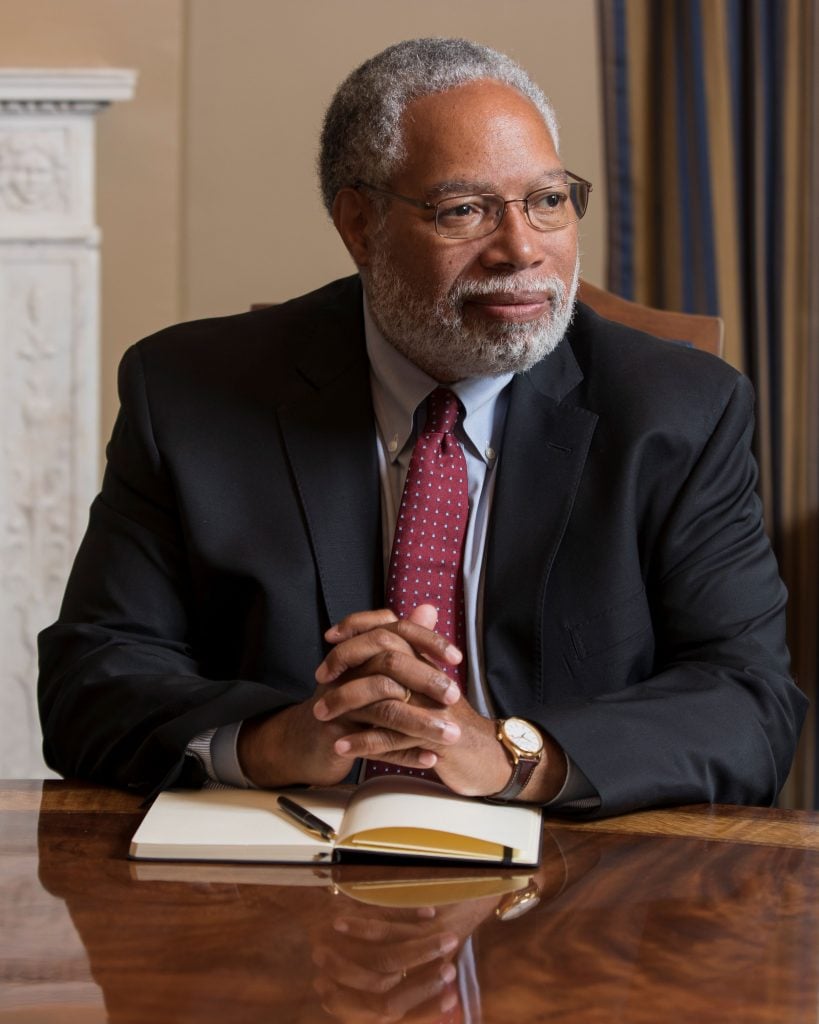
Lonnie G. Bunch III, the 14th Secretary of the Smithsonian. Photo: Robert Stewart/ Smithsonian Institution.
Smithsonian secretary Lonnie G. Bunch III met with President Trump at the White House on Thursday, August 28, as the president intensified efforts to reshape the institution’s exhibitions. The lunch, described by a White House official as “productive and cordial” in a statement to the New York Times, comes amid a sweeping review of Smithsonian museums ordered earlier this month. The administration has criticized the museum network for promoting “divisive narratives” and “race-centered ideology,” and directed them to audit wall texts, websites, and social media content for tone, framing, and alignment with “American ideals.” Bunch and Trump were joined by Lindsey Halligan, a special assistant to the president who is leading the White House review, according to reports. The Smithsonian did not respond to a request for comment on the meeting.—M.C.
Read More: Can Trump Really Control the Smithsonian? Here’s What We Know
August 28: Trump Revives Classical Architecture Mandate for Federal Buildings

The classical stylings of the U.S. Supreme Court building in Washington, D.C. Photo: Nicolas Economou/ NurPhoto via Getty Images.
President Trump signed an executive order mandating that new federal buildings in Washington adopt a classical Greco-Roman style, part of what the White House calls an effort to “make federal architecture beautiful again.” The order discourages modernist approaches such as Brutalism and applies to new projects nationwide, including courthouses in Hartford, Connecticut, and Chattanooga, Tennessee. Architects had anticipated the new rules since January, when the White House issued a memorandum calling for federal buildings to honor “classical architectural heritage,” reviving a Trump-era order from his first term that President Biden later rescinded. The order also coincides with broader White House efforts to exert control over federal development, from redevelopment projects in southwest Washington to a controversial $700 million Federal Reserve renovation. Trump recently appointed allies, including his personal lawyer William Scharf, to the National Capital Planning Commission, raising further concerns about political influence. —M.C.
August 24: Artist Amy Sherald Speaks Out About Smithsonian Censorship

Amy Sherald at the opening of “Amy Sherald: American Sublime” at the Whitney Museum of American Art. Photo: Tiffany Sage / BFA.com.
In an op-ed published by MSNBC, Amy Sherald said the Trump Administration’s ideological crackdown on the Smithsonian amounted to “policing imagination.” The painter canceled her exhibition “American Sublime” at the Smithsonian’s National Portrait Gallery in July after she was allegedly pressured to remove a painting of a trans woman.
“This country’s story has always been a contradiction,” Sherald wrote. “Slavery alongside freedom. Erasure alongside invention. Art carries what is too heavy for language to hold. And museums, at their best, give us the full picture rather than the flattering one. That independence is not ornamental. It is as vital to democracy as the freedom of the press. History shows us what happens when governments demand that museums perform loyalty. Nazi Germany weaponized them. So did the Soviet Union… Constraining museums does not protect the public. It impoverishes us.”
Read More: Amy Sherald Pulls Smithsonian Show Over Censorship Concerns
August 21: Amy Sherald’s ‘Trans Forming Liberty’ and Fauci Portrait Named in White House List of Offending Artworks
The White House continued targeting the Smithsonian Institution on Thursday, August 21, publishing a letter on its website titled “President Trump Is Right About the Smithsonian.” The epistle simply listed a range of artworks and exhibitions across the federal museum network that display images and wording that the Trump administration disagrees with. It included previously criticized shows, such as a Smithsonian American Art Museum exhibition about sculptures as signifiers of power and displays at the National Museum of African American History and Culture referencing “white dominant culture.”
Also named were specific artworks, including Rigoberto A. González’s Refugees Crossing the Border Wall into South Texas (2022) and Amy Sherald’s painting of a Black trans woman as the Statue of Liberty—which was never actually shown at the National Portrait Gallery since the artist canceled her traveling survey after museum staff allegedly advised her not to include the work. The National Portrait Gallery was further criticized for commissioning a stop-motion portrait of Anthony Fauci.
Other targets included a papier-mâché Statue of Liberty holding a tomato, shown in the National Museum of American History, and a 2023 National Museum of African Art show focused on the fictional Afrofuturist kingdom of Drexciya. Wall texts from the National Museum of the American Latino and LGBTQ+ content at the National Museum of American History were also condemned.
It marked the second time that week the Trump administration publicly attacked the Smithsonian and museum programming on the whole. On Monday, the president posted on Truth Social stating museums are the “last remaining segment of WOKE.” Earlier in August, the White House issued a statement ordering several Smithsonian institutions to comply with a comprehensive review of their exhibitions and programming ahead of the U.S.’s 250th anniversary to ensure alignment with President Trump’s vision of American history. —M.C.
Read More: ‘Nobody’s Coming to Save Us’: How U.S. Museums Are Battling for Their Future Under Trump
August 19: Trump Extends ‘Woke’ Criticism to Museums Beyond the Smithsonian
President Trump has broadened his attacks on U.S. museums, calling them the “last remaining segment of WOKE” and vowing to subject them to the same legal and financial tactics his administration has used against universities. His comments, shared on his social media platform Truth Social, followed the White House’s recent announcement of an audit of eight Smithsonian museums to ensure alignment with his March executive order, Restoring Truth and Sanity to American History. The audit will review exhibitions, programming, and public text, with potential content revisions. Trump accused the Smithsonian of focusing too heavily on slavery and oppression while ignoring America’s “success” and “brightness,” declaring “WOKE IS BROKE.” The move has drawn sharp criticism from professional associations, including the American Alliance of Museums, which warned such measures risk a “chilling effect across the entire museum sector.” Museum leaders argue that freedom of thought and expression is fundamental, and institutions must remain spaces for honest, fact-based engagement with history and culture. —M.C.
August 12: Smithsonian Museums Face Large-Scale White House Review Ahead of America’s 250th Anniversary
The White House will conduct a comprehensive review of Smithsonian exhibitions, materials, and operations ahead of the U.S.’s 250th anniversary to ensure alignment with President Trump’s vision of American history. In a letter to Smithsonian secretary Lonnie Bunch, senior officials outlined plans to assess public text, online content, curatorial processes, collection use, and artist grants, aiming to emphasize “unity, progress, and enduring values” and remove “divisive or partisan narratives.”
“By focusing on Americanism—the people, principles, and progress that define our nation—we can work together to renew the Smithsonian’s role as the world’s leading museum institution,” reads the letter, which was signed by Lindsey Halligan, special assistant to the president and senior associate staff secretary; Vince Haley, director of the Domestic Policy Council; and Russell Vought, director of the Office of Management and Budget.

The Smithsonian Castle. Photo: Shutterstock.
The White House letter instructs each Smithsonian museum to, within 30 days, submit requested exhibition materials and plans, designate a staff liaison, coordinate with curators on America 250 programming, and prepare for on-site visits to review current displays, themes, and visitor experience. Within 120 days, museums must start revising exhibits to replace divisive or ideologically driven language with “unifying, historically accurate, and constructive descriptions” across all public-facing materials.
Initially, the review will focus on the National Portrait Gallery, Hirshhorn Museum and Sculpture Garden, Smithsonian American Art Museum, National Museum of African American History and Culture, National Museum of the American Indian, National Museum of American History, National Museum of Natural History, and the National Air and Space Museum. These institutions are all located in Washington, D.C., where Trump just instituted a federal takeover, deploying the National Guard and taking control of the city’s police department amid claims of widespread crime. Additional museums and institutions will be examined in phase two of the review, according to the letter.
The Smithsonian is comprised of 21 museums, 14 education and research centers, and the National Zoo. The review reflects the Trump Administration’s broader efforts to reframe cultural institutions and follows the National Museum of American History’s change to its descriptions of Trump’s two impeachments in exhibition texts earlier this month. White House representative Halligan said that the goal of the review is to keep museums “accurate, patriotic, and enlightening.” In a statement to the Wall Street Journal, the Smithsonian affirmed its commitment to scholarly rigor and factual accuracy, and said it is reviewing the letter in consultation with its Board of Regents, which includes Vice President J.D. Vance. —M.C.
August 8: Smithsonian Softens Description of Trump’s Impeachments at American History Museum
The Smithsonian’s National Museum of American History has updated its exhibit text on President Trump’s impeachments, altering language in descriptions of both proceedings. For the second impeachment, in 2021, the text now states he was impeached for “incitement of insurrection based on his challenge of the 2020 election results and on his speech on January 6,” and notes he was acquitted after leaving office. Previously, it said he had “repeated ‘false statements’” that “foreseeably resulted in” violence. The description of his 2019 impeachment now cites “alleged” solicitation of foreign interference, according to the New York Times.
The new text replaces a 2021 temporary label that included details about the impeachments of Andrew Johnson, Bill Clinton, and Richard Nixon, as well as Trump. The update also marks a shift in how the institution presents politically sensitive topics, amid heightened scrutiny over potential political influence on Smithsonian programming.—M.C.
August 4: Smithsonian to Revise Exhibit After Quietly Removing Trump Impeachment Placard
The Smithsonian Institution says it will “update” a display from the National Museum of American History following reports that a placard added to the display in 2021, which had mentioned President Trump’s two prior impeachments alongside those of Andrew Johnson and Bill Clinton, was removed. The removal returned the display to its 2008 iteration, which noted “only three presidents have seriously faced removal.”
As the keeper of memory for the nation, it is our privilege and responsibility to tell accurate and complete histories. As has been recently reported, in July, a placard was removed from @amhistorymuseum’s exhibit “The American Presidency: A Glorious Burden.” The intent of the…
— Smithsonian (@smithsonian) August 2, 2025
The Smithsonian wrote in an official statement posted to X that no Administration or government official had asked it to remove content from the display, but that it had removed the placard because it “did not meet the museum’s standards in appearance, location, timeline, and overall presentation,” and it “blocked the view of the objects inside the case.” The institution stated that the presentation “will be updated in the coming weeks to reflect all impeachment proceedings in our nation’s history.” —M.C.
July 31: Smithsonian Drops Trump Impeachment References From Museum Display

An exhibition exploring revolutionary and social justice movements that formed the United States at the Smithsonian National Museum of American History in Washington, D.C. Photo: Maansi Srivastava/ For The Washington Post via Getty Images.
The Smithsonian’s National Museum of American History has removed references to former President Trump’s two impeachments from a display. A temporary label referencing the impeachments of Trump and other former presidents had been in place since September 2021.
The change comes amid broader concerns about political interference at the Smithsonian and growing unease over how the institution tasked with preserving American history may be influenced by efforts from the Trump administration to assert greater control over its content.
According to the Washington Post, which first reported the news, the label was removed in July as part of a broader review of the institution’s content for bias. A museum official said the review was connected to pressure from the White House to remove the director of the National Portrait Gallery. After the story broke, the Smithsonian released a statement confirming that a revised exhibit will eventually include all presidential impeachments. A spokesperson emphasized that the original label was always intended to be temporary while a more permanent update was under development.—M.C.
July 22: U.S. Withdraws from UNESCO for the Second Time as a New Bill Aims to Ban ‘Wokeness’ in Museums

A general view of the United Nations Educational, Scientific and Cultural Organization (UNESCO) headquarters in Paris, France. Photo: Mustafa Yalcin/Anadolu Agency via Getty Images.
The U.S. announced it will withdraw from UNESCO by the end of 2026, citing the organization’s promotion of “divisive social and cultural causes” and alignment with U.N. Sustainable Development Goals. The move, part of President Trump’s “America First” agenda, revives a similar break he initiated in 2017 that was reversed under Biden in 2023. Earlier, the Obama administration halted U.S. funding after UNESCO granted membership to Palestine.
UNESCO oversees 1,200 World Heritage Sites worldwide, including 26 in the U.S., and plays a key role in safeguarding cultural heritage and designating new landmarks. Director-General Audrey Azoulay said the withdrawal would have minimal financial impact, as the U.S. currently contributes just 8 percent of the agency’s budget.
The decision has raised alarm among cultural leaders, who say it reflects the administration’s increasingly authoritarian approach to arts and culture. On the same day, Sen. Jim Banks introduced a bill seeking to ban “wokeness” and “divisive narratives” at the Smithsonian, codifying Trump’s earlier executive order requiring “patriotic” interpretations of history. Critics, including Julie Trébault of Artists at Risk Connection, warned that the administration’s pattern of hostility towards “multilateral institutions and the cultural sector at large is deeply troubling,” and has already produced a “chilling effect” on creative expression and participation in culture. —M.C.
July 1: Senate Passes “Big Beautiful Bill” That Includes $40 Million for Sculpture Garden, Strips Funding for Critical Social Services

Statue of George Washington Patriotic Washington Memorial Chapel Valley Forge Pennsylvania USA. Photo: By C P George/ Classicstock/ Getty Images.
On July 1, the U.S. Senate narrowly approved a revised version of President Trump’s “Big Beautiful Bill,” which include tax cuts for businesses and wealthy citizens, major spending cuts to social services like Medicaid and food stamps, increases to the national debt—and $40 million in funding for Trump’s proposed National Garden of American Heroes. The sculpture garden initiative, listed on page 820 of the roughly 940-page bill, allocates funds from the beleaguered National Endowment for the Humanities’ 2025 budget to remain available through 2028.
The National Garden of Heroes has been a priority for Trump since his first term in office. It will showcase 250 life-size statues honoring a rather random mix of influential figures from America’s cultural, scientific, economic, and political history ranging from former presidents George Washington and Abraham Lincoln to basketball star Kobe Bryant. Selected artists can receive up to $200,000 per statue, which must be crafted from traditional materials like marble, granite, bronze, copper, or brass and must be “life-like” rather than abstract.
The bill now returns to the House of Representatives for final approval before potentially reaching Trump’s desk by his July 4 deadline. —M.C.
Read More: Fine, Let’s Argue About Trump’s National Garden of American Heroes
June 16: Trump Administration Violated Law by Withholding Federal Museum and Library Funds, Watchdog Finds
A nonpartisan government watchdog has found that the Trump administration broke the law by withholding funding for the nation’s museums and libraries. The Government Accountability Office (GAO) concluded that the Institute of Museum and Library Services (IMLS) ceased operations and withheld congressionally approved funds after Trump issued a directive in March aimed at reducing the federal bureaucracy.
This marks the second recent instance where oversight officials determined that the administration unlawfully attempted to bypass Congress in reshaping federal spending to align with political goals, according to a New York Times report. Ethics officials deemed the funding delay an illegal impoundment, violating a 1970s law designed to prevent the executive branch from overriding Congress’s power of the purse. The White House, however, argues that these legal limits on presidential authority are unconstitutional, with Trump and his budget chief, Russell Vought, openly challenging them as part of broader efforts to reorganize government spending. The finding sets the stage for a potential legal clash over executive power and fiscal control. —M.C.
Read More: Trump Administration Sued Over Gutting of Institute of Museum and Library Services
June 13: National Portrait Gallery Director Steps Down

Kim Sajet. Photo: Andre Chung for The Washington Post via Getty Images.
Kim Sajet has stepped down as director of the Smithsonian’s National Portrait Gallery (NPG), the museum confirmed via email. Her resignation comes shortly after President Trump claimed on social media that he had fired her on May 30. The decision follows a closed-door meeting by the Smithsonian’s Board of Regents, where Sajet’s role was reportedly discussed, though no official actions were announced, according to the Washington Post. Kevin Gover, the Smithsonian’s Under Secretary for Museums and Culture, will take over as acting director.
Appointed in 2013, Sajet became the NPG’s first female director and brought a focus on diversity and contemporary relevance to the museum’s programming. Under her leadership, the institution launched the Portrait of a Nation Awards, introduced the Identify performance series, expanded its podcast offerings, and reopened the America’s Presidents gallery in 2018. She also oversaw growth in the museum’s endowment and annual funding. “I believe that stepping aside is the best way to serve the institution I hold so deeply in my heart,” Sajet said in a statement shared over email, adding that she will remain a “steadfast champion” of the museum.—M.C.
June 9: Smithsonian Says Staffing Decisions Are Made by Secretary Amid Standoff with Trump
The Smithsonian Institution has pushed back against President Trump’s recent claim that he fired National Portrait Gallery (NPG) director Kim Sajet, clarifying in a statement that all staffing decisions are overseen by its Secretary and Board of Regents, not the president, although Trump, Sajet, and the NPG are not mentioned by name.
The statement immediately followed a quarterly meeting of the Board of Regents, including Vice President J.D. Vance, in which the president’s alleged removal of Sajet was discussed. When Trump announced on May 30 that he had allegedly fired Sajet, he called her “a highly partisan person, and a strong supporter of DEI, which is totally inappropriate for her position.” Despite Trump’s declaration, Sajet has continued to show up for work and conduct business since the announcement.
The White House’s grievances against the museum director included concerns about wall texts mentioning Trump’s impeachments, which the president deemed partisan. The controversy comes amid Trump’s broader pattern of targeting cultural institutions. In its statement, the Smithsonian reiterated its nonpartisan status and commitment to unbiased content, although it indicated it would assess museum staff as needed to maintain this standard. “The Board of Regents is committed to ensuring that the Smithsonian is a beacon of scholarship free from political or partisan influence,” the statement said. “We recognize that our institution can and must do more to further these foundational values.” —M.C.
Read More: Can Trump Really Control the Smithsonian? Here’s What We Know
June 2: Trump Replaces His Official Portrait

A photo of U.S. President Donald Trump is displayed in the America’s Presidents exhibition at the Smithsonian Institution’s National Portrait Gallery on June 1, 2025 in Washington, D.C. Photo: Kevin Carter/Getty Images.
The White House released a new portrait of President Trump, replacing a controversial January photo that critics compared to his mugshot, released by authorities in Georgia after he turned himself in for allegedly attempting to overturn the state’s 2020 election results. Changing presidential portraits this early in a term is rare, but Trump is renownedly image-conscious. The new photo, shared on the White House’s social media channels, shows Trump facing the camera directly with a neutral, unsmiling expression, wearing a blue suit and his signature red tie, against a dark background. The previous portrait featured unusual “up lighting,” which experts noted is uncommon and can create a sinister effect.
“In the new portrait, the lighting is more natural but still dramatic,” Jeff Whetstone, director of the visual arts program at Princeton University, told NPR. He added that the lighting shows one side of the face more than the other, creating a “duality,” similar to the famous 1941 portrait of U.K. Prime Minister Winston Churchill, as captured by Yousuf Karsh. The new portrait also does not include a U.S flag in the background, which has been customary for presidential portraits since at least the 1970s.—M.C.
May 30: Trump Says He Has Fired the Director of Smithsonian’s National Portrait Gallery
President Trump announced Friday that he has fired Kim Sajet, the director of the Smithsonian’s National Portrait Gallery in Washington D.C. In a post on Truth Social about the dismissal, Trump called Sajet “a highly partisan person, and a strong supporter of DEI,” adding that her successor would be named shortly. But, according to the Washington Post, it is unclear if the president can remove Sajet, given that senior-level staffing decisions at the Smithsonian are overseen by its secretary, Lonnie G. Bunch III. Sajet was appointed to the directorship in 2013 by the Smithsonian’s then-secretary Wayne Clough; she was the first woman to serve in the role.
Her alleged dismissal follows Trump’s March 28 executive order that targets funding for Smithsonian programs that he deems have “promoted narratives that portray American and Western values as inherently harmful and oppressive.” Two weeks before the executive order, Kevin Young, director of the Smithsonian Institution’s National Museum of African American History and Culture, was placed on indefinite leave. —M.C.
May 29: Judge Blocks Trump From Barring Foreign Students at Harvard—For Now
A federal judge in Boston announced that she plans to halt President Trump’s attempt to bar Harvard from enrolling international students, a key component of the administration’s broader push to challenge the university’s finances and international reach.
The administration’s recent threats to revoke Harvard’s certification to enroll international students sparked concern at art schools heavily reliant on foreign enrollees. Many U.S. art institutions have significant international student bodies, with Chinese students making up the largest share, followed by South Korea, India, and Canada, according to a June 2 report by Artnews. For example, the School of Visual Arts in New York has an international student body of 50 percent, while Parsons School of Design has 35 percent, and California Institute of the Arts has 30 percent. These numbers have surged over the past two decades as declining public funding has pushed universities to rely more on full-paying international students. —M.C.
May 13: Trump Fires Head of U.S. Copyright Office Following Report on A.I. and Copyright Infringement

A man holds a flag outside the Library of Congress on May 12, 2025, days after Donald Trump fired Carla Hayden, the head of the Library of Congress and Shira Perlmutter, the head of the U.S. Copyright Office. Photo: Kayla Bartkowski / Getty Images.
Shira Perlmutter, head of the U.S. Copyright Office, was pink-slipped over the weekend, just days after publishing a report about how the development of artificial intelligence could violate copyright law, according to the Washington Post. Published earlier this month, the report, titled “Copyright and Artificial Intelligence, Part 3: Generative A.I. Training,” questioned whether uses of copyrighted material to train A.I. programs could be allowed under the fair use doctrine of copyright law, which allows some unauthorized use of copyrighted material—for example if the new use is “transformative” or does not infringe on the market for the copyrighted material.
“Several stages in the development of generative A.I. involve using copyrighted works in ways that implicate the owners’ exclusive rights,” the report said. “The key question… is whether those acts of prima facie infringement can be excused as fair use.” It concluded that “government intervention would be premature at this time.”—B.B.
May 8: Dutch Museum Rethinks Lending Artworks to U.S. Museums, Citing Drastic Funding Cuts
The Mauritshuis museum in The Hague, home to masterpieces like Vermeer’s Girl With a Pearl Earring and Rembrandt’s The Anatomy Lesson, is reconsidering lending artworks to U.S. museums due to instability caused by President Trump’s funding cuts and ideological mandates. Director Martine Gosselink cited increasing political interference in U.S. museum operations and concerns over staff reductions, which could compromise the care and presentation of loaned works. Longstanding transatlantic partnerships are now at risk, she told the Guardian, adding that while future loans aren’t ruled out, her team will require “firm guarantees” to proceed. —M.C.
May 6: Trump Taps Ex-NEA Chair as Agency Battles Budget Cuts
Mary Anne Carter, who led the National Endowment for the Arts (NEA) during Trump’s first term, has been nominated to head the agency again amid mounting turmoil. The nomination follows Trump’s renewed proposal to eliminate the NEA and recent decisions to rescind millions in grants, prompting several senior officials to resign. According to the New York Times, which first reported the news on May 8, Carter was seen by many as a stabilizing figure in her previous appointment, during which time she helped the agency survive elimination efforts thanks to bipartisan congressional support. She described returning to the NEA as “coming home” and emphasized her belief that all Americans should have access to the arts. —M.C.
May 6: Judge Grants Preliminary Injunction in Favor of IMLS
U.S. District Chief Judge John J. McConnell, Jr. granted a preliminary injunction blocking President Trump’s attempt to dismantle the Institute of Museum and Library Services (IMLS) and other congressionally mandated government agencies. The ruling, in response to a lawsuit filed in April by 21 state attorneys general, stated that Trump’s March 17 executive order, “Continuing the Reduction of the Federal Bureaucracy,” “violates the Administrative Procedures Act in the arbitrary and capricious way it was carried out.” The judge also said it “disregards the fundamental constitutional role of each of the branches of our federal government,” specifically, that Congress makes the law and appropriates funds, and the Executive implements the law Congress enacted and spends the funds Congress appropriated. The AGs’ suit also aimed to defend the Minority Business Development Agency and the Federal Mediation and Conciliation Service. —B.B.
May 5: Numerous NEA Grants Terminated Following Trump’s Proposal to Nix Agency

National Endowment for the Humanities building in Washington, D.C. Photo: Kayla Bartkowski / Getty Images.
Numerous arts organizations have had grants withdrawn following a sweeping White House budget request which proposes eliminating the National Endowment for the Arts (NEA), National Endowment for the Humanities (NEH), and the Institute of Museum and Library Services (IMLS). The affected groups include the Berkeley Repertory Theatre in California, the Portland Playhouse and Eugene Symphony in Oregon, Open Studio Project in Chicago, the American Conservatory Theater in San Francisco, and the arts publication n+1. The grantees received termination emails that stated that the NEA was “updating its grantmaking policy priorities to focus funding on projects that reflect the nation’s rich artistic heritage and creativity as prioritized by the President,” according to NPR. This round of cancelations follow the NEA’s updating of its grant guidelines in February, which terminated awards under its Challenge America program. In April, the NEH, which has seen a 70–80 percent reduction in its staff, canceled more than a thousand grants. —M.C.
Read more: All the Arts Organizations Impacted by NEA Funding Cuts
May 1: Trump Strips Funding for Public Broadcasting

A rally calling on Congress to protect funding for U.S. public broadcasters, Public Broadcasting Service (PBS) and National Public Radio (NPR), outside the NPR headquarters in Washington, D.C., March 26, 2025. Photo: Saul Loeb / AFP via Getty Images.
President Trump has signed an executive order to end federal funding for National Public Radio (NPR) and the Public Broadcasting Service (PBS), which he has repeatedly accused of both left-wing bias and undermining journalistic independence since his first term. The order instructs the Corporation for Public Broadcasting to halt funding, citing coverage on trans issues and Covid-19, among others topics, as justification. PBS CEO Paula Kerger called the move “blatantly unlawful” and vowed to fight it. Trump’s push to defund public media aligns with long-standing conservative goals and has significant implications for arts and culture in the U.S. Both public broadcasters play a critical role in supporting arts education and access to the humanities. Shows like PBS NewsHour, Great Performances, and American Masters, along with NPR’s extensive arts coverage, help amplify artists’ voices, support local culture, and provide free, nationwide access to the arts. —M.C.
May 1: Legal Pressure Mounts Over DOGE’s Arts Cuts
A new lawsuit filed Thursday, May 1, claims that the Department of Government Efficiency (DOGE) has hollowed out the National Endowment for the Humanities (NEH) through aggressive cost-cutting. The lawsuit—brought by the American Council of Learned Societies (ACLS), the American Historical Association (AHA), and the Modern Language Association (MLA)—argues that DOGE, its operatives, and the NEH violated the Administrative Procedure Act and the U.S. Constitution. The NEH, a federal agency supporting historical and cultural institutions and initiatives, has allegedly failed to justify its drastic changes, they claim. Meanwhile, a district court judge overseeing the case on DOGE’s dismantling of the Institute of Museum and Library Services (IMLS) indicated in court that he is likely to block the Trump administration’s efforts, according to Washington, D.C.’s WUSA9. —M.C.
Read more: Legal Resistance Grows Against DOGE Cuts to Cultural Agencies
April 30: State Department Calls for Venice Biennale Proposals Emphasizing “American Values”
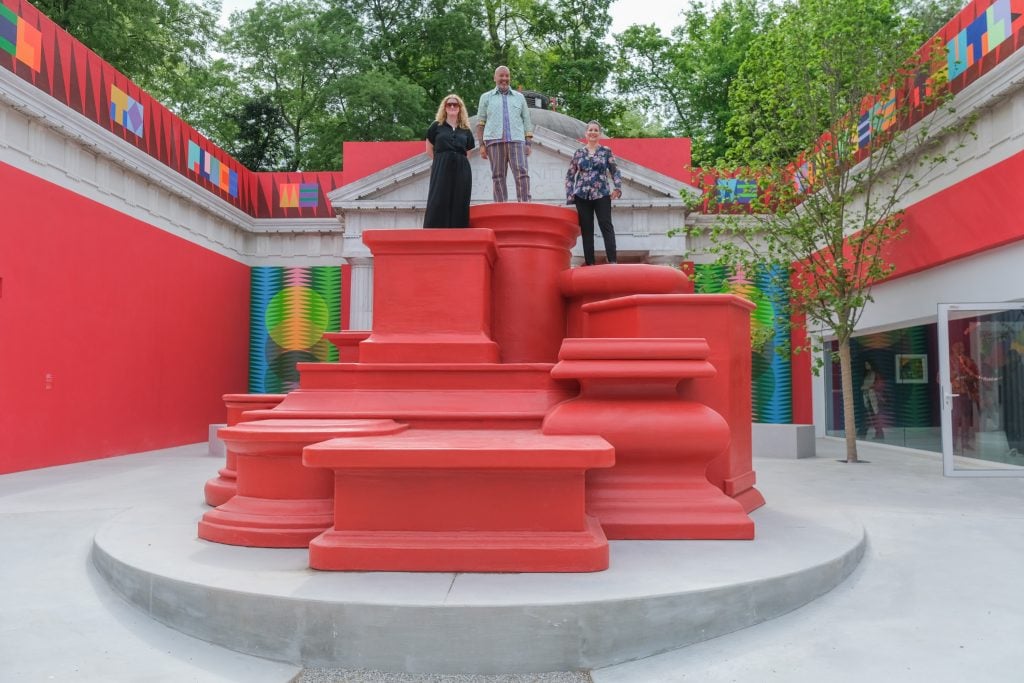
Abigail Winograd, Jeffrey Gibson, and Kathleen Ash-Milby pose at the entrance to the U.S. Pavilion at the Giardini during the 60th Biennale Art 2024 on April 16, 2024 in Venice, Italy. Photo: Stefano Mazzola/Getty Images.
The U.S. government has opened applications for the 2026 Venice Biennale pavilion under new Trump-era guidelines emphasizing “American values” and “exceptionalism,” while banning any programming tied to Diversity, Equity, and Inclusion (DEI). According to Vanity Fair, which first reported the news on May 2, applicants face a compressed timeline, with selections due September 1—just eight months before the exhibition opens. In previous years, the $375,000 grant application has usually gone live about 18 months prior to the Biennale’s opening. The artist proposal for the 2024 Biennale, which featured the works of Cherokee-Choctaw artist Jeffrey Gibson, had been selected by July of 2023. The U.S. State Department’s new proposal requirements also demand applicants explain how their projects will serve U.S. interests and demonstrate “American exceptionalism and innovation.” The embattled National Endowment for the Arts (NEA), which is responsible for convening the panel of proposal reviewers. —M.C.
April 30: Biden Appointees Booted from Holocaust Museum Board
President Trump has removed several Biden-era appointees from the U.S. Holocaust Memorial Museum’s advisory board, including Doug Emhoff, husband of former Vice President Kamala Harris. Other dismissed members include Ron Klain, Tom Perez, Susan Rice, and Anthony Bernal, according to the New York Times. Emhoff criticized the move as politicizing Holocaust remembrance. The shake-up follows Trump’s history of controversial remarks about neo-Nazis and right-wing extremists, including his infamous “very fine people on both sides” comment after the 2017 Charlottesville rally. His DOGE appointee, Elon Musk, was also seen making a Nazi salute earlier this year. The White House said Trump will appoint new members who support Holocaust remembrance and the State of Israel. —M.C.
Brian Boucher contributed reporting.
This story was last updated on Monday, December 22, at 4:40 p.m. ET.