Museums & Institutions
Gold Romanian Helmet Recovered After Explosive Heist at Dutch Museum
Besides the helmet, two of the three stolen gold bracelets have been recovered.

Besides the helmet, two of the three stolen gold bracelets have been recovered.
Richard Whiddington
 ShareShare This Article
A 2,500-year-old gold helmet from Romania that was stolen from a museum in the Netherlands last year has been recovered by Dutch police as part of a plea deal with the suspects.
The ancient Dacian helmet was on loan from the Romanian National History Museum in Bucharest along with three golden bracelets when thieves used explosives to break into Drents Museum, in the northeastern Dutch city of Assen, during the early hours of January 25, 2025.
The helmet, along with two of the three Iron Age bracelets, were unveiled a press conference in Assen on April 2. “We are incredibly pleased,” the region’s chief prosecutor Corien Fahner told media at the museum. “It has been a roller-coaster. Especially for Romania, but also for employees of the Drents Museum.”
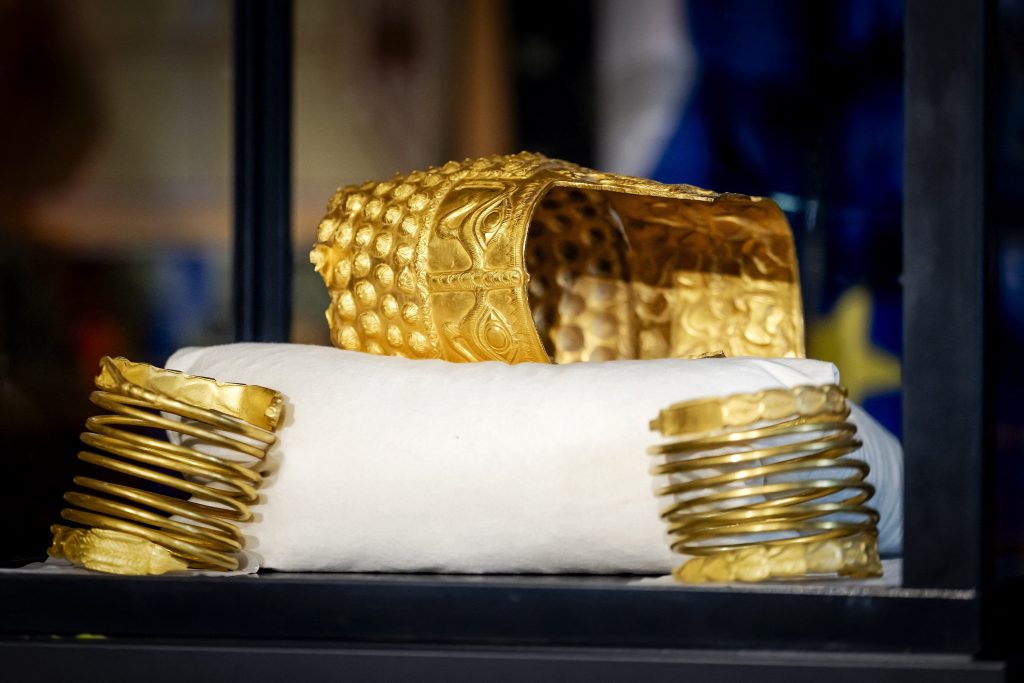
The recovered golden helmet and two gold bracelets. Photo: Sem van der Wal/ANP/AFP.
The Coțofenești helmet, named after the village in which was found by farmers in 1926, is considered a national icon in Romania and the theft sparked a vociferous reaction in the country. The director of the National Museum of Romania lost his job, Romanian politicians exerted maximum pressure on their Dutch counterparts, and the country’s prime minister, Marcel Ciolacu, even weighed in, threatening to claim “unprecedented damages.” In September last year, the Dutch government paid €5.7 million ($6.5 million) in insurance compensation.
The payment was something of a reflection of the impasse that Dutch police seemed to have reached. For, although they arrested three men within days of the theft, the suspects had remained silent ahead of their trial, which is due to begin later this month.
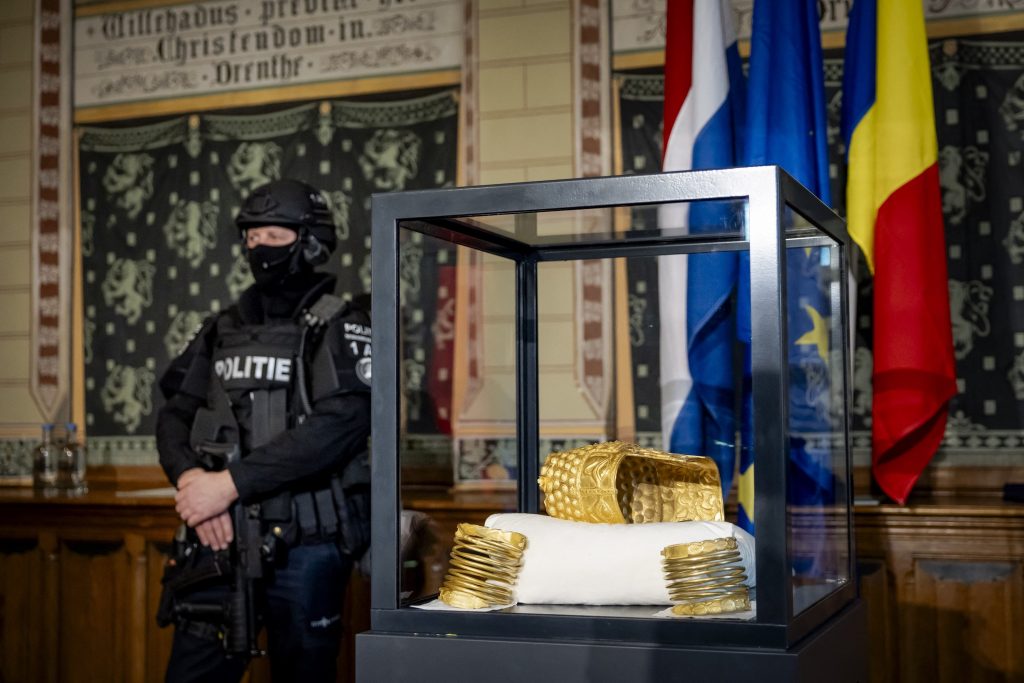
The Romanian helmet of Cotofenesti and two gold bracelets are displayed in a glass box in Assen. Photo: Sem van der Wal/ ANP/AFP.
The police were aided by the Dutch art detective Arthur Brand. According to reports in Dutch media, in order to coerce suspects into revealing the location of the Romanian artifacts, police had promised to halve the sentence of one suspect, while another suspect had been offered €400,000 ($461,000) by an undercover officer pretending to be a criminal dealer. The details of the enticement offered to the suspects by Dutch authorities is unknown.
At the press conference, Robert van Langh, the director of the Drents Museum, said the helmet had suffered minor damage: it now has a small dent, and glue from a previous repair had been dislodged. The two bracelets, however, remain in perfect condition.
In describing the Romanian helmet, van Langh noted the pair of eyes worked into the soft metal that were intended as symbols to protect both the wearer and the object against the evil eye. “They have done so for centuries,” van Langh said. “And even today, they seem to prove their value.”
The search is now on for the third gold bracelet.