Museums & Institutions
Mystery 17th-Century Portrait Sparks Search for Identity of Black Sitter
The painting has been described as 'ambitious and unusual' by experts.

The painting has been described as 'ambitious and unusual' by experts.
Jo Lawson-Tancred
 ShareShare This Article
An investigation has been launched into the identity of the Black sitter in a mysterious 17th-century double portrait from a stately medieval house in England.
The painting of two teenaged boys by an unknown artist has stunned experts for its particularly rare portrayal of a Black and white sitter shown side-by-side at a time when Black figures were typically depicted as attendants. Having hung at Penshurst Place in Kent for centuries, the artwork is now undergoing a landmark restoration at London’s National Portrait Gallery (NPG). Researchers hope material analysis and archival research will bring to light new information that may shed light on Black lives in early modern Britain.
“You’ve got a Black figure at the equivalent size to the white figure,” the British cultural historian Michael Ohajuru told the BBC. “This is exceptional. The pictures I normally see, the Black figure is marginal, on the edge [of the composition], and often smaller.”
Very little is known about the painting’s origins or author, although it was likely produced in 1626, according to an inscription at the base of a column to the left. Added later, however, this text also falsely claims that the white boy is Prince Rupert, cousin to King Charles I. He is described as being 13 years old.
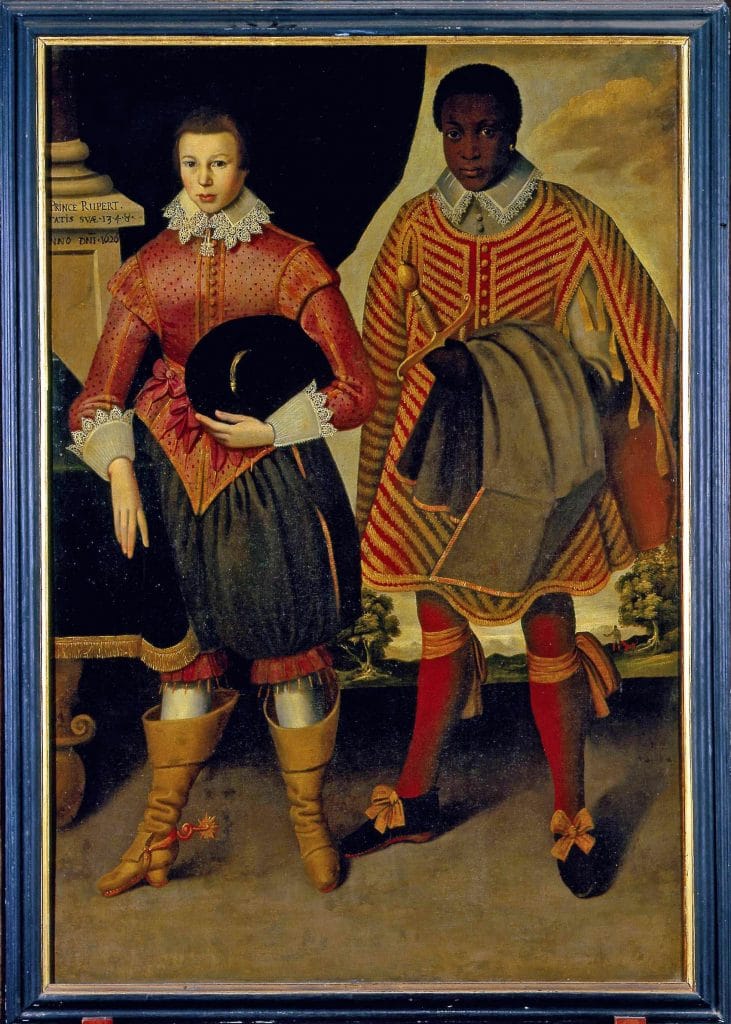
The Two Boys (1626). Image: © Viscount De L’Isle, Penshurst Place (from his private collection).
It is not known when the painting entered the collection of the Sidney family, which has lived at Penshurst Place since Tudor times. However, it was first recorded at the family home in 1743 and has been on public display since 1947.
The NPG’s senior curator for research, Charlotte Bolland, has described the painting as “an incredibly early” full-length depiction of a person of African heritage in England. She told ITV that portraits were typically reserved for elite subjects “who were interested in conveying messages about themselves.” She described the portrait as particularly “ambitious and unusual” in its presentation of two young boys side-by-side.
Conservators have lifted layers of discolored varnish from the canvas, allowing the work to “really come to life,” said Bolland.
A deeper investigation into the portrait has so far included both a technical analysis, including examining pigments and using radiography to look beneath the surface, and extensive archival research to try and find hints about who the two boys might be. Speaking to the BBC, Bolland described the work as “a real collaborative effort.” Dress historians, hunting historians, and genealogists are among the experts who will weigh in.
Similar research projects have been successful at recovering the long lost identities of Black sitters in recent years. One notable example is another 17th-century English portrait of Mary Lawley at Claydon House, which features the young Black attendant Peregrine Tyam. Some of his life story has been reconstructed thanks to surviving letters. A rare allegorical painting from the 17th-century that features a Black woman and a white woman side-by-side was recently revealed to be a moralizing meditation on the dangers of vanity and foreign influence associated with contemporary beauty regimes.
Once conserved, the double portrait of the two teenage boys will go on public display at the NPG this September until March 2028, when it returns to Penshurst Place. In the meantime, a facsimile of the painting has gone on view at the historic home as part of “Who Are the Two Boys?,” a special display inviting visitors to come to their own conclusions about the work.
“We’re recognizing that there’s somebody here that we want to know more about and how he relates to the white elite,” said Ohajuru. Though researchers are still hoping to learn more about the context for the artwork, he noted that the painting is already an important testament to the history of Black Britons. “We were here,” Ohajuru told ITV. “You can’t write us out.”