Art History
Who Was the Black Figure in This 17th-Century Portrait? A Rare Letter Holds Answers
A letter written by the boy, identified as Peregrine Tyam, provides an exceptionally rare insight where the voice of a Black attendant has survived for over three centuries.

by
Jo Lawson-Tancred
 Share This Article
A 17th-century British portrait featuring an identified Black subject is shedding new light on the lives of enslaved attendants in aristocratic households thanks to the rediscovery of a letter written by the sitter himself.
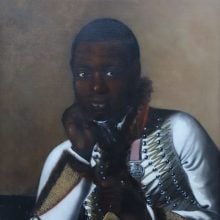
Countless British portraits of the 17th and 18th centuries feature Black figures as an anonymous attendants to one or more white sitters. Their identities have generally been lost to history, but one exception is a portrait at Claydon House in England, a National Trust property, in which both sitters are identified as Mary Lawley and Peregrine Tyam. The painting is one of the earliest British portraits to feature a person of color whose identity is known.
New information about Tyam has been brought to light thanks to research published last month by historian Hannah Lee in the British Art Studies journal. The painting was also the subject of presentation by historian Susan D. Amussen at The Huntington in California in March.
Portraits like that of Tyam provide only a fragment of insight into the experiences of Black people who lived and worked in the homes of the British elite, Lee explained in her essay, adding that, “in Peregrine’s case, his own letter provides an extraordinary, rare example of voice and agency within an archive preserved and curated for posterity by those who enslaved him.”
Status Symbols
The painting was commissioned by John Verney to mark the occasion of his marriage to his second wife, Lawley, in the summer of 1692. It is attributed to a little-known artist called Lenthall. Tyam, who was around nine years old at the time, stands to the far left of the scene, as though he has just entered it, and looks towards Mary while she meets the viewer’s gaze. He was most likely enslaved, as indicated by the silver collar he is wearing, which he may have been forced to wear in everyday life. The art historian David Bindman has noted how, despite the sumptuous dress of Black attendants in historical portraits, a collar often served as the sole “direct hint of the cruelties of plantation or chattel slavery.”

The West Front at Claydon, Buckinghamshire. ©National Trust Images/Polly Stock
The boy was included in the picture as a status symbol, reflecting Verney’s wealth and his ties to the Royal African Company (RAC), which, by some estimates, transported more African slaves to the Americas than any other company. Verney served on the governing board on and off for nearly two decades and, in 1679, was recorded as owning 700 shares. There is substantial evidence that the RAC sent enslaved African children as gifts to high profile members and investors in England, though it is also possible that Tyam was paid for by Verney.
The earliest record of Peregrine Tyam is his baptism at Middle Claydon church on October 6, 1689, when he was around six years old. John Verney was listed in the place of a parent and likely chose the name Peregrine, which means “one from abroad.” Tyam would continue to live in the Verney household until his death in 1707, when the parish register recorded him as being “a native of Tiam in Guinea in Africa.” Whether or not this is accurate, Guinea was a term then used to refer to West Africa and Tiam is located in Senegal.
Verney’s surviving correspondence suggests that Tyam worked as a servant from the time he arrived in England. Most of his time was spent in London carrying out public-facing errands like carrying letters around the city. There is some evidence that, when he was older, he may have occasionally received wages for his services. Verney recorded some direct payments to Tyam in his account book but it is not known what these were for.
A Flurry of Letters
The most compelling piece of evidence about Tyam in the extensive Verney family archive is a letter that he wrote to Verney in March 1699, when he was around sixteen. The missive was written to resolve a matter that started on March 17, when Verney sent Tyam to buy milk and judged that he had stayed out longer than necessary after he returned some hours later. As Verney recounted in a letter to his steward, “as soon as he came in seing me angry (tho I have not strength to beate him) out of doors he went and is run away.” He said he had threatened violence against the boy in the past but that he had never followed through. It may be the case that Tyam was scared of Verney’s bad temper.
Verney further described to his steward how Tyam was “half drunck for of late he keeps some very ill company and setts with shabby fellowes at the alehouse but never would to any body confess who his comrades be.” He said he had heard rumors that Tyam was frequenting local pubs “of no good repute. Where he is rogueing today I knowe not. I feare he will be trapand on shipboard and soe sent away to ye West Indies where ye Rogue will fetch above 20 pounds.”

Screenshot of professor Susan D. Amussen’s presentation of “Peregrine Tyam & Mrs. Mary Verney: Patriarchy & Race in Late 17th-Century England” at the Huntington Library.
“It may be that Peregrine, now aged around sixteen, was testing the limits of his situation,” Lee said in her essay, adding that “it is difficult to ascertain whether in this moment [Verney] was concerned for the personal safety of the young man who had lived in his house since he was a small child or for the loss of a valuable piece of property.”
Some days later, Tyam wrote a letter to Verney in which he apologized and expressed hope that he would be allowed to return, signing off as Verney’s “Most Obedient and faithfull Sevt.” However, he also pointed out a double standard in his treatment and that of other servants who “have not been with you half soe long” yet “may Stay [out] half the day and you not say anything to them.”
It is extremely rare for a letter written by a Black servant to have survived. It provides his side of the story and is an expression of his agency within an archive where he is only otherwise described by others. It greatly develops the very limited glimpse into the experiences of enslaved Black Britons that is offered by their inclusion as attendants in portraits.
Vital Research
“The portrait of Peregrine Tyam has demonstrated the vital importance of further research into depictions of as yet unknown Black sitters and its potential to restore the identities and experiences of erased individuals,” Lee said.
Thanks to the Verney family’s meticulous record keeping, we known that Tyam did return to Verney’s household and continued to work closely by his side for another eight years before falling ill in 1707. He died soon after and was buried at Middle Claydon church on September 3 of that year. Verney received many messages of condolences from family members who stressed their concern that Tyam would be sorely missed.
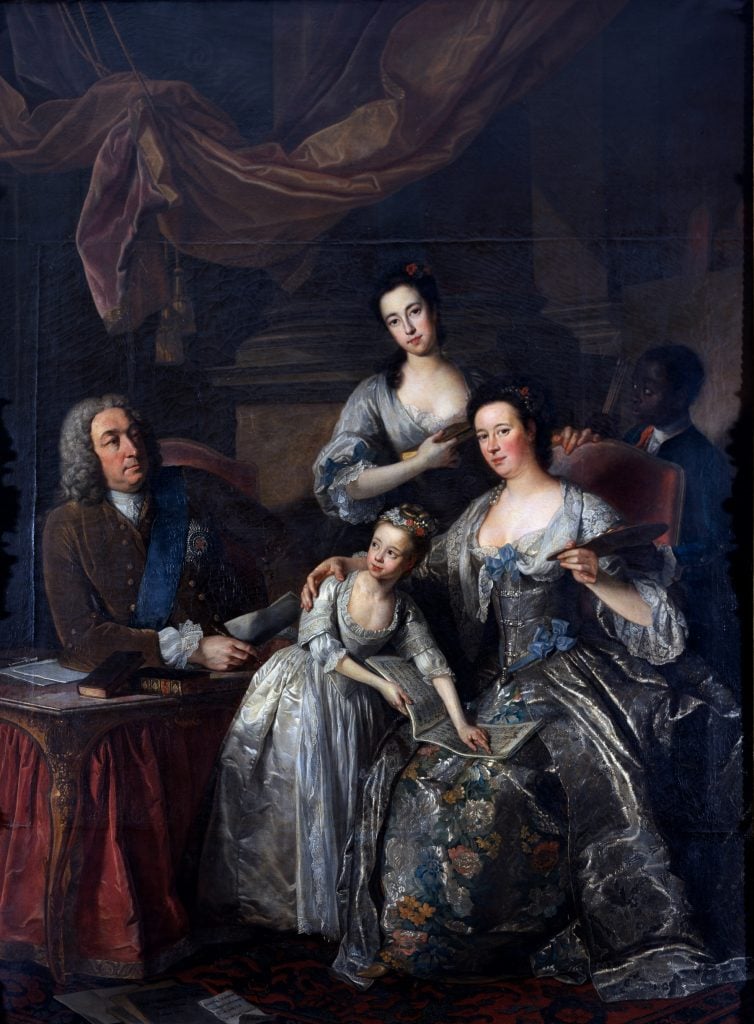
Jean-Baptiste van Loo, Richard Boyle, 3rd Earl of Burlington and 4th Earl of Cork, and His Wife Lady
Dorothy Boyle with Three Children (1739). Photo courtesy Chatsworth House Trust.
A growing number of valuable research projects are seeking to recover the erased identities of Black subjects in early modern British portraiture. Last year, new research was conducted into an 18th-century portrait of the British architect Lord Burlington and his family by the French artist Jean-Baptiste van Loo, which is on permanent display at England’s Chatsworth House.
Dr. Edward Town of the Yale Center for British Art was able to identify the Black attendant as James Cumberlidge. Records written by Cumberlidge elucidated his responsibilities in the household, which included fetching medicine or having books bound. Later in life, he spent two decades working for King George III as a trumpeter before retiring in the town of Walton-on-Thames, Surrey.
Last year also saw the debut of an exceedingly rare 17th-century allegorical painting showing a Black woman and a white woman side be side at Compton Verney in England. The work had been the subject research project, which revealed new context for how it reflects the cultural anxieties of its time, as well as deeply embedded racist and misogynistic beliefs.
Related Articles
-