Art World
5 Rediscoveries Transforming Black Art Narratives
Recent research, rediscoveries and rehangs shine a light on Black artists and sitters.
by
Verity Babbs
 Share This Article
Arts research never sleeps, with dozens of discoveries and news stories breaking each week about our favorite artists, styles, and periods. The examination of Black artists and sitters throughout art history, however, has been a chronically understudied and undervalued within Eurocentric discourse, making headlines reexamining Black art history all the more compelling.
Content creators and authors have been calling attention to narratives of Black artists and their subjects of late, including Alayo Akinkugbe (@ABlackHistoryOFArt) whose debut book ‘Reframing Blackness: What’s Black about ‘History of Art’, is coming out on July 10.
We’ve taken a look back at the Artnet News archives to find five recent reinterpretations, rediscoveries, and rehangs that spotlight this vital area of research.
Gustav Klimt’s Portrait of Prince William Nii Nortey Dowuona – March 2025

Gustav Klimt, Prince William Nii Nortey Dowuona (1897). Courtesy W&K – Wienerroither & Kohlbacher.
Unaccounted for since 1938 and rediscovered in 2023 as a work by Gustav Klimt, Prince William Nii Nortey Dowuona (1897) is a stark reminder of humiliating “human zoo” practices which could be found in major cities across Europe right up until the mid-20th century, visited by thousands of people per day. Klimt created the portrait after he and the artist Franz Matsch visited Vienna’s Tiergarden am Schüttel, a zoo which put on ethnographic exhibitions of living Africans.
These exhibits were both deeply racist and poorly researched, with the exhibition the year that Klimt visited advertising itself as showing representatives of the Ashanti people (also known as Asante) from modern-day Ghana, when in fact the 120 individuals were members of the Osu people from Nigeria. The Osu Prince William Nii Nortey Dowuona, nephew of the Osu king, came to Vienna as the group’s leader, and was painted by both Klimt and Matsch. Klimt’s portrait was exhibited at an exhibition in 1928 memorialising his death before its disappearance. The painting went on display at TEFAF Maastricht this year, with a $16.4 million price tag.
Edvard Munch’s Portraits of Sultan Abdul Karem Tell Two Stories – March 2025

Edvard Munch, Model with a Green Scarf (Sultan Abdul Karim) (1916). Photo: © Munchmuseet.
On display until 15 June at London’s National Portrait Gallery as part of “Edvard Munch Portraits”, Model with a Green Scarf (Sultan Abdul Karim) (1916) by the Norwegian Expressionist evidences the duality of the representation of Black sitters in early 20th-century Europe. Munch created seven paintings and one lithograph of Sultan Adbul Karem, who who had arrived in Norway as a member of the German Hagenback Circus. In Model with a Green Scarf, Karem is portrayed with a soft intimacy, appearing casual in his winter clothes.
However, in Munch’s Cleopatra and the Slave (1916), he is portrayed as an enslaved person, entirely exposed and naked, watched and examined closely by the reclining—and clothed—Cleopatra. “Edvard Munch Portraits” aims to show a more comprehensive view of the artist’s biography and the zeitgeist in which he was creating, and the inclusion of Karem’s portrait is surely a reminder of the struggle against racial stereotyping.
New Painting Research Tells of the Life of James Cumberlidge – October 2024
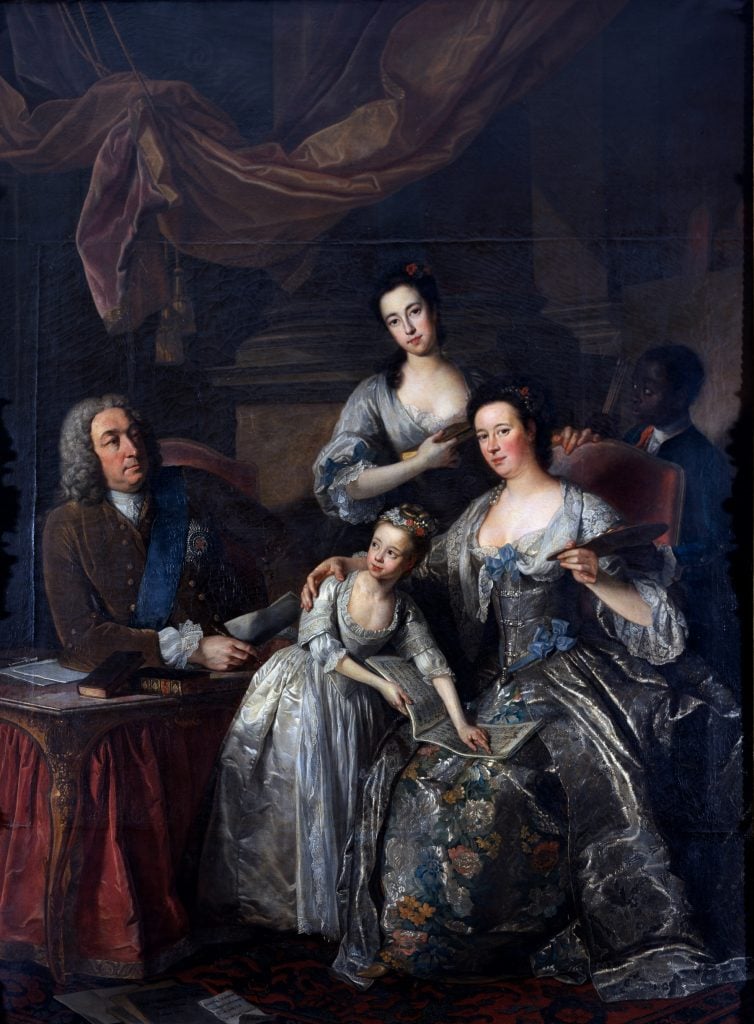
Jean-Baptiste van Loo, Richard Boyle, 3rd Earl of Burlington and 4th Earl of Cork, and His Wife Lady Dorothy Boyle with Three Children (1739). Photo courtesy Chatsworth House Trust.
New research last year uncovered the identity of a once anonymous Black sitter in a portrait by French painter Jean-Baptiste van Loo. The 1739 portrait shows the British architect Lord Burlington, his wife Dorothy, and their two daughters Dorothy and Charlotte. Behind the countess is a young boy carrying a bundle of paintbrushes. After being mistakenly identified as James Cambridge after a mistranscription of a tailor’s bill, the figure has now been identified as James Cumberlidge.
Cumberlidge’s childhood remains undocumented, but research from the Yale Centre of British Art discovered that he continued working for the Burlington family after the portrait was made. He was responsible for running a large amount of errands within the household including purchasing medicine, snuff, prints, and having books bound. After the death of the Countess, her son-in-law Lord Chamberlain found employment for Cumberlidge as a trumpeter for King George III. There is evidence to suggest that Cumberlidge retired after around two decades in the royal household and owned his own house in Surrey (becoming one of very few Black Britons to do so). He may have also been one of the first Black Britons to vote.
Newly Displayed 17th-Century Painting Shows Embedded Racist and Misogynistic Beliefs – December 2024
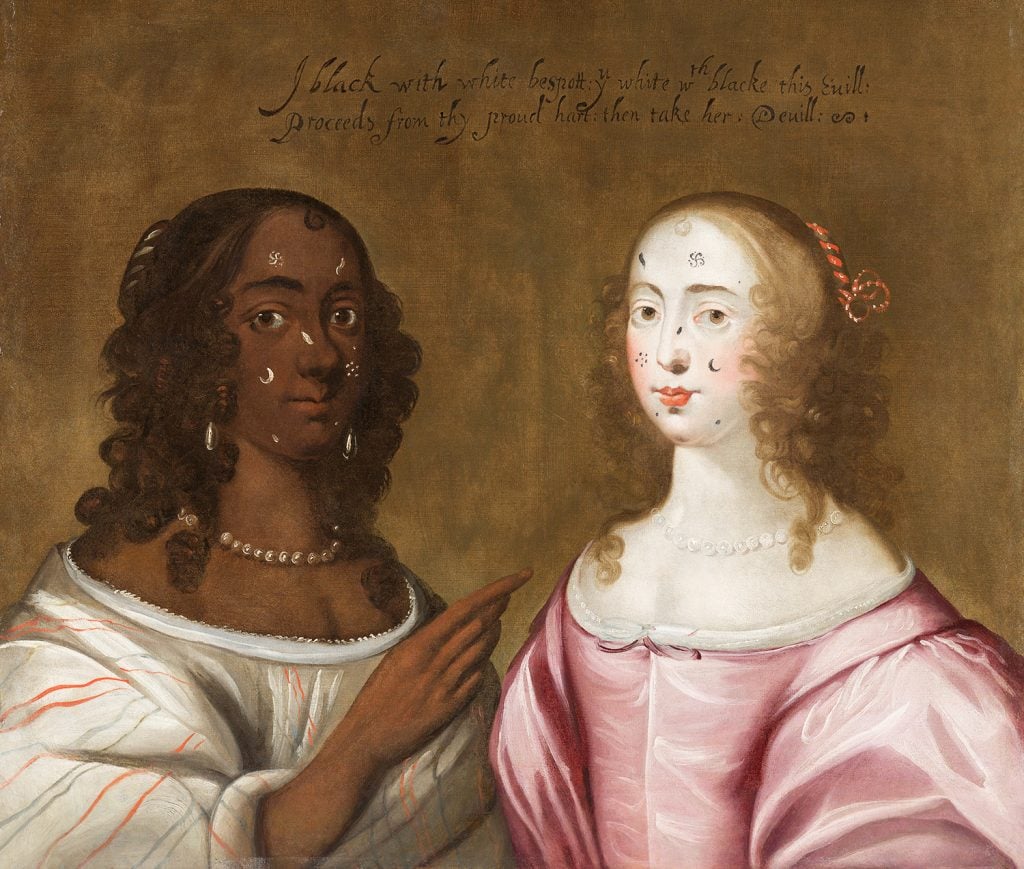
Two Women Wearing Cosmetic Patches (ca. 1655). Photo by Jamie Woodley, ©Compton Verney.
In December 2024, a rare 17th-century portrait of a Black and white sitter was put on display at Compton Verney, a historic English manor in Warwickshire, after an 18-month conservation and research period. Two Women Wearing Cosmetic Patches (c. 1655) was likely made for local politician Roger Kenyon, although the reason why is unclear. Both women are wearing cosmetic patches, common in the 17th century as a way to cover up scars and blemishes. These decorative stickers were typically made from silk, satin, or leather. The inscription above the figures reads “I black with white bespott: yu white wth blacke this Evill: proceeds from thy proud hart: then take her: Devill.”
This damning statement came at a time when England was tussling with the sin of vanity, and the work was likely made during the puritanical parliamentarian reign of Oliver Cromwell. While the painting may seem to position the women as equals, Compton Verney curator Jane Simpkiss explained that “the Black woman is supposed to amplify the sins and misdeeds of the white sitter by suggesting that not only are her uses of cosmetic patches vain but also undermining of her English identity by aligning her with the customs of other, non-European nations.”
Long-Lost Ben Enwonwu Portrait Sets Bonhams Record – March 2018
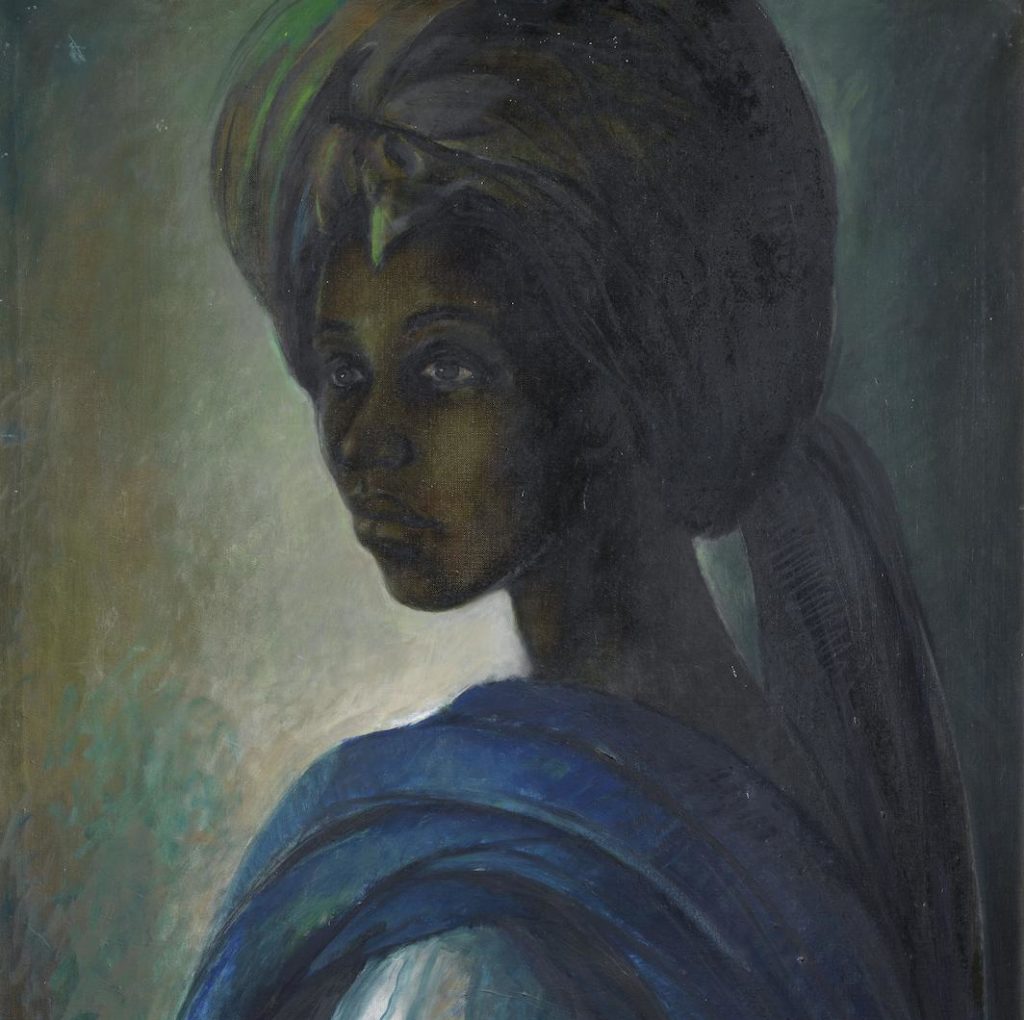
Ben Enwonwu, Tutu (1974). Courtesy of Bonhams London.
Considered one of Africa’s greatest ever artists, work by Ben Enwonwu is highly sought-after around the globe. Fans of Enwonwu will have been excited to hear of a long-lost masterpiece by the Nigerian painter and sculptor heading to auction after almost 50 years unaccounted for. Enwonwu painted three portraits of the Nigerian royal princess Adetutu Ademiluyi in 1974, after the artist tracked down the princess and convinced the royal family in the town of Ile-Ife to allow him to paint her.
The painting became like an “African Mona Lisa” so popular was it in Nigeria, but when it went missing in 1975 after being exhibited at the Italian embassy in Lagos. When the painting was brought to be evaluated at Bonhams in 2017, the owners who had inherited it said they had no idea of its value. Sold at Bonhams’ first ever evening sale of contemporary African art, “Africa Now” , the masterpiece achieved £1.2 million ($1.67 million). The painting was created three years after the end of the Nigerian Civil War and was meant to express a sense of national unity (Enwonwu and Ademiluyi’s tribes were on opposite sides of the conflict).

Related Articles
-


