Law & Politics
Toppled Monuments Are Reappearing Across the U.S. Under Trump
From a new Columbus statue at the White House to revived Confederate monuments, the return of contested figures has reignited debates over what it means to erase history.

From a new Columbus statue at the White House to revived Confederate monuments, the return of contested figures has reignited debates over what it means to erase history.
Eileen Kinsella
 ShareShare This Article
Just a few years after Black Lives Matter protests sparked the removal of dozens of monuments, statues of contested historical figures are making a comeback across the United States. That includes a statue of the 15th-century Italian explorer Christopher Columbus, which was mounted on White House grounds in Washington, D.C. earlier this week, as well as the planned reinstallation of a monument to Revolutionary-era leader Caesar Rodney.
The reappearance of these tributes reflects a wider rollback of 2020-era actions, underscoring shifting political currents and reviving debate over whether removing such symbols confronts oppression or “erases” history.
“Christopher Columbus is a hero, and President Trump will ensure he’s honored as such for generations to come,” White House spokesperson Davis Ingle said in a statement after the statue was installed on March 22 near the Eisenhower Executive Office Building, part of the White House compound.
The Columbus figure is a replica of one that was toppled in downtown Baltimore nearly six years ago, during the social justice protests that swept the U.S. in the wake of the 2020 murder of George Floyd in Minneapolis, Minnesota. At the time, protestors took down the sculpture and dumped it into the waters of the city’s Inner Harbor area, citing the explorer’s history of enslaving and colonizing of Indigenous peoples of the Americas. According to reports after the incident, local artist Tilghman Hemsley organized a team of divers to recover the statue. Next, his son, Will Helmsley, scanned the figure in order to create a replica, thanks in part to support from a $30,000 contribution via the National Endowment for the Humanities during the Trump administration, according to a New York Times report.
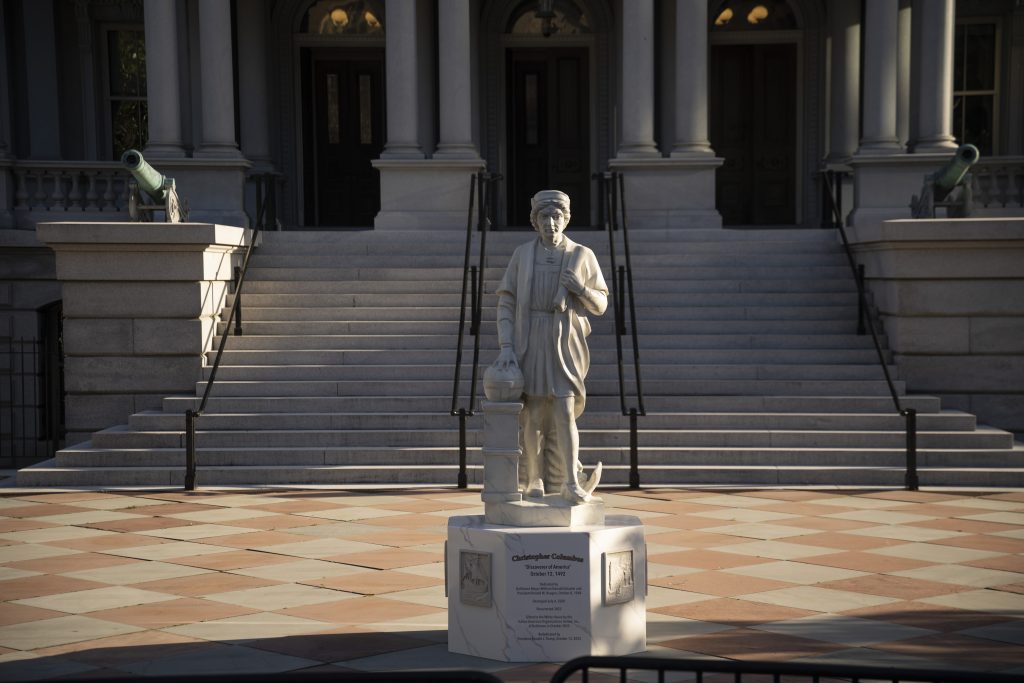
A statue of Christopher Columbus installed in front of the Eisenhower Executive Office Building in Washington, D.C., 2026. Photo: Celal Gunes / Anadolu via Getty Images.
Efforts to remove Columbus from public spaces have been strongly opposed by Italian American groups, who view his statues as symbols of ethnic pride and resilience in the face of past discrimination. The Helmsleys’ statue is on loan to the White House from the Italian American Organizations United (IAOU), which owns the work.
“We are delighted the statue has found a place where it can peacefully shine and be protected,” Maryland lobbyist and IAOU president John Pica told NPR.
President Trump has made no bones about wanting to redeem Columbus and other storied figures from U.S. history who have been found wanting by critics in recent years.
“We pledge to reclaim his extraordinary legacy of faith, courage, perseverance, and virtue from the left-wing arsonists who have sought to destroy his name and dishonor his memory,” the president said of Columbus in a proclamation last October, timed to Columbus Day, alternately known as Indigenous Peoples’ Day. Trump added that the Italian was a “true American hero, and every citizen is eternally indebted to his relentless determination.”
Right-wing pundits have celebrated the statue’s placement at the White House. “America is just now emerging from a destructive frenzy of woke self-loathing,” wrote Roger Kimball in The Spectator, further praising the nearby installation of Freedom’s Charge, a large sculpture of two Continental Army soldiers from the Revolutionary War by artist Chas Fagan. Kimball also noted the return of a statue depicting Caesar Rodney, a founding father and slave owner. The sculpture, removed by officials from a public plaza in Delaware in 2020, will be displayed in Washington’s Freedom Plaza this summer as part of celebrations of the nation’s 250th birthday.
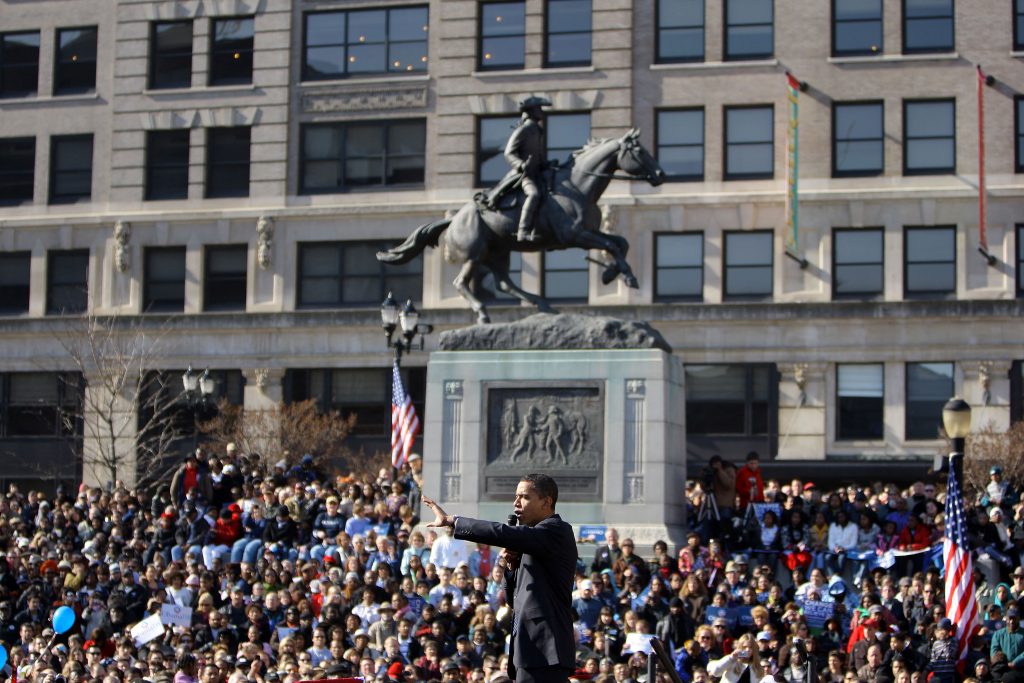
Former president Barack Obama addresses a rally before a statue of Revolutionary War figure Caesar Rodney in February 2008 on Rodney Square in Wilmington, Delaware. Photo: Emmanuel Dunand / AFP via Getty Images.
Rich Lowry, writing in the National Review, deemed the statues’ return “a happy ending,” after “the spasm of violence in the wake of the killing of George Floyd.”
Many have cited the Black Lives Matter movement—which started in 2013 but gained worldwide attention after Floyd’s murder by a white police officer in 2020—as the impetus for demoting Columbus and other historical figures with ties to slavery from places of honor in public life. Indeed, more than 30 statues were dismantled in the span of four months after Floyd’s death, either torn down by protesters or ordered removed by officials.
The Black Lives Matter organization did not respond to a request for comment on the removal of public statues in recent years, or the reinstatement of some under the current Trump administration.
“This might-makes-right politics is not new,” Marcus Board Jr., an associate professor of political science at Howard University in Washington, D.C. said over email. “After all, these original monuments are being rebuilt in honor of longhand foundation myths. America is and has always been an empire. That’s what these monuments are about. It’s inaccurate to say that these statues are a backlash to George Floyd.”
Board criticized those pushing for the reinstatement of these statues. “With all the power, wealth, and resources in the world, brilliance at their fingertips, and the best idea they have is to rebuild statues honoring the forefathers and mothers of the Epstein class,” he said, adding that “these are monuments to incompetence.”
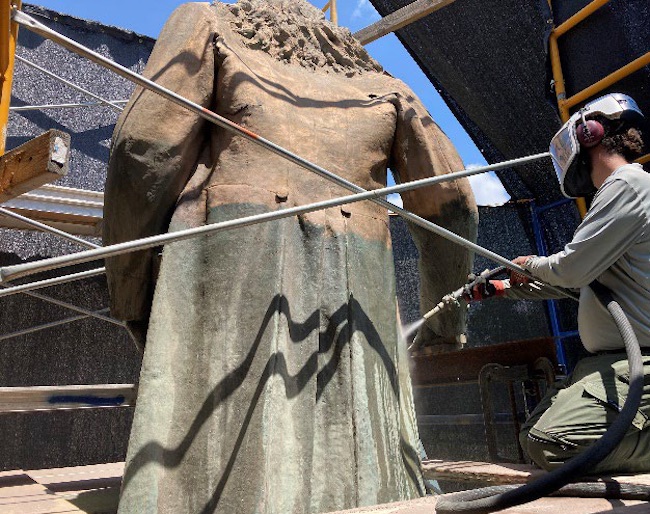
Micro-abrasive cleaning of a statue of Albert Pike. Photo: National Park Service.
Confederate statues, long positioned as either emblems of Southern pride or white supremacy, have also been making a comeback under Trump. Last fall, the National Park Service restored and reinstalled a statue of Confederate general and slave owner Albert Pike in D.C.’s Judiciary Square; it had been toppled and set on fire in 2020.
Earlier this month, a larger bill under consideration by Virginia General Assembly members to get rid of the remaining Confederate statues in the city of Richmond, Virginia, was up-ended when a House committee killed the bill, though supporters hope to resurrect it during a budget special session in April.
Kevin Levin, a Boston-based author and Civil War historian with a specific interest in “monuments and memory” said in a phone call that he is confident “the Democrats will get around to removing these last few statutes in Richmond.”
Levin noted in a recent Substack post that the debate over which figures deserve public commemoration has been “one of the loudest fault lines in American political and cultural life,” noting that there was a push to remove Confederate general statues following the murder of nine Black churchgoers in Charleston, South Carolina, in 2015, and again in the wake of Floyd’s killing in 2020. The refrain from conservatives, he wrote, has largely been “history, however uncomfortable, must not be erased.”
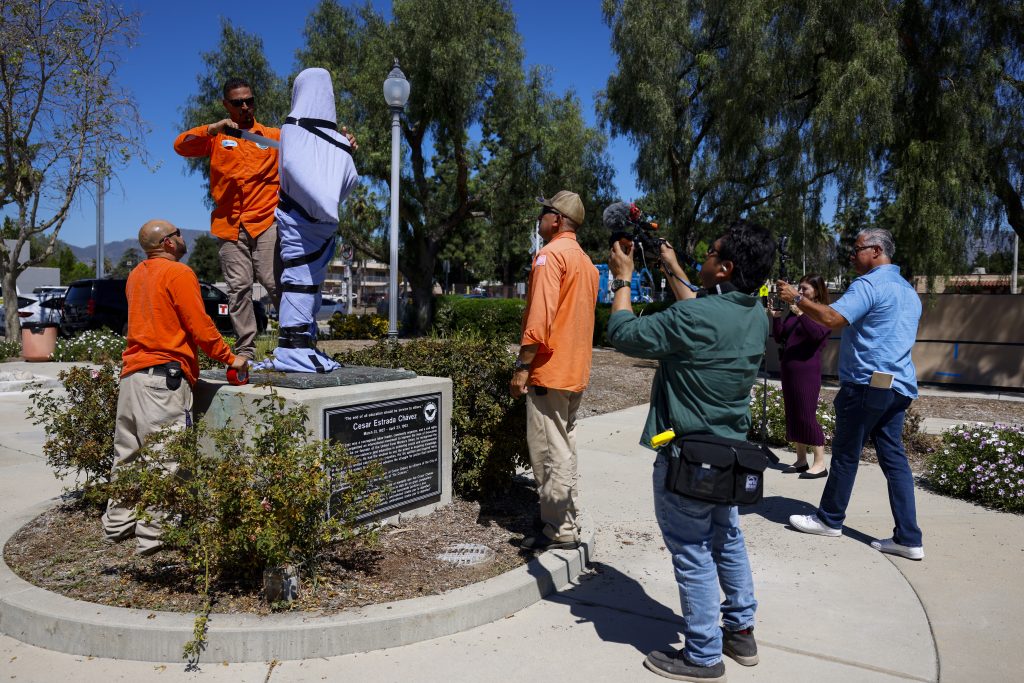
Public Works for the City of San Fernando cover the statue at the Cesar E. Chavez Memorial Park on Thursday, March 19, 2026. Photo: Kayla Bartkowski / Los Angeles Times via Getty Images.
Yet the right has been inconsistent in demanding which statues be reinstated now. Levin noted that the speed with which tributes to civil rights icon Cesar Chavez have been covered up or removed in the wake of an explosive New York Times report about his history of sexual abuse against women and girls has failed to ignite any outcries.
“Everything you could say about removing a statue of Robert E. Lee, you could say about removing a statue honoring Cesar Chavez,” Levin said. “The fact that Republicans are silent on the the removal of statues honoring Chavez, especially erasing his name from schools, roads, and highways, has reinforced to me that the overall debate over monuments was never about erasing history—it was about championing the narrative of the past that suited a specific political agenda.”