Artists
The Business of KAWS: What Data and a Museum Show Reveal About His Market
After his auction results soared in 2019, he shifted.
by
Eileen Kinsella
 Share This Article
As KAWS has risen from a street artist to a global phenomenon over the past few decades, he has shown an uncanny ability to connect with a wide variety of people. Younger buyers clamor for his $50 Uniqlo T-shirts, celebrities place orders for far pricier custom material, and trophy-hunting collectors shell out millions for paintings.
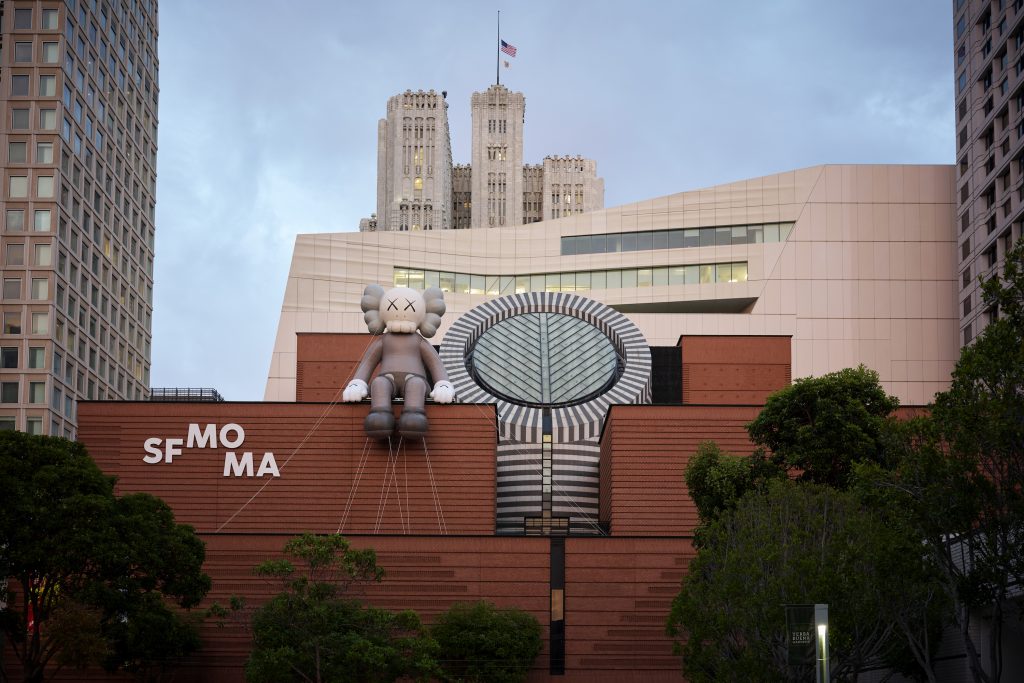
The San Francisco Museum of Modern Art is currently hosting a survey of the artist’s work—the final stop on a three-museum tour—that offers evidence of his business acumen, presenting a portrait of an artist intent on building a diversified operation while making canny moves to bolster his artistic credibility.
As part of the show, the artist, whose real name is Brian Donnelly, designed 1,000 KAWS-branded memberships that were priced at $300 each and included a complimentary KAWS figure and limited-edition KAWS cards. “This is a genius play,” the collector Ronnie Pirovino said, arguing that the 51-year-old artist is allowing SFMOMA “to truly benefit from the audience that will attend the show.”
Museums are hungry for that enormous audience, but KAWS also benefits from institutional approval, which can help with the complicated task of sustaining an artist’s market over the long term.
A Spike and a Shift
In the auction realm, KAWS has had a truly wild ride. In 2019, when his 2005 painting The Kaws Album—the Beatles’ Sgt. Pepper’s Lonely Hearts Club Band as a Simpsons cartoon—went for a record $14.7 million at Sotheby’s in Hong Kong, auction houses sold a whopping $112.9 million of his art, according to the Artnet Price Database. Last year, his auction total was just $7.72 million, his lowest result in a decade.
Just as his market was soaring in 2019, KAWS stopped working with dealer Emmanuel Perrotin, who reps market stars like Takashi Murakami and Maurizio Cattelan. “Considering all the pressure, this collaboration has come to an end,” Perrotin said, rather cryptically, at the time.
KAWS chose instead to work with Skarstedt, a far more staid outfit that specializes in rarefied secondary market work. (One of its New York locations currently has on view a Édouard Vuillard, a rather different figure from KAWS.)
Even amid his auction decline, KAWS has arguably become a more popular figure around the world, and the multifarious nature of his operations means that he may be thriving. (Artists, in most cases, do not receive a cut of auction sales anyway.)
Attendance numbers underscore KAWS’s current reach. SFMOMA clocked 106,000 visitors to its show as of mid-March, four months into its run. That’s short of the total for its recent Ruth Asawa retrospective (174,000), but KAWS has drawn the most visits from children and teenagers since a 2019 Andy Warhol show, the museum said.
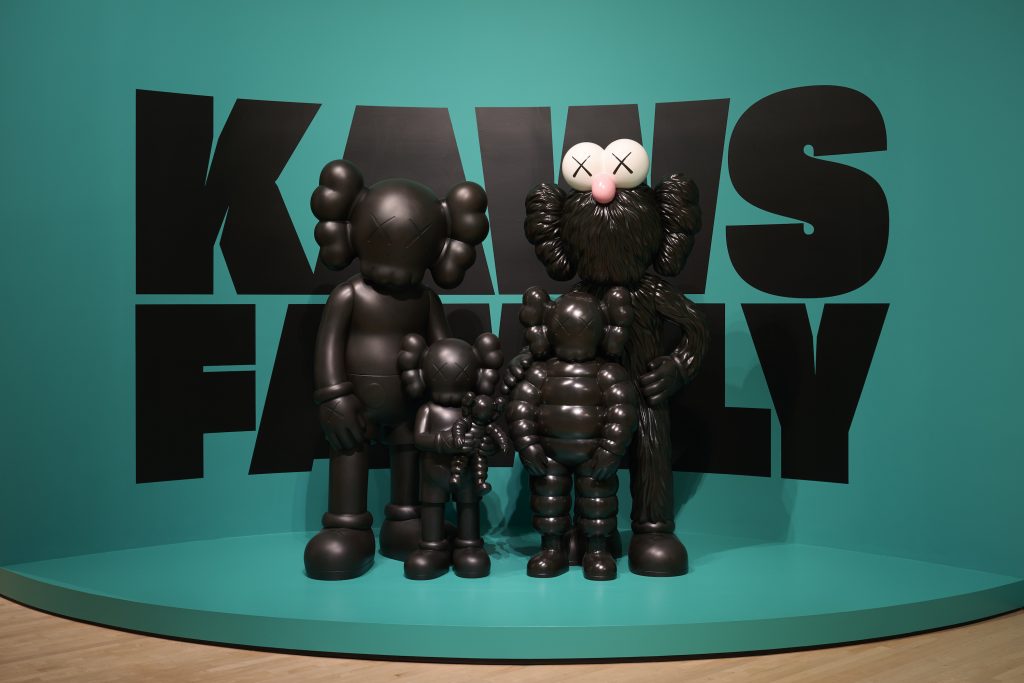
Installation view of “KAWS: Family” at SFMOMA. Photo by Jason Schmidt
The museum was looking for something to fill the slot after Asawa, Daryl McCurdy, SFMOMA’s curatorial associate for architecture and design, told me, “so there was some big shoes to fill.” The show was already built, and so they went for it. “People just love KAWS,” she said. “It was kind of a no-brainer.”
A Diversified Operation
What has given KAWS such staying power? His relatable cartoon-like companions and characters are instantly recognizable, and he regularly draws on characters from mainstays like the Smurfs, the Simpsons, and Sesame Street, which resonate with all ages.
Donnelly grew up with that material. He was born in Jersey City, New Jersey, in 1974, across the river from Manhattan, which he would visit as a teen to leave his KAWS tag. (He chose those letters because he liked the way they looked together, he’s said.) He started on Downtown walls and buildings, then began adding playful, cartoon-like figures to street and bus-shelter advertisements.
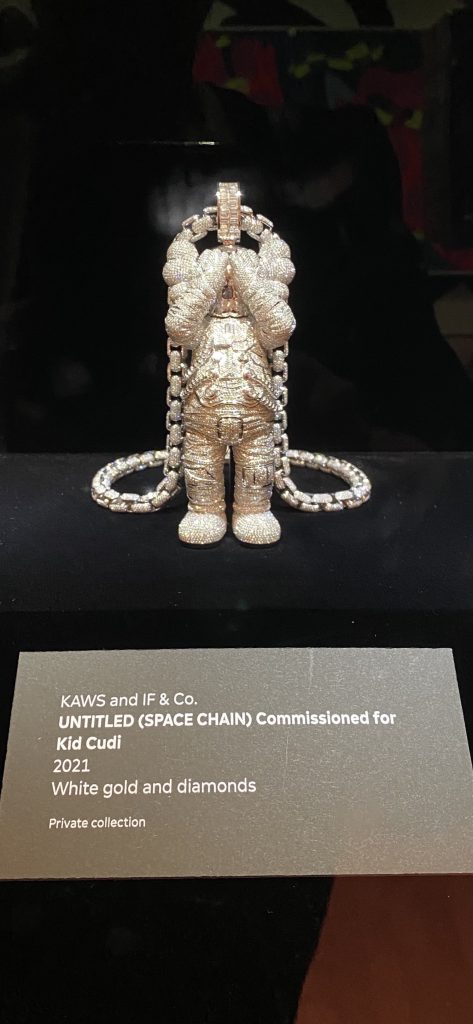
Installation view KAWS, Untitled (Space Chain) (2021), at SFMOMA. White gold and diamonds. Commissioned for Kid Cudi. Photo by Eileen Kinsella
“He poses the characters in these ways that are very general, but also very emotive,” McCurdy said. “The seated, crouched-down Companion covering its eyes? That’s heartbreaking,” McCurdy said. It’s titled Separated and is intended as a commentary on children being separated from their parents at the U.S.-Mexico border.
Another ingredient of KAWS’s success: He partners with companies and artists with enormous cultural cachet. Over the years, he has collaborated with mass-market brands like Nike and Uniqlo, as well as luxe labels like Christian Dior and and Comme des Garçons. He’s also done album covers for Clipse and Kanye West (in his less controversial days). The SFMOMA show includes, in a vitrine, a gold figure, bedazzled with jewels, that KAWS created for rapper Kid Cudi.
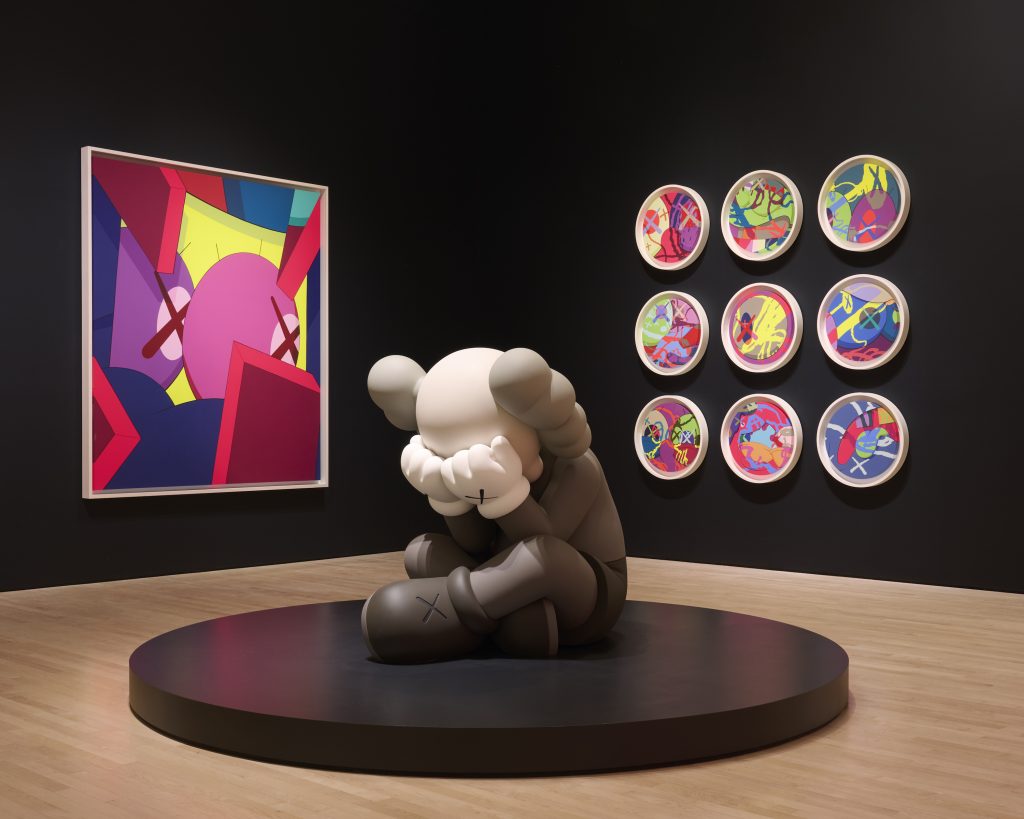
Installation view of KAWS Separated (2021) at SFMOMA. Photo by Jason Schmidt
Plenty in the art world scoff at such work—note how few major art museums actually own his work—but he has his defenders. “He’s just been on the same authentic path the whole time,” said advisor Rachel Greene, who has helped numerous clients acquire his work. His early graffiti and “subvertising” experiments, remixing bus-shelter ads, connects directly to what he does now, she said. “KAWS has become a household name, but he continues to push forward from that original place.”
KAWS has converted some skeptics by plowing his earnings into purchases of vanguard art, which he regularly loans to museum shows. In 2024, the Drawing Center in New York hosted “The Way I See It,” a selection of roughly 400 drawings by 60 artists owned by KAWS. New York magazine critic Jerry Saltz wrote that the show was “so exceptional that I now see his own art quite differently, as part of a much broader project inseparable from the whole.” The review was headlined: “Maybe KAWS Is Not So Bad After All.”
“I recommended that Drawing Center show to clients,” Greene said, arguing that it revealed his “interesting eye, and eye for character.”
“His process is more complex than it appears,” Greene said of KAWS. “He layers images and edits a lot.”
A Bubble or a Banner Year?
When KAWS’s auction results were peaking in 2019, some critics and detractors saw a bubble. Back then, advisor and writer Josh Baer told me: “If you want to tell me that his market is great, just prepare to take one or two zeroes off in 20 years when you prepare to sell. It’s that kind of art.” When I checked in with him recently, he stood by his prediction, writing: “Whoever bought . . . the Simpson work is probably doubting that purchase.” (He was referring to the record-setting KAWS Album, the $14.1 million Beatles–Simpsons mashup.)
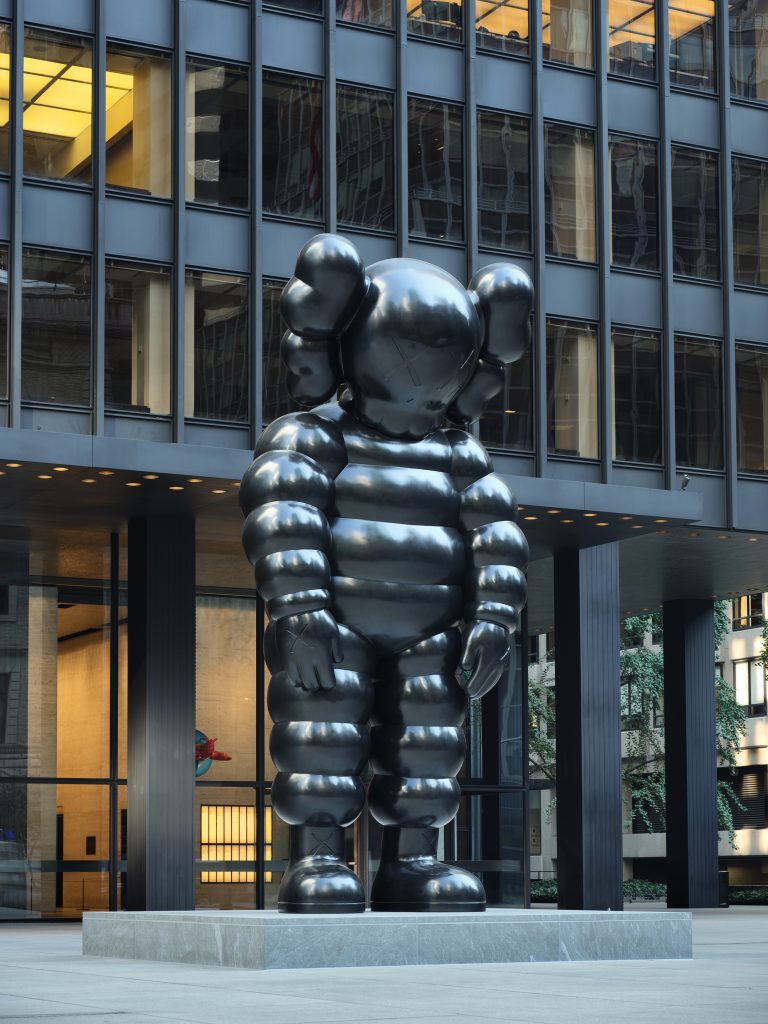
Installation view of “KAWS: What Party” at Seagram Plaza in New York in 2021. Photo by Michael Biondo.
On the primary market, prices right now start at $180,000 for paintings and $600,000 for sculptures and go up as the size increases, a Skarstedt rep said.
Experts I spoke to suggested that KAWS has sought to wrest back control of his market since 2019 by curbing his output and focusing on institutional shows like the one at SFMOMA. In 2019, “a handful of individuals were indeed competing for the trophies,” said Pirovino, the collector. “It created a hyperbolic situation at the high end because that level of quality had never been available at auction up until then.”
Things have calmed, thanks to the artist’s efforts, Pirovino said, and he believes that “right now is best time to be entering the KAWS market as a collector who’s going to be able to deliberate over their decisions.”