Opinion
At 250, America Must Reframe Its Founding Icons
Amid mounting debates over power, dissent, and national identity, a familiar image of Washington is recast to reflect the unresolved tensions at the heart of American democracy.

Amid mounting debates over power, dissent, and national identity, a familiar image of Washington is recast to reflect the unresolved tensions at the heart of American democracy.
Karl Kusserow
 ShareShare This Article
As debates over democracy, executive power, and historical memory intensify in the United States, even its most iconic images must be reconsidered.
Charles Willson Peale’s George Washington at the Battle of Princeton depicts a tide-turning moment in the Revolution following a string of dispiriting defeats. The painting, commissioned by Princeton University’s trustees in 1783, has been a part of its collection for longer than any other work and had previously been on continuous view for the 236 years since its completion—an unprecedented streak in this country.
With the recent reopening of the Princeton University Art Museum following a five-year construction hiatus, this icon of American art and history has returned to view, just in time for the nation’s 250th birthday. Once displayed as an unambiguous celebration of the nation’s founding ideals, the painting is now reframed to acknowledge the tensions between those ideals and the realities of the early republic—and their resonance today.
The nation’s defining democratic values are embodied in Peale’s painting, beginning with the frame. Magnificently ornate and gilded, it was intended for royalty and originally surrounded a portrait of British King George II that hung in the college’s Nassau Hall. During the Battle of Princeton, a cannonball flew into the building and destroyed the king’s portrait. The frame, however, was saved, and the artist’s portrayal of George Washington painted exactly to fit it, with one modification: the large gilt crown that decorated the top of the frame was cut off. You can see the space it left—you can even see the hacksaw marks where it was removed when Washington’s portrait replaced the one of the king. We fought a long and bloody revolution to step out from under that crown, because we did not—do not—want a king.
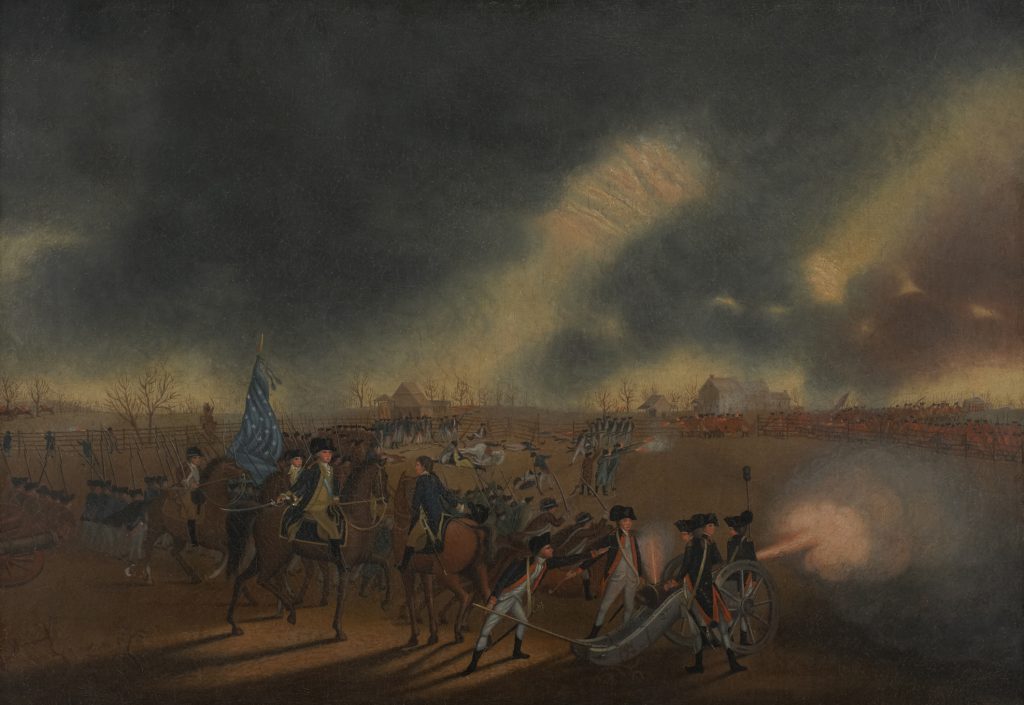
The Battle of Princeton on January 3, 1777 as painted in 1782 by James Peale. Photo: Pierce Archive LLC/ Buyenlarge via Getty Images.
Following the Revolution, Washington was urged by many to claim enduring power, but he refused, resigning his commission in 1783. That same year, Princeton served temporarily as the nation’s capital, and Washington paid a visit to the assembled representatives in Nassau Hall. Continental Congress President Elias Boudinot described having to physically restrain himself from rising to his feet as Washington entered the room, thus showing the distinction between dispersed, democratic authority and dominion concentrated in a single overlord. It is a difference now lost in the permanent capital of the nation, named in 1791 for the leader who eschewed permanent power—and whose portrait is deliberately free of a crown.
Washington’s legacy is nonetheless complicated—and it does the larger legacy of the ideals he espoused no justice to ignore his faults. He owned more than 150 enslaved African Americans, and despite growing personal reservations did nothing to publicly criticize, let alone abolish, slavery. To Native Americans of the Haudenosaunee (Iroquois) Confederacy, he is known as Hanödaga:yas, or Town Destroyer, for his pitiless treatment of a people who had pledged neutrality during the Revolution. In 1779 he wrote a directive calling for “the total destruction and devastation of their settlements, and the capture of as many prisoners of every age and sex as possible.”
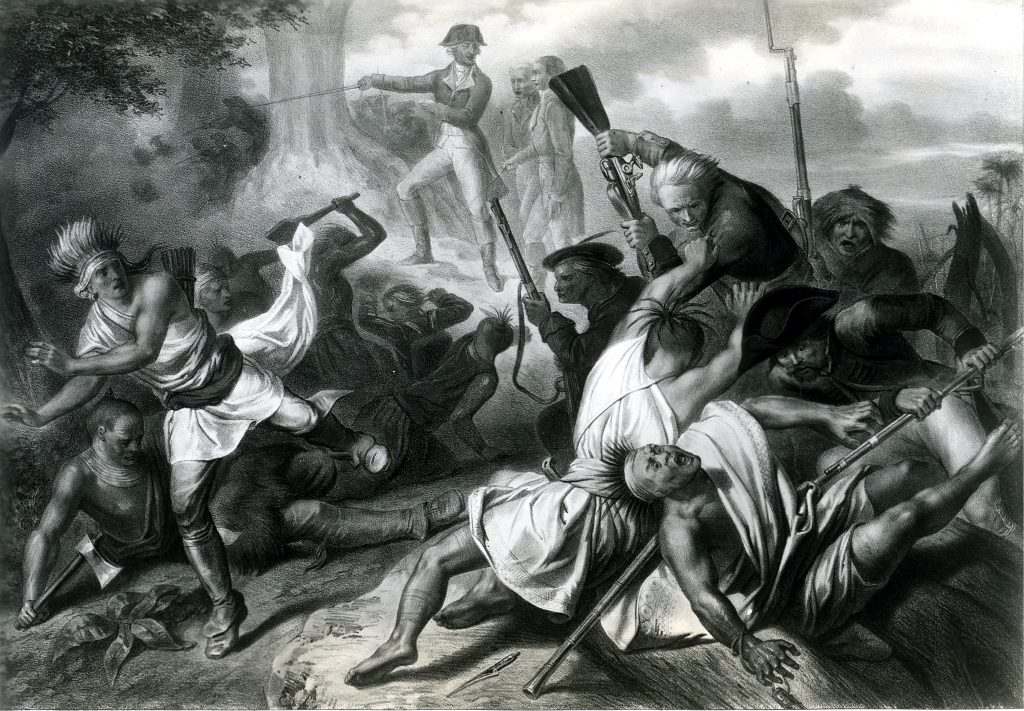
Illustration showing George Washington in the midst of fighting during the French and Indian War. Photo: PhotoQuest/ Getty Images.
In order to convey some of this complexity—to present both Washington the nation builder and town destroyer—and to foreground enduring tensions between America’s political ideals of democratic egalitarianism and the contrasting realities of many, Peale’s portrait is flanked by two sculptural busts also depicting Washington. One was made around 1817 by William Rush, Peale’s friend from Philadelphia. It was originally owned by another president, Thomas Jefferson, like Washington a major enslaver who nevertheless loftily proclaimed, “all men are created equal.” Installed opposite Rush’s sculpture, Mohawk artist Alan Michelson’s contemporary bust Hanödaga:yas (Town Destroyer): Reflect refers pointedly to Washington’s efforts at “total destruction and devastation” of the artist’s own ancestors. Its pedestal of charcoaled wood evokes the villages Washington had burned, while its mirrored surface reflects viewers back to themselves, undercutting the mythic heroism earlier artists projected onto Washington and asking viewers, in Michelson’s words, “Do you see yourself reflected in this American icon?”
Despite Washington’s real shortcomings in the equal application of his principles, he saw the overarching aim of democracy as rooted in justice and opposed to tyranny. And importantly, he understood the essential role of dissent in a free society. It was, after all, dissent that brought the United States into being. American history—and the art created around it—thus proclaim a central truth about historical agency: that injustice breeds dissent, and rightful resistance, in the end, often prevails. Peale’s great portrait, and the history surrounding it, is about resistance to tyranny, about courageously asserting the principled rights of people in the face of unjust governance.
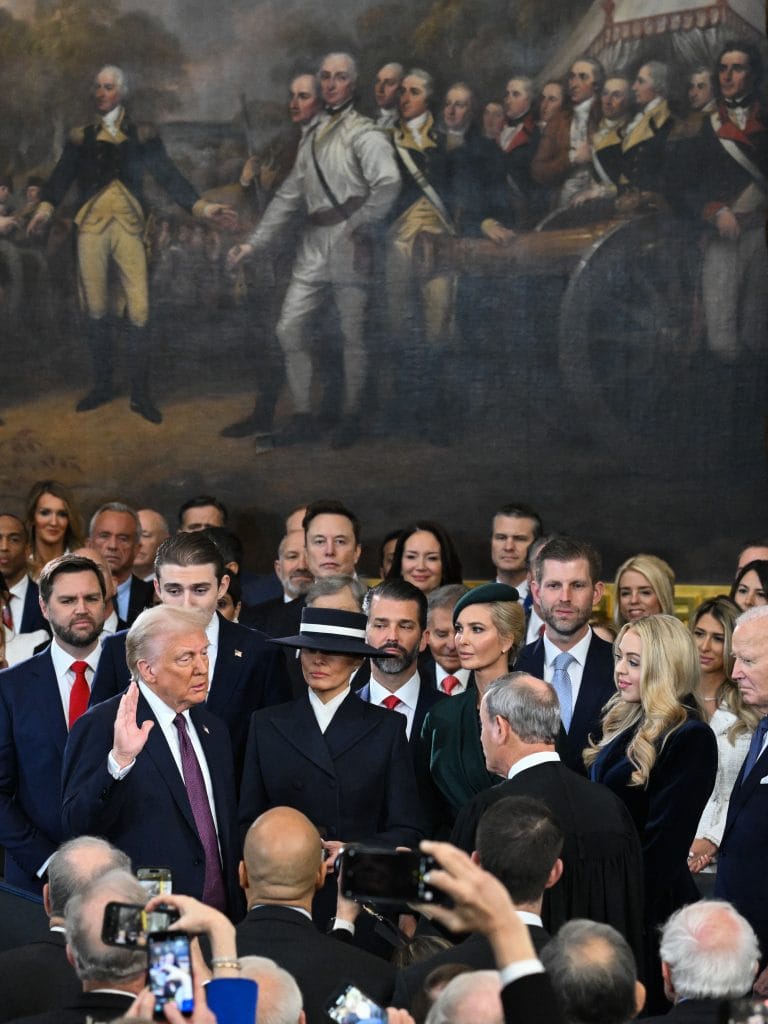
Donald Trump is sworn in as the 47th US President in the U.S. Capitol Rotunda in Washington, DC, on January 20, 2025. Photo: Saul LOEB / POOL / AFP via Getty Images.
Forty years after Peale put down his brush, John Trumbull’s Declaration of Independence was installed in the new Rotunda of the U.S. Capitol, across the room from Trumbull’s General George Washington Resigning His Commission. The two paintings bracket the crucial themes of the American project—liberty and democracy—in both of which Washington played a critical role. Our current president was inaugurated last year in the Rotunda, flanked by these icons of our nation’s foundational values. We must insist that that the forty-seventh American president abide by the lessons imparted by our first president, and exercise our constitutional right to ensure he does.
Karl Kusserow is the John Wilmerding Senior Curator of American Art at the Princeton University Art Museum.