Art History
Mystery Portrait of Black Woman Finally Identified After Six-Year Search
The Art Gallery of Ontario bought the unknown painting at auction in 2020, before embarking on years of research into its sitter.
by
Richard Whiddington
 Share This Article
- AGO researchers have identified an anonymous 18th-century portrait sitter as Eleonora Susette, an enslaved woman.
- Multidisciplinary research traced her origins to Dutch-controlled Guyana and linked her to colonial networks.
- Genealogy enthusiasts’ discovery of archival letters provided the breakthrough, revealing her name and life story.
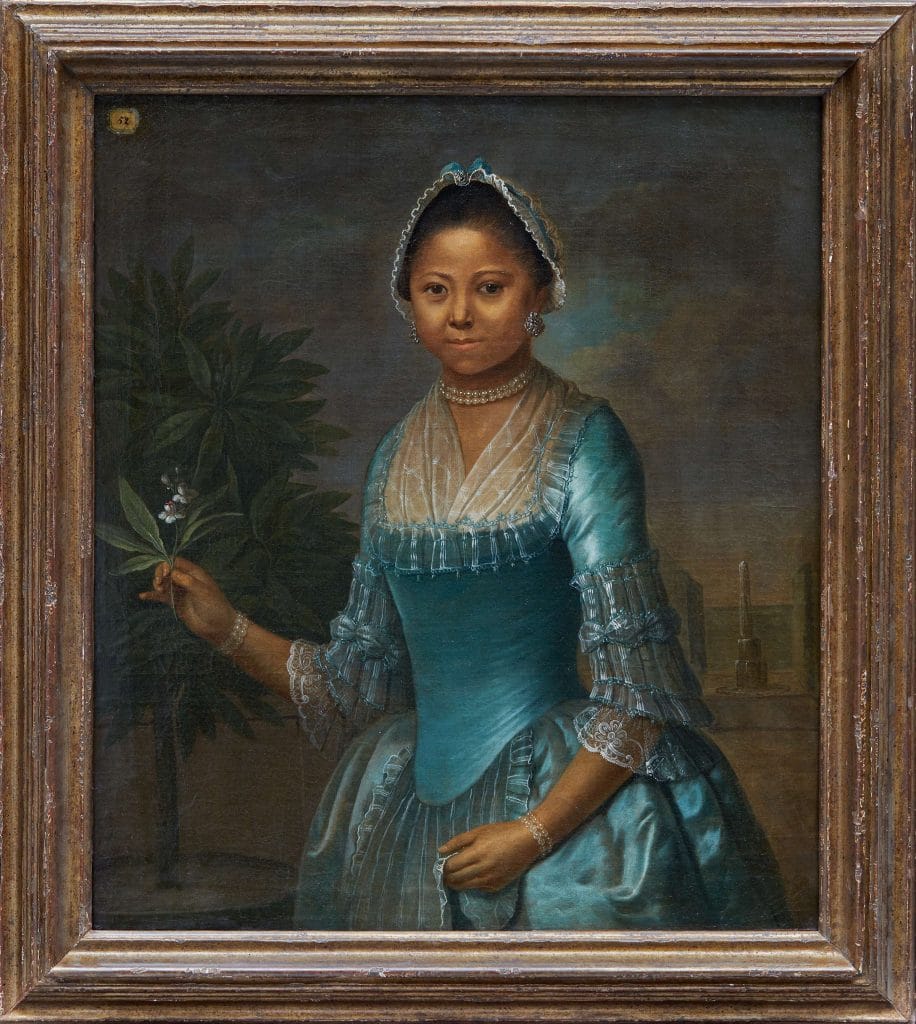
In 2020, the Art Gallery of Ontario (AGO) did something slightly unusual: it acquired a portrait whose sitter, artist, and date were unknown. The Toronto museum was looking to diversify its holdings of historic European art and swooped on a painting at Sotheby’s depicting a young Black woman dressed in pearls and slate-blue silks. Dated to around the mid-18th century, it was granted the descriptive title Portrait of a Lady Holding an Orange Blossom.
More than six years on, the insights of art historians, botanists, archivists, and Dutch genealogy hobbyists have combined to identify and rename the work. Today, the painting hanging in a ground floor gallery of the AGO is called Portrait of Eleonora Susette—her last name remains unknown. It depicts an enslaved mixed-race woman from Guyana that was painted by Jeremias Schultz in 1775.
“We look at Europe in a global context and we like to highlight the ways that European artists and collectors traveled and traded with the world. Part of that is representing the people who lived in Europe but came from abroad,” Adam Harris Levine, associate curator of European art at the AGO, said over email. “The painting is an amazing means for exploring these themes.”
Art Gallery of Ontario. Photo: Shutterstock.
The first two years of research saw a team led by Levine make steady progress. It was confirmed that the young woman was indeed clutching an orange blossom that chimed with the potted orange tree behind her—a link perhaps to the Netherlands’s royal family, the House of Orange. Moreover, details in the sitter’s blue silk gown allowed fashion historians to date the painting to between 1770 and 1775.
The artist came next. A partial signature identified Schultz, a Berlin-born artist who achieved success in the second half of the 18th century painting Amsterdam’s merchant class. Researchers initially thought the work was painted by Johann Cristoffel Schultz, an engraver who was the artist’s nephew, but the signatures on two paintings at the Museum de Waag in Deventer matched AGO’s work.
Soon, researchers found companion portrait in an old auction catalogue that showed a young black man sporting a rich green suit and a lace cravat. From these facts, researchers inferred that the young sitters had likely been brought to Amsterdam through the web of the Dutch colonies.
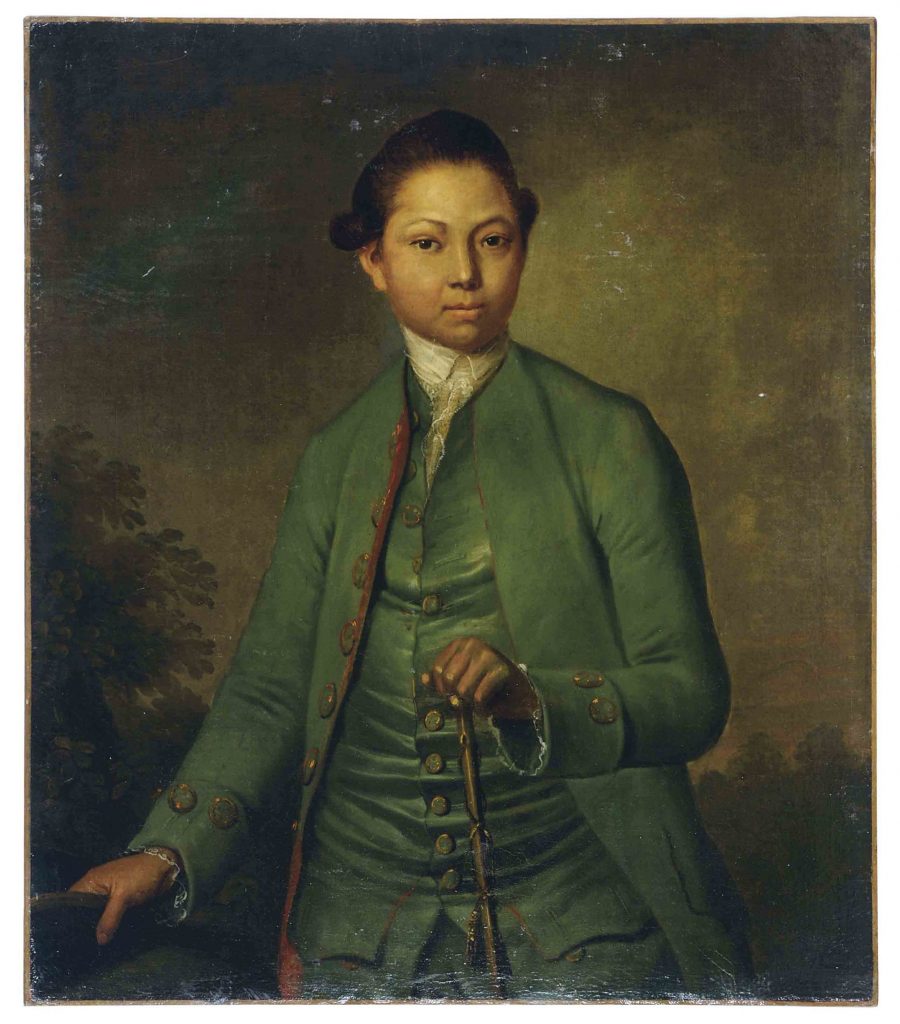
Jeremias Schultz, Portrait of a Young Man Wearing a Green Jacket Holding a Cane (18th century). Photo courtesy of Christie’s.
For the next four years, however, Levine and his team made little progress. “We were looking for two young people of color who were living in Amsterdam in the 1770s,” Levine told the museum’s magazine Foyer. “That, frankly, felt like a complete dead end to me.”
The breakthrough came with an email from Dorien Nieuwenhuijsen and Tim de Jonge, a mother and son from the Netherlands who had come across AGO’s podcast on the painting, Portrait of Possibilities, while research their family history. They had information they thought would be useful to the researchers.
Their direct ancestor, Beata Louise Schultz, was the painter’s first cousin who had moved to the Dutch colony of Berbice (modern-day Guyana) in 1768 after her husband was appointed governor. Archives showed that after Beata’s husband died in 1773, she decided to return to Amsterdam and wrote a letter to the Dutch government asking permission to bring two enslaved people who worked in her home. Their names were Michiel and Eleonora Susette, who was born in 1756 and was forced to work alongside her mother, Lucia Afiba.
Upon returning to Amsterdam, Beata commissioned her cousin to paint portraits of her son and daughter as well as of Eleonora Susette and Michiel. It was most likely intended as a keepsake of the pair, the museum noted. Eight months later, they were sent back across the Atlantic Ocean to Berbice.
While many questions surrounding the painting remain, Levine hopes the research will refocus what is granted art-historical attention. “For a long time, art historians have drawn our attention to foreign objects in Dutch still life compositions,” Levine said. “But it is important to think about this cultural context beyond the material and to think about peoples’ lives.”