Art History
The Hidden History of Spanish Fashion, Revealed in 150 Years of Portraits and Manuscripts
A new show at the Hispanic Society Museum and Library offers a decade-by-decade account of shifting tastes.

by
Richard Whiddington
 Share This Article
Every empire has its color. For the Habsburgs in Spain, it was a rich, deep shade of black. It’s the black that luxuriates the royal sitters of Diego Velázquez paintings, a color that was austere, pious, and extremely expensive to achieve.
It came from the dense core of logwood, a spiny tree native to Central America, and before its discovery by Spanish conquistadors, the best approximation was a muddy brown. Black was the base layer upon which the fineries of the empire were laid: gold taken from the Aztecs, silver from Bolivia’s Potosi mine, silk from Naples, and lace from Flanders. From the ascension of Charles V in 1516 until the death of his great-great-great-grandson Charles II in 1700, these were the raw materials of Spanish fashion and they were woven into forms that define Catholic Church vestments and our sense of business attire today.
The influence of Spanish fashion across Europe mirrored the Habsburgs’ fortunes. At its 16th century peak, its extravagant silhouettes were being adopted by the English court. By the end of the 17th century, with Habsburg preeminence in retreat, even the Spanish were taking fashion cues from Versailles. This century and a half plays out in “Spanish Style: Fashion Illuminated”, which fills the terracotta courtyard of The Hispanic Society Museum in New York. It’s curated by Amanda Wunder, who recently published a book on the forgotten tailor of Philip IV, and here pulls generously from the Hispanic Society’s deep and eclectic archives.
“Unlike today, clothing during this period is not about showing individuality or personality,” Wunder told me on a recent visit. “The royal family is setting the trends and the elite model themselves after it—fashion is a uniform, a way of showing that you belong.”

Paintings from 1612 to 1613 of Anna and Phillip, the children of Phillip III. Photo: courtesy Alfonso Lozano.
A childhood portrait of Philip IV from the 1610s is a good place to start. The crown prince appears staid and awkward, his jaw resting on an enormous ruff that reaches well above his ears. Period women followed suit, as the neighboring painting of his sister Anne shows. These intricately scrolled yards of linen and lace were fashioned by their father, Phillip III, and following the defeat of the Spanish armada in 1588 came to symbolize Spain’s decadence. Spain was feared, the saying went, when it had more armorers than ruff setters. In an edict, Philip IV banned men from wearing the ruff in 1623, and instituted a plain linen collar in its place.
This moderation is apparent in a pair of nearby paintings from the 1650s and 1660s. The men still flex, but status is shown in subtler details. A painting attributed to Jose Antolínez offers a gentleman in billowing sleeves and a sharp-edged collar with backstitching. He flouts a pair of gloves with red silk lining and his trusty spaniel dons loops of red and white ribbons around its ears. Next door, Alonso de Mora literally wears his nobility: his black cape is stitched with the red cross of the knights of St. James, an exclusive military order whose members traced their noble ancestry back to the 12th century (the same mark emblazons Velázquez’s tunic in 1656’s Las Meninas).

Attributed to Juan de Pareja, Don Alonso de Mora y Villalta (mid-1650s). Photo: courtesy Alfonso Lozano.
For those newly rich from plundering the new world, this was a level of social status they could only dream of achieving. These ordinary hidalgos—literally sons of something—protected their noble status in court with cartas ejecutorias, executive letters. It was worth doing so as nobles didn’t pay taxes. To compile these passports of nobility, families enticed those from their ancestral village to provide testimony swearing that they were an old household of “pure blood”—i.e. free of Muslim or Jewish heritage. These hidalgos bankrolled two versions: a dry, official one that remained with the court at Granada or Valladolid; and a richly illustrated one they kept at home, ready to be brandished in the face of any future doubters.

Letter of nobility petitioned by Alonso de Castro in 1553. Photo: courtesy Alfonso Lozano.
The Hispanic Society has a remarkable 600 cartas ejecutorias, 16 of which are on display, many for the first time. Not only did the documents have to say a family was noble, they had to show they dressed noble too. Accordingly, these aspirants are pictured in the latest fashions of the day, even though, in most cases, they couldn’t have afforded to dress so lavishly. They are, Wunder said, as informative as paintings. “They are dated and we know who they are and where they lived. They let us track how elite fashion changed decade by decade for 150 years.”
This is particularly helpful given the scant physical evidence that remains. Fabric was so valuable it was constantly being reused and recycled, sometimes descending the social ladder until it was little more than rags. The black dye derived from logwood was another factor: it’s corrosive and over time consumes the fabric it embellishes, a process known as inherent vice. One survivor is a 17th-century velvet vestment, itself an upcycled wall hanging, with a trompe l’oeil pattern and heavy gold embroidery that would have been worn by the clergy on extremely solemn occasions. “I don’t understand why this one made it,” Wunder said.

A 17th century embroidered velvet vestment that would have been used for solemn occasions. Photo: courtesy Alfonso Lozano.

A detail of the church vestment. Photo: courtesy Alfonso Lozano.
The evolution of Spanish fashion is laid out in a case displaying six side-by-side cartas ejecutorias. In 1553, a banker who made his fortune in the trans-Atlantic trade of enslaved Africans appears decked out in armor, as if a Medieval knight. Less than two decades later, tastes have softened. A couple from Extremadura is pictured with the husband sporting a high collar of lace and a paunch of padding that briefly trended; his wife wears a high-necked pink gown and a pious head covering.
By 1610, a noble claimant from Seville mimics the style of Phillip III in an all-white getup and an outrageous ruff. A charming family portrait from 1651 sees the ruff replaced with a linen collar (dyed with indigo powder imported from the colonies) and a woman wearing a scalloped bobbin and an elaborate wig that follows the shape of a guardainfante, broad hoopskirts that required vast quantities of fabric. Partly at the behest of the church, which claimed they were used to hide pregnancies, Phillip IV outlawed them. It didn’t work: the royal women of Spain, for one, kept wearing them. By the end of the case, it’s 1699 and Paris has arrived: the women wear off-the-shoulder pastel colored gowns and the men boast lace cravats and powdered wigs.

A letter of nobility petitioned by Don Antonio de Contreras in 1651. Photo: courtesy Alfonso Lozano.
It’s the end of the Spanish Habsburgs and their fashions. But, as with all trends, they run in cycles. The exhibition’s endcap, Francisco Goya’s Portrait of the Duchess of Alba (1797), shows us how. The black and gold of Spain’s glory days are back and she wears a lace mantilla, a reworking of the 16th century head covering. “She’s reincorporating traditional elements of Spanish fashion,” Wunder said. “It’s a rejection of the French style.”
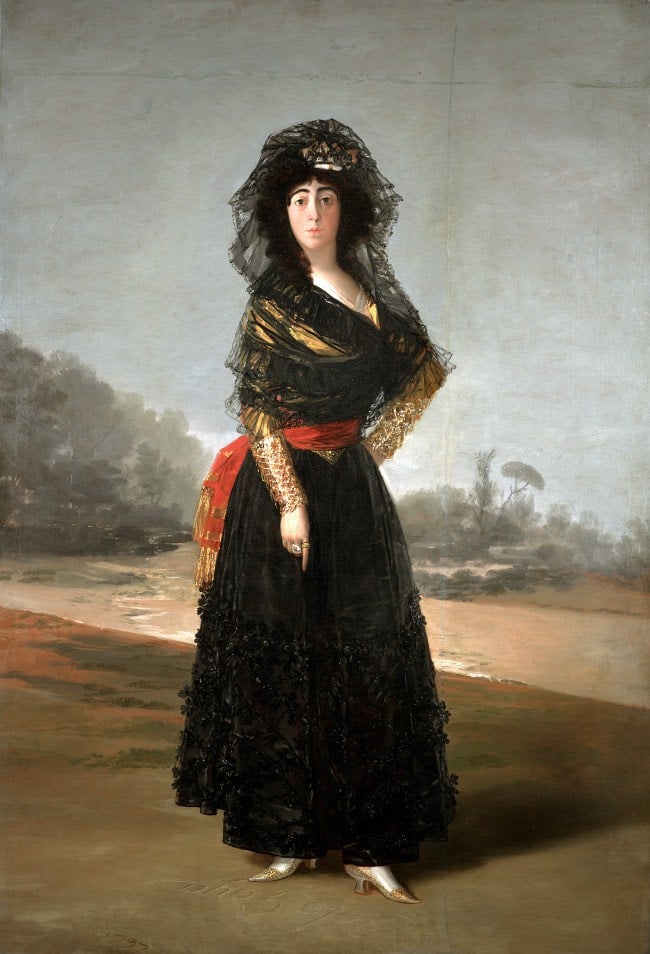
Francisco Goya Year, Portrait of the Duchess of Alba (1797). Collection of the Hispanic Society of America.
“Spanish Style: Fashion Illuminated, 1550–1700” is on view at the Hispanic Society Museum and Library, 3741 Broadway, New York, November 6, 2025—March 22, 2026.

Related Articles
-


