Law & Politics
Inside the Fight to Keep a Trove of Frida Kahlo Works from Leaving Mexico
The planned transfer of masterpieces from the Gelman Collection to Spain are testing Mexico’s protections on national treasures.

The planned transfer of masterpieces from the Gelman Collection to Spain are testing Mexico’s protections on national treasures.
Jo Lawson-Tancred
 ShareShare This Article
A blockbuster exhibition of works Mexican modernist works, including many by Frida Kahlo in Mexico City has been shadowed by controversy, as the prized collection prepares to leave the country for Spain later this year.
The Gelman Collection, part of which is currently on view at the city’s Museum of Modern Art, is set to be transferred to Banco Santander’s new cultural hub under a deal that has sparked outrage among artists and historians. Authorities have now said the move is temporary—and the works will return in 2028—but the dispute has ignited a broader debate over cultural patrimony, transparency, and the role of private institutions in stewarding Mexico’s artistic heritage.
The dispute has drawn in Mexican President Claudia Sheinbaum, who on Monday defended the bank’s agreement and said officials were obeying the law.
An open letter, published on March 18 on e-flux, claimed the bank’s decision to move the collection to Spain violates national heritage law. “How can Mexicans entrust their financial assets to a bank that, through its decisions, chooses to strip them of their cultural heritage?,” the letter said, noting that among the works are 11 paintings by Kahlo. Two of these—Self-Portrait with Monkeys (1943) and Diego in My Mind (1943)—are “widely regarded by scholars and experts as masterpieces essential to understanding Kahlo’s artistic development and intellectual universe,” the letter’s authors argued.
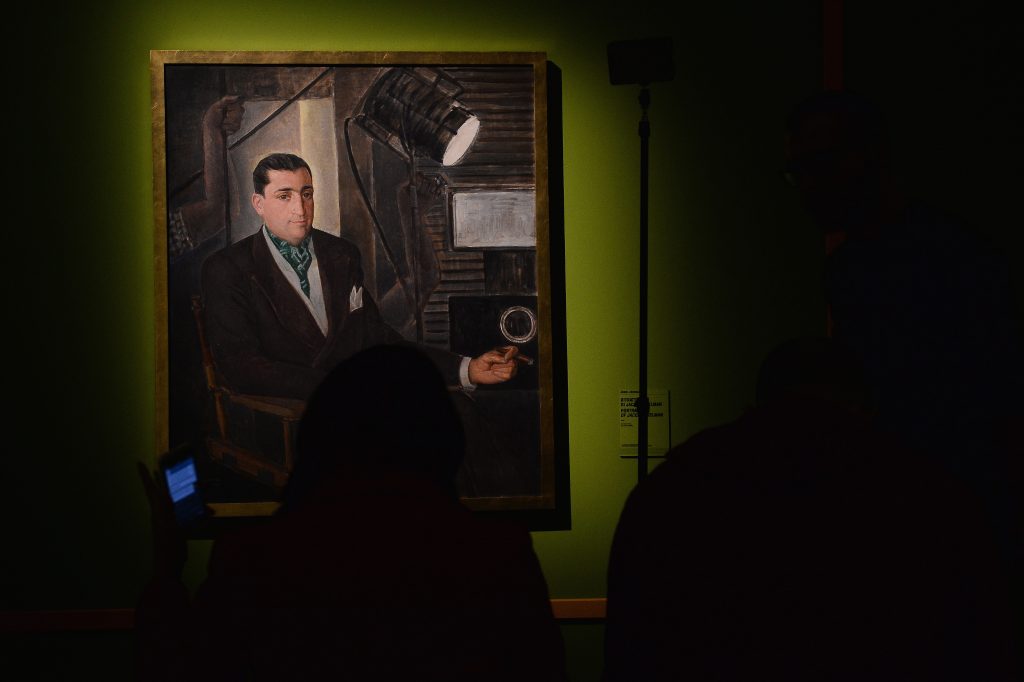
“Frida Kahlo and Diego Rivera – Mexican Art in the Gelman Collection” at Albergati Palace on November 18, 2016 in Bologna, Italy. Photo: Roberto Serra – Iguana Press/ Getty Images.
The trove of more than 160 20th-century works was originally amassed by Jacques Gelman, who was born in St. Petersburg to Jewish parents and moved to Mexico in 1938, and his wife Natasha Zahalka. The couple became friends with Kahlo and her husband Diego Rivera and began collecting their works as well as those by other Mexican modernists, such as María Izquierdo, José Clemente Orozcó, and Rufino Tamayo.
After Natasha’s death in 1998, the collection was bequeathed to her advisor and friend Robert Littman, who later expanded and partially sold it after ownership disputes halted its display in Mexico after 2008. Janet C. Neschis, a lawyer representing the Jacques and Natasha Gelman Foundation, told the New York Times that the Gelman family always intended to keep the collection in Mexico.
In January, some 18 years since it was last seen publicly, it was revealed that the collection was acquired in 2023 by the Zambrano family, one of Mexico’s wealthiest business families. Its management was turned over to the Banco Santander Foundation as part of a private deal with the Zambranos, who retain ownership of the collection. The bank then announced the collection would be rebranded as the Gelman Santander Collection and would be installed in its new Faro Santander cultural center this summer.
Though no official timeframe was given for how long the collection would remain in Spain, Faro Santander’s director Daniel Vega Pérez suggested to Spanish press earlier this year that it would have a “permanent, yet dynamic presence” at the new institution.
On March 10, the first open letter decrying the move noted that the collection contains 30 artworks by artists such as Kahlo, Rivera, and David Alfaro Siqueiros, which are subject to an export ban.
Mexican law strictly protects certain artworks, especially those by Kahlo, designating them as national cultural monuments that cannot be permanently exported, even if privately owned. They may be loaned abroad temporarily, but must be returned to Mexico.
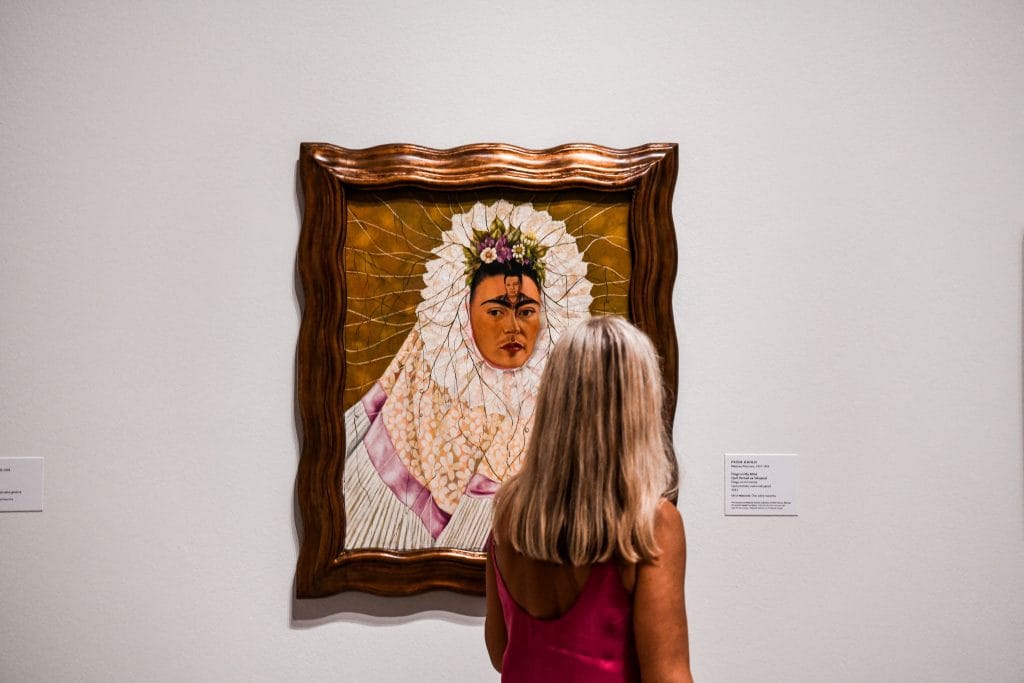
“Frida Kahlo, Diego Rivera and Mexican Modernism from the Jacques and Natasha Gelman Collection” at the Norton Museum of Art in West Palm Beach, Florida on October 23, 2021. Photo: Chandan Khanna/AFP via Getty Images.
“The citizens of this country have the right to be fully informed about the reasons that have led these authorities to allow the indefinite removal of Kahlo’s 11 canvases from the country, which seriously contravenes the decree that establishes that her work, unlike that of her colleagues, can only be exported temporarily,” the open letter stated.
“This decree was specifically intended to put a lock on private collections,” the historian Francisco Berzunza told the Guardian. “To ensure they would not leave the country or be dispersed. That’s why we’re defending it so vigorously.”
Berzunza is one of eight authors of the open letter, which has been signed by nearly 400 Mexican cultural figures. They criticized a lack of transparency on the part of Mexico’s ministry of culture, which they say failed to explain why it had permitted the “indefinite removal” of the Kahlo works.
In a press conference on March 30, Mexico’s secretary of culture Claudia Curiel insisted that the collection “wasn’t sold, it’s only on display [in Spain] temporarily.”
The bank also released a statement clarifying that the deal does not imply a change in ownership of the works or a permanent relocation. “We are committed to caring for and disseminating the valuable holdings of the Gelman Santander Collection in strict adherence to Mexican regulations and with respect for what these works represent for Mexico,” the statement said.
Some experts have argued that rules limiting how long art can leave Mexico miss the bigger issue: even when works stay in the country, collectors aren’t required to display them publicly.
The Gelman Collection had not been publicly exhibited in Mexico for nearly two decades before roughly 70 pieces went on display at the Museum of Modern Art in Mexico City in February. These works will remain on display through June before it is transferred to Spain. Since 2010, works from the Gelman Collection have left Mexico around 30 times to tour internationally.
Margaret Carrigan contributed reporting.