Opinion
Why I’m Not Celebrating Frida Kahlo’s $54.7 Million Auction Record
The historic sale of the artist's "El Sueño (La Cama)" may have set a new auction record for a woman artist, but it hardly represents cultural progress.

The historic sale of the artist's "El Sueño (La Cama)" may have set a new auction record for a woman artist, but it hardly represents cultural progress.
Eddy Frankel
 ShareShare This Article
It’s mid-July, 1954. The Mexican summer heat scorches the tarmac outside the home of Frida Kahlo, La Casa Azul. Storm clouds are gathering on the horizon. Inside, on her deathbed, Kahlo is surrounded by those closest to her. She’s weakening. One of them says: “Look into your heart Frida, tell us, what is it you most desire for your legacy?”
She takes a shallow breath, her voice a mere whisper, and manages to utter: “For my work to be worth more than Georgia O’Keeffe’s.”
Obviously, this is not a verbatim transcription of what actually happened on Kahlo’s deathbed, because the artist wouldn’t have given a rat’s ass how much her art would sell for at auction 70 years after her death. But judging by the reactions of many to the news of the $54.7 million sale of her 1940 painting El Sueño (La Cama)—which broke multiple records at Sotheby’s New York last week—you’d think that this moment was the apotheosis, the absolute apex of art achievements, the thing all artists long for, rather than just a grim financial anomaly.
Notably, the sale reset the record for the most expensive work of art by a woman artist sold at auction, surpassing the previous $44.4 million high set in 2014 for O’Keeffe’s Jimson Weed, White Flower No. 1 (1932). (You could almost hear the ghost of Kahlo in the salesroom shouting “suck it, O’Keeffe!”, apparently.)
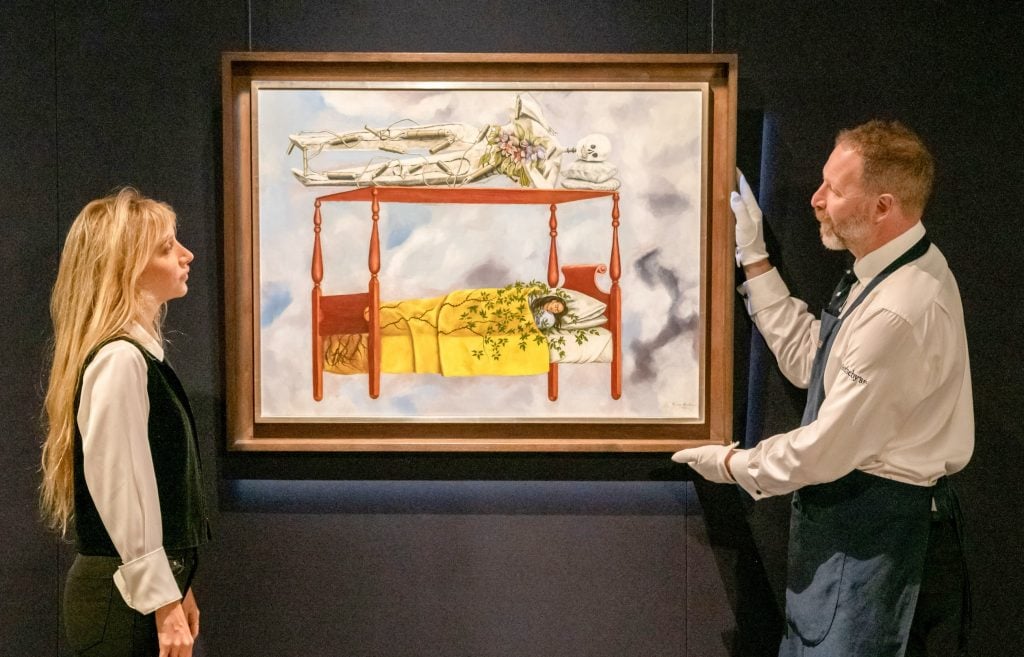
Frida Kahlo, El sueño (La cama), 1940. Courtesy of Sotheby’s.
But, as everyone is desperate to point out, there is still a yawning gap between $54.7 million and, say, $450.3 million, the sale price of Leonardo Da Vinci’s Salvator Mundi in 2017, or even the $236.4 million paid for Gustav Klimt’s Portrait of Elisabeth Lederer (1914–16), which set a record for the most expensive Modern work of art in last week’s auctions. Da Vinci and Klimt are both importantly and inarguably men. As such, there were two reactions to the Kahlo price: “Woohoo, a landmark moment for women in art history!,” or “Boohoo, still not worth as much as a painting by a dead man.” It’s either a victory for feminism or a sad indictment of the state of the patriarchy.
In the rush to map cultural issues like gender disparity onto high-level financial trading, we’re forgetting that this has nothing to do with gender at all, and even less to do with art.
I get it, the work of women should be as valuable as the work of men. And I also get the concept of knock-on effects, that if this was a living artist—not one who has been dead for decades—the auction result would pump up their primary market value and then everyone involved would be richer, happier, and able to afford better champagne at their private views. But that’s not what this is. This is anonymous buyers and sellers speculating and profiteering, using art as a commodity. It symbolizes nothing other than the financial system it represents.
Treating this like some kind of victory is gross. Celebrating auction records makes me feel like a medieval peasant being told to applaud the king’s new crown from down here in the sewer. Beyond the tiny group of people who benefit from this—buyer, seller, auction house, and the small group of market-pervs who treat auction results like messages from the gods about next year’s harvest— this record is a total irrelevance. The only thing it tells you is that the ultra-rich have too much money, and the rest of us don’t have enough. It’s a symbol of financial avarice and inequality. That’s it.

Sotheby’s specialists celebrate the sale of Frida Kahlo’s El Sueño (La Cama). Photo: Alive. Courtesy of Sotheby’s.
Striving for equity in auction records is like striving for equity in who has the worst diarrhea—good for you, I guess, but it’s still a shitty situation for everyone.
For people who don’t have a spare $50 million, the real question is: What is the actual value of art? I’ll tell you this much for free, it’s not about how much someone spends on it, it’s about its cultural importance, its accessibility, its influence, its societal impact. Buried in every news story about the Kahlo sale are short sentences about how cultural agitators were fighting to stop the sale, begging for the painting to be moved into public ownership so that everyone could experience it, so that it wouldn’t just languish in one of the spare bedrooms of some tasteless mansion, or worse, sit in storage until it was time to flip it again. But they are ignored, because art is too often seen not as beauty, or ideas, but as an asset.
I do not care about this auction result, and nor should 99.9 percent of people. Something selling for vast amounts of money makes no material difference to my life, and it probably makes no difference to yours. The more we celebrate auction records, the more we move away from the true value of art. Treating this like it’s somehow the bridging of a gender gap, or like it exposes that same gap, however you want to see it, just edges us ever further away from everyday reality, and the actual value of art.
Eddy Frankel is a London-based art critic. He is a regular contributor to the Guardian, and writes for the Art Newspaper and ArtReview among others. He is the founder of OOF, the world’s only gallery in a football stadium, and an accompanying biannual magazine about the relationship between art and football. From 2016 to 2025, he was the art editor and chief art critic for Time Out London.


