Artists
Why Rising Star Ding Shilun’s Sweet and Unsettling Work Is Suddenly on Everyone’s Radar
Blending zhiguai, pop culture, and personal fable, Ding Shilun’s paintings explore misreading, narrative, and the power of images.
by
Cathy Fan
 Share This Article
Ding Shilun is one of the most-searched artists of the year, featured in Artnet’s latest Intelligence Report.

The first time I came across Ding Shilun‘s name was in 2022, when Artnet China published a series spotlighting overseas art graduates. Three years later, his 2021 work The Adoption of the Maiden sold for £114,300 ($151,519) at Phillips London, according to Artnet Price Database—smashing its presale estimate of £20,000–30,000 ($25,240–$37,860) and setting a new record for the artist.
Ding’s career is rapidly gaining momentum. Art industry insiders are taking notice. According to our new Artnet Intelligence Report, Shilun is among the seven rising star artists that have Artnet Price Database users have suddenly begun searching for in the past year.
Right now in Zurich, his third solo show with Bernheim Gallery, “Spectres in Rehearsal,” is currently on view. Across four large-scale paintings, Ding constructs a highly theatrical visual system, orchestrating figures as a puppeteer might. The works combine Goya-esque compositions, populated by monster-like figures from popular culture, expressions influenced by Japanese manga, and narrative structures reminiscent of Chinese zhiguai tales.
Beyond his solo exhibitions, his inclusion in Hauser & Wirth’s 2025 group show “Interior Motives” further signals his growing visibility and marks an early step into the blue-chip gallery ecosystem.
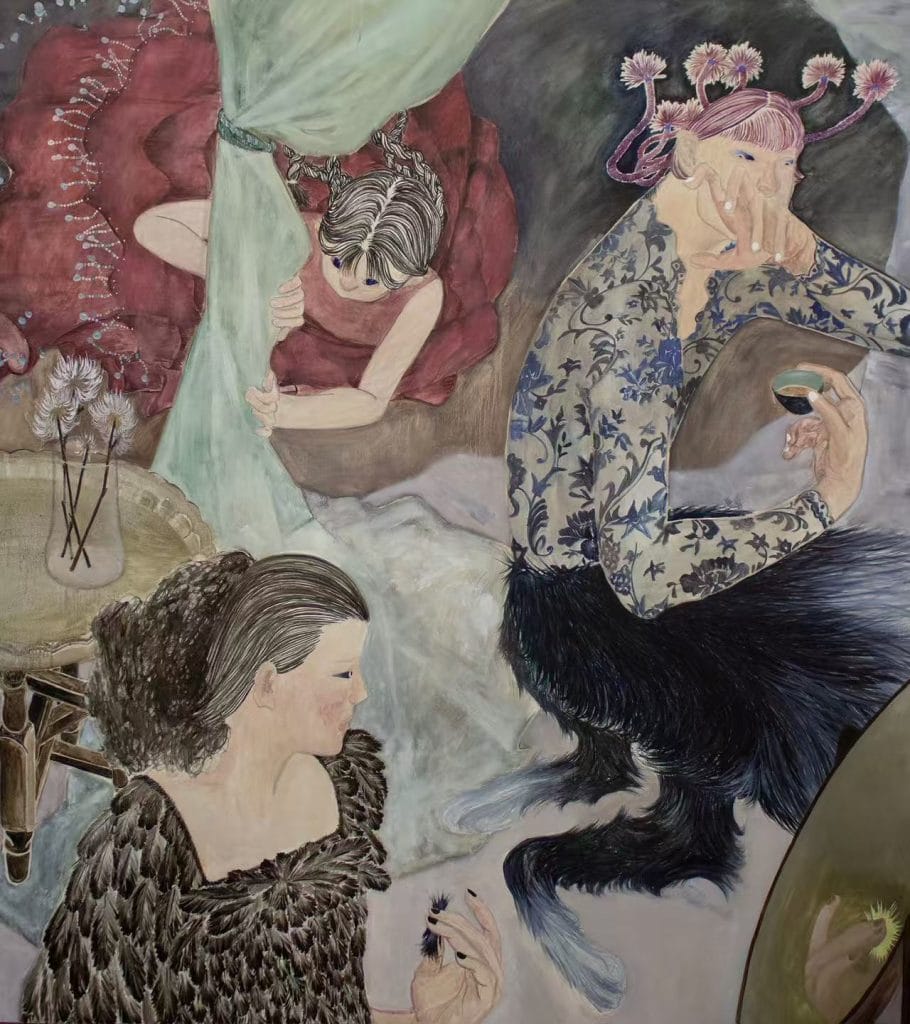
Ding Shilun, The Adoption of the Maiden, (2021). Courtesy of the artist.
Ding grew up in a family with a strong artistic background, but his formal training began in art school. He studied oil painting at the Guangzhou Academy of Fine Arts, where his early interests focused on historical subjects. At the time, “major historical painting” was more likely to receive institutional support and was considered a legitimate path, in line with long-standing traditions in Guangdong province.
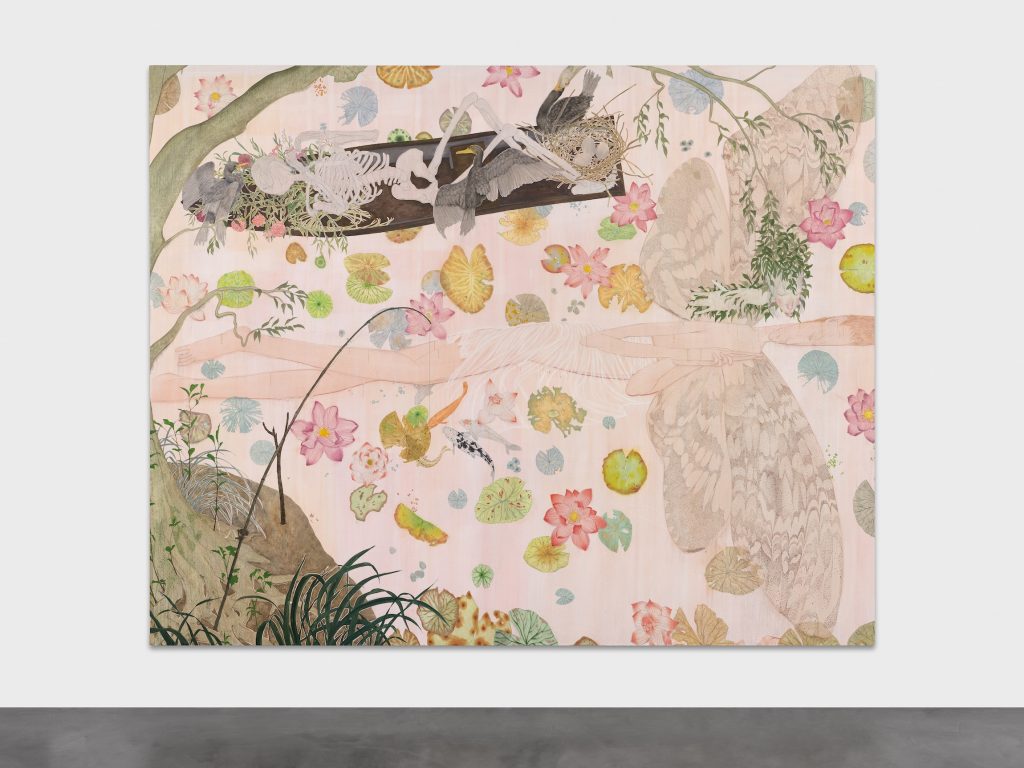
Ding Shilun, By the pond (2026). Courtesy the artist and Bernheim Gallery. Photo: Annik Wetter.
London Roots
But, Ding said, “I was never that interested in this kind of mainstream historical narrative.” It is often very heroic. I wanted to look for the parts that are not told in that way.” This led him toward more open image-based experiments.
A six-month exchange at Slade School of Fine Art brought him to the U.K., marking an important shift. He realized that his earlier figurative language depended on a specific cultural context. Once removed from it, he began asking: “How do I explain myself? How do I translate effectively?” This pushed him to rethink painting as a medium.
He later continued his studies at the Royal College of Art. During the pandemic, working on small, quick pieces in his own room laid the foundation for his later practice. When he returned to a proper-sized studio and resumed large-scale paintings, his work changed significantly, with more figures appearing in more complex narratives.
“When I started working within a stronger narrative framework, I had to face one question: narrative itself is a form of power. How should I deal with that power?” Ding said. He does not want to directly explain his work. “Most of the time, I try to find an entry point into a story or a piece of history, then understand its structure and how it connects to me.”
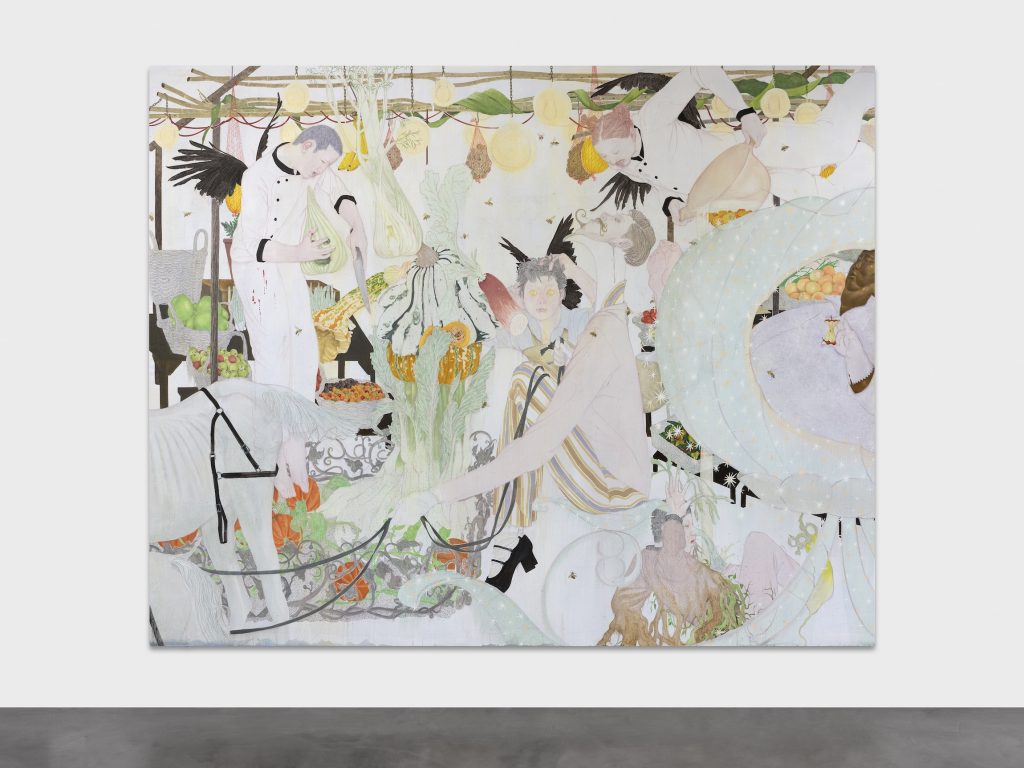
Ding Shilun. September (Harvest Moon) (2026). Courtesy the artist and Bernheim Gallery. Photo: Annik Wetter.
Ghosts and Monsters
He gradually turned to the tradition of Chinese zhiguai stories. These seemingly absurd tales of ghosts and monsters often reflect reality indirectly and reveal ways of understanding power and society. Ding became deeply interested in this approach.
What interests him is not history itself, but how it is misread, retold, and translated, and the distortions that follow. “When people face the unknown, it starts with not knowing, and then becomes fear, anger, or even hatred,” he said. “What I want to explore is the moment before fear and after hatred—what actually happens there?”
In his work, the recurring “ghost” figure represents this process of mistranslation. “It is like a wrongly translated term,” he said. “Something that needs to be understood again.” His idea of zhiguai is not about depicting traditional supernatural figures, but about showing how something becomes distorted and dehumanized through misunderstanding.
Ding has described his paintings as “sugar-coated bullets.” From a distance, they appear light and sweet, but up close they reveal something more unsettling. “Sweetness works like a filter,” he said. “It hides violence and discomfort. But I hope viewers can see what is behind it when they come closer.”
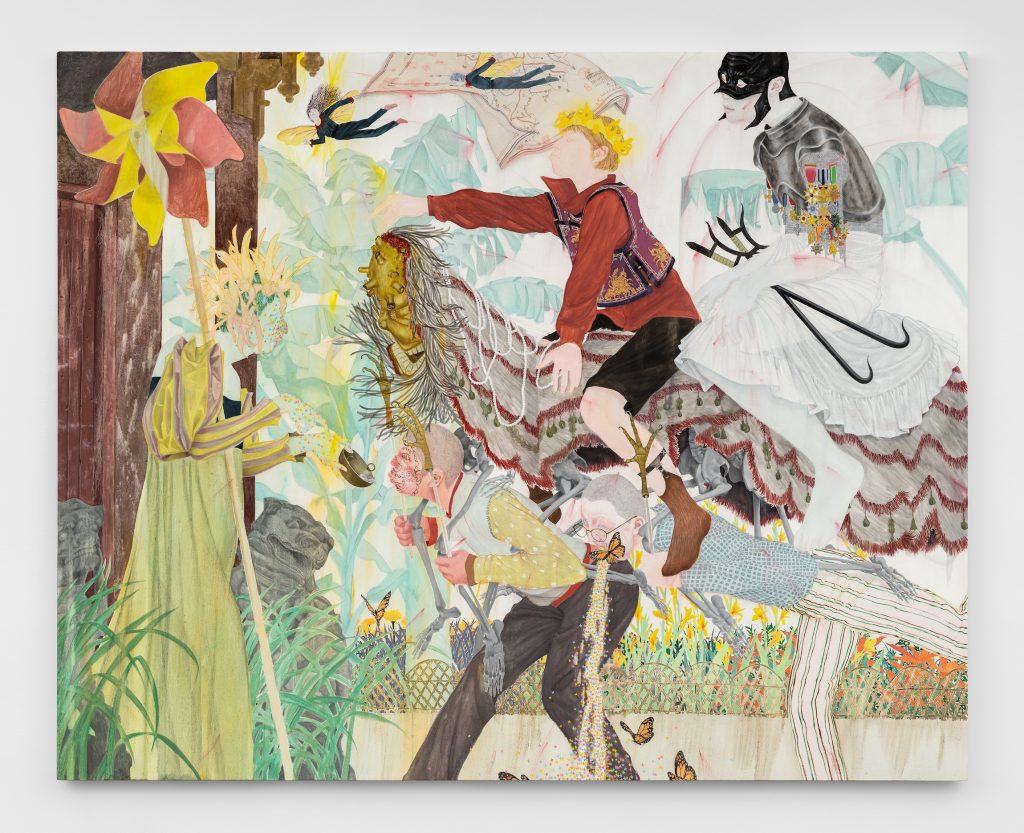
Ding Shilun, The Unbidden (2025). Courtesy of the artist and Hauser & Wirth. Photo: Deniz Guzel.
Audience responses reflect this tension. In Miami at his solo show at the Institute of Contemporary Art (December 3, 2024 to April 27, 2025), some viewers described his work as having a hell-like quality. In Guangzhou, his hometown, others saw it as something that could ward off evil. For Ding, these different readings are a critical aspect of his work.
His visual language draws on multiple sources: the precision of the Lingnan gongbi school, the expressiveness of Japanese manga, and the rhythm of humor in stand-up and sitcoms that he’s obsessed with. “Humor is very difficult,” he said. “But that is also what makes painting interesting—it can use simple materials to talk about complex things.”
Ding describes his work as a “personal fable,” a psychological concept referring to the amplification of personal experience. For him, it is a form of individual storytelling. “I am not interested in universal values,” he said. “I care more about emotions that are only true for myself. I take small feelings and turn everyday experience into something like a strange tale.”
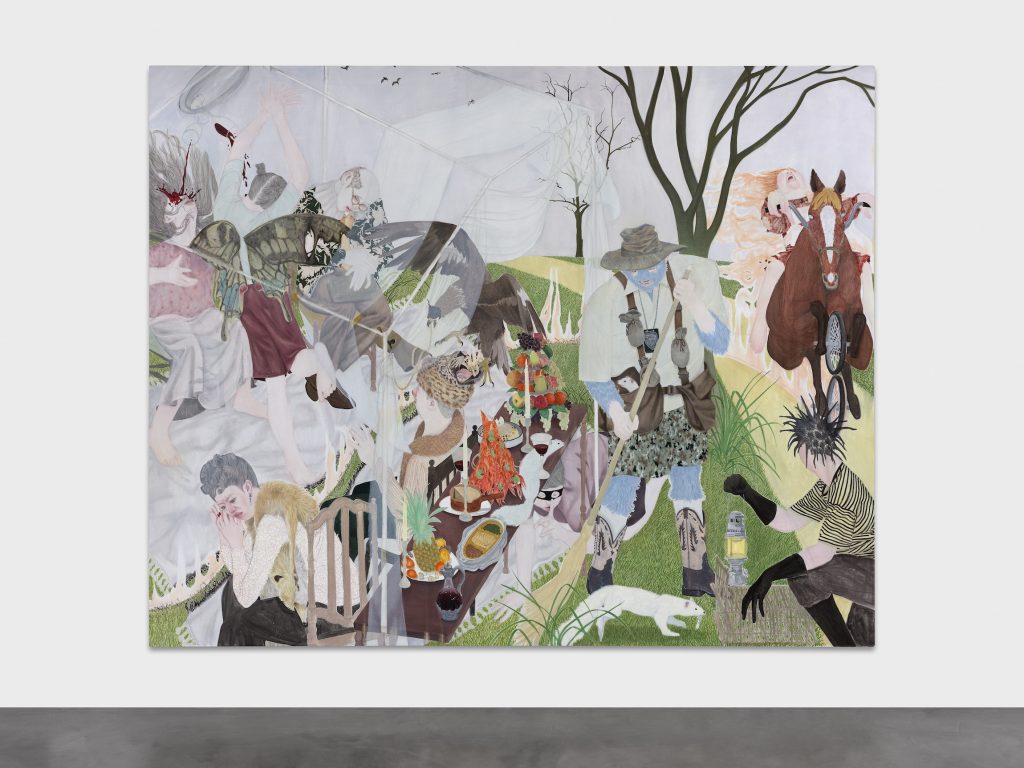
Ding Shilun, Stolen (2025). Courtesy the artist and Bernheim Gallery. Photo: Annik Wetter.
When discussing his market, Ding takes a cautious view. He admits that the anxiety it creates may outweigh its benefits. He recalled that one of his earliest works to enter auction, The Adoption of the Maiden, was sold before he began working with his current gallery. The title was translated as “adopted girl,” which he found uncomfortable.
In Chinese, the title, “‘Tuogu (托孤),’ refers to entrusting a child to someone before death. It carries a strong sense of responsibility,” he said. “But once translated as ‘adoption,’ the meaning changes completely.” This made him realize that once a work enters the secondary market, it is outside of the artist’s control. “The only thing I can do is stay calm and keep working.”
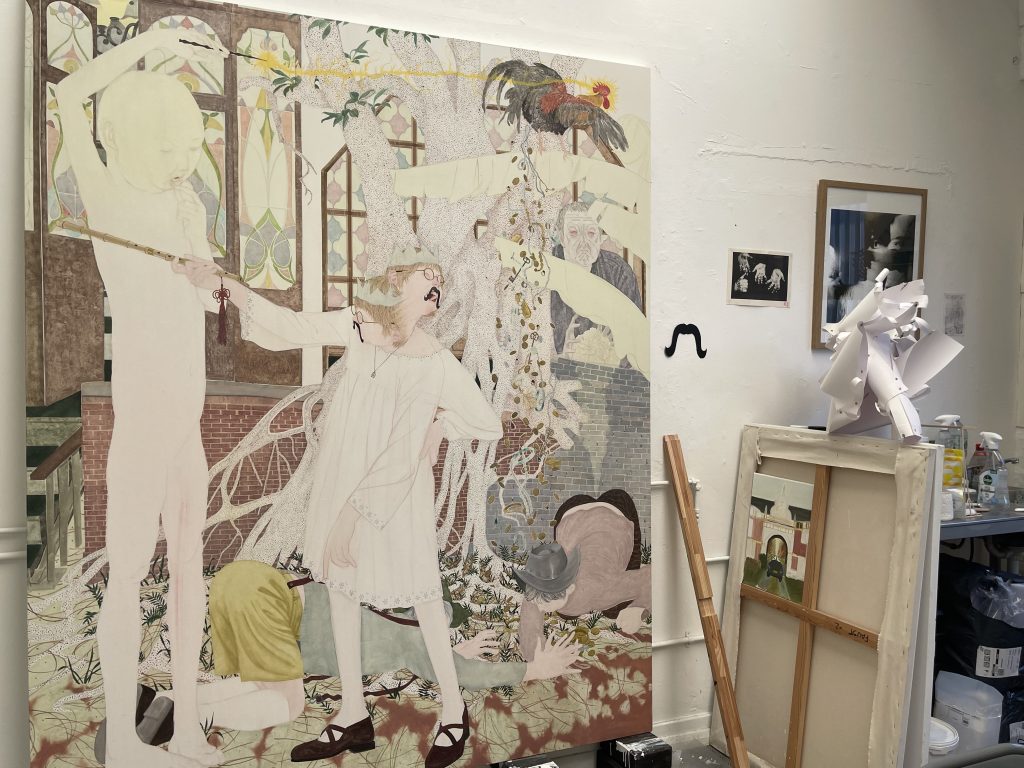
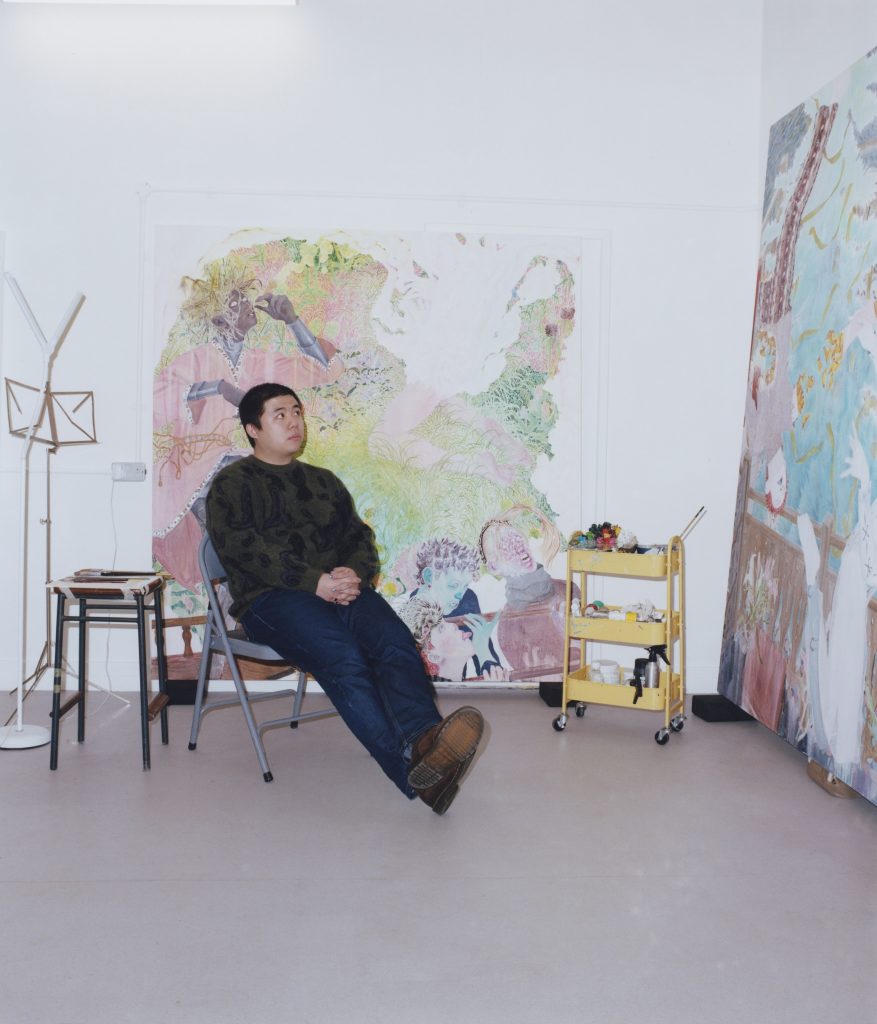
Ding Shilun’s studio in London. Courtesy of the artist
What’s next? Ding will present his first comprehensive presentation in China, a solo show at Song Art Museum in Beijing from May 20 to June 28. He also plans to expand into other media, including comics and stop-motion or handmade animation. At the studio, he showed me small paper models he has made, including an elephant-form paper hat. Originally used as props or prototypes in his paintings, they may develop into independent works. “In the age of A.I., I still insist on hand-making,” he said. “The contact between material and the body is unreplaceable.”
Related Articles
-