Art History
Lost Cecil Beaton and Lee Miller Photos Turn Up in Old Scrapbook
Compiled by the photographers' assistant, the book has been acquired by the Bodleian Library at the University of Oxford.

Compiled by the photographers' assistant, the book has been acquired by the Bodleian Library at the University of Oxford.
Vittoria Benzine
 ShareShare This Article
British photographer Cecil Beaton and his American peer Lee Miller first crossed paths when Beaton photographed Miller in Condé Nast’s apartment in 1928. Over a decade later, they were both working as World War II correspondents for British Vogue and sharing the same assistant—Roland Haupt. Now, six decades after Haupt’s death, his family has sold a previously unknown scrapbook featuring more than 150 unseen Beaton and Miller photographs.
The University of Oxford’s Bodleian Library now owns the artifact. “It’s a very personal album with personal choices,” London-based photography dealer Michael Hoppen, who facilitated the sale, told me over email. “Many images would not have been published at the time despite [Miller’s] desire to see them shown.”
Haupt assembled this book between 1943 and 1949. That’s four years after Beaton started his war reportage, and three years after Miller joined the staff at British Vogue, though she only became an accredited war correspondent in 1942. Both photographers delivered their undeveloped film to Haupt for processing before he sent the shots to their editors, Hoppen learned from Haupt’s descendants.
“This is the story of my favorite photographer Lee Miller,” Haupt wrote at the very beginning of his memento, outlining Miller’s journey following the American army from Normandy to Berlin alongside at the end of the war, since British troops wouldn’t let women cover them. Miller famously faced house arrest for photographing the battle of Saint-Malo during this stint, even though women correspondents were still barred from combat. “Here are a few of the beautiful pictures she sent back,” Haupt’s inscription concluded.
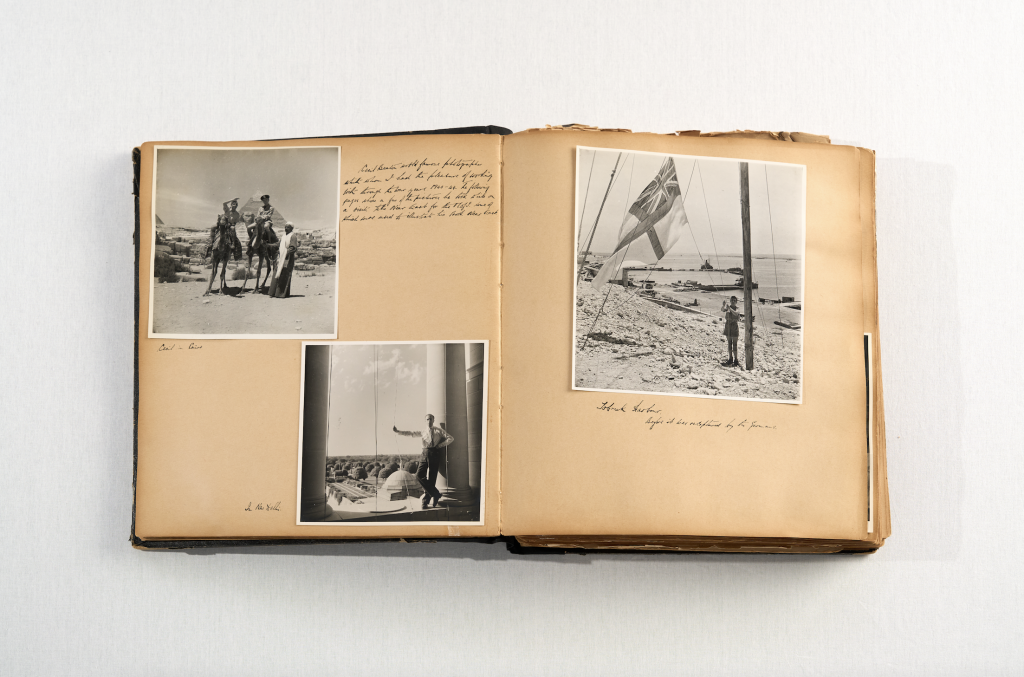
Beaton’s photos from abroad. Photo courtesy of the Bodleian Library.
Miller applied the Surrealist eye she’d honed alongside lovers like Man Ray and Roland Penrose to her war photography, transforming journalism into a bona fide art. In his scrapbook, Haupt pits Miller’s photos of corpses with her snaps featuring lazing models—drawing haunting comparisons between the two while also highlighting how Miller treated both subjects with equal elegance.
An unpublished, lesser-seen iteration of LIFE magazine correspondent David Scherman‘s iconic shot of Miller bathing in Adolf Hitler’s Munich tub stands out amongst these crowded pages honoring her and Beaton. Like the image’s more famous counterpart, this b-side shot depicts Miller’s boots, dirty from their harrowing visit to Dachau that day, stationed before the tub. Here, however, Miller’s body language looks less seductive, more troubled. Inhabiting Hitler’s house made him seem “less fabulous and therefore more terrible,” she said.
Like Miller, Beaton started off photographing WWII’s impact on London, particularly the 1940 Blitz. The role started taking Beaton abroad, though, in 1942—first to Egypt, Iraq, and Syria, then to India, Burma, and China. Many of the shots in Haupt’s book hail from Beaton’s forays in North Africa, documenting “the detritus of war in the dry endless desert landscape,” as Hoppen put it. Portraits by Beaton, Lee, and Haupt all abound in the book’s back half—punctuated by “theater sets and newspaper cuttings” throughout.
Once Haupt’s descendants brought the book to Hoppen, he emphasized the importance of keeping its pages together—which is how it will remain in the Bodleian Library’s very astute care.