Opinion
How Wifredo Lam Made Surrealism More Surreal Than the Surrealists
A close look at 'The Jungle' and the Exquisite Corpse.
by
Ben Davis
 Share This Article
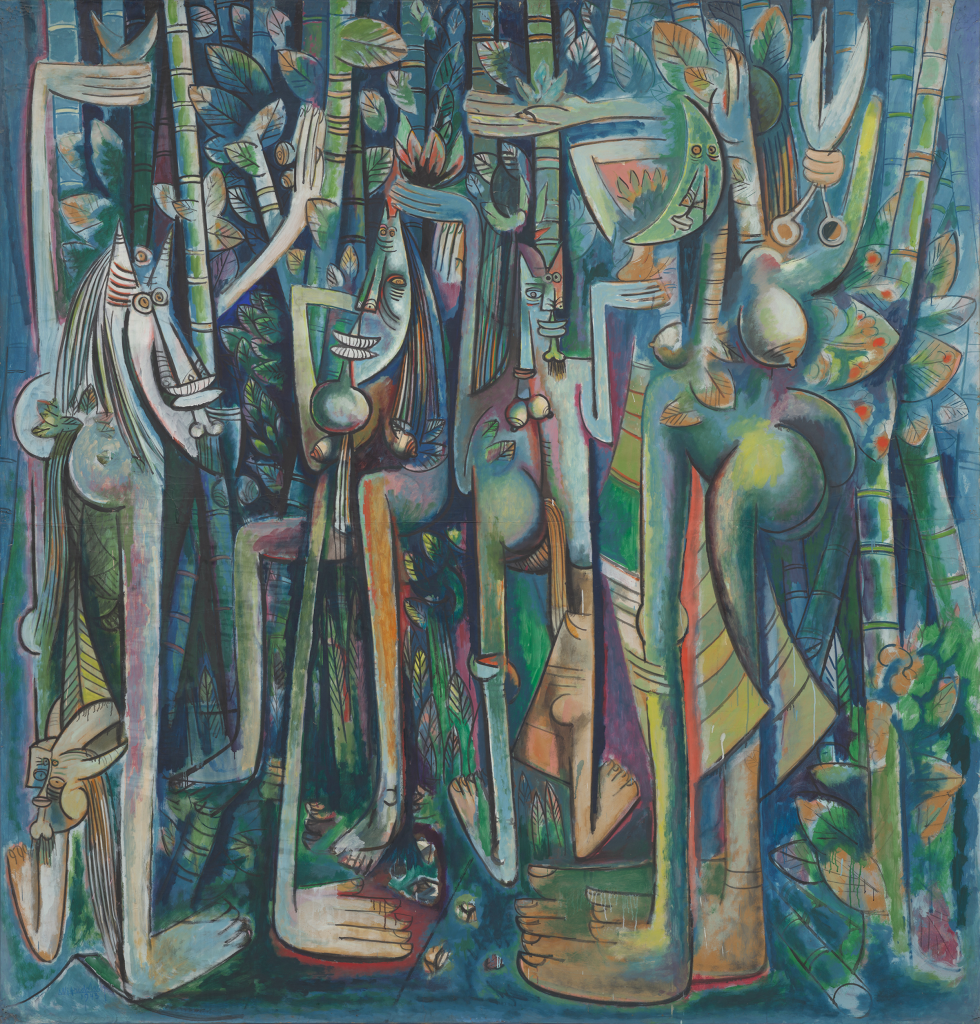
An exhibition of Wifredo Lam is about as safe a bet as the Museum of Modern Art can place and still plausibly say that it’s a bet on expanding the canon. The Cuban artist is one of the most famous painters of the 20th century, featured in almost every single key show about Surrealism. MoMA acquired his famous painting The Jungle in 1946, a few years after he made it. There it stands, about halfway through “Wifredo Lam: When I Don’t Sleep, I Dream,” a mythic work in its time and ours, the artist’s immediately recognizable calling card, but also an enduring, still-to-be-processed enigma.
Plenty of good essays have been written about this show, so I’ll just put down a few things that it made me think, specifically about Wifredo Lam’s relationship to art history and his significance now.
Culture Clash
If there’s one issue that hovers in the background of the exhibition, it’s how to fit together two facts of Lam’s biography: his intense engagement with Europe’s interwar Modernist avant-gardes versus his view of his art as a self-conscious project of cultural decolonization, throwing off imposed European cultural values.
There is a long tradition of celebrating Lam as “Cuba’s Picasso.” He was personally close with Picasso, and many elements of The Jungle (1942–43) read as a head-on confrontation with Les Demoiselles d’Avignon (1907), Picasso’s own first swaggering statement piece as a Modernist dynamo. But viewing Lam through this lens risks relegating his practice to an exercise in “applied Cubism,” as if he were merely taking developments from across the sea and finding Caribbean uses for them.
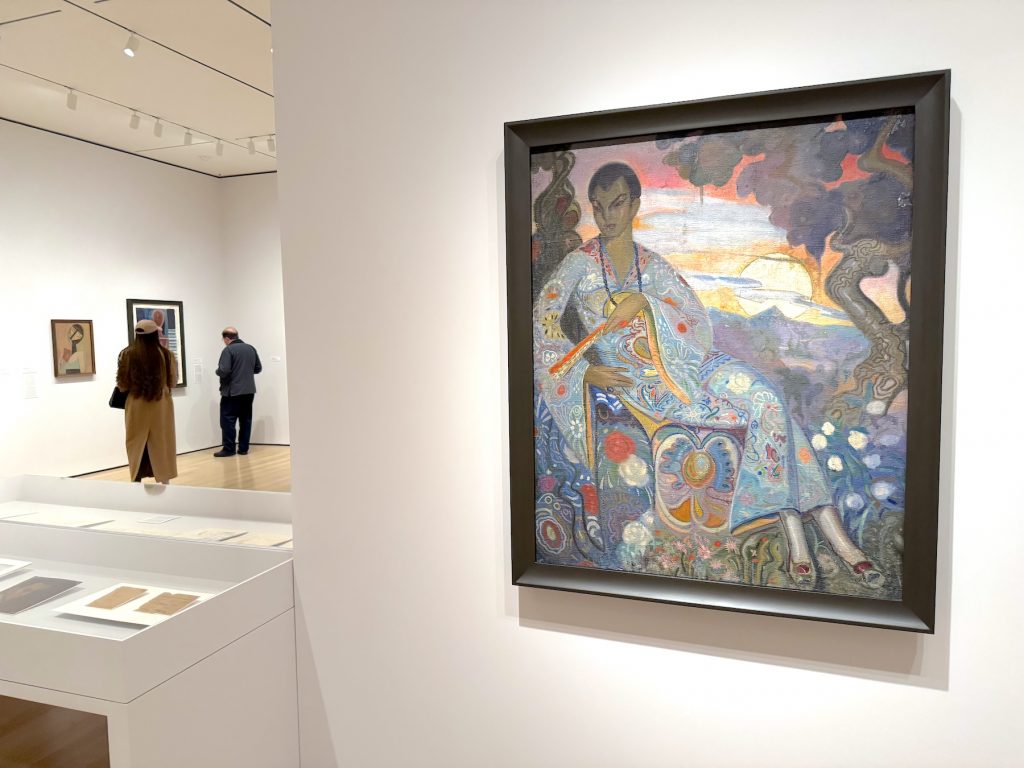
Wifredo Lam, Sol / Son (1925), a possible self-portrait, on view at MoMA. Photo by Ben Davis.
In a contemporary art world where “decolonial” is a buzzword, the tendency runs mainly in the other direction, emphasizing the absolute alterity of Lam’s themes, his art’s “Afro-Cuban-ness” as its main defining feature. His canvasses teem with creatures that you can link to various orisha spirits of Santería, the folk religion that descendants of enslaved Africans innovated in Cuba.
And yet, there’s a danger in this language of representation, too. Despite early exposure via a grandmother who was a priestess of Santería, Lam was never a practitioner himself; he was more of a sympathetic observer. Above all, Lam’s works are very proudly individual in their vision. He rarely paints anything that is a clear-cut reference. “I don’t use symbolism,” he once said. “I never invent my paintings in relation to symbolic tradition, but always from a poetic stimulus.”
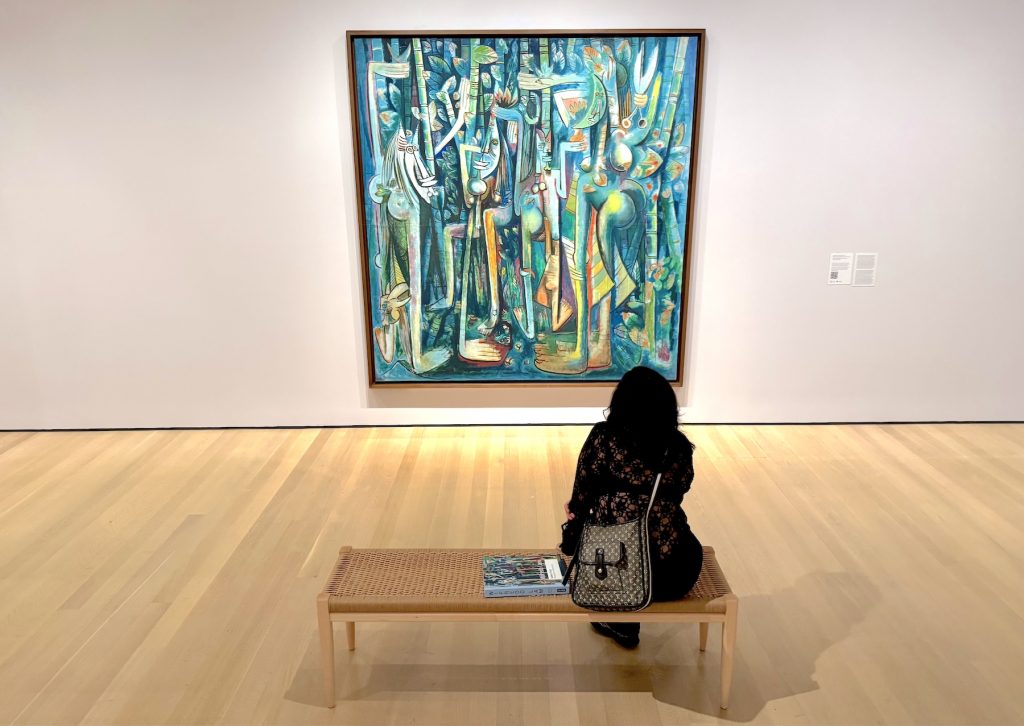
Wifredo Lam, La jungla (The Jungle) (1942-43) in “Wifredo Lam: When I Don’t Sleep, I Dream” at the Museum of Modern Art. Photo by Ben Davis.
Lam saw himself as walking a tightrope when it came to audience expectations. “I knew I was running the risk of not being understood by the man in the street or the others,” he would tell Max-Pol Fouchet in 1976. As intuitively enchanting as his work looks, that’s still the case today.
To Europe and Back
Lam was near 40 when he made his big artistic breakthrough with The Jungle, and he had already seen a lot of life. He was born in the town of Sagua la Grande on the north coast of Cuba, in 1902, the year of the island’s formal independence from Spain, to a mother of African and Spanish heritage and a much-older Chinese immigrant father. He went to art school at the Academia Nacional de Bellas Artes San Alejandro in Havana, earning a grant to study in Europe for a needy and promising “student of color.”
Lam spent most of his twenties and thirties in Spain. He absorbed painting in the Prado (Goya, El Greco, Bosch) and picked up intimations of the new Modern art (he spoke of Cézanne as an influence). He married a Spanish woman, Eva Piriz, and had a son, only to lose both to tuberculosis. He became a Marxist as the Civil War came on and joined the anti-fascist side, and then in 1938 fled for Paris, where he shortly befriended Picasso and then the Surrealists.
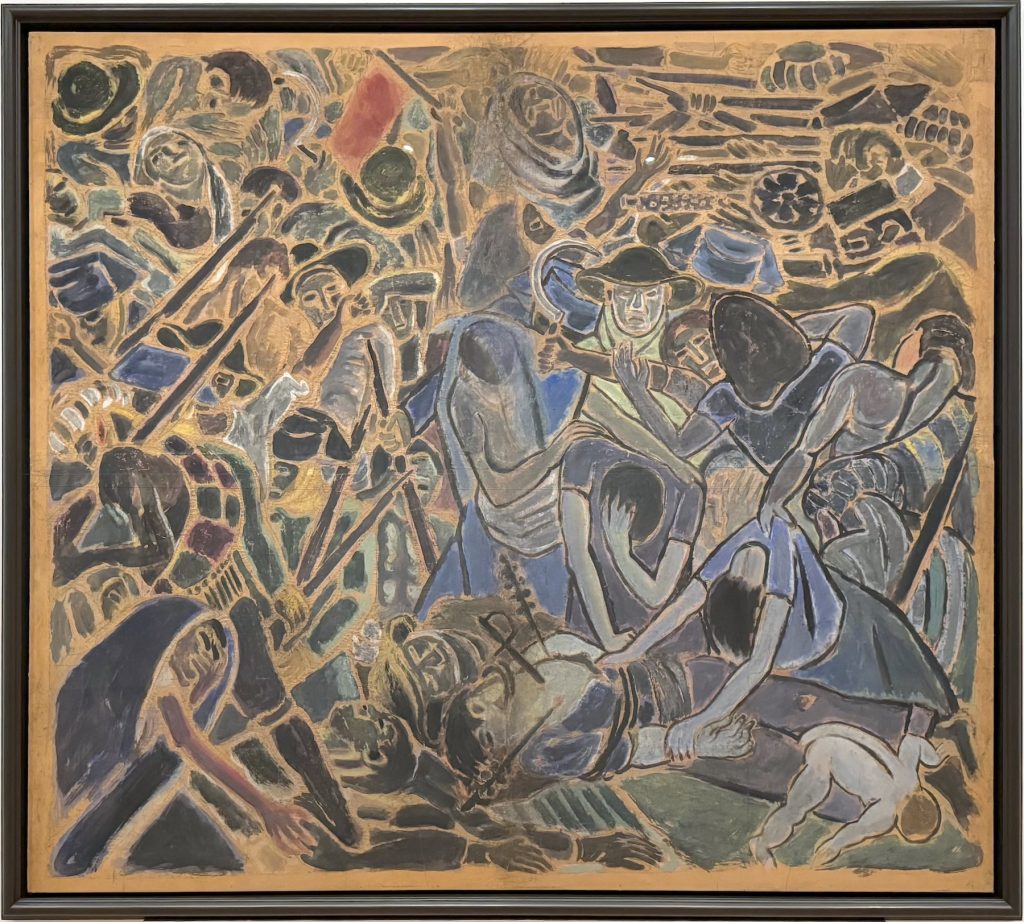
Wifredo Lam, La Guerra Civil / The Spanish Civil War (1937) at MoMA. Photo by Ben Davis.
World War II loomed. Lam was among a group of refugees who escaped south to Marseilles as Paris was invaded, eventually leaving the collapsing Old World aboard a refugee boat, the Capitaine Paul Lemerle. That ship’s passengers included the “Pope of Surrealism,” André Breton; the future father of structural anthropology, Claude Levi-Strauss; and the exiled Russian revolutionary Victor Serge (a cast of personalities so symbolic of what shaped culture in the 20th century that it is the subject of a least one novel and one musical).
After arriving in Vichy-controlled Martinique, Lam and Breton crossed paths with Aimé Césaire, the radical poet who was in the midst of launching the Négritude movement of proto-Black nationalism. Lam and Césaire would become lasting comrades, the painter lending his art to the Spanish edition of Césaire’s 1939 poem-manifesto, Notebook of a Return to the Native Land. (Lam’s second wife, Helena Holzer, did the translation.)
After weeks in a new limbo in Martinique, the refugees were eventually dispersed. Lam would have preferred to go on to New York, like Breton, or to Mexico, like Victor Serge, but the bureaucracy was impossible. So instead he went to the Dominican Republic, and then back to Cuba.
Return to the Native Land
Eighteen years before, he had left the island of his birth dreaming of escaping the colonial world of semi-dependency and stagnation. Now he was back. “I had no great horizons before me,” Lam would recall to Fouchet. “If you want to know my first impression when I returned to Havana, it was one of terrible sadness.”
Yet it was only now that he created The Jungle, with its dense vegetal world peopled by gawky, staring figures who are equal parts animal, beast, plant, and African sculpture. Seeing it at MoMA makes me understand, in a way that the Picasso connection had perhaps obscured for me before, the effects of his intense recent communion with the Surrealists.
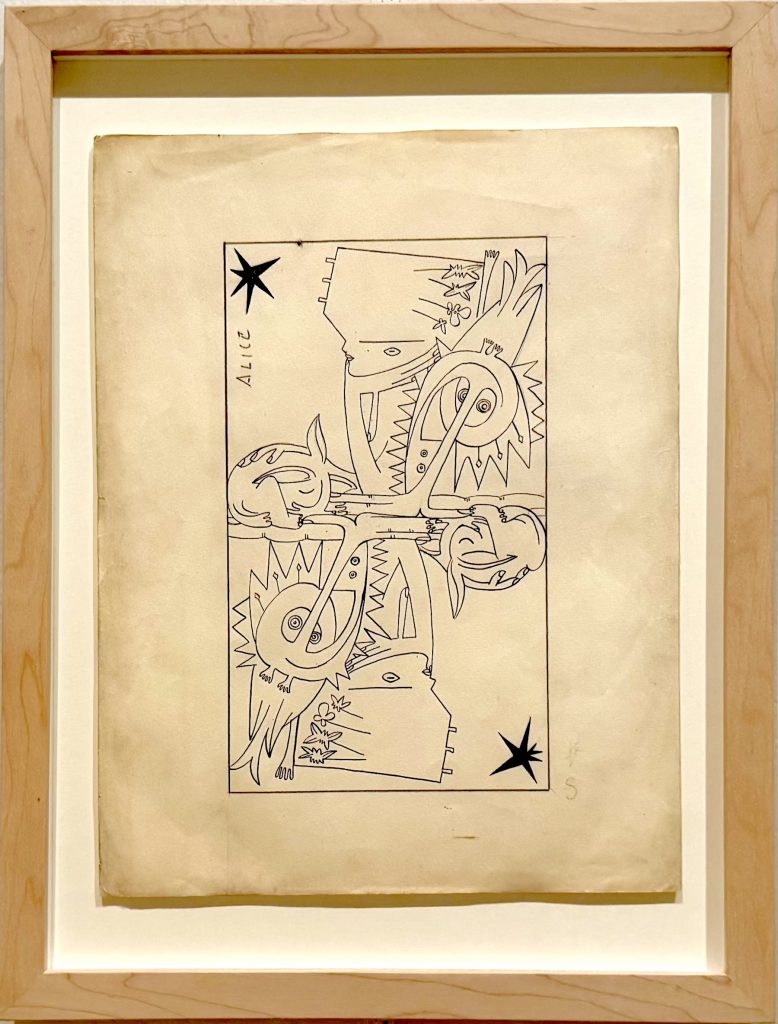
The design Wifredo Lam created for the Queen, an homage to Alice from Alice in Wonderland, for the Jeu de Marsailles. Photo by Ben Davis.
Holed up for months together in Marseilles at the Villa Air Bel in 1940, Lam, Breton, and the other artist-refugees killed time with, and found hope in, creative experiment. Lam did illustrations for Breton’s poem Fata Morgana, marking the start of a more fantastical turn in his art. As a group, they co-created a Surrealist deck of playing cards, the “Jeu do Marseilles;” the suits were Locks for knowledge, Wheels for revolution, Stars for dreams, and Flames for desire.
And the group played exquisite corpse, the Surrealist-invented parlor game for which, per Breton’s description, “several people compose a phrase or drawing together, folding the paper so that no one can see the previous collaboration or collaborations.” MoMA presents several of these collectively authored trifles.
Viewing them, you get the sense that the mysterious figures that populate The Jungle owe as much to these passed-paper games as they do to the faceted female forms of Picasso’s Les Demoiselles. (As it happens, because of a lack of art supplies when he got to Cuba, Lam painted The Jungle on a big piece of paper, rather than on a canvas.) As in the exquisite corpse, just how all the parts of the composition’s creatures connect, or even what they are, shape-shifts up and down the canvas, as if Lam started a form with one thought but finished with another, even as a sense of an overall structure bubbles up nevertheless.
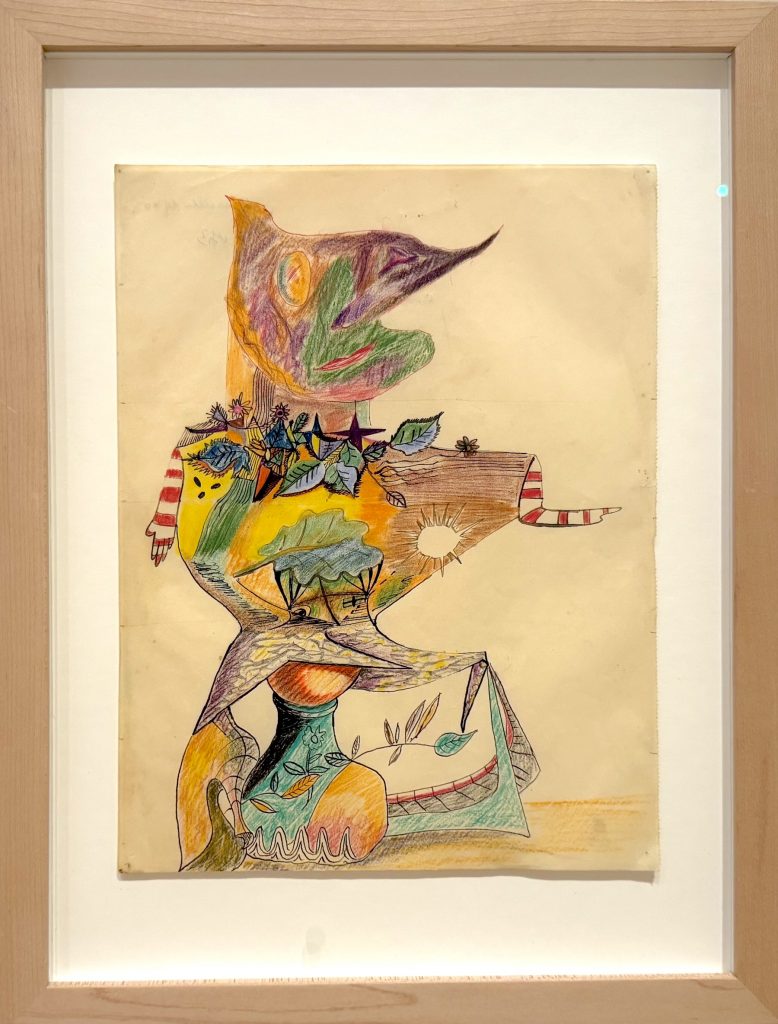
A collective drawing by Victor Brauner, André Breton, Oscar Dominguez, Jacques Hérold, Wifredo Lam, and Jacqueline Lamba, made ca. 1940-41. Photo by Ben Davis.
At the same time, in The Jungle, Lam incorporates the Caribbean world more directly and intentionally than he ever had before. As the MoMA show illustrates, up until 1940, Lam hadn’t found a style, adopting and adapting bits of Picasso and Matisse. But in the exact same moment that he perfected his own personal form of Surrealist automatism, he also discovered the social inspiration for his art that would make him one of the great artists of the Black Atlantic. The two apparent threads connect, naturally but unexpectedly, like an exquisite corpse.
Surrealism’s Greatest Influence
In the recent 100th-anniversary initiatives tied to Breton’s 1924 First Surrealist Manifesto, there has been an emphasis on how Surrealism, of all Europe’s storied Modernist art insurgencies, had a uniquely international resonance, from Egypt to Japan to Mexico. Why was it so adaptable?
The Surrealism of Breton and comrades was born out of the disgust and horror of the First World War and the European haute-bourgeois culture that had cheered it on. Fired by militant disillusion, the Surrealists exalted everything they viewed as opposite to the French rationalism they knew: dreams, and fantasies, and magical thinking; non-Western cultures of all kinds (sometimes in a forward-looking way, sometimes in a fetishistic way, often in a mix of the two); and—particularly after the Second Surrealist Manifesto, of 1929—Marxist politics. (Some, like poet Louis Aragon, went Stalinist; Breton couldn’t abide socialist realism, and eventually journeyed to Mexico and wrote a manifesto about the revolutionary imagination with Leon Trotsky.)
Well, disgust with European culture was something that many non-Europeans, particularly those who had lived under Europe’s domination, could identify with. Aimé and Suzanne Césaire, for instance, were among a cadre of Black intellectuals who discovered Surrealism while studying in Paris in the 1930s. In Surrealism’s extravagant rhetoric blasting French culture, they found a “weapon” to use in rejecting the demands of their own middle-class mothers and fathers back on the island, who wanted their children to assimilate European ways so they could serve the colonial center as administrators. Now, African heritage was not backwardness but the very mark of avant-garde seriousness.
Surrealism was hardly the only influence on Négritude—they also looked, among other things, to the Harlem Renaissance—but it was an influence, and enough of one that Négritude may be the most historically consequential aspect of the Surrealist project, or at least the one where the political claims made for it connected most with reality.
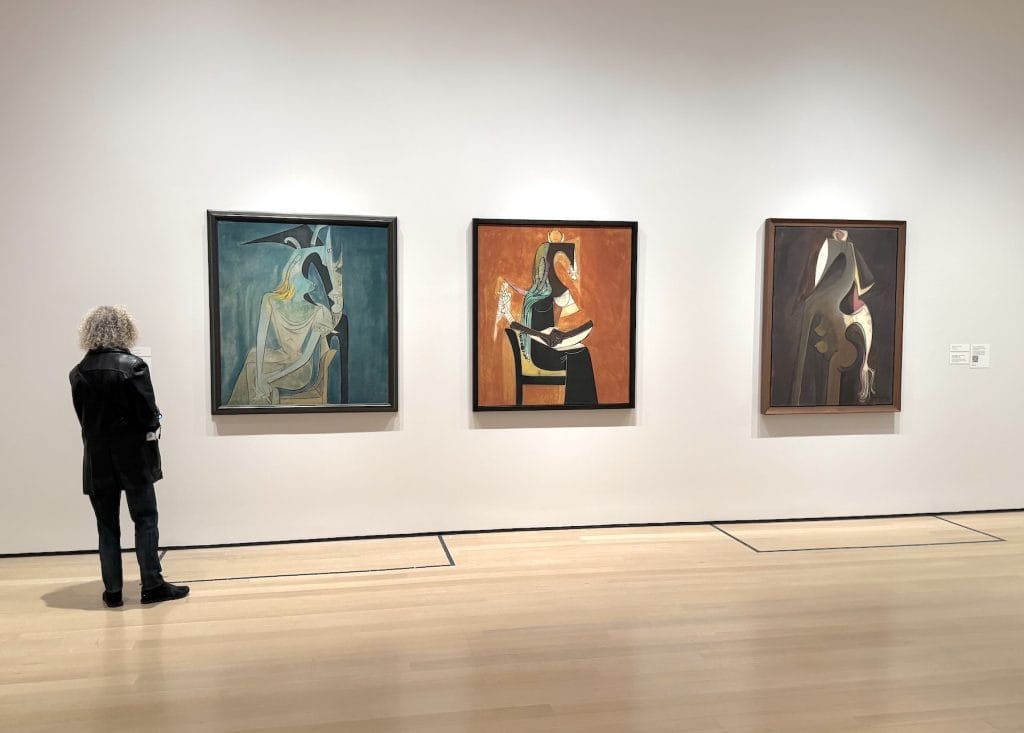
Three works by Wifredo Lam in “Wifredo Lam: When I Don’t Sleep, I Dream” at MoMA. Photo by Ben Davis.
Lam, of course, met the Cesaires, and was having his own version of this intellectual journey in this catalytic late-’30s/early-’40s moment, as the nightmare of war once again consumed Europe.
The topic is too complex to go into here—and, frankly, Lam’s thinking remains a bit mysterious to me—but it’s worth noting that he was a strongly independent thinker, and had differences from Césaire as well as agreements. Lam’s Marxism remained such that he would emphasize, in opposition to Négritude, that “the real issue of history is not about race, but about class struggle.” At the same time, he would later collaborate with another Caribbean poet-intellectual, Édouard Glissant, who argued that Négritude’s romance with an original African culture downplayed what was most vital about Caribbean life: its mixing of cultures. That line of thought surely congenial to Lam, given his own Chinese and Afro-Cuban heritage.
Exquisite Life
Asked about Surrealism in a famous late-in-life interview for a Cuban magazine, Lam admitted its influence but denied its precedence. “Surrealism gave me an opening, but I haven’t painted in a surrealist manner…,” he said. “Here in Cuba there were things that were pure Surrealism [surrealismo puro]. One example would be Afro-Cuban religious beliefs [Santería].”
Why, for Lam, was Santería “surrealismo puro“—seemingly, for him, a culture more surreal than the Surrealists? Santería, of course, involved ritual and magic of the exact kind the Surrealists looked to for inspiration. But I think it’s more than that.
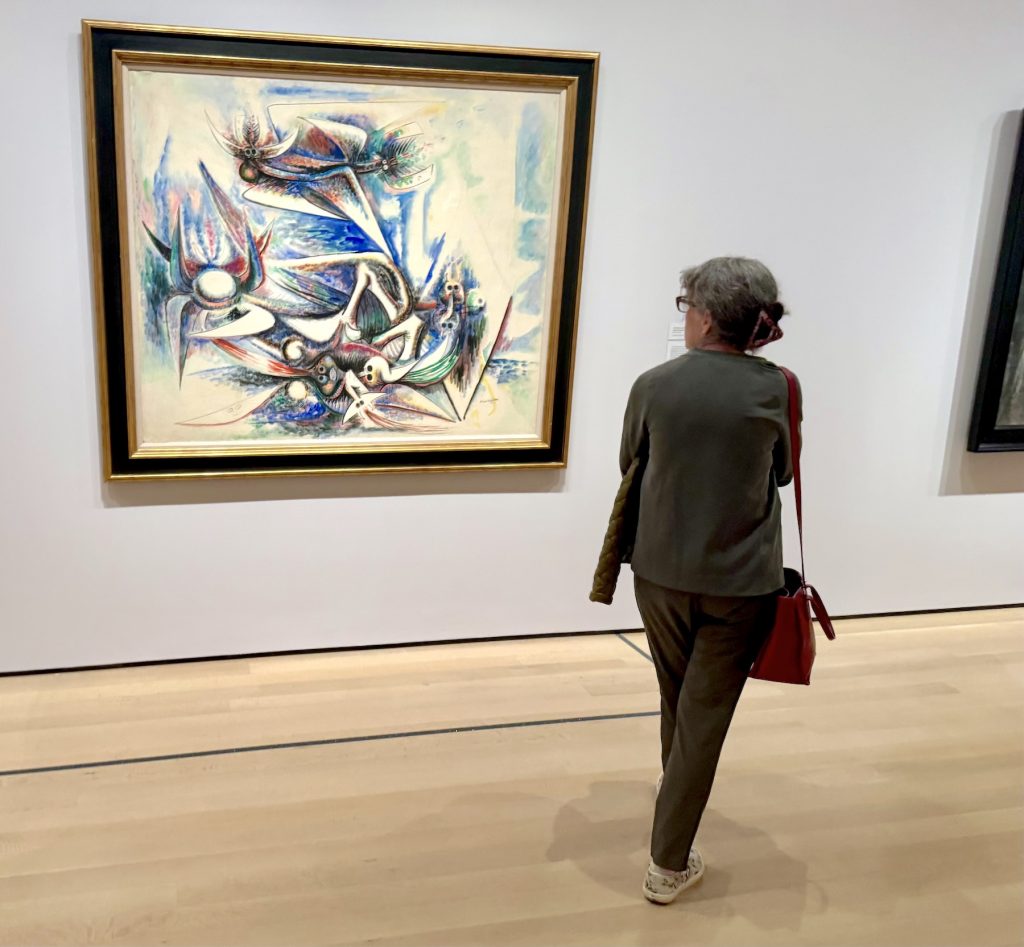
Wifredo Lam, Chant of Osmosis (1945) at MoMA. Photo by Ben Davis.
Lam had found the Surrealist experiments with collective creation personally generative. The unexpected, half-legible hybrid creatures and spiritual entities that foam up in his great canvasses seem to emerge from some form of automatism.
But I think that the basic idea governing that game had a certain intuitive symbolism. Lam had lived a life in-between: between the Afro-Cuban and Sino-Cuban communities as a young man, a minority among minorities, then between the Caribbean and Europe and back again (and then back again: he fled or Europe once more after the Batista coup in ’52). Here was a game that made poetry from the play of unexpected differences, from the interplay of multiple and diverse consciousnesses; it found creativity in their clash but also a sense of a new exciting energy welling up, to be discovered and tapped.
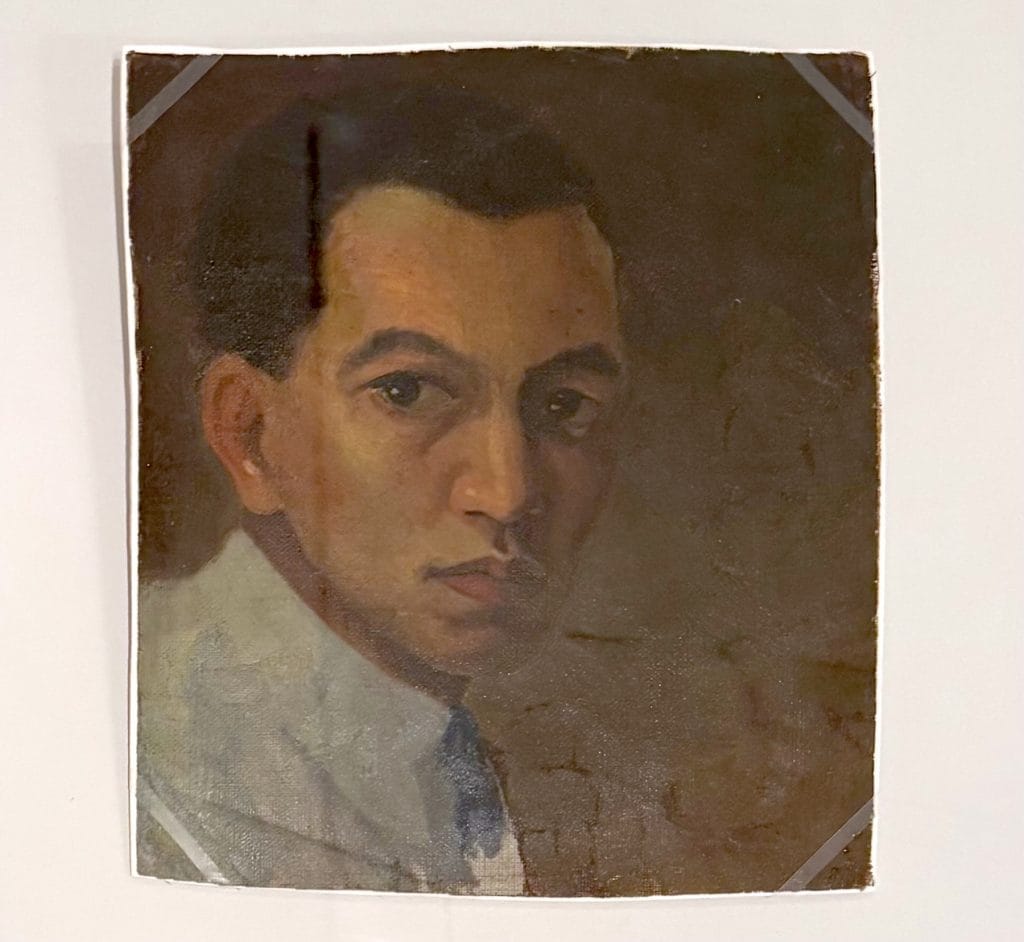
Wifredo Lam, Self-Portrait (1923). Photo by Ben Davis.
It’s this principle that Lam would find also, and even more powerfully, in the Afro-Cuban spiritual world he rediscovered back in Cuba. I think that he found “pure surrealism” in it because it was syncretic: a demotic mixing, not just of African spirituality with Roman Catholic saint worship, but also of many different African belief systems, into something vital. Lam himself mixed Cézanne and Cesaire, Surrealism and Santería. You could call this “syncretic surrealism:” the surrealist principle, not as an arty game but as culture in its largest sense; not exquisite corpse but exquisite life.
“Wifredo Lam: When I Don’t Sleep, I Dream” is on view at the Museum of Modern Art in New York through April 11, 2026.

Related Articles
-