Law & Politics
Can Trump Really Control the Smithsonian? Here’s What We Know
A recent executive order demands that “improper ideology” be removed from the Smithsonian's museums.
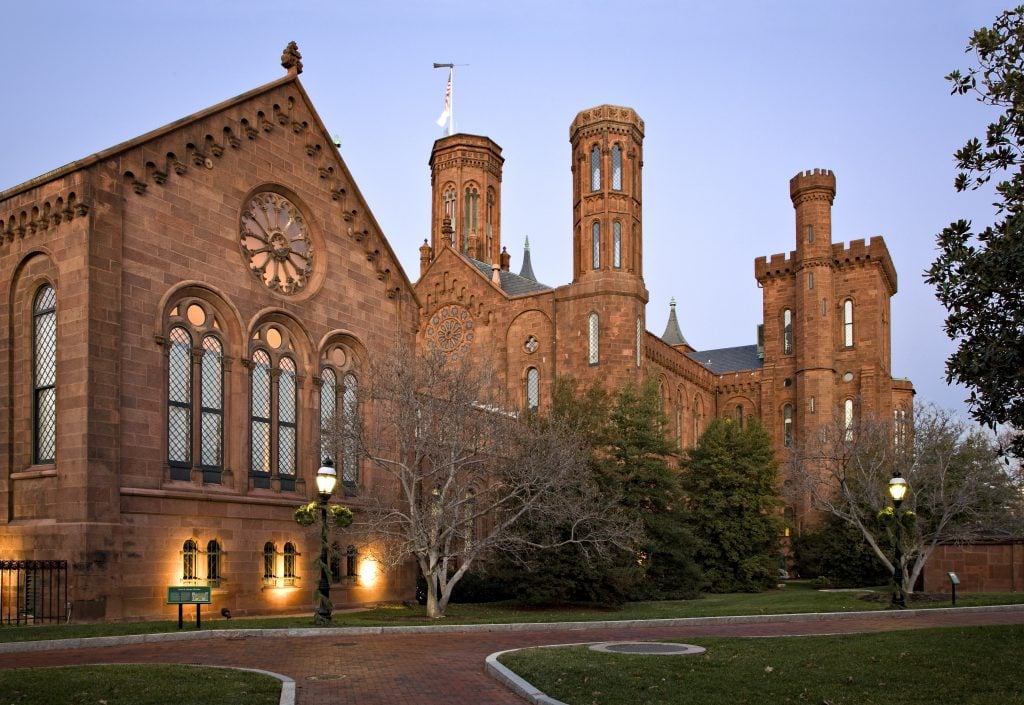
A recent executive order demands that “improper ideology” be removed from the Smithsonian's museums.
Sarah Cascone
 ShareShare This Article
• A recent executive order targets exhibitions on race and gender.
• Vice President J.D. Vance is tasked with reshaping the board of regents.
• Critics of the order argue that more than just funding could be at stake.
Last week, President Donald Trump took aim at the Smithsonian Institution, issuing an executive order titled “Restoring Truth and Sanity to American History.” It’s a radical effort to remake the nation’s museums in accordance with Trump’s vision of an America where racism and sexism are ignored, and trans people don’t exist.
The order tasks Vice President J.D. Vance with purging “improper ideology” from Smithsonian sites. Among his helpers are Secretary of the Interior Doug Burgum, and Lindsey Halligan, an insurance lawyer whose official title is “Assistant to the President for Domestic Policy and the Special Assistant to the President and Senior Associate Staff Secretary.”
“It’s totalitarian. It does remind you of a fascist state,” Raymond Arsenault, a professor of Southern history at the University of South Florida in St. Petersburg, told the Guardian.
It remains to be seen how much control the Trump Administration can truly exert over the Smithsonian, and whether he can bend its many museums to his will. But the threat of the loss of federal funding has proved a powerful tool in Trump’s arsenal in the early days of his administration.
High-profile institutions such as New York’s Columbia University have succumbed to Trump’s demands in recent weeks, offering minimal resistance despite legal protections for freedom of speech. (To keep its $400 million in federal funding, the school will restrict on-campus protests and hire campus police that can arrest students, among other changes.) Even law firms are falling in line, lest they risk losing security clearances and being banned from federal properties, including, crucially, courthouses.
The Smithsonian, while independent, is part of a public-private partnership, and stands to face even greater pressure to do as Trump says. Here’s what to know about this extensive network of federal museums and the president’s plans for it.
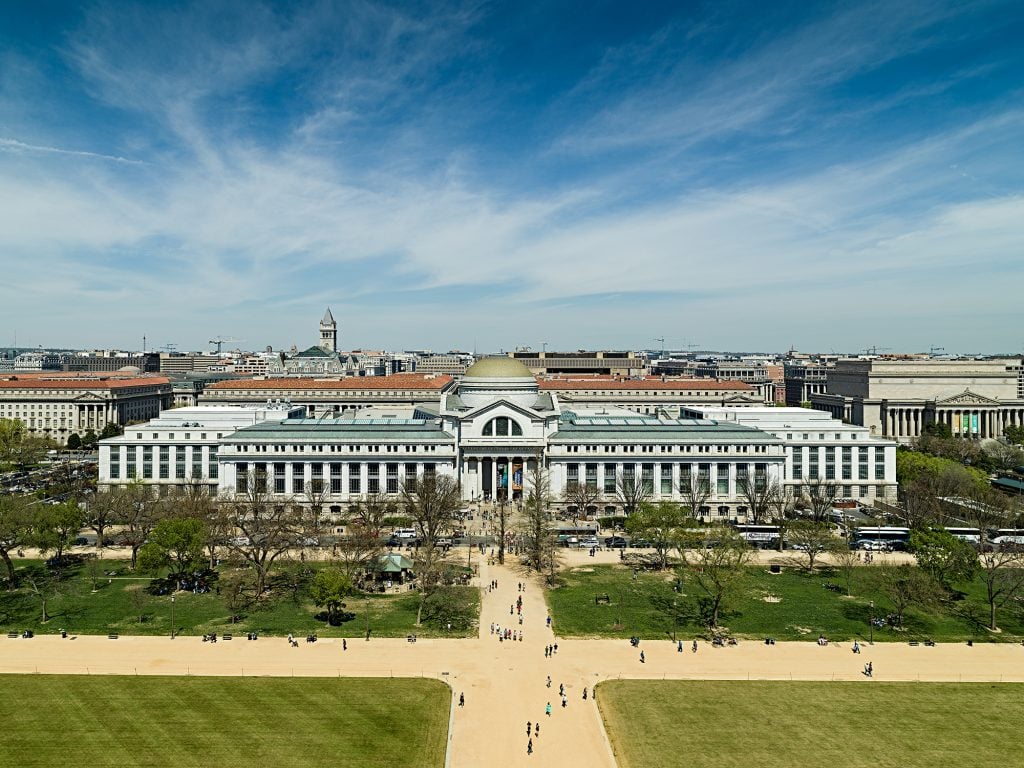
Smithsonian National Museum of Natural History. Courtesy of the Smithsonian Institution.
Don’t tell Trump, but we have an Englishman to thank for the Smithsonian: James Smithson (1765–1829), a chemist and mineralogist. He never visited the United States, but he left the entirety of his fortune to the then-young nation, stipulating his $500,000 endowment be used to create “an establishment for the increase and diffusion of knowledge among men” in Washington, D.C.
The Smithsonian has grown since its founding in 1846 to include 21 museums and the National Zoo, as well as libraries and 14 education and research centers. It describes itself as the “world’s largest museum, education, and research complex.”
Most of its institutions are located on the National Mall—although the Cooper Hewitt Smithsonian Design Museum and one of two locations of the National Museum of the American Indian are in New York—and there are several dedicated to art. There’s the Hirshhorn Museum and Sculpture Garden for contemporary art, the Renwick Gallery for craft and decorative arts, the American Art Museum, the National Portrait Gallery, the National Gallery for Asian Art, and the National Museum of African Art.
Worth noting is that D.C. also has some major national art museums that are not affiliated with the Smithsonian, including the National Gallery of Art and the National Museum for Women in the Arts.
The Smithsonian is still expanding (although plans for a London outpost in collaboration with the V&A fell through). In 2020, Congress approved the creation of the National Museum of the American Latino and the American Women’s History Museum. It will take years before either new museum opens to the public, although the Smithsonian board identified possible sites for the institutions in 2022, and fundraising is underway.
In December, the Senate passed a bill to create an eight-member congressional commission that would develop a plan to make Philadelphia’s Weitzman National Museum of American Jewish History part of the Smithsonian.
Former President Joe Biden also established a congressional commission to study the proposal for a National Museum of Asian Pacific American History and Culture in 2022. That same year, U.S. Representative Mark Pocan of Wisconsin introduced two bills to create a National Museum of American LGBTQ+ History and Culture. It is perhaps unlikely that either institution will be green lit under the Trump administration.
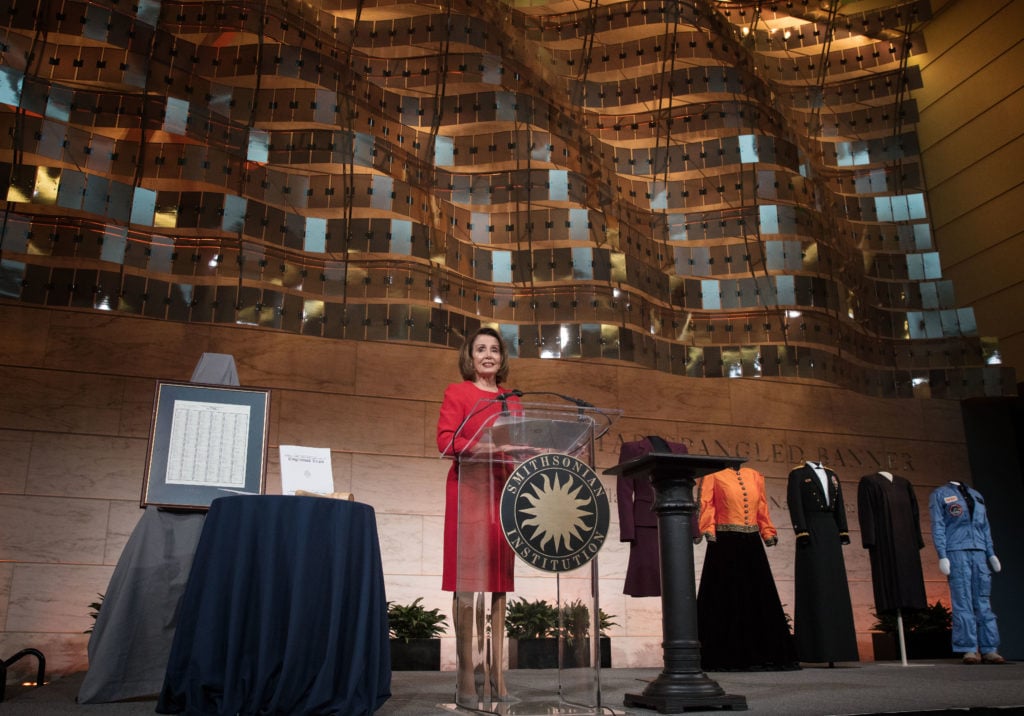
Nancy Pelosi donating her gavel to the Smithsonian. Beside her are other objects from the institute’s collections representing women’s firsts. Courtesy of the Smithsonian Institute.
Trump’s order takes issue with the way the Smithsonian is telling the story of American history—namely, its acknowledgement of systemic inequality due to the country’s history of colonialism and slavery. He also takes umbrage with the institution’s inclusion of trans people and their stories, as well as other civil rights movements.
“Once widely respected as a symbol of American excellence and a global icon of cultural achievement, the Smithsonian Institution has, in recent years, come under the influence of a divisive, race-centered ideology,” the executive order claimed. “This shift has promoted narratives that portray American and Western values as inherently harmful and oppressive.”
The order called out three specific Smithsonian museums as particularly problematic in that regard, and demanded a moratorium on spending for exhibitions or programs that “degrade shared American values, divide Americans by race or promote ideologies inconsistent with federal law.” (The idea that federal law controls ideology in a county that ostensibly maintains freedom of speech and expression is in and of itself confounding.)
The specific museums that attracted Trump’s ire are the American Art Museum, the Women’s Museum, and the National Museum of African American History and Culture (NMAAHC).
The American Art Museum’s current exhibition “The Shape of Power: Stories of Race and American Sculpture,” comes under fire in the order for stating that “societies including the United States have used race to establish and maintain systems of power, privilege, and disenfranchisement.” It also criticizes the show for explaining the widely understood fact that there is no biological distinction between races.
The Women’s Museum, meanwhile, was lambasted for planned exhibitions about trans women athletes, which the order described as “the exploits of male athletes participating in women’s sports.” One of Trump’s first-day executive orders, about the “biological reality of sex,” claimed that there are only two sexes, which cannot be changed, and banned use of federal funds to “promote gender ideology.”
The NMAAHC has been on Trump’s radar since his last administration for its claims that “’hard work,’ ‘individualism,’ and ‘the nuclear family’ are aspects of ‘White culture.’” Those were quotes from the museum’s online “Talking About Race” portal, launched in 2020 in the wake of the protests of the police killings of unarmed African Americans including George Floyd and Breonna Taylor. The museum removed the graphic, taken from a 1978 book, White Awareness: Handbook for Anti-Racism Training by Judy H. Katz, after six weeks following conservative complaints.
Two weeks ahead of the executive order, the Smithsonian placed Kevin Young, who has been the museum’s director since 2020, on indefinite personal leave. Linda St. Thomas, the Smithsonian’s chief spokesperson said that decision was “totally unrelated” to the executive order, but his future at the institution is now in doubt, leaving the museum vulnerable at a crucial moment when leadership is needed.
And there are other areas where Trump seems likely to target the Smithsonian. On January 8, 2021, the National Museum of American History issued a statement from director Anthea M. Hartig titled “A Disturbing Day Unfolds: The Unlawful Capitol Takeover and the Smithsonian’s Role in Documenting American Democracy.” Curators rushed to collect artifacts and ephemera from January 6 as part of its efforts to document American democracy.
Since returning to office, Trump has pardoned all those involved. He’s called the Capitol invaders “patriots,” and rebranded the insurrection as a “day of love” and a “beautiful day.” How the museum tells that story—and whether it echoes the president’s distorted version of events—could stand to change dramatically going forward.
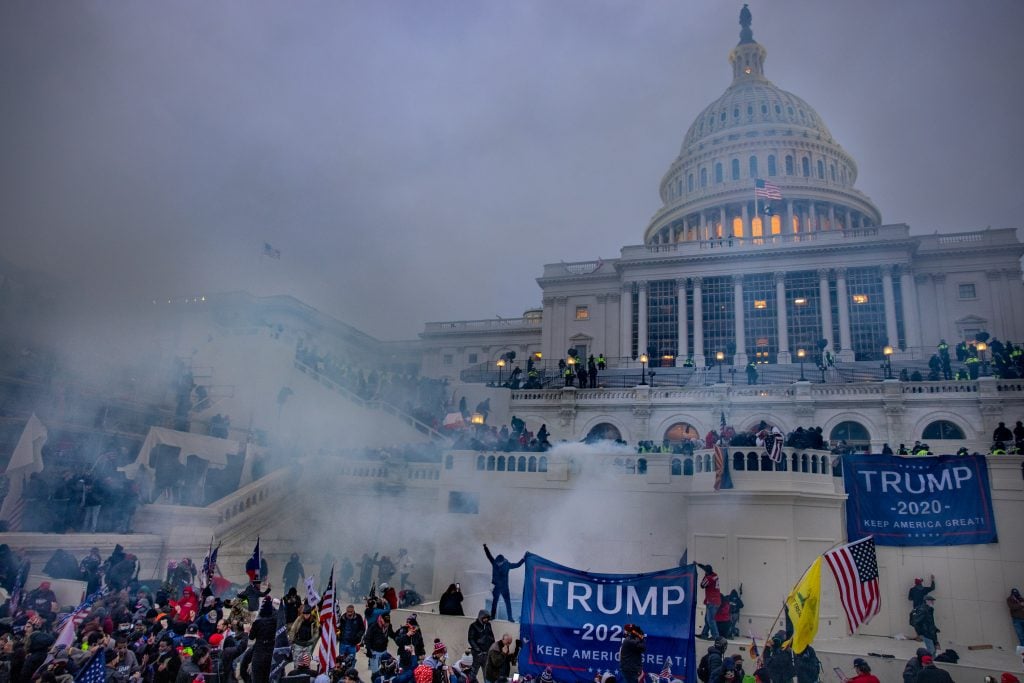
Tear gas is fired at supporters of President Trump who stormed the United States Capitol building. Photo by Evelyn Hockstein for the Washington Post via Getty Images.
In a word, yes. In 2021, some Republican congressmen took issue with what they called “irresponsible bias” in an African American Museum exhibition about the second Black Supreme Court Justice, Clarence Thomas.
More recently, the Latino Museum’s funding was threatened in 2023. House Republicans were objecting to what they felt was a portrayal of Latinos as the victims of oppression in an exhibition at Molina Family Latino Gallery, the forthcoming institution’s space at the National Museum of American History in Washington, D.C. Congress ultimately restored the museum’s funding, but the institution also canceled plans for a potentially controversial Molina Gallery exhibition about the Latino civil rights movement of the 1960s. (The museum has also faced a lawsuit for only hiring Latino interns.)
There have also been numerous concerns about leadership. In April 2023, the Museum of African Art director Ngaire Blankenberg stepped down after less than two years at the helm. Her tenure had begun following claims that the museum was plagued by a “culture of racism;” her successor, John K. Lapiana, was officially appointed in November after serving in an interim capacity for a year and a half.
Last fall, Stephanie Stebich stepped down as director of the American Art Museum after complaints that she had fostered a toxic work environment. She remains with the Smithsonian as senior advisor to the undersecretary for museums and culture.
The fledgling Women’s History Museum’s first director, Nancy Yao, never actually started the job due to criticism about how she had handled allegations of sexual harassment while heading New York’s Museum of Chinese in America. The museum appointed her replacement, Elizabeth C. Babcock, last spring.
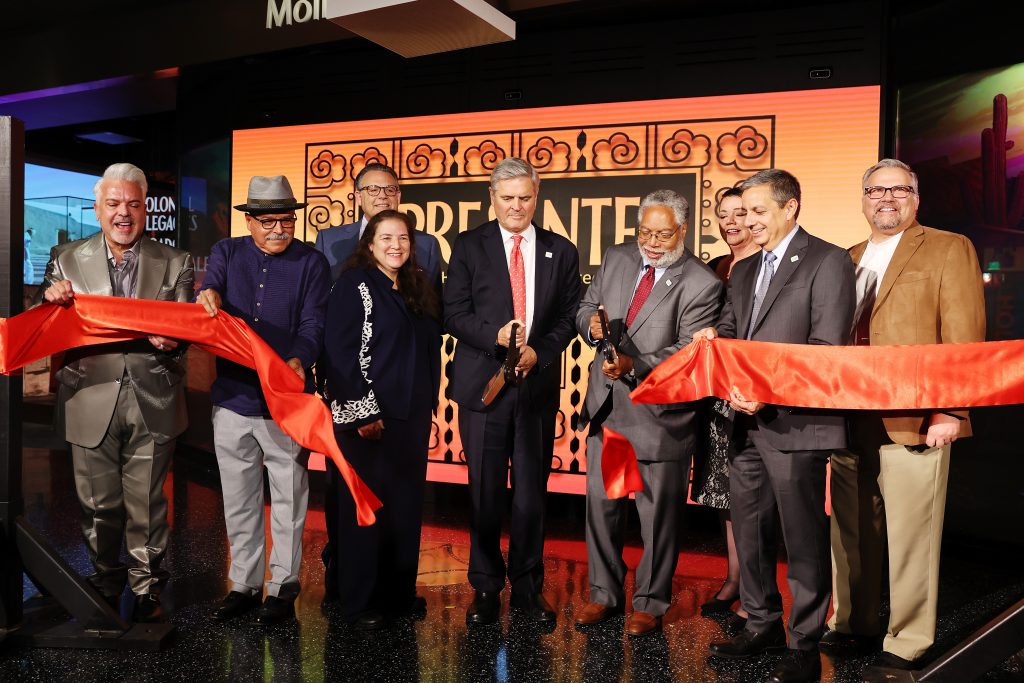
Henry R. Muñoz III, Eduardo Díaz, J. Mario Molina, Martha Molina Bernadett, Steve Case, Lonnie Bunch III, Josephine Molina, Jorge Zamanillo, and John C. Molina cut the opening ribbon during the Smithsonian Latino Museum reception on June 16, 2022 in Washington, D.C. Photo: Tasos Katopodis/Getty Images for Smithsonian Latino Museum.
The head of the Smithsonian is its secretary, a post that has been held since 2019 by Lonnie G. Bunch III. He was the founding director of the NMAAHC, shepherding the project nearly from its inception to its much-lauded opening on the National Mall in 2016.
Bunch, 72, is the Smithsonian’s 14th secretary, and he is both the first historian and African American in the role. He has openly pushed back against the executive order.
“We remain steadfast in our mission to bring history, science, education, research, and the arts to all Americans,” he wrote in an email to Smithsonian staff after the executive order was announced. “We will continue to showcase world-class exhibits, collections, and objects, rooted in expertise and accuracy. We will continue to employ our internal review processes which keep us accountable to the public. When we err, we adjust, pivot, and learn as needed. As always, our work will be shaped by the best scholarship, free of partisanship, to help the American public better understand our nation’s history, challenges, and triumphs.”
But Bunch “might bow out for a variety of reasons, especially if he thought his stance was harming the institution,” the New York Times reported, citing two anonymous sources at the Smithsonian.
So, it’s possible that a changing of the guard could be in the Smithsonian’s future—and with it, a leader more inclined to back up Trump’s executive order. Should Bunch resign, be it voluntarily or under pressure from the president, it would fall to the board of regents to name his replacement.
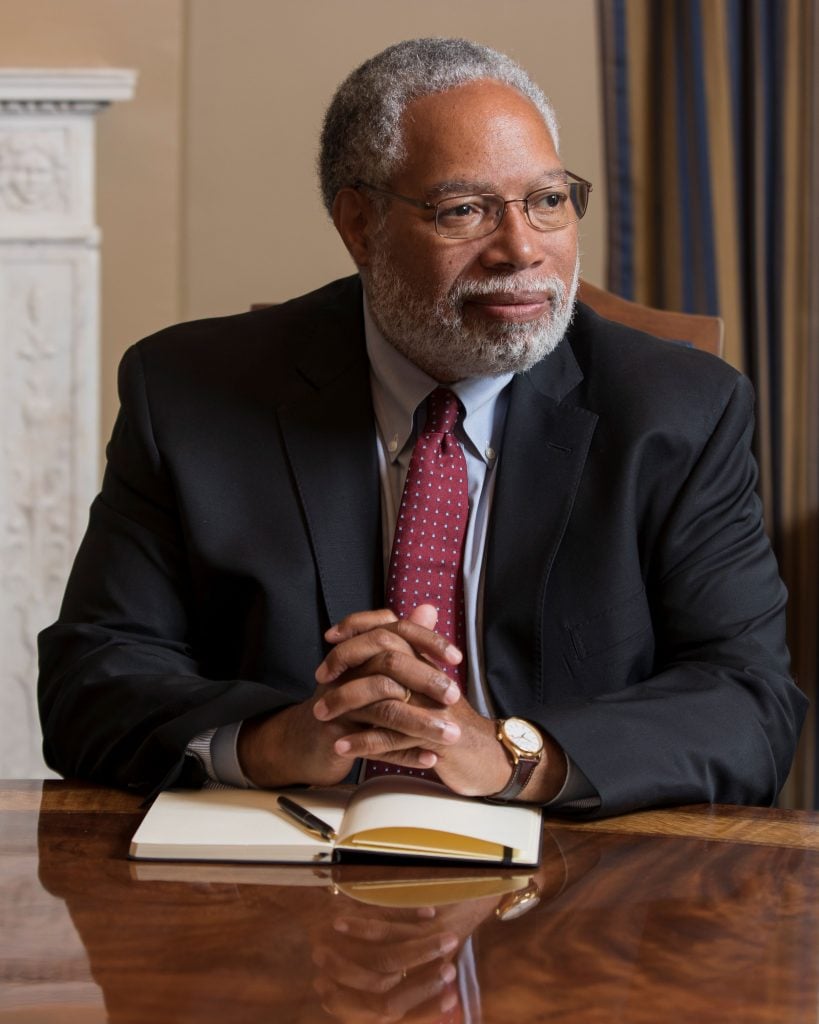
Lonnie G. Bunch III, the 14th Secretary of the Smithsonian. Photo: Robert Stewart/Smithsonian Institution.
As the vice president, Vance sits on the Smithsonian’s 17-person board of regents, alongside Supreme Court Chief Justice John G. Roberts Jr. and six members of Congress (three each from the Senators and House of Representatives). There are also nine citizen board members who each serve six-year terms, limited to two terms.
“Vice presidents traditionally have not attended the quarterly meetings of the board. The content of the exhibitions is determined by curators, museum directors, and staff, all of whom report to the secretary,” St. Thomas said. “The board is a governing body and do not handle day-to-day management of the institution.”
Trump’s executive order instructs Vance to recruit new citizen members who are “committed to advancing the policy of this order.” Even without attempting to cut terms short, Vance will have at least six opportunities to appoint new board members next year.
The current board chair is Risa Lavizzo-Mourey, a medical doctor who was the first African American to head the Robert Wood Johnson Foundation, a philanthropic organization founded by a Johnson and Johnson pharmaceuticals heir. Her second term ends in March 2026.
Also term-limited for next year are Michael M. Lynton, the head of Snapchat parent company Snap Inc.; John Fahey, the chairman emeritus of the National Geographic Society; and Barbara Barrett, the former secretary of the Air Force. The second term of Michael Govan, director of the Los Angeles County Museum of Art, runs through 2029.
Frank Raines, who was the first African American CEO of a Fortune 500 corporation, and Denise O’Leary, a member of the board of directors of American Airlines Group, find their board seats up for renewal in 2026. The last two board members, Antoinette C. Bush, a former News Corp executive, and Roger W. Ferguson Jr., the former vice chairman of the Federal Reserve, finish their first terms at the end of 2029.
Trump must sign a resolution for a board of regents member to be approved. But it is unclear how much power the board holds over the Smithsonian’s museums, and their exhibitions and programming.
The president, it’s worth noting, has already installed 14 new board members at the Kennedy Center in Washington, D.C., who then dutifully named him the organization’s board chair.
“We’re going to make sure that it’s good and it’s not going to be woke,” Trump said of the performing arts center in remarks from the Oval Office after his appointment to the board. “There’s no more woke in this country.”

President Donald Trump looks down from the presidential box in the Opera House at the John F. Kennedy Center for the Performing Arts as he participates in a guided tour and leads a board meeting on March 17, 2025 in Washington, D.C. Trump fired the center’s president, removed the bipartisan board of Biden appointees, and named himself institution’s chairman. Photo: Chip Somodevilla/Getty Images.
About 62 percent of the Smithsonian’s annual budget is federally funded. That includes its congressional appropriation, federal grants, and contracts, totaling about $1 billion for the 2024 fiscal year.
But the Smithsonian is also heavily dependent on fundraising. The institution announced its largest-ever fundraising effort, called the “Campaign for Our Shared Future,” last September, looking to raise $2.5 billion ahead of the 250th anniversary of the founding of the U.S. in 2026.
The congressional appropriations for the Smithsonian typically cover staff salaries, maintaining the physical facilities, and other operating costs. Exhibitions, on the other hand, are funded via donations by foundations, corporations, and private individuals.
Ostensibly, there is no federal funding that would be going directly toward the kinds of exhibitions and programming that Trump’s order defines as objectionable. But should he threaten to withhold those federal funds regardless, the Smithsonian would certainly be hard-pressed to raise enough to cover the shortfall.
Trump might not risk going that far. The Smithsonian has traditionally enjoyed bipartisan support, and its museums and zoo are among the nation’s leading tourist attractions. In 2024, the Smithsonian welcomed an impressive 16.8 million visitors. (All the museums are free, except the Cooper Hewitt.) Stripping its funding would surely be an unpopular and controversial move.

Donald W. Reynolds Center for American Art and Portraiture, home to the Smithsonian American Art Museum, the National Portrait Gallery, and the Lawrence A. Fleischman Gallery of the Archives of American Art in Washington, D.C. Courtesy of the Smithsonian.
If Trump has his way, it appears that the Smithsonian will be leading the way toward whitewashing history, the evils of slavery and the hard-fought civil rights movement glossed over in favor of an uncritical view of our nation’s past. The cultural sector could change—and is already changing—in ways that were hard to imagine ahead of the election.
That could mean the cancellation of the planned Smithsonian museums for women and Latinos. An op-ed from a member of conservative think tank the Heritage Foundation called the latter a “woke indoctrination factory” last year.
Or it could just mean strictly controlling what stories those museums—and existing ones—are telling. The executive order, for instance, specifically noted that future appropriations for the Women’s Museum must “not recognize men as women in any respect in the museum.” Already the National Park Service has made amendments to its webpages, notably removing a quote and image of Harriet Tubman from its Underground Railroad webpage, replacing it with language highlighting “Black/White Cooperation,” in line with the Trump administration’s broader effort to sanitize U.S. history.
Additionally, the Smithsonian has shuttered its diversity office in response to Trump’s earlier executive order banning Diversity, Equity, and Inclusion (DEI) initiatives at organizations that receive federal money, which called them “illegal and immoral discrimination programs.”
It is possible that Smithsonian leaders will capitulate willingly, following in the footsteps of some universities, to avoid loss of federal funding and a drawn out battle with Trump. But as lawsuits mount against the administration’s numerous overreaches, the institution may rally to push back in the courts. Those who stand against Trump may choose to resign in protest, or be forced to step down. If they do, that is almost certainly what the president wants: to be able to install his own supporters, eager to carry out his wishes, throughout the Smithsonian.
This story was updated on Wednesday, April 9, at 7:05 a.m. ET.