Artists
Walter Swennen, Revered Belgian Painter and Poet, Has Died Aged 79
His paintings were illogical, joyful, and radically free.

His paintings were illogical, joyful, and radically free.
Jo Lawson-Tancred
 ShareShare This Article
Walter Swennen, whose playful yet rigorous paintings sought to unshackle the medium from representation, narrative, and even legibility, has died at the age of 79. An enduring figure in European contemporary art, he is widely credited with reshaping the field’s understanding of what painting can do. His galleries Xavier Hufkens and Gladstone Gallery confirmed the news on August 15.
Something of a painter’s painter who had originally studied philosophy, Swennen spent his life trying to resolve painting’s inherent “conflict with representation.” He developed an improvisational, process-led approach that sought not to impose meaning onto the canvas. Instead, he freed painting from the burden of being understood, returning its autonomy as an object not an illusion.

Walter Swennen, Untitled (Beste P., bis), 1984. Courtesy of Walter Swennen and Xavier Hufkens, Brussels. Photo: Dirk Pauwels.
Despite the powerful conceptual thrust of his practice, Swennen was always alive to art’s humorous possibilities. There is no obvious logic that connects his subjects, and they are often rendered with an almost naive or cartoonish simplicity. They could range from slapstick signifiers, like a banana peel in negative space, to art historical musings, such as Piet, Georg & I (2016). The latter features the signature primary color blocks of Piet Mondrian coupled with painted bricks recalling German artist Georg Herold’s iconic three-dimensional “brick paintings” that used actual bricks. His unending curiosity about painting as a medium has proven highly influential to younger generations of artists, among them Sanya Kantarovsky.
“Walter’s passing is an immense loss, both personally and artistically,” said the Brussels-based dealer Xavier Hufkens, who has represented Swennen since 2014. “He was a dear friend and a true visionary, whose thinking was as uncompromising as it was free.”
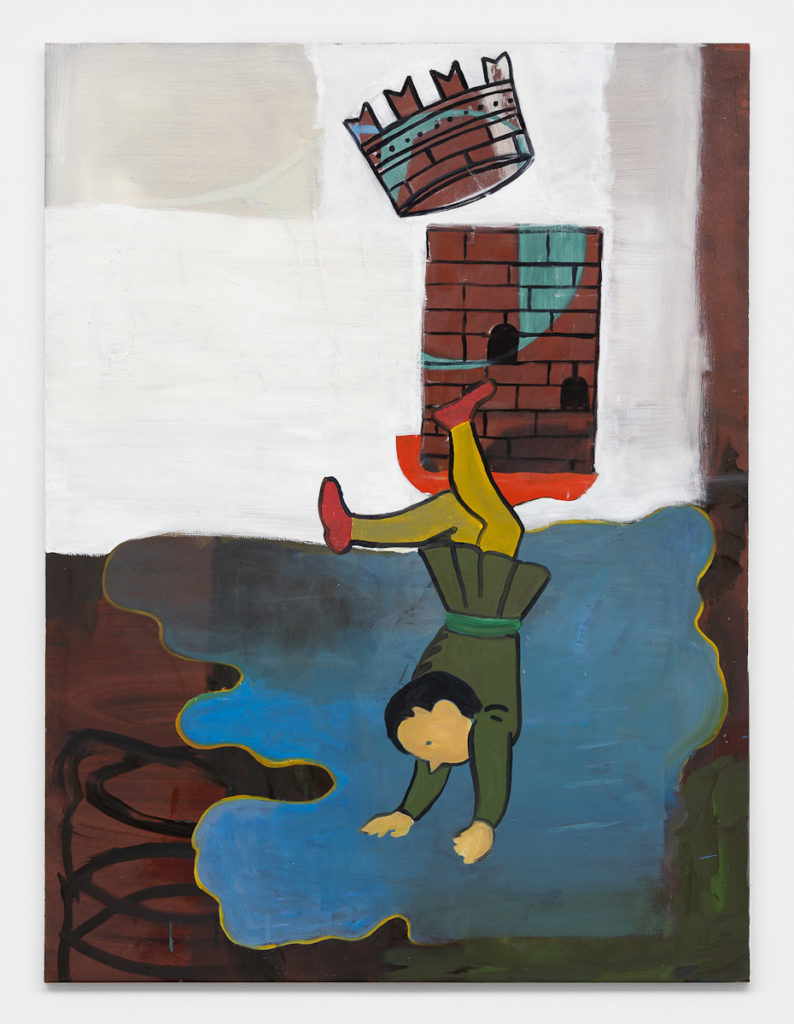
Walter Swennen, Untitled (2019). Courtesy of Gladstone Gallery.
Born in Brussels on February 27, 1946, Swennen exhibited broad academic interests from a young age. He initially studied philosophy at Saint-Louis University before transferring to study engraving at the Académie Royale des Beaux-Arts. Eventually, however, he completed a Masters in Psychology at the Université Catholique Louvain in 1973. Some years later, he taught psychoanalysis at the École de Recherche Graphique, and he would later cite the influence of theories by Freud, Jung, and Lacan on his work as an artist.
During his student years, the artist threw himself into Belgium’s countercultural scene, regularly attending happenings organized by his friend and fellow conceptual artist Marcel Broodthaers (1924–1976). In particular, he was inspired by Dada and the Beat Generation to write poetry that deconstructed and toyed with traditional approaches.

Walter Swennen, Piet, Georg & I (2016). Courtesy of Walter Swennen and Xavier Hufkens, Brussels. Photo: HV-studio.
Despite his training in printmaking and early participation in happenings, Swennen made his name as a painter. His approach in the medium was clearly informed by his interest in language’s associative, symbolic possibilities, and he began by painting words onto large sheets of paper until they became images.
“Little by little, it became clear to me that images and words are essentially the same–they both belong to the realm of literature,” he later explained to Frieze. “The real opposition is not between image and word, but between image and word on the one hand and painting on the other.”
Swennen often painted on unconventional supports, favoring found wood, plastic, or even metal instead of traditional canvas, reflecting his characteristically offbeat approach to materials.
The year 1981 marked Swennen’s breakthrough as a visual artist. As well as enjoying his first solo show at Gallery Patrick Verelst, he won a national award from the Centre for Fine Arts in Brussels. It was there that the artist had his institutional debut in 1986. In 1990, Swennen was included in the group show Artists (from Flanders) at Palazzo Sagredo, a collateral event during the 44th Venice Biennale. The buzz around Swennen resulted in shows at the Palais des Beaux-Arts in Charleroi in 1991 and the Museum of Contemporary Art in Antwerp in 1994.

Walter Swennen guides Belgium’s King Philippe through the Contemporary Art Center’s “Wiels” on January 16, 2014 in Brussels. Photo: Didier Lebrun/ Photonews via Getty Images.
A revival of interest in the artist came some decades later, starting with a significant 2013 retrospective at WIELS in Brussels, which the artist would credit with bringing him newfound attention including that of Hufkens and New York-based dealer Barbara Gladstone, who began representing the artist in 2015. Swennen went on to have three solo shows with the latter gallery, one coinciding with and an outing at White Columns in New York in 2017. A year later, Swennen received a solo exhibition at the Triennale di Milano. In 2021, a retrospective that opened at Kunstmuseum Bonn in Germany travelled to Kunstmuseum Den Haag in the Netherlands and, the following year, Kunst Museum Winterthur in Switzerland.
Swennen has been recognized for his lifetime achievements by the Flemish Community, winning its annual artist prize in 2003 and receiving the Ultima award in 2020. He is survived by his wife, the artist Carole Vanderlinden.