Artists
Rising Artist Victoria Dugger Reclaims the American Flag in Gingham and Glitter
Dugger brings her maximalist Southern Gothic dream to a new solo exhibition at Sargent's Daughters.
by
Katie White
 Share This Article
“The American flag was never meant for me,” said artist Victoria Dugger on a video call from her home in Athens, Georgia. “As a Black person, a person of the South, and as a disabled woman as well, I don’t think the flag ever had me in mind.”
Dugger, who is 34, has been a steadily rising force in the art world for the past few years, following her buzzy debut with “Out of Body” at New York’s Sargent’s Daughters in 2021. Known for her maximalist, soft-sculpture figurative creations, Dugger creates mixed-media works that fuse Southern Gothic aesthetics with the language of girlhood. Glitter, bows, and gingham abound in her works.
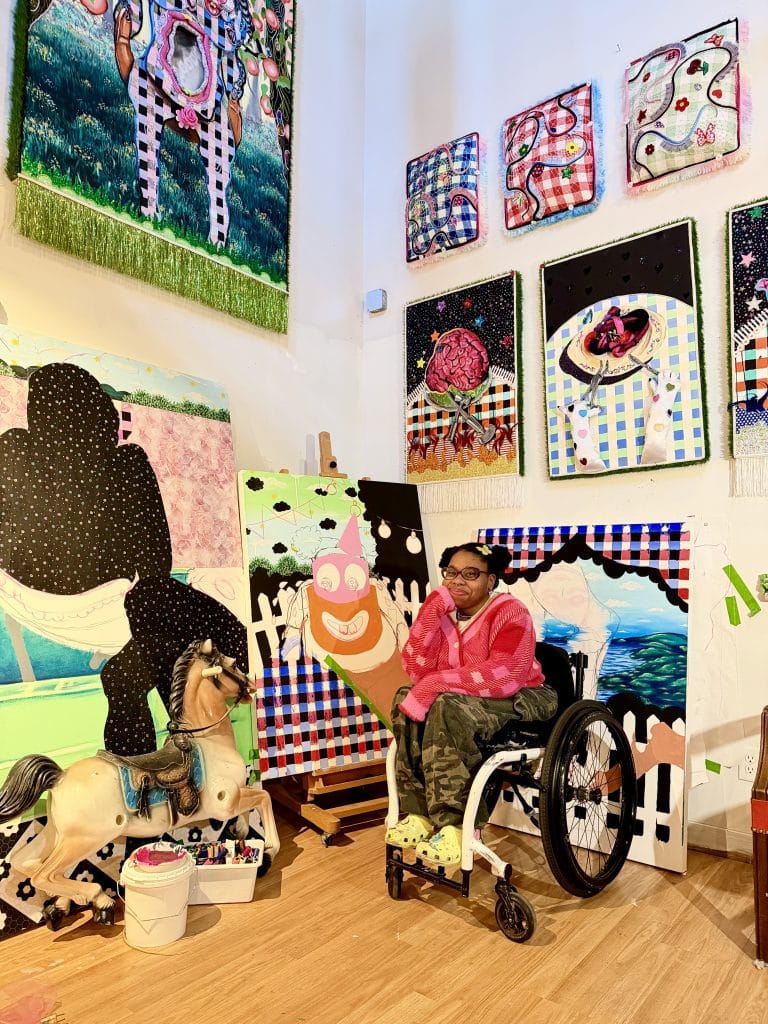
Victoria Dugger in her studio in Athens, Georgia. Courtesy of the artist and Sargent’s Daughters.
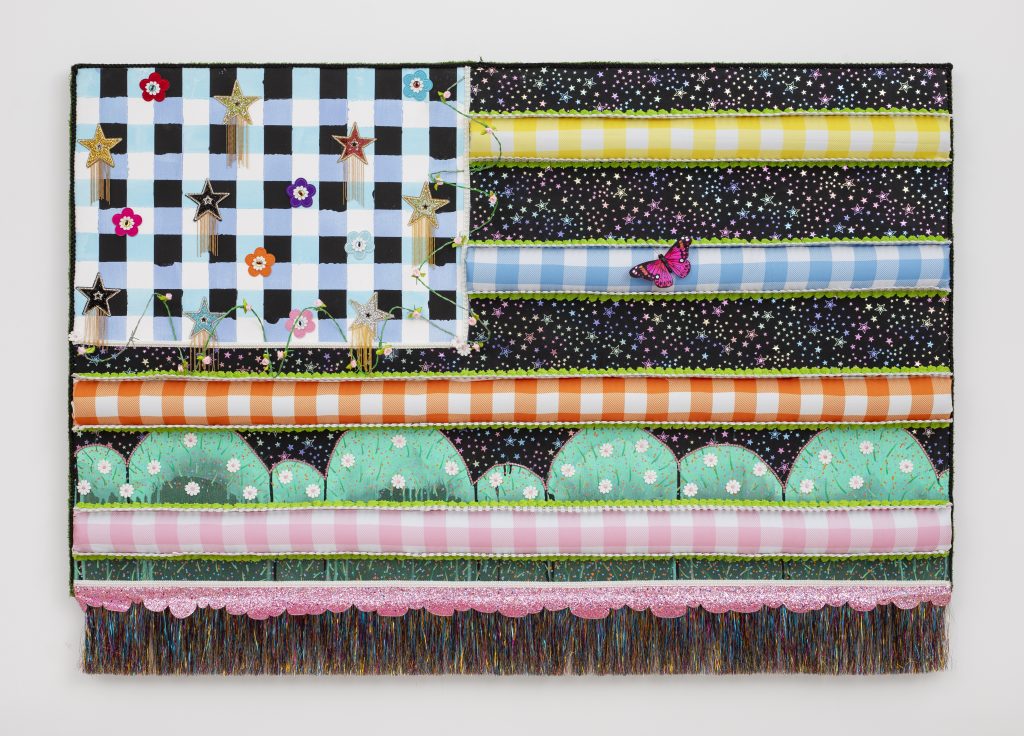
Now, in “Freak Flags,” her third solo exhibition with Sargent’s Daughters (through February 28, 2026), she transforms the American flag with her bright and unabashed visual language. Six mixed-media flags are on view, each measuring 3 feet by 5 feet, the dimensions of a standard home-use flag. These flags approximate the “stars and stripes” design, but here red, white, and blue are replaced by shades of hot pink, bright green, and glittery blacks. Gingham, barbed wire, fringe, and paint make up their surfaces. In one work, Freak Flag II, the stars are even made of glittery nipple tassels.
Dugger first started thinking about flags back in 2024. In New York for the opening of her exhibition “Tough Love,” Dugger made a pilgrimage to the Museum of Modern Art to see Jasper Johns’s iconic Flag painting in person. She counts Johns among her artistic heroes, along with Frida Kahlo, Vincent Van Gogh, and Kerry James Marshall, among others.
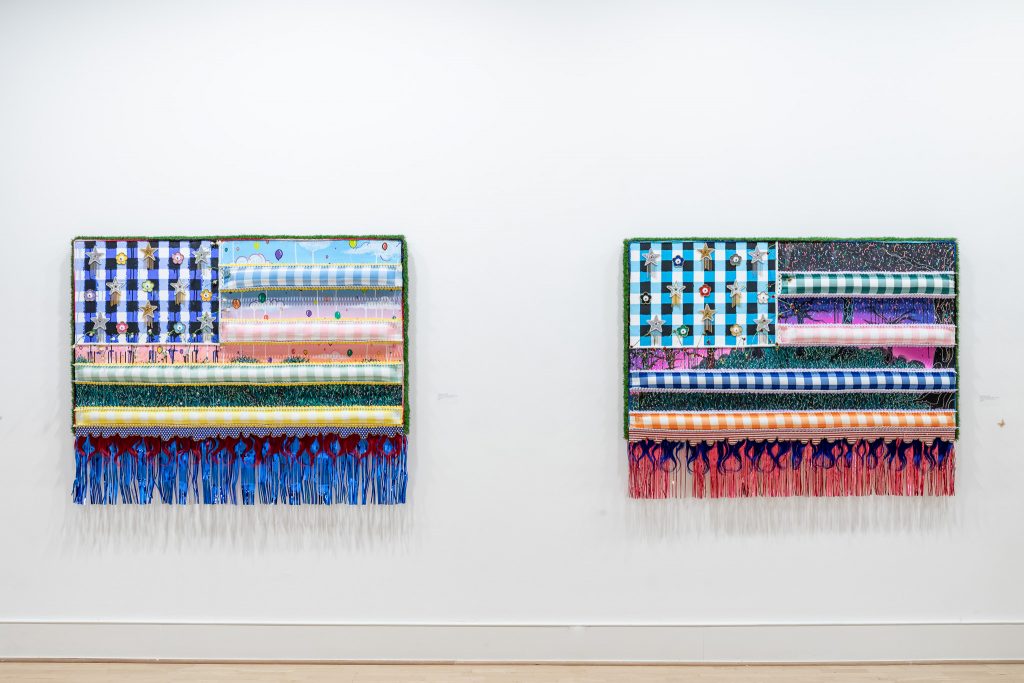
Installation view “Victoria Dugger: Freak Flag” 2025. Courtesy of the artist and Sargent’s Daughters,
Dugger, who earned her MFA from the University of Georgia’s Lamar Dodd School of Art in 2022, found her mind returning to the American flag as a graphic pattern after she left New York. Back at her studio, she had been wondering what to do with a series of oddly shaped panels when she realized they were the same measurements as the standard flag. “That felt like a happy coincidence,” said Dugger. “It got me thinking about the flags and Americana and what the flag actually means to people. Who is allowed access to that American dream?”
Dugger, at first, thought a series of flags could be celebratory in the lead-up to the 2024 Presidential Election. “If we’re going to have our first Black and South Asian woman president, this is going to be amazing,” said Dugger, of Kamala Harris’s presidential bid. “But then November came, and the work took on an almost sinister meaning.”
Much like Johns’s flags, Dugger allows her works to operate on multiple levels. The works in the show were all made in 2025. Now, just a few months later, in 2026, the year marking the 250th anniversary of the founding of the United States of America, she finds their meanings have shifted already, in the wake of the deadly events in Minnesota, among other near-constant turmoil. In the show, several flags appear upside down, a sign of distress, an intentional choice on the part of the artist, reflecting the national climate.
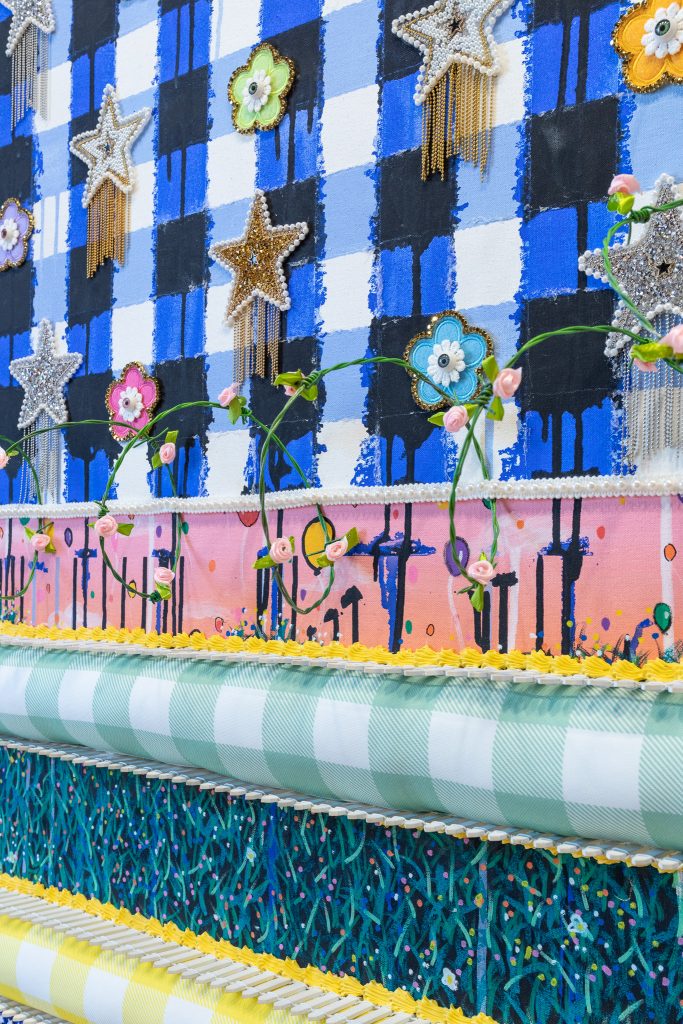
Detail of Victoria Dugger’s Freak Flag II (2025). Courtesy of the artist and Sargent’s Daughters.
In this age of heightened nationalism, Dugger’s flags scream of girlhood in a way that feels subversive. She is quick to remind people that the American flag was the invention of women—Betsy Ross is credited with creating the “stars and stripes” flag, while other women flag makers, including Margaret Manny, Rebecca Young, Anne King, and Cornelia Bridges, made other early versions of the American flag.
“The flag was sewn and created by a woman, but it’s become this overtly masculine symbol,” Dugger considered. “It has a whole other meaning besides patriotism.” By creating flags with glitter and rosettes, Dugger brings the flag back into the world of female, domestic craft, and by including objects like nipple pasties and hair bows, pulls the American flag back into a direct relationship with the female body.
The disabled body is also present in these works. The exhibition title “Freak Flags” draws from the expression “Let your freak flag fly,” which originated in the 1960s counterculture. For Dugger, who is paralyzed from the waist down, “Freak Flag” was also a tongue-in-cheek nod to America’s history of “freak shows” in the 19th and early 20th centuries. These traveling shows were places where people with disabilities were exploited for profit while simultaneously offering fame and independence.
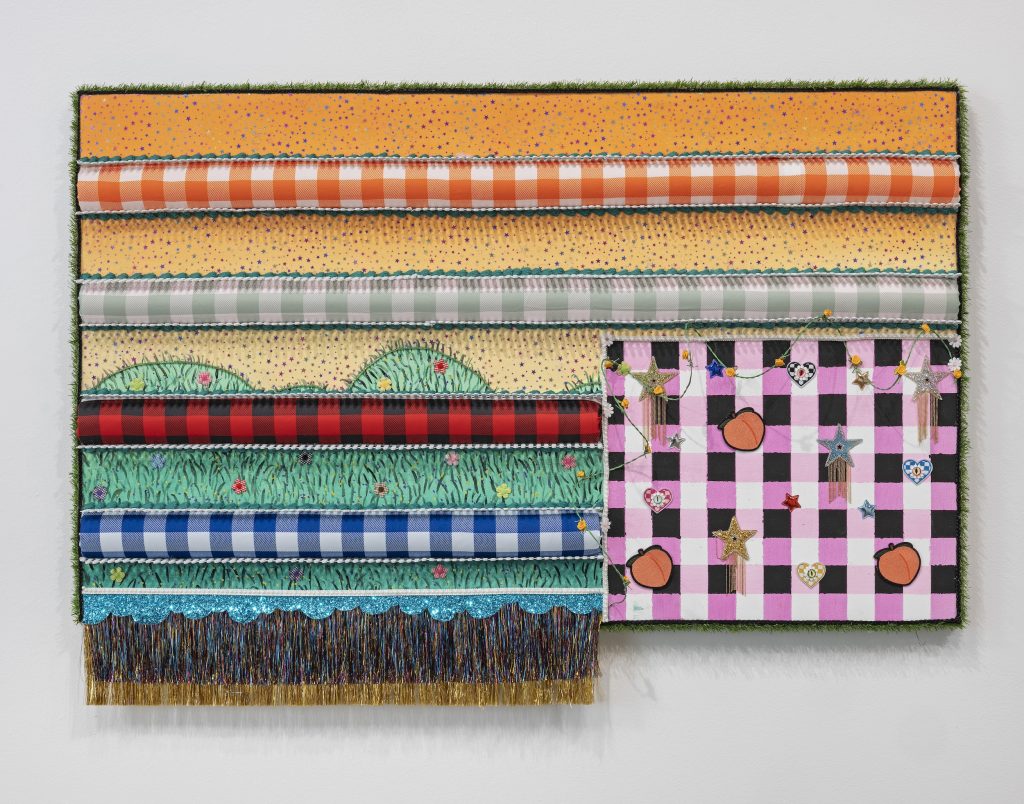
Victoria Dugger, Freak Flag III (2025). Courtesy of the artist and Sargent’s Daughters.
“On one hand, I thought of it as reclaiming the word freak and a bit funny,” said Dugger. “But with recent news, I also think the rest of the world is looking at us as a bunch of freaking weirdos in another sense.” Dugger believes these meanings can live alongside one another and create fruitful complications. “Having humor, fear, humiliation, or pure joy happening all at once in a painting is really a testament to how we live in our day-to-day,” she said.
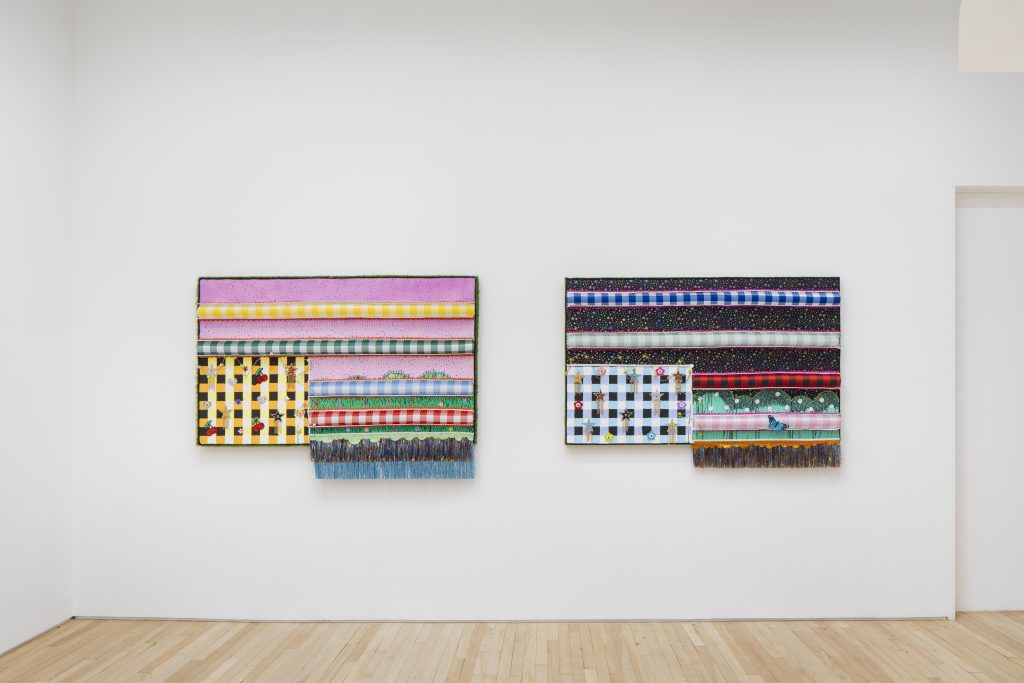
Installation view “Victoria Dugger: Freak Flag” 2025. Courtesy of the artist and Sargent’s Daughters.
These works are rooted deeply in the American South, too. Dugger had hesitated to label her work as decidedly Southern earlier in her career, but she’s changed her mind. “There’s a resurgence of Black people reclaiming the South, as with Beyonce’s Cowboy Carter,” she said. “My dad’s from Louisiana and my mom’s from Georgia. There’s a lot of pride in being from the South.” Here, one finds subtle allusions to this terrain, such as stripes painted with snippets of lush green landscapes. “In the South, the landscape becomes its own character,” the artist said. “So much time is spent outside. Dugger’s frequent use of gingham is another nod to the Black American South. “Children and slaves used to be dressed in gingham because it was such a durable fabric to make,” she explained. “That’s another love affair that I have with gingham—dressing fragile bodies in this kind of resilient fabric is something that I’m interested in.”
In some ways, she hopes her news works speak to the “celebratory stories of the South and resilience” and “showing the joy of it.” At the same time, she knows the meanings of these flags will continue to change in ways she never could have imagined. “These are the most decorative pieces I’ve made so far,” she acknowledged, “But they also feel the most loaded.”
Related Articles
-