Artists
Rising Artist Veronica Fernandez’s Uneasy Monument to Childhood Imagination
In her debut solo exhibition at Anat Ebgi, the artist transforms memory and imagination into scenes that blur nostalgia with quiet unease.

In her debut solo exhibition at Anat Ebgi, the artist transforms memory and imagination into scenes that blur nostalgia with quiet unease.
Annikka Olsen
 ShareShare This Article
There is nothing in the paintings of Veronica Fernandez that specifically suggests imminent danger or looming threat. To the contrary, some works portray lively community gatherings or children playing—yet underpinning each work is a permeating sense of foreboding.
“There’s this push and pull between feeling unease and discomfort, the nature of the spaces, and why they feel uncomfortable. But there is also tenderness and warmth, people adapting to these spaces and finding ways to make them comfortable,” said Fernandez in a video call from her base in La Habra, California.
In Fernandez’s solo show at Anat Ebgi, “Prey,” this seemingly veiled tension is heightened by her shift toward small-scale canvases rather than her typically monumental ones (though one epic painting is included in the show). The artist had previously experimented with more modestly sized compositions, but the decisive shift came after moving from a large Downtown Los Angeles studio to a more compact townhouse in La Habra; the chaos of moving studios coupled with the more limited space prompted Fernandez to lean more seriously into the smaller format.
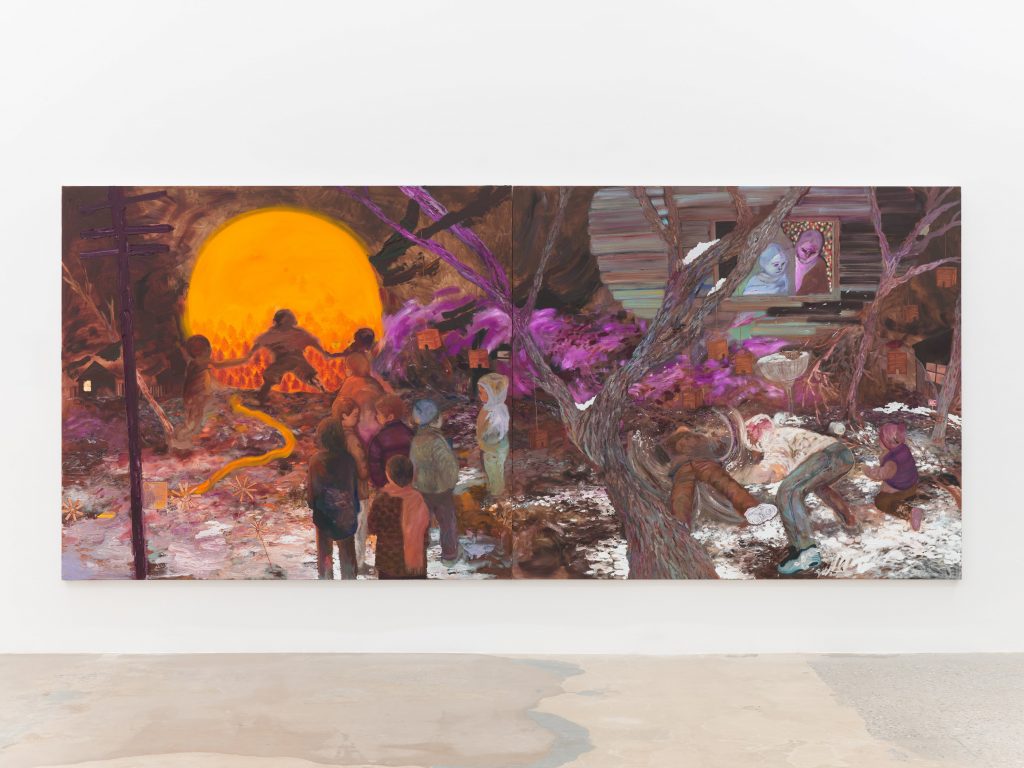
Veronica Fernandez, Some Things Don’t Stay for Tomorrow (2026). Photo: Matthew Kroening. Courtesy of the artist and Anat Ebgi, Los Angeles / New York.
It’s an intriguing practical parallel to the confined spaces, both physically and psychologically, that Fernandez portrays in her paintings. The title of the show is drawn from a poem she wrote, I Wanna Fly, that, like the show, taps into feelings of claustrophobia and survival. The works have, as Fernandez described, “almost a state of urgency, like [if the figures] close their eyes they feel like the walls are compressing them and they want to escape.”
In making these works, Fernandez draws from her childhood. Born in Norfolk, Virginia, she and her older sister and younger brother were raised by a single father. During her childhood, the family experienced periods of homelessness and spent time in shelters, motels, and transitional housing in areas that “weren’t great.”
While memories of these experiences heavily inform Fernandez’s work, her practice does not seek to document or faithfully recreate them. Instead, they are potent starting points for the emotional and psychological elements they manifest, like resiliency, adaptability, and community, as well as vulnerability and the stress of fighting for survival.
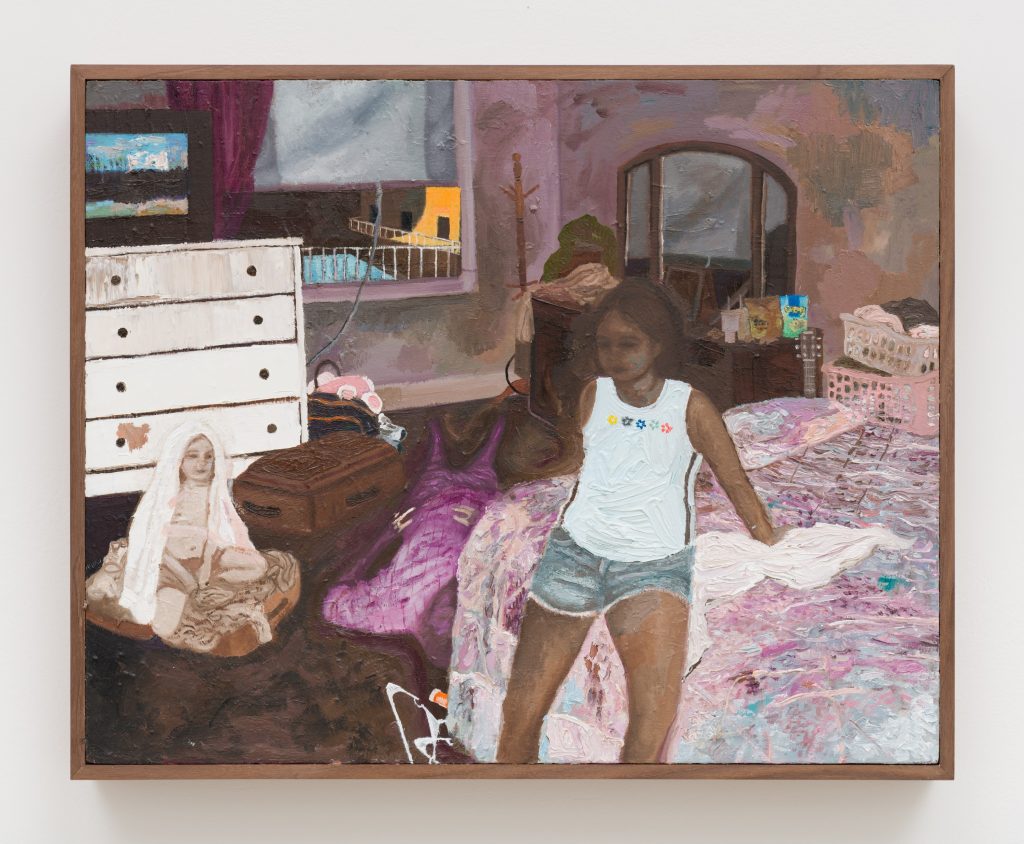
Veronica Fernandez, Next to Shower Here (2026). Photo: Mason Kuehler. Courtesy of the artist and Anat Ebgi, Los Angeles / New York.
Despite eschewing attempts at direct representation, Fernandez’s work nevertheless begins with reality. Using a combination of old family photographs and her imagination, the figures that populate the artist’s paintings are a form of amalgamation. Images of her siblings as children are frequently the “models” for her work.
“I always joke with them, ‘you guys are like my muses—you’re in all my works!” Fernandez laughed.
Although not depicted with absolute fidelity in the manner of true portraiture, isolated characteristics, pieces of anatomy, or poses are drawn from the images and recreated on canvas. Further references are drawn from strangers in the background of images, or images from other family members, like her cousin, who was the basis for Next to Shower Here (2026). “I repainted her to make her anonymous because I didn’t want to use her actual face, and then the memory itself was inspired by my own family.
Also among the children shown is a type of self-portrait as a child, though viewers would not be able to pick her out of the crowd, as with her other figures, Fernandez has taken steps to anonymize herself. Obscuring identities through a combination of partial abstraction and distorting or shadowing features, she creates a pictorial balance between specificity and generality, opening the work up to the viewers.
“There’s always an element of things that are very personal to me, and then broadening them,” said Fernandez, “through paint, abstracting certain areas of an image, or adding a lot of movement.”
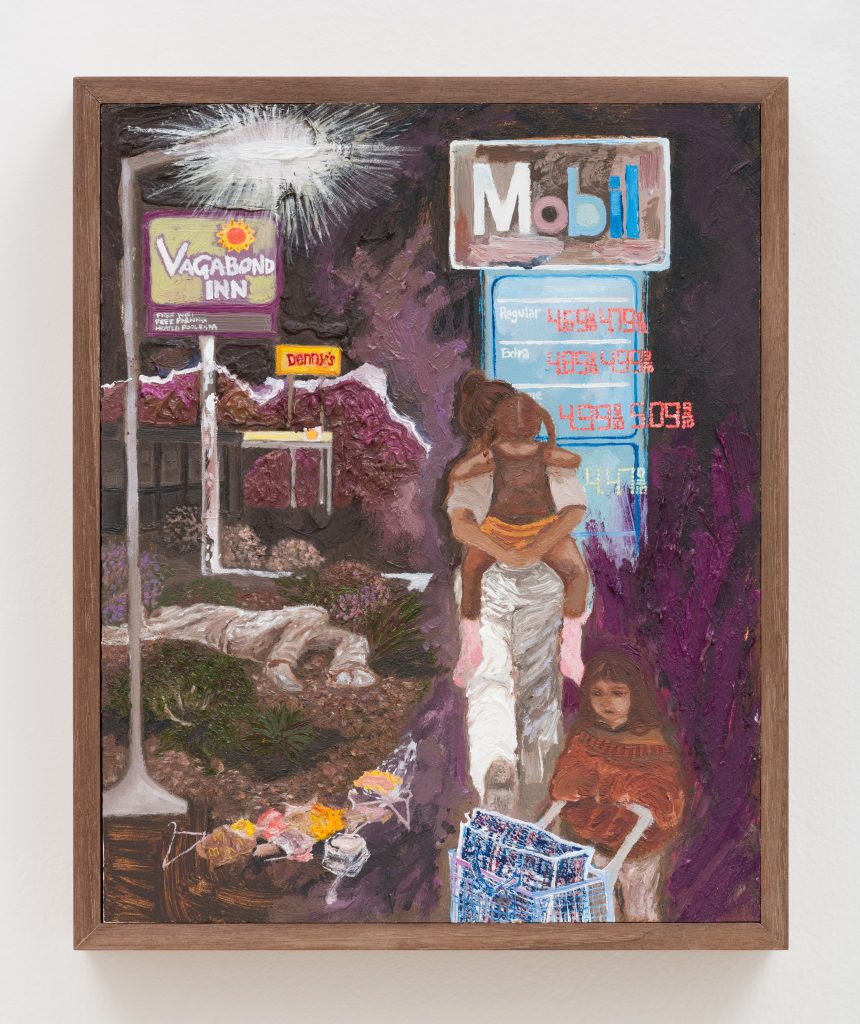
Veronica Fernandez, Highway Laundry (2026). Photo: Mason Kuehler. Courtesy of the artist and Anat Ebgi, Los Angeles / New York.
Like with her figures, the spaces Fernandez realizes are a creative composite. In Next to Shower Here, the photo of her cousin simply showed the young girl on a bed with a dresser in the background. Fernandez expands not only the interior of this scene but also transforms it into the room of a motel, like those from her own childhood, through the window showing the distinctive walkway rail and courtyard pool.
Fernandez underscores that her spaces are not true to life through expressive inclusions of color and resisting the rules of pictorial space. Swathes of vibrant purple, in Next to Shower Here, used to fill in an adult lying on the floor, signal their separation from childhood, a disregarded afterthought of the children in the room. In Highway Laundry (2026), the figure of a man sprawled beside the sidewalk appears wraithlike, rendered in chalky white, and the illuminated signs for a Vagabond Inn, Denny’s, and Mobil gas station, while drawn from Fernandez’s own history, could be from any number of places across America.
These surreal additions leave the otherwise quotidian scenes with an otherworldly, haunting atmosphere. One where boundaries between memory and the present, reality and imagination are irrevocably blurred and made mutable.
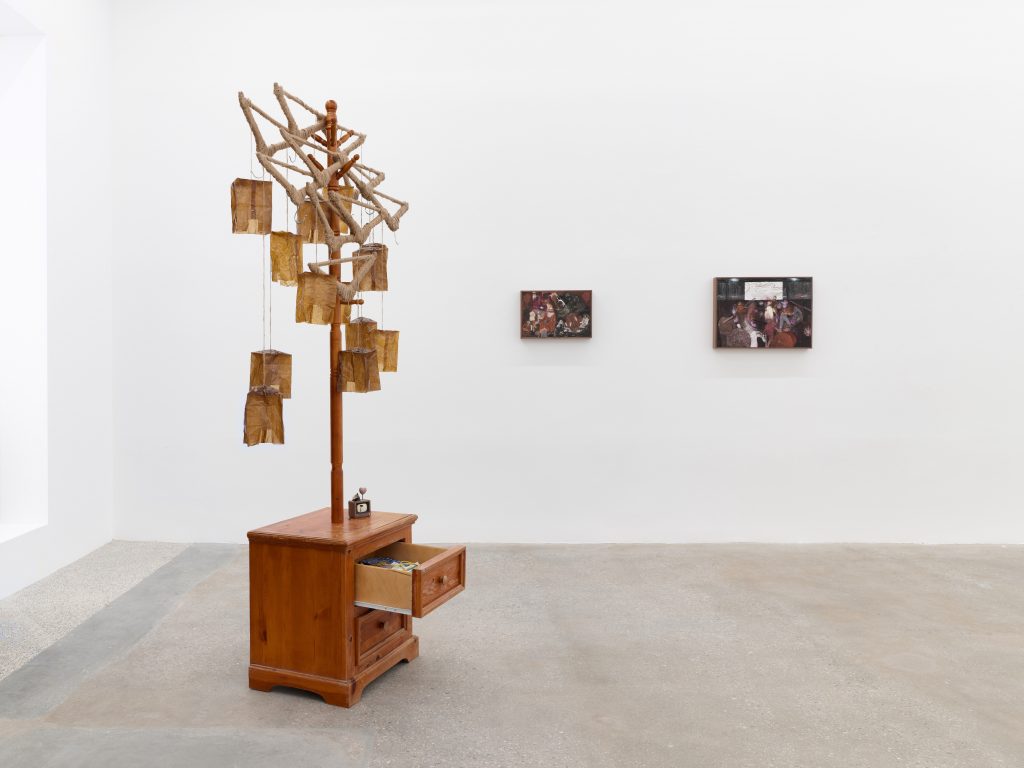
Installation view of “Veronica Fernandez: Prey” (2026). Photo: Matthew Kroening. Courtesy of the artist and Anat Ebgi, Los Angeles / New York.
At the heart of the exhibition is one of Fernandez’s most ambitious sculptures to date, Play (2026). Fernandez recounted building entire villages out of make-believe houses made from brown paper bags with her sister, improvising with what they had at hand. Here, the paper bags have been cast in resin—the artist’s first foray into the medium—and hung upon the “branches” of clothes hangers arranged atop a coat tree. At its base, a found nightstand with a small, whimsical trinket or child’s toy, and in the open drawer, an assortment of ephemera like scratchers and old Christmas cards, the objects found in any household junk drawer.
Together, the carefully composed elements of the sculpture act as a monument or memorial to childhood imagination and ingenuity, and the magic that is conjured when children are at play, regardless of circumstances.
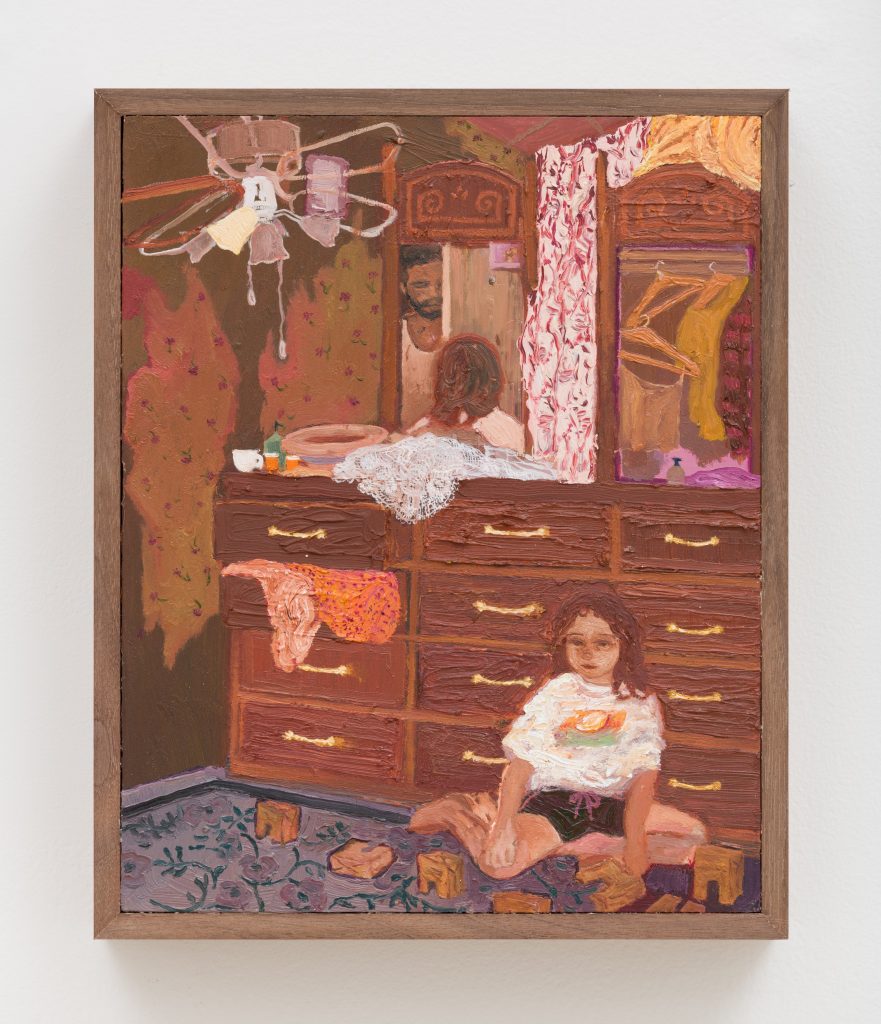
Veronica Fernandez, Stranger Asks for Toilet Paper (2026). Photo: Mason Kuehler. Courtesy of the artist and Anat Ebgi, Los Angeles / New York.
The painting and sculpture in “Prey” strike at the heart of existential anxieties. Against the backdrop of exploding costs of living, mass layoffs, and economic hardship on both an individual and global scale, visions of life on the razor’s edge of survival mirror the fears of many. And focusing on the experience from the viewpoint of a child only amplifies these anxieties.
But as noted, the dangers that lurk in everyday existence aren’t immediately distinguishable in Fernandez’s paintings. Works like Stranger Asks for Toilet Paper (2026) refer to actual situations the artist experienced. At home alone with her brother and sister, a neighbor asked for toilet paper—an otherwise innocuous encounter, but the unidentified relationship between the figures leaves a looming “what if.” That an adult would be asking for assistance from children was confusing and, in some primal way, frightening.
As viewers, we see a small child isolated against a dresser, but in a mere glimpse of a mirror’s reflection, an adult man’s face hovers over the back of a girl’s head. With no other context, the scene is enough to make anyone hold their breath.
The universality and singularity of each painting are a sobering reminder of how close to the edge we may all come, and a haunting invitation to consider circumstances beyond your own.
“Thinking about what I see today, and what I’ve experienced, how hard it is to exist,” said Fernandez. “I’ve watched my dad struggle so much, and I’ve had to ask: how can I depict this in paintings? I feel it is my job as a painter to talk about things that people don’t always think about.”