Art & Exhibitions
How Yellow Became Van Gogh’s Most Powerful Color
The Van Gogh Museum is celebrating the artist's favorite color in a show dedicated to his sunflowers, wheat fields, and more.

by
Sarah Cascone
 Share This Article
“How beautiful yellow is!” Vincent van Gogh wrote in an 1888 letter to brother Theo van Gogh that began “Sunshine, a light which, for want of a better word I can only call yellow—pale sulfur yellow, pale lemon, gold.”
Now, the artist’s affinity for yellow is the starting point for a unique exhibition at his namesake institution, Amsterdam’s Van Gogh Museum, that presents the bright golden hue as an integral part of his artistic legacy.
Van Gogh’s famed sunflowers series, his sprawling wheat field landscapes, and even the straw hat accessorizing a number of his self-portraits all prominently feature yellow. During his time in Arles, Van Gogh even lived, famously, in what’s simply dubbed the Yellow House, notably painting both the colorful exterior and his sleeping quarters, the composition anchored by his yellow bed frame.
But the show doesn’t just explore Van Gogh’s use of yellow. It delves into the color’s appearance in the work of 19th- and early 20th-century masters such as Marc Chagall, Wassily Kandinsky, Hilma af Klint, Paul Signac, Kazimir Malevich, and J.M.W. Turner, and even features a light installation by contemporary artist Olafur Eliasson, extending the conversation about yellow into the present day.

Cuno Amiet, The Yellow Hill (1903). Collection of the Kunstmuseum Solothurn, Switzerland. Photo by David Aebi.
“Normally you would not put them together because they’re not from the same time or the same art historical movements, and so you have these really interesting combinations,” Ann Blokland, the museum’s curator of education, said in an interview. (It’s also an opportunity to bring other creative voices into a single-artist museum.)
What’s in a Color?
We think about yellow as being cheerful and optimistic, associated with warmth and energy, but it is also associated with cowardice. And it can seem sickly—and even invoke madness, as in Charlotte Perkins Gilman’s 1892 short story “The Yellow Wallpaper.” But what did it mean to Van Gogh?

Vincent van Gogh, The Yellow House (The Street), 1888. Collection of the Van Gogh Museum, Amsterdam.
“For Van Gogh, the sun is life-giving,” Van Gogh Museum chief curator Edwin Becker said.
The yellow glow of the Provençal sunshine animated Van Gogh’s work during the 15 months he lived in Arles in 1888 and ’89, before tragically taking his own life in July 1890.
“It’s crucial, the color yellow,” Blokland said. “A lot of Van Gogh’s iconic paintings that he painted in Arles have a lot of yellow in them.”
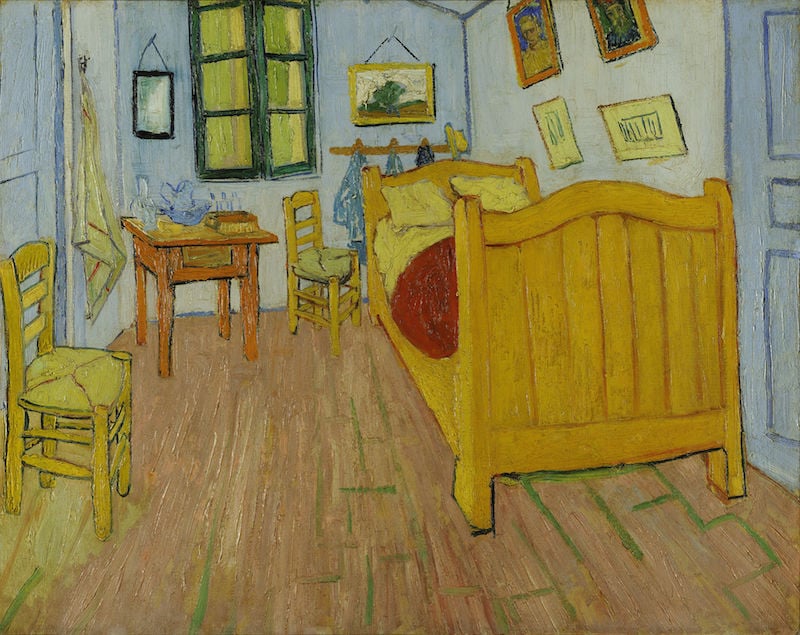
Vincent Van Gogh, The Bedroom (1888). Collection of the Van Gogh Museum, Amsterdam.
He wrote to Theo of how inspired he felt by the contrast between the blue skies and yellow buildings in Arles: “That’s a really difficult subject! But I want to conquer it for that very reason. Because it’s tremendous, these yellow houses in the sunlight and then the incomparable freshness of the blue. All the ground’s yellow, too.”
The artist relied on the color so heavily during this period, he even wrote to Theo about running out of yellow paint, calling it “fundamental.” (Van Gogh expert Martin Bailey calculated that Van Gogh used over a third of a large tube of yellow paint on average for each work completed between April 1888 and ’89.) But even for Van Gogh, yellow could serve different purposes in his canvases.
“The meaning of colors can have various dimensions. Certain colors can have more of a universal meaning that have been there for forever, like associating yellow with the sun,” she added. “And then there are more specific cultural time-framed meanings. What we found very surprising is that at the end of the 19th century, yellow was often associated with modernity and decadence.”

Vincent van Gogh, Piles of French Novels (1887). Collection of the Van Gogh Museum, Amsterdam. Courtesy of the Vincent van Gogh Foundation.
One of the less well-known works in the show is Piles of French Novels, a still life of books, many of which have yellow covers—something that would have had a very specific meaning in Van Gogh’s time. French novels with yellow covers were instantly identifiable for their modern, worldly content, often racy or sexual content.
“They were about certain subjects like prostitution, social changes, alcoholism,” Blokland said. “For contemporaries of Vincent, everybody would recognize them and know what they meant.”

Vittorio Matteo Corcos, Dreams (1896). Collection of the
Galleria Nazionale d’Arte Moderna e Contemporanea di Roma.
That’s why Vittorio Corcos’s seemingly straightforward 1896 canvas Dreams was so controversial in its day. The demurely dressed young woman gazing back at the viewer is sitting next to a stack of yellow books, suggesting that she is a modern woman, and an intellectual.
Van Gogh’s 1887 book painting actually predates the artist’s move to Arles, as does his still life from the same year, Quinces, Lemons, Pears and Grapes. That almost all-yellow composition still hangs in the only frame original to the artist’s lifetime—and he painted it yellow to match.

Vincent van Gogh, Quinces, Lemons, Pears and Grapes (1887). Collection of the Van Gogh Museum, Amsterdam.
“It’s a beautiful picture, especially because of the frame. And it’s a unique example,” Becker said, noting that such a prominent use of yellow was a bold artistic choice. “I think that yellow, perhaps more than red and blue, is more daring and more confronting in a certain way.”
Save the Yellow
In 2018, scientists sounded the alarm. Van Gogh’s sunflower paintings were fading. One of the two chrome yellow pigments used to create the famed masterpieces had proven unstable and prone to discoloration. The artist’s vibrant yellows were darkening over time, adding a brown hue to the glorious blooms.
Fortunately, the study, conducted by the University of Antwerp and the Delft University of Technology, determined that this change was taking place extremely slowly. And museums are taking precautions, of course, to preserve these historic works, and to ensure that the yellow pigment stays as true as possible to the artist’s original vision.
“It’s quite amazing to imagine that a painting that still shines from within almost could have been even more bright,” Blokland said.

Vincent van Gogh, Sunflowers (1889). Collection of the Van Gogh Museum, Amsterdam.
“I have never seen the sunflowers so bright as it is now,” Becker added. “We have chosen, with the designers, a very nice bluish color of the wall. With the contrasting color, the yellow really shines—and we did also a lot with the lighting.”
The way that our perception of yellow changes depends on lighting and display also factors into the show’s site-specific installation by Eliasson, Color Experiment No. 78. The artist has hung 72 circular monochromatic paintings under one of his monofrequency lamps emitting only yellow light. This creates a unique viewing experience, in which one’s spectral range is limited to shades of yellow and black.

Olafur Eliasson, Color Experiment No. 78 (2015). Photo by Michael Floor, courtesy of the Van Gogh Museum, Amsterdam.
“He’s a very science-based and theory-based artist who plays with your perception and makes magic,” Blokland said. “It becomes quite a strange and philosophical experience.”
The installation puts an appropriate exclamation mark on the museum’s tribute to the color yellow, underscoring the visual power of this hue so beloved by Van Gogh.
“Being in a room with yellow light is very intense,” Eliasson said in a statement. “Yellow is like wow!”
“Yellow. Beyond Van Gogh’s Colour” is on view at the Van Gogh Museum, Museumplein 6, 1071 DJ Amsterdam, Netherlands, February 13–May 17, 2026.

Related Articles
-


