Art & Tech
Van Eyck Attribution Dispute Pits Art Historians Against A.I. Firm
A new A.I. analysis claims two Renaissance paintings attributed to Jan van Eyck are fakes—but leading scholars say the technology has "discredited itself."

A new A.I. analysis claims two Renaissance paintings attributed to Jan van Eyck are fakes—but leading scholars say the technology has "discredited itself."
Jo Lawson-Tancred
 ShareShare This Article
Once again, A.I. and human experts are butting heads over the authenticity of a world-famous painting. A Belgian art historian has refuted claims made by Swiss company Art Recognition that two paintings have been falsely attributed to the Northern Renaissance master Jan van Eyck.
The paintings in question are versions of Saint Francis of Assisi Receiving the Stigmata (ca. 1428-32) belonging to the Royal Museums of Turin and the Philadelphia Museum of Art. The dispute over their authenticity raises questions about the proper use and limitations of A.I., as well as the nature of authorship in Renaissance art.
According to Art Recognition, its A.I. model ruled that these works were not by the hand of Van Eyck with 91 percent certainty in the case of the Philadelphia picture. For the Turin version, this figure was 86 percent.
Speaking to the Guardian, Carina Popovici, the company’s CEO suggested that the museums “wont be happy,” with the finding. The Royal Museums of Turin did not respond to a request for comment, while the Philadelphia Museum of Art said “the museum has not been involved in this analysis so therefore we are unable to comment.”
The legitimacy of Art Recognitions claims has been called into question by Maximiliaan Martens, a Van Eyck expert from Ghent University. For one thing, he questioned the feasibility of training an A.I. model to detect and recognize Van Eyck’s distinctive brushstroke, which Art Recognition claims to have done.
“Even when one studies Van Eyck’s paintings on a microscopic level, his brushstrokes are barely visible,” Martens said by email. “That is one of the most prominent characteristics of his work!”
Martens said there is “no consensus” among historians about the authenticity of both Saint Francis of Assisi paintings. Attempts to determine Van Eyck’s involvement are complicated by the fact that he, like many Old Master painters, worked with a studio of collaborators. But is A.I. best placed to parse the subtleties with which art historians have long been grappling?
The Philadelphia version, for example, is painted on parchment glued onto a panel, which produced different surface effects than oil paint on a calcium ground, the technique for which Van Eyck is better known. Both the Philadelphia and Turin paintings have been damaged and retouched over the 600 years since they were made.
“Does Art Recognition have any clue about this?,” Martens asked.
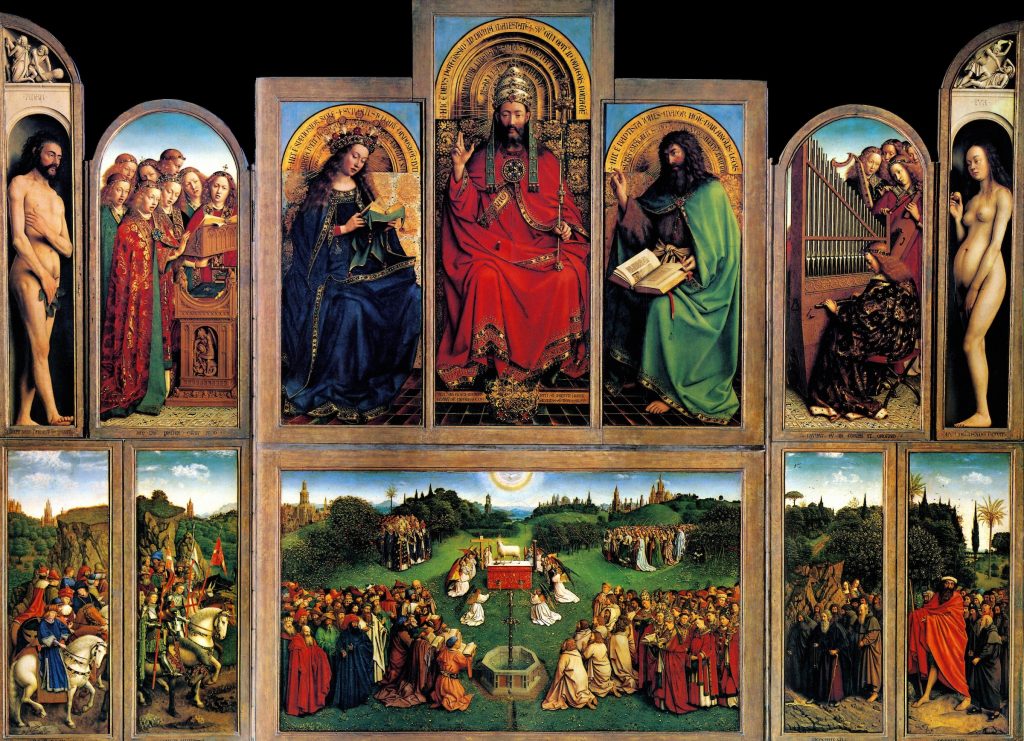
Jan van Eyck, The Ghent Altarpiece, 1430. Photo: Photo12/Universal Images Group via Getty Images.
The complexity of taking into account factors like condition and pigment deterioration are why for-profit tech companies like Art Recognition should “collaborate with the scholarly community,” Martens said. “These algorithms need to be trained by art historians and conservators who have spent decades studying Van Eyck.”
Martens, who co-authored a paper on the use of A.I. to detect cracks on the surface of Van Eyck’s Ghent Altarpiece in 2020, also raised doubts about the methods used by Art Recognition. After all, only around 25 paintings are attributed to the Flemish painter, so any dataset of his work is insufficient to feed an A.I. model, said Martens “even if every square inch of surface is taken into account.”
Ultimately, he noted the lack of “a serious, peer-reviewed scientific article” explaining Art Recognition’s methods, without which “all those claims are thoroughly untrustworthy.”
In an email, Carina Popovici said that she consulted Van Eyck specialist Till-Holger Borchert on the project and that he collaborated on building the model’s dataset. She added that she and Borchert are preparing a peer-reviewed paper. She has previously published three papers explaining Art Recognition’s methods.
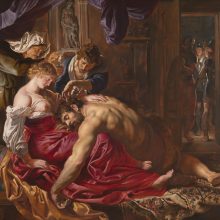
The A.I. company, which was founded in 2019, has frequently made headlines for its bold claims about the authenticity of famous works of art. In 2021, it claimed that Rubens‘s Samson and Delilah, owned by London’s National Gallery, was a fake. Though the authenticity of the painting has been called into question, leading experts tend to agree that it is an authentic work by the Flemish Baroque painter.
Nils Büttner, chairman of the Centrum Rubenianum in Antwerp, who is working on the definitive Rubens catalogue raisonné, described doubts about the work as “conspiracy theories.”
Martens believes Art Recognition had already “discredited itself” years ago with the Rubens claim. “I am afraid the media storm they create now will further hamper their reputation,” he said.
This story was updated with a comment from Carina Popovici on Tuesday, February 10 at 04:24 a.m. ET. It was edited for clarity on February 18 to specify that the Ghent Altarpiece paper Martens co-authored dates to 2020, given he has published multiple times on the subject.