Law & Politics
What the Turmoil at the Kennedy Center Means for the Arts
To what lengths will Trump go to control U.S. culture?

To what lengths will Trump go to control U.S. culture?
Sarah Cascone
 ShareShare This Article
Late last year, President Donald Trump renamed the Kennedy Center in Washington, D.C., “The Donald J. Trump and the John F. Kennedy Memorial Center for the Performing Arts.” The backlash was immediate. Now, he is closing the center for a major renovation, triggering fears for the future of the building, designed by architect Edward Durell Stone, and raising questions about how far he will go to win the battle over U.S. culture.
Shortly after taking office last year, Trump dismissed the Kennedy Center’s president of 10 years, Deborah Rutter. A new board of loyalists, led by Richard Grenell, a former ambassador to Germany with no arts experience, promptly elected Trump the center’s chairman. Grenell committed to eliminating so-called “woke” programming that he said appealed only to niche audiences, and thus wasn’t profitable. (Trump had promised “NO MORE DRAG SHOWS, OR OTHER ANTI-AMERICAN PROPAGANDA.”)
But the Kennedy Center has seen a precipitous drop in ticket sales under the new regime. The Washington Post reported last October that a 93 percent sell-through rate in fall 2024 had dipped to just 57 percent between September 3 and October 19—before the controversial renaming. Artists and performers have boycotted the venue under Trump, including an expected blockbuster production of Hamilton. (More than 100 staff members, out of 370, also departed over the course of 2025, and the Washington National Opera is moving out.)

An aerial view of the John F. Kennedy Memorial Center for the Performing Arts, is seen along the Potomac River in Arlington, Virginia. Photo by Kevin Carter/Getty Images.
When Trump abruptly put his own name on the facade in December, Representative Joyce Beatty (D-OH) filed a lawsuit attempting to block the change, which did not have congressional approval. Philip Glass, one of the nation’s greatest living composers, told the New York Times he canceled the long-awaited world premiere of his Abraham Lincoln-inspired Symphony No. 15, because “the values of Kennedy Center today are in direct conflict with the message of the symphony.”
Established by the National Cultural Center Act of 1958, the Kennedy Center opened in 1971 as a “living memorial” to assassinated President John F. Kennedy. It’s administered as a bureau of the Smithsonian Institution, but has its own board. It’s a public-private partnership, with federal funding for operations and maintenance, and privately funded programming. It has been a nonpartisan organization—until now.
Trump’s intervention, seen by some as a hostile takeover of an American cultural institution, has thrown the center’s future into question. Some of the programming over the last year has included a Charlie Kirk vigil, the Christian Persecution Summit from the American Conservative Union Foundation, and FIFA’s 2026 World Cup draw, which forced the cancellation of some previously scheduled programming.
In November, Senator Sheldon Whitehouse (D-R.I.) launched an investigation into whether Trump was using the venue to “dole out political favors.”

First Lady Melania Trump attends a screening of the documentary film Melania at the Kennedy Center in Washington, D.C. Photo by Samuel Corum/Getty Images.
The last event there before Trump announced the impending closure, set to take effect after July 4, was the premiere of Melania, the self-produced documentary film about First Lady Melania Trump.
In the surprise announcement, Trump claimed that a two-year closure is necessary to refurbish “a tired, broken, and dilapidated center.”
The Kennedy Center unveiled a massive $250 million renovation and expansion from Steven Holl Architects, called the Reach, in 2019. The original building is admittedly showing its age, but it is not clear whether needed repairs, such as to the leaky roof and HVAC systems, really necessitate a two-year shutdown.
“Is it renovations, or is it that he couldn’t fill the seats? You tell me,” Representative Alexandria Ocasio-Cortez (D-N.Y.), asked a reporter who questioned her about the planned closure.
“[Trump]’s run [the Kennedy Center] into the ground financially; he’s made it a place where performers don’t want to perform, and individuals don’t want to attend performances,” Representative Chellie Pingree (D-ME) said on Instagram. “I’m sure he’s just covering up the financial disaster he’s created there.”
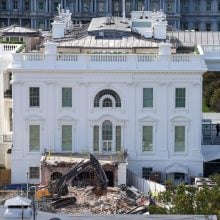
In the wake of the demolition of the East Wing of the White House to build a ballroom, and Trump’s promise of “complete rebuilding,” it is not hard to imagine a remaking of the Kennedy Center in the president’s highly gilded style. (In both terms, Trump has issued executive orders mandating classical architecture in all government buildings.)
Trump claimed the renovations will cost $200 million. (In 2025, Congress allocated $257 million for capital repairs on the building.) “I’m not ripping it down. I’ll be using the steel. So, we’re using the structure. We’re using some of the marble,” Trump told reporters.
The Kennedy Center is not especially revered for its architecture. Upon its completion, in fact, the New York Times delivered a savage review: “What it has in size, it lacks in distinction. Its character is aggrandized posh. It is an embarrassment to have it stand as a symbol of American artistic achievement before the nation and the world.”
But Stone is a highly respected modernist American architect, responsible for New York’s Radio City Music Hall and Museum of Modern Art—and the Kennedy Center does have its adherents.
“It may not be Edward Durell Stone’s most important, best-known, or most famous building, but the Kennedy Center is just a super elegant, beautiful, and serene looking example of how stately and grand the modernist expression can be,” C.C. Sullivan, the former editor of Architecture, now head of a design publicity firm, said.
He recently published a letter to the editor of the New York Times warning that Trump’s renovations could mean “Corinthian columns and gilded finishes” for “this 1971 masterpiece of modernism.”
Art and architecture critic Philip Kennicott is already bemoaning how Trump painted the building’s delicate gold columns white, writing in the Washington Post that “they read like columns but also like powerful cables that restrain the building’s exuberance. At sunset, as you approached for an evening performance, they also looked a bit like the strings of some great, wind-powered Aeolian harp.”
The National Trust for Historic Preservation, which is suing the administration over the demolition of the East Wing, declined to comment for this story.
When the Kennedy Center opened, it was to an outpouring of international support, including gifts of artwork from foreign ambassadors and cultural attachés from around the world. Today, there are 88 works from 36 countries, as well as many other gifts of art given to the center over the decades.
Australia gave a quartet of tapestries by John Coburn. Egypt gave a 4,600-year-old alabaster vase. The U.K.’s contribution was a Barbara Hepworth sculpture. Other pieces on permanent view include a large, hanging glass sculpture by Dale Chihuly, one of Dustin Yellin’s layered glass and mixed media sculptures, and two Valery Koshlyakov murals in the opera house.
There are also a number of artworks on view at the Reach, including prints by Robert Mangold, Richard Anuszkiewicz, and Linda Sibio, from the permanent collection of VSA, the center’s organization dedicated to arts, education and disability (it was originally known as Very Special Arts.)
By far the most significant artwork in the center is a monumental, eight-foot bust of JFK by Robert Berks, whose monumental bronzes across D.C., for Mary McLeod Bethune and Albert Einstein, earned him the nickname “The Capitol’s Michelangelo.”

The Robert Berks bust of JFK at the John F. Kennedy Center for the Performing Arts in Washington, D.C. Photo by Leigh Vogel/FilmMagic.
And for the center’s 50th anniversary in 2022, the venue opened a permanent new exhibition, “Art and Ideals: President John F. Kennedy,” which is free and open to the public.
In New York City, Trump built his namesake Trump Tower on the site of the old Bonwit Teller and Co. department store, promising to donate a pair of Art Deco limestone relief panels to the city’s Metropolitan Museum of Art. When removing them in one piece proved too expensive, he destroyed them.
With the scope of Trump’s plans for the Kennedy Center still unknown—and his track record for putting the wrecking ball ahead of the design plans, as he did with the East Wing—it is worth keeping a close eye on the venue’s exhibitions and artworks. Trump seems determined to win his war for the heart and soul of American culture, regardless of the casualties.