Books
The Best Art Books of All Time (According to Us)
Our staff shared their favorite books on art of all time—from a gothic-tinged memoir by Sally Mann to a rollicking, research-rich portrait of the artist’s psyche across centuries.

Our staff shared their favorite books on art of all time—from a gothic-tinged memoir by Sally Mann to a rollicking, research-rich portrait of the artist’s psyche across centuries.
Annie Armstrong &
Kate Brown &
Sarah Cascone &
Min Chen &
Eileen Kinsella &
Andrew Russeth &
Katie White &
William Van Meter
 ShareShare This Article
Summer is a great time to revisit the art books we love best. They’re not necessarily best sellers or famous or familiar titles. Our team members each share the one seminal art or art history book they find unforgettable

Hold Still (2015) by Sally Mann. Photo: courtesy of Hachette.
I’m glad this listicle is coming out in the dead of summer, because that’s the perfect time to crack open Sally Mann’s memoir—part account of life in rural Virginia, part reflection on her photographic career (scandals and misinterpretations included), and part intense meditation on family. Art lovers will get hooked by her easter eggs about Cy Twombly—like the story of his odyssey through Virginia antique stores to find a childhood painting of a sailboat—and by her brusque, clear-eyed response to the Immediate Family controversy: “The fact is that these are not my children; they are figures on silvery paper slivered out of time.”
I love this book as a child of the Deep South, though. When I feel homesick, I read her romantic, ecstatic recollections of rumbling summer storms, carefree skinny dips in cool rivers, swaying Spanish moss, mosquito bites, sunburns, and broken arms. She writes frankly about the ghosts of the Deep South’s past and present, but doesn’t turn away from its bedeviled beauty. Her prose reads like her photography: a Southern Gothic tale told with exquisite, shadowy detail. “So alluring and so repellent, like fruit on the verge of decay,” she writes of the landscape. I wish I could jump into this book as though it were a lake.
Earlier this year, Artnet News reported on a group of Texan policemen who spent $7,000 of taxpayer funds to visit three New York museums in an effort to research Mann’s artwork for “critical leads” towards a new version of the old culture wars debate over the use of Mann’s kids in her photos. The case was later dropped, and I like to imagine it’s because those cops got to the Guggenheim, took a real look at the work, and said, “Oh.”
—Annie Armstrong

Born Under Saturn: The Character and Conduct of Artists (1963/2006) by Margot Wittkower and Rudolf Wittkower. Photo: courtesy of Penguin Random House.
To tell the truth, I have been wavering about whether to include Margot and Rudolf Wittkower’s Born Under Saturn (1963/2006) here. It is so rich with rare information, and so wildly entertaining, that I have been tempted to keep it to myself. But everyone deserves to experience its magic, I have decided. Surveying primary sources from antiquity to around the time of the French Revolution, the Wittkowers offer a lucid account of—as their book’s subtitle has it—“the character and conduct of artists” over the centuries in Europe.
The basic argument of these freethinking art historians is that the idea of the artist as a brooding, alienated individual—which, of course, still holds today—was developed by ambitious painters and sculptors to differentiate themselves from mere workaday artisans. They make their case convincingly, with crisp prose, but the real reason to pick up this book is for its bounty of anecdotes about how artists approached life, in sections like “Suicides of Artists,” “Genius, Madness, and Melancholy,” and “Misers and Wastrels.”
Two choice examples of the breadth of their research: Dürer once wrote to a patron “you stink so of whores that I can smell it over here.” And Cellini had no fewer than four serious run-ins with the law and avoided some punishments variously via a papal pardon and the intervention of Duke Cosimo I. These are not examples to emulate, to be sure. But you do have to admire the confidence of Guido Reni—“an inveterate gambler,” according to our authors—who once told a Catholic cardinal: “Money means nothing to me for I am an inexhaustible goldmine in my brushes.”
—Andrew Russeth

High Price: Art Between the Market and Celebrity Culture (2009) by Isabelle Graw. Photo: courtesy of Saint-Martin Bookshop.
Like many of us, when I first got drawn into the art world, I believed—naively, maybe hopefully—that there was a clear boundary between art and the art market. One basket for ideas, one for money. Isabelle Graw, the art critic and publisher of Texte zur Kunst, put that illusion forever to rest for me with High Price. Written in the aftermath of the 2008 financial crash, the book reads like both diagnosis and warning: the market isn’t just shaping how art is bought and sold—it’s shaping what art is, and what it means.
Graw argues that the art economy has evolved from a niche trade among insiders into a consumer industry that manufactures meaning. She dismantles the idea that artistic and market value can be cleanly separated. Instead, she insists the two are in constant, mutually reinforcing tension. Most significantly, she posits that while art may be a commodity like all the rest, it’s a strange one because its symbolic value must precede its financial value (this was, problematically for the art world, not the case with NFTs). With art the promise is: no meaning, no money.
It’s not a cynical take so much as a contemplative and realistic one. Graw also considers artists who have integrated the market intelligently into their work, exploring the practices of Andrea Fraser and Merlin Carpenter.
Packed with great quotes and doses of post-Fordism and pepperings of Marxist thinking, High Price is one of those books that I frequently pull off my shelf when I am working on an essay or trying to center my thinking around a story—there are a lot of notes in the margins. Nota bene: if you really want to take off your rose-tinted glasses and throw them out forever, a perfect pairing for High Price is Hito Steyerl’s Duty Free Art: Art in the Age of Planetary Civil War.
–Kate Brown

Pictures of Nothing (2006) by Kirk Varnedoe. Photo: courtesy of Princeton University Press.
Why should we bother with abstract art? Kirk Varnedoe, then chief curator of painting and sculpture at the Museum of Modern Art, makes a moving, humorous, and even existential case for non-representational art in his book Pictures of Nothing (Princeton University Press, 2006). The text is drawn from Varnedoe’s A. W. Mellon Lecture Series, which he delivered to throngs of art believers—and maybe a few doubters—at the National Gallery of Art in Washington in the spring of 2003, mere months before his death from cancer.
Varnedoe charts abstraction from Jackson Pollock through five decades since—acknowledging attitudes of skepticism. One memorable and moving description of a Cy Twombly painting comes up in my mind years after reading this book with surprising frequency. The lectures are heartening and enlivening, and Varnedoe asks us to embrace “a recurrent push for the temporarily meaningless,” as an act of faith.
—Katie White
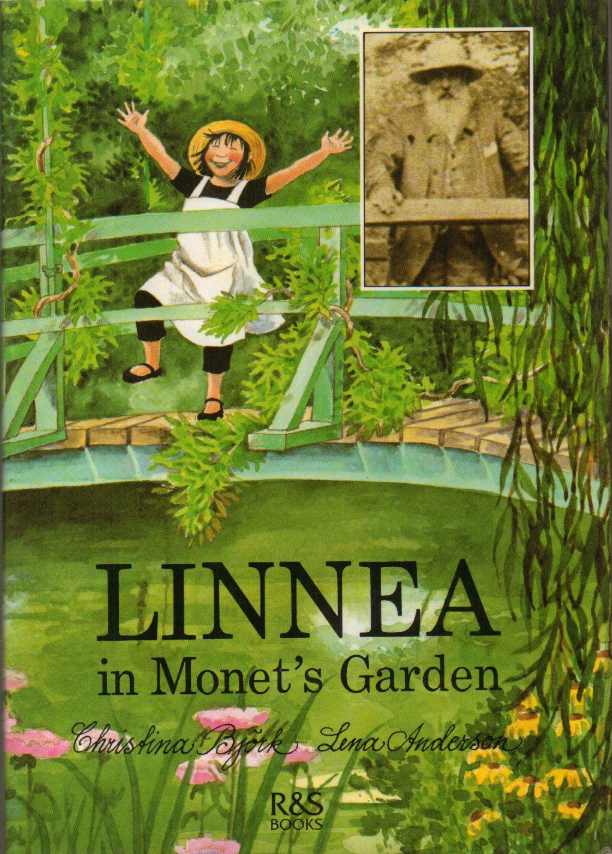
Linnea in Monet’s Garden by Christina Björk and Lena Anderson (1985/87). Photo: courtesy of R & S Books.
I’ve already shared in another post why I love Jonathan Harr’s The Lost Painting, so rather than rehash that old favorite, I thought I’d dive a little deeper, to the children’s book that helped cement my love of art and set me on the path to the fulfilling art career I enjoy today.
Linnea in Monet’s Garden is two stories in one: the life of Claude Monet and his blended family, and the tale of a young Swedish girl named Linnea on vacation to see his paintings in Paris, and his famous home and garden just over an hour from the city in the village of Giverny—the subject of many of the artist’s paintings. The book is gorgeously illustrated, combining co-author Lena Anderson’s adorable watercolors of the book’s titular child heroine with Monet’s instantly recognizable oils.
There are also historic photos of the great Impressionist and his children, as well as contemporary snapshots taken by the authors during their meticulous research for the book, which involved visiting the pink house and its waterlily pond for themselves. But I also learned—and never forgot—fascinating art historical tidbits about Monet, like the fact that he temporarily went nearly blind due to cataracts (miraculously cured by surgery), and that his paintings of Giverny’s Japanese bridge were neigh unrecognizable for a couple of years. On a more macabre note, there’s also a reproduction of Monet’s portrait of his first wife, Camille, painted after her death. (It was years later before I realized most people don’t know about either of those things.)
Reading it again today, I’m reminded of how magical this book made Paris seem, and how much of an appreciation of art it instilled in me from a young age. There are few children’s books I would consider more formative, or that I would more wholeheartedly recommend to a burgeoning art lover.
—Sarah Cascone

Celine Dion’s Let’s Talk About Love: A Journey to the End of Taste (2007) by Carl Wilson. Photo: courtesy of Bloomsbury.
Admittedly, this is an unlikely book to have on a list about art and art history, but stick with me. Wilson’s seminal entry in the 33 1/3 series is ostensibly about Celine Dion’s blockbuster 1997 album, which contains her world-dominating Titanic theme song, though Let’s Talk About Love becomes more of a jumping-off point for the critic to unpack the tension between commercial success and critical disdain. Why do people love this record? And why do critics love to hate it?
Wilson’s journey to untangle taste roves through the history of schmaltz, the division between high and low art, and the matter of social prejudice. In engaging prose, he consults with sociologists and critics from Pierre Bourdieu and Theodor Adorno to David Hume and Clement Greenberg on artistic and cultural theory, before rubbing elbows with Dion fans at her Las Vegas residency. He delves into musicals, novels, and camp aesthetics. He also highlights Russian artists Komar and Melamid’s Most Wanted project, in which the duo explored popular taste by polling the public on the kind of art they liked and producing paintings based on those findings (America’s Most Wanted painting is a sentimental landscape dominated by a blue sky).
Aesthetic taste, Wilson finds, is a knotty relationship of class, identity, bias, and emotion. Breaking through that takes sympathy as much as an “art of translation,” he writes, a form that won’t “sit in judgment of its audience” but instead offers a “newness [that] consists in letting the world in.” It’s an open, winning notion. Sometimes, as Dion reminds us, we should leave it to the heart to go on.
—Min Chen

A Giacometti Portrait (1965) by James Lord. Photo: courtesy of Farrar Straus Giroux.
Even though Swiss artist Alberto Giacometti is one of my favorite artists, I wasn’t aware of this book until I learned Stanley Tucci (one of my favorite actors) was making a movie about it titled Final Portrait. My first order of business was to request an interview with Tucci for Artnet, which he agreed to. And my second was to get the book from The Strand bookstore. It documents James Lord’s experience of sitting for 18 days for Giacometti in his studio at rue Hippolyte Maindron, near Montparnasse, in Paris, while the artist worked out how to paint his portrait in oil. All the while Lord recorded the sittings and took photographs of the work at its various stages.
What was supposed to be a one- or two-day sitting stretched into a far more lengthy and intense timespan, during which Lord saw first-hand the artist’s alternately inspired and tortured creative process. Lord also became privy to Giacometti’s complex relationships with his loyal brother Diego, and his even more loyal wife, Annette, not to mention local prostitutes and his mistress Caroline.
Tucci told me how he was struck the first time he happened upon Giacometti’s artwork and that, when he found the book: “I carried it with me like a kind of bible—like a creative bible.” I couldn’t agree more with his description: “It is so beautifully written and interesting to read.”
—Eileen Kinsella

The Andy Warhol Diaries (1989) edited by Pat Hackett. Photo: by William Van Meter.
The Andy Warhol Diaries isn’t just a portrait of the artist in his own words—it’s a document of an era and city in flux, from the high-octane disco glamour of the 1970s through the image-obsessed 1980s. Sure, there’s plenty of celebrity cameos—Halston, Liza, Bianca, Liz—but it’s also full of surprising poignancy and occasional revelation, both personal and artistic. Dictated in near-daily phone calls to Factory stalwart Pat Hackett, the entries capture Warhol’s deadpan voice and flitting mind, bouncing between gossip, anxieties, art-making, and mortality.
This is not the untouchable, effortlessly cool Warhol of the Silver Factory era. By the 1970s and ’80s, he’s no longer the mythic figure at the center of the avant-garde, but a celebrity among celebrities. He’s ensconced in the day-to-day swirl of Interview magazine and constantly hustling to sell society portraits. He obsesses over healing crystals, calorie counts, and cash flow. He launches a modeling career and guest stars on The Love Boat. He becomes deeply entangled with Jean-Michel Basquiat, their bond blurring lines between friendship, influence, and calculated reinvention. For all of the party-hopping and bold-faced name-dropping, underneath it all is a current of loneliness. The Diaries also trace the emergence of AIDS. When his love interest, the Paramount executive Jon Gould dies, Warhol notes it quietly: “And the Diary can write itself about the other news from L.A., which I don’t want to talk about.”
In the end, what emerges isn’t just gossip or celebrity churn, but a raw and revealing self-portrait—unguarded, intimate. It’s one of Warhol’s masterpieces.
—William Van Meter