Art & Exhibitions
Tate Modern to Mount Its First Monet Show Ever
The museum unveiled its full slate of programming for 2027, including an immersive installation by David Hockney in the Turbine Hall.

by
Vittoria Benzine
 Share This Article
Today, the Tate Modern museum in London announced its slate of 2027 exhibitions, including an opera-inspired installation by David Hockney in the revered Turbine Hall marking the artist’s 90th birthday, Algerian artist Baya’s debut U.K. solo show, and the first-ever exhibition devoted entirely to French impressionist Claude Monet since the Tate Modern opened 26 years ago. That milestone show, titled “Monet: Painting Time,” is scheduled to open on February 27, 2027.
“Painting Time” will present “breathtaking paintings from lenders across the globe, including rarely seen works from private collections,” the museum noted, while also “drawing on new research.”
The Tate Modern’s rendition will follow the exhibition’s initial engagement, opening this September 30 at the Musée de l’Orangerie, which remains best known for its two oblong galleries immersing viewers in eight of Monet’s beloved Water Lilies. As such, the Musée de l’Orangerie’s showcase will honor 100 years since Monet’s death with 40 paintings, mostly sourced from the Musée d’Orsay and Musée Marmottan, and conclude with an ode to said Water Lilies. The exhibition will also feature a virtual reality component.
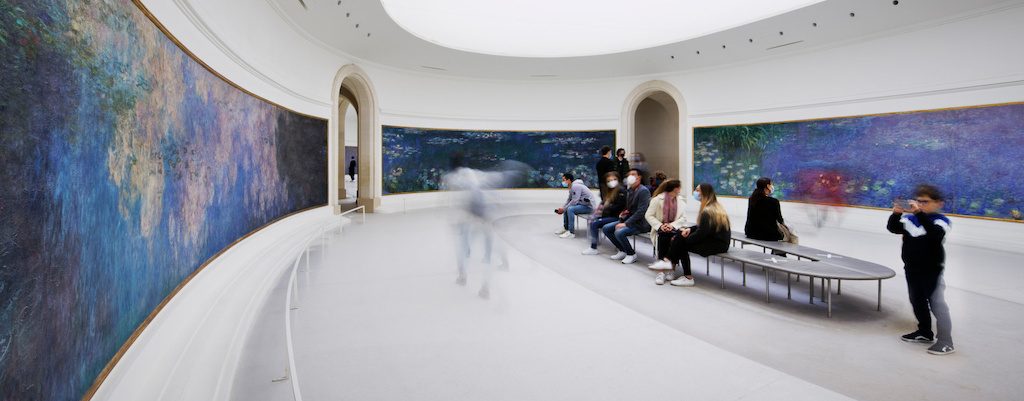
“The Water Lilies” by Claude Monet at the Musée de l’Orangerie, Paris. Photo courtesy of the Musée de l’Orangerie, Paris.
The Tate declined to comment on how its presentation might differ from the Musée de l’Orangerie’s—especially considering the Tate alone will benefit from the support of heavyweights like Morgan Stanley and Anthropic. Nevertheless, “Painting Time” marks just the latest effort to expose underrepresented elements of Monet’s ubiquitous oeuvre.
Recent endeavors have largely focused on the artist’s relationship with various world capitals, like “Picturing Paris,” which concluded at Oberlin College’s Allen Memorial Art Museum last December, and “Monet and Venice,” which opens at San Francisco’s de Young Museum later this month.
“Painting Time” appears to draw from art historian Andre Dombrowski‘s 2023 book “Monet’s Minutes: Impressionism and the Industrialization of Time“—the first to explore this overlap. Although neither the Musée de l’Orangerie nor the Tate Modern mention Dombrowski in their announcements, the French institution evokes his tome by similarly contextualizing Impressionism’s adoration for the fleeting present within the 19th century—an era where the Industrial Revolution was booming, locomotives like the one in Monet’s Arrival of the Normandy Train, Gare Saint-Lazare (1877) were zooming, and clocks were looming in more and more public places, serving the rise of standardized time.
Meanwhile, in series like Monet’s Haystacks (1890-91) and Poplars on the Epte (1891–97), the artist dissected time by portraying subjects repeatedly. Society’s pace has only accelerated in the centuries since. Surely “Painting Time” will feel like it’s opening in, well, no time.

Related Articles
-


