Art History
Revealing the Secret History of Rembrandt’s ‘The Night Watch’
Rembrandt's largest painting is more complicated than it appears.
by
Richard Whiddington
 Share This Article
Listen to this article:
When the Rijksmuseum reopened after a decade-long, $410 million redevelopment in 2013, it was party time in Amsterdam. In a ceremony marked by fireworks, oranje carpets, and military marching bands, Queen Beatrix thrust open the doors with the turn of an oversized bronze key.
Particular reverence was reserved for Rembrandt van Rijn’s The Night Watch (1642), the altarpiece around which, as the director put it, the entire museum had been built. A flash mob recreated the famous scene in a shopping center, the work trended on social media, and the painting itself was treated to a royal entrance: housed in a custom-made box, it was lowered by crane onto wheels and carefully shepherded through streets lined with proud Amsterdammers.
Inside, it took its rightful place in the majestic Gallery of Honor, where it glowed beneath newly fitted skylights enhanced with LED lighting. Within seven years, however, The Night Watch was back in a box, this time one of glass, as Rijksmuseum conservators embarked on a thorough restoration in full view of the public, one extending worldwide courtesy of a live video stream.
It was the first restoration in more than 40 years and the latest chapter in the painting’s tumultuous history. Rembrandt received the commission sometime in late 1640 from the Kloveniers, a volunteer militia of musketeers. They wanted it for the banquet room of the newly built Kloveniersdoelen, where it would hang along paintings of five other militias.
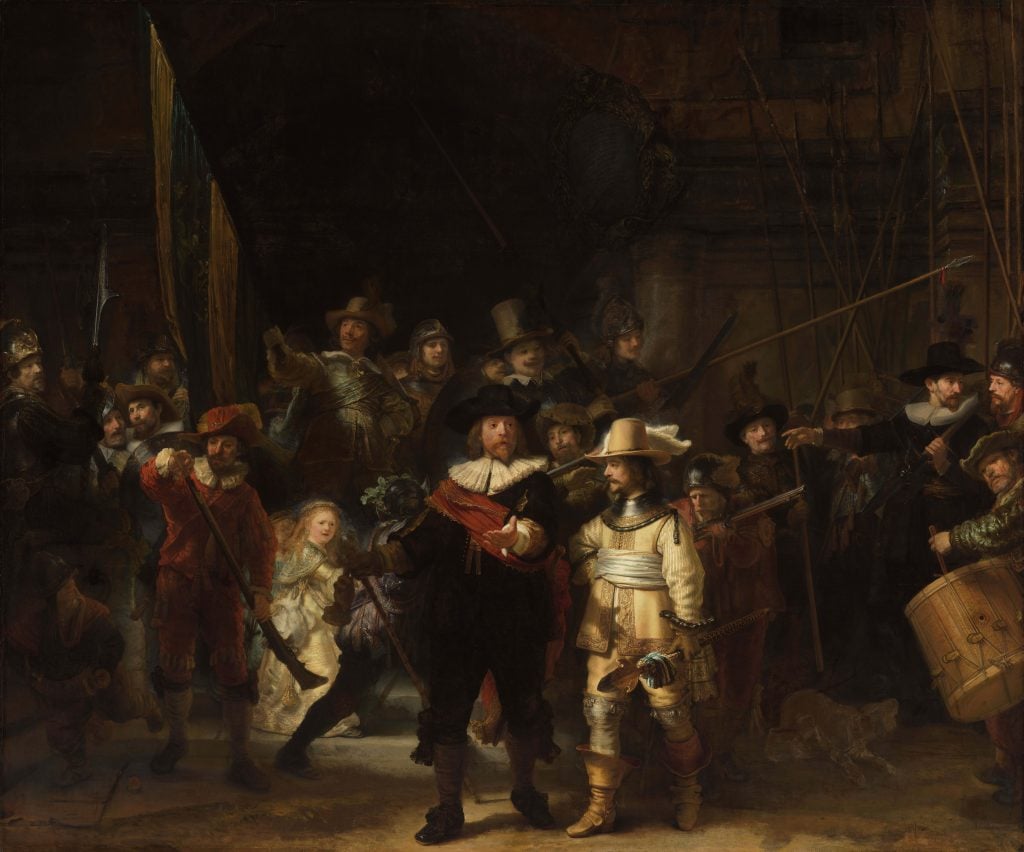
Dynamic, dramatic, and playful, it broke from the tradition of staid group portraits and Rembrandt was compensated handsomely for his largest-ever commission—somewhere between 2,000 and 4,000 guilders, perhaps as much as three-quarters of a million dollars today. Sitters paid according to prominence, with Captain Frans Banninck Cocq and his lieutenant Willem van Ruytenburch contributing the most. They emerge on the canvas locked in lively conversation and surrounded by a merry band of militiamen. An enigmatic girl hovers to their right, her glowing tresses carry a dead chicken, whose claw was the troop’s emblem.
Contrary to popular myth, the painting was not rejected by its commissioners, but it has suffered numerous indignities in its nearly 400-year history. In 1715, it was pared down to fit between two doors in Amsterdam’s Town Hall, and its name arrived at the end of the 18th century on account of varnish and dirt that had darkened it into a nighttime scene. The action, in fact, takes place at dawn’s first light, perhaps a symptom of other ways in which Rembrandt’s work has been misunderstood.
Here, we delve into the details of the Dutch masterpiece to unearth some of the fascinating history that has been overshadowed.
Tiny Details Show Amsterdam’s Place in a Changing Europe

Details of “The Night Watch” showing Amsterdam’s coat of arms. Photo: courtesy Rijksmuseum.
When the painting was commissioned in late 1640, Dutch freedom from Spain was close at hand. Spanish forces had been driven deep into Belgium, and though the Treaty of Münster concluding the Eighty Years’ War wouldn’t be signed until 1648, the so-called Golden Age was at its peak. Amsterdam was a flourishing center of art, science, and commerce, granting it a sense of power and independence.

Joachim von Sandrart I, Officers and other Civic Guardsmen of the XIX District of Amsterdam waiting to welcome Marie de Médicis, 1 September 1638, 1640. Photo by Heritage Art/Heritage Images via Getty Images.
In 1638, the city had acted on this confidence and invited Marie de’ Medici, the exiled mother of Louis XIII, for a royal visit. In doing so, Amsterdam defied the protestations of the central authorities in The Hague, who were worried about jeopardizing relations with France. What followed was a six-day celebration that saw Marie de’ Medici escorted by the full complement of the city’s militias (despite heavy rain) and decorated in the grand hall of the Kloveniersdoelen. It was, in short, a flex—an exorbitant one, at a whopping 8,000 guilders (for reference, the grand home Rembrandt bought in central Amsterdam in 1639 cost 13,000 guilders.)
The Night Watch is perhaps the greatest legacy of Marie de’ Medici’s visit. To decorate the Kloveniersdoelen’s cavernous walls, tapestries had been rented, and in their absence afterwards, it was decided that portraits of six militias who had taken part should be commissioned.

Jan Martszen de Jonge, Arrival of the procession with Maria de’ Medici at the triumphal gate on the Varkenssluis (ca. 1638). Photo: courtesy the Rijksmuseum.
Rembrandt drew from the numerous sketches and engravings that had been created to commemorate the event. In a formal sense, he mimicked the staged and theatrical depictions of Marie de’ Medici entering the city, known as tableaux vivants, with prominent groups arranged ostentatiously in front of architectural features. This is fitting because Rembrandt’s cast of characters are in effect acting: though originally formed for municipal defense, by 1640 the militias had become social networking clubs. The members are essentially cosplaying (more on that later). Another reference is more explicit. The archway was likely drawn from Jan Martszen de Jonge’s sketch of Marie de’ Medici before a theatre gate.
The message is one of civic pride, a point embodied by Banninck Cocq. Rembrandt has him dressed in the red and black of Amsterdam’s colors (militia captains typically sported a blue sash trimmed with gold lace). The shadow of his hand falls on the mantle of Willem van Ruytenburch’s coat, right at the place where the city’s coat of arms is subtly embroidered. Remember the militia’s role in Amsterdam’s independence, the painting declares with a little wink, we’re in safe hands.
A Hidden Map Reveals Meticulous Planning
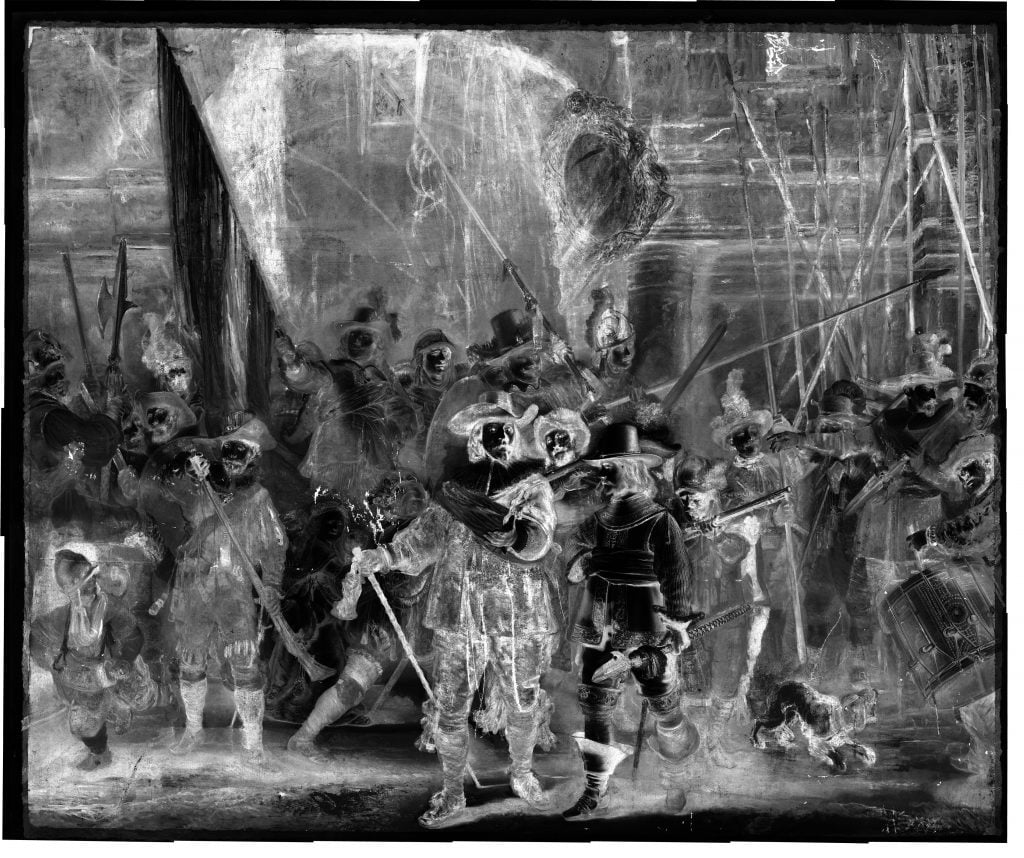
The Calcium map of Rembrandt’s The Night Watch. Photo courtesy The Rijksmuseum.
Thank goodness for calcium. This was the sentiment shared by members of “Operation Night Watch,” the 30-strong team that employed the latest technologies to delve into the painting as part of its most recent restoration. Given its scale and complexity, scholars had long suspected Rembrandt had made a preparatory sketch, but until 2021 (including a radiographic examination in the 1970s), one hadn’t been found.
The breakthrough came with the use of macro X-ray fluorescence. This allowed researchers to isolate the chalk present in the beige paint Rembrandt used to lay out his largest work. It’s the only known example of the artist applying this type of paint, and “Operation Night Watch” duly labelled the emergent picture “a calcium map.”
The painting’s structure becomes clear. First came architecture, columns, and wraparound ledges of the Kloveniersdoelen set the scene below in place. As previously mentioned, the archway grounding the action is fictitious, a symbol, perhaps, of the city the militia have sworn to protect. Before the canvas was pared down to fit inside Amsterdam’s Town Hall, the archway stood at its center with the protagonists’ position askew on the right, creating a sense of purposeful movement.
Rembrandt also tinkered with the composition. Unsurprisingly, Banninck Cocq received the most thorough sketch, and elements surrounding him, such as the spears and feathers of militiamen, were removed to keep the focus on the captain. Adding to the drama was a plume of musket smoke that wafted around Banninck Cocq’s head. It has completely disappeared through deterioration, something the scan showed Rembrandt had tried to ward off with a grounding of brown quartz paint. The sketch, “Operation Night Watch” said, is like peering over the great master’s shoulder.
There’s Devilishness In the Details

Rembrandt, The Night Watch (ca. 1642). Photo: courtesy the Rijksmuseum.
Why is The Night Watch so famous? The answer, in part, is that it has come to symbolize European democratic values. Rembrandt’s vision was hardly so serious. In fact, some art historians argue the whole scene can be seen as a light-hearted painterly joke.
There is a pantomime quality to the action with the band of 18 militiamen gallantly performing the art of civil defense. It’s a busy melee, some strike bold poses, others are locked in earnest conversation, or gaze wistfully to the heavens. Then there are the 16 extras (plus a dog), who crowd the scene and draw attention away from Rembrandt’s paying customers. This is not the well-drilled militia that will save Amsterdam in its hour of need, it’s a costume party.

Jacques de Gheyn, The Exercise of Arms (ca. 1607). Photo: courtesy the Metropolitan Museum of Art.
Red was the chosen color in Dutch military and court circles, and yet only three wear it here. Those are the three musketeers, who act out the loading, firing, and cleaning of the weapon. By the 1640s, their style of dress was long outdated, belonging to the 16th century. Instead, most of these militiamen don civilian attire that shows off their wealth as merchants. In outfits of lace, silver brocade, decorative breeches, and ostrich feathers, we meet not only the expensive fashions of the 1630s, but also a city thriving from global trade.
The musketeers seem antiquated by comparison, and scholars also note that their gestures and muskets, which Rembrandt drew from Jacques de Gheyn’s illustrated military manual, are erratic and not in keeping with standard military procedure, something Rembrandt would have known given his collection of weapons and books on the subject. Sure, the three musketeers are symbolic, representing the official weapon of the Kloveniers, but there’s a comedy to a faceless man firing off a shot at close range to the head of Lieutenant Willem van Ruytenburch. The confused expression on the face of the enigmatic “golden girl” seems to agree.

Related Articles
-


