

As the U.S. marks 250 years, we’re diving into the early American art world—and the figures the spotlight missed—who are finally getting their due. Read about the 19th-century pottery star Nampeyo, the women artists of the American West, and the overlooked first Black professional artist, Joshua Johnson.
No family did more to define American art in its infancy than the Peales. Charles Willson Peale painted the Founding Fathers, founded one of the nation’s first museums, and established the first art school, the Pennsylvania Academy of the Fine Arts (PAFA) in Philadelphia. His sons, brothers, and their children followed him into the field, creating a multigenerational dynasty unparalleled in American art history. And one of the most pioneering of all the artists in the family legacy, his niece Sarah Miriam Peale, was arguably the first professional woman artist in the United States. Yet, she has been reduced to a footnote.
Born in 1800, Sarah forged a unique path. She never married, and supported herself as an artist across six decades. She painted hundreds of portraits and still lifes, advertising her services as an artist for nearly 60 years out of studios in Baltimore and later in St. Louis, moving on her own to what was then still a frontier town. (She died in 1885.)
In the single solo show of her work, which was held in 1967 at the Peale Museum in Baltimore, Sarah was hailed as “the first successful woman artist in America and the only truly professional one until late in the 19th century.” And, still today, almost no one knows her name.
That may soon be changing. As museums and scholars undertake a long-overdue reckoning with the women written out of art history, Sarah is rightfully emerging as one of its most compelling recoveries—with exhibitions at PAFA, the Winterthur Museum, Garden and Library in Delaware, and the National Museum of Women in the Arts (NMWA) in Washington, D.C., including her work in the coming years.


Charles Willson Peale, The Peale Family (1773–1809). Collection of the New York Historical, gift of Thomas Jefferson Bryan.
A Family Forged in Art
When it comes to the Peales, it is Charles Willson Peale and his sons Rembrandt Peale and Raphaelle Peale who have become the institutional and canonized darlings. Charles, who was on the home front during the American Revolution fighting as a captain in the Pennsylvania militia, painted many of the Founding Fathers at the height of the war, including George Washington. The once-struggling saddle maker became the head of a multigenerational artist dynasty and father of 18 children.
It’s a complicated family tree, unparalleled in the history of American art. Charles’s brother James Peale Sr. was an esteemed miniature painter, and taught his daughters, including Sarah and her older sisters Anna Claypoole Peale and Margaretta Angelica Peale. Various other Peales were also artists, including Charles’s sister-in-law, daughter-in-law, two nephews, two grandnephews, five granddaughters, and beyond. After Charles founded PAFA, which opened in Philadelphia in 1807, Sarah and Anna were the first women artists elected as members, in 1824. Eight other Peale women exhibited there over the years.


Charles Willson Peale, George Washington (ca. 1779–81). Collection of the Metropolitan Museum of Art, New York.
“The size of the family, just the number of children that went on to become artists, had a huge impact because it helped really establish American art as a real practice,” said Deborah Gaston, the director of education and interpretation at NMWA, which owns a pair of Sarah’s portraits, as well as work by Anna.
The Peales largely taught each other, often copying their compositions and painting the same elements in their still lifes. A single ceramic basket even appears across paintings by six different family members, including those by Sarah. This development of a distinct family style, however, may have helped obscure the talent of the Peale women, long overshadowed by their male relations.


Attributed to Sarah Miriam Peale, Millard Fillmore (ca. 1845–50). Collection of the U.S. House of Representatives.
Becoming a Woman Artist
Sarah continued the family tradition of painting important political figures. The collection of the U.S. House of Representatives includes a portrait of President Millard Fillmore attributed to Sarah, and she had four sittings with war hero the Marquis de Lafayette during his 1824 return to the U.S.
“Sarah’s been submerged under the Peale family, which in itself is not very well understood,” said Carol Eaton Soltis, a project associate curator at the Philadelphia Museum of Art and author of The Art of the Peales in the Philadelphia Museum of Art. “It becomes a three-ring circus, and Sarah becomes a minor attraction. And she’s not. She’s a wonderful painter.”
Sarah studied first with her father James, and then with her cousin Rembrandt. At a time when formalized art education was rare, the Peale women had unique access to the field. Women were also long excluded from figure drawing classes, a foundation that was essential to the lucrative genre of history painting.
“Looking at the history of women artists, the ones who do actually make it as professionals, they had a male relative who could teach them, which meant they weren’t subjected to a lesser kind of training,” Gaston said.


Sarah Miriam Peale, Self-Portrait (ca. 1830). Collection of the Maryland Center for History and Culture.
Making Her Own Name
Sarah’s first recorded work is a stunning self-portrait, completed at just 18 years old and one of her most enduring images. The work—and her PAFA debut that year—announced the arrival of a remarkable new talent.
Sarah followed in her sister Anna’s footsteps, but took her professional career one step further. Anna regularly exhibited at PAFA and sold work, though she stopped working after her second marriage. Sarah, on the other hand, made work for 60 years, opening a studio in Baltimore and working often in D.C. before she moved to St. Louis in 1847, living there for 30 years.


Sarah Miriam Peale’s business card, identifying her as a portrait painter. The address, “South East Corner of 9th and Pine,” may be in Washington, D.C. Collection of the Maryland Center for History and Culture, Baltimore.
Part of the reason for Sarah’s relative obscurity is that she did not have an independent archive of her writings. Back in the 1980s, a woman came to the Maryland Historical Society, now Maryland Center for History and Culture, with a selection of paintings by Sarah, both still lifes and portraits of her ancestors. She promised to donate them all, along with two boxes of Sarah’s letters with the family.
“She would not let us photograph or copy the correspondence, but she was bequeathing it all to us,” recalled Stiles Tuttle Colwill, then the center’s curator and now its incoming board chair, as well as a prolific Peale family collector who owns over 60 of their works. But when a minister delivered the donation some years later, there was only one painting. He told Colwill he had burned the correspondence because “it was too intimate.”
Though she is mentioned in some of Charles’s letters, housed with the family papers at the American Philosophical Society Manuscript Collections, and there are records from newspaper advertisements of her services, there remains very little in her own words.


Sarah Miriam Peale, Still Life: Peach, Pear and Grapes on a Plate (1868). Collection of the Hammond-Harwood House, Annapolis, Maryland. Purchase through gifts of Dee and Sandra Murray, Gregory Stiverson, Emelie Stiverson, Richard and Beverly Tilghman, 2024.
A Mysterious Chapter
There are few traces of Sarah’s life after she left Baltimore. The reason for the move remains something of a mystery. She won prizes at art competitions, exhibiting still life works at the St. Louis Fair beginning in 1856, and a pair of portraits in the 1860 edition. Newspaper articles mention some of her notable sitters, but the whereabouts of almost all of her work from this period remain unknown, perhaps stashed away in local attics. (A handful of her St. Louis-era portraits are in public collections.)
“There has to be a body of work out there that none of us have seen, which is tantalizing to me because she was so brilliant when she left Maryland,” Soltis said. “The level of the work that she had produced at that point is really exceptional.”


Sarah Miriam Peale, Helen Sinclair Owens (Mrs. Leonidas Cecil), ca. 1857. Collection of the Maryland Center for History and Culture, Baltimore.
Sarah was also involved in the formation of the short-lived Western Academy of Art, the city’s first professional art school. There, she may have taught Hannah Brown Skeele, a Maine transplant who described herself as self-taught when first exhibiting in 1858. Two years later, at the Western Academy’s first exhibition, Skeele showed an accomplished still life, Fruit Piece, that now belongs to the Art Institute of Chicago.
“It is extraordinary, and it looks very much like a Peale still life,” Amy Torbert, associate curator of American art at the St. Louis Art Museum, said. “I love thinking that with Sarah’s presence in St. Louis, many more women were very much inspired by her model and by the instruction that she was giving through the Western Academy of Art.”

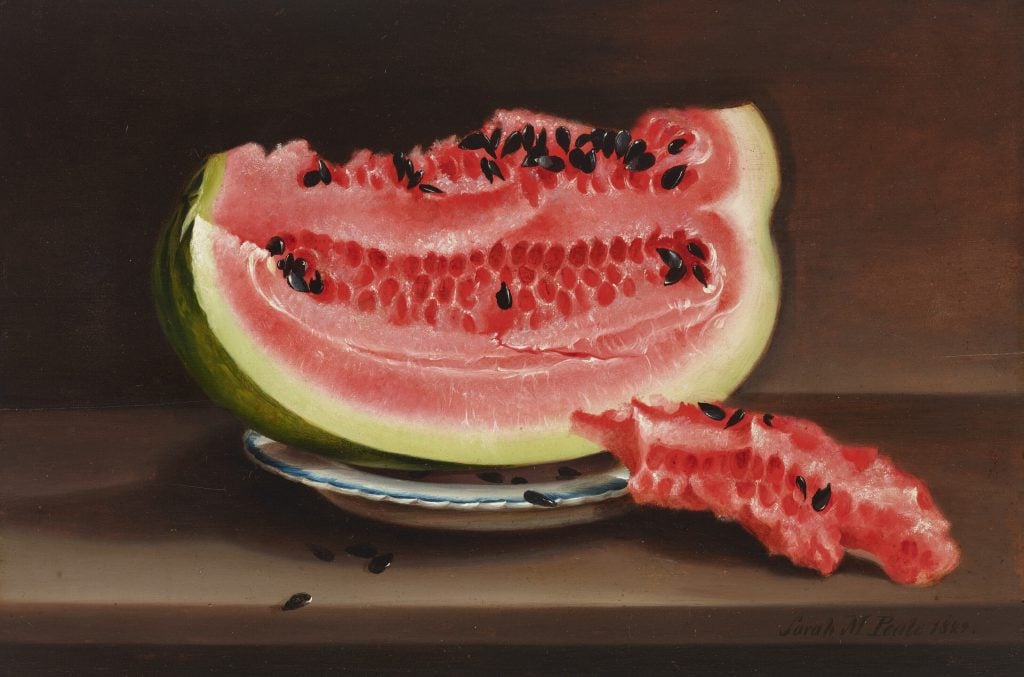
Sarah Miriam Peale, Watermelon (1822). Photo courtesy of Christie’s New York.
An Undersung Market
Sarah’s auction record currently stands at $277,200, a price achieved at Christie’s New York in 2023 for the 1822 still life Watermelon. It bested a mark of $61,900 that had stood since 1996, also for a still life. In fact, the only other time in the last 10-plus years that Sarah has cleared $20,000 was in 2021, according to the Artnet Price Database.
That mark currently represents her most expensive portrait, of an unidentified mother and child. Before that, you have to go back to 1994, when the National Museum of Women in the Arts purchased a matching pair of portraits, Susan Avery and Isaac Avery, at Butterfields in San Francisco for $21,850.


Sarah Miriam Peale, Susan Avery and Isaac Avery (1821). Collection of the National Museum of Women in the Arts, Washington, D.C.
The intricate details—the delicate lace of Susan’s collar, embroidered shawls, jewelry—are typical of her early work, but such ancestral portraits of the merchant class have limited present-day demand, despite Sarah’s unquestionable skill. She remains the only one of the Peale women to have hit six figures, compared to at least seven of the family men.
The Time for Rediscovery
Last year, the Peale women got a brief moment in the spotlight at the Hammond-Harwood House in Annapolis. “In the Shadow of a Legacy: The Peale Women Painters” featured 22 works by seven of the Peale women, in their first dedicated exhibition. At NMWA, the portraits of the Averys will be featured in “Ms. Americana,” opening April 2026, an installation in the museum’s great hall of 10 works from the collection by historical women artists, including Anna Claypoole.


Anna Claypoole Peale, Nancy Aertsen (ca. 1820). Collection of National Museum of Women in the Arts, Gift of Wallace and Wilhelmina Holladay. Photo by Lee Stalsworth.
PAFA is also including work by Anna Claypoole and Margaretta in “A Nation of Artists,” its big show with the Philadelphia Museum celebrating the nation’s 250th anniversary. Work by Sarah will be added during a rehang midway through the exhibition’s run.
And the Peale women will be prominently featured in “Becoming Peale,” curated by Kedra Kearis and opening at the Winterthur in September 2027.


Margaretta Angelica Peale, Strawberries and Cherries (ca. 1813–1830). Collection of the Pennsylvania Academy of the Fine Arts.
The exhibition will include Sarah’s first self-portrait, which the Smithsonian Institution’s National Portrait Gallery in D.C., acquired in 1984, though it hasn’t been hung in the galleries at the museum since the family loaned it for a 1974 self-portraiture exhibition. It is one of the museum’s “treasures,” according to NPG chief curator emeritus Brandon Brame Fortune.
“If you have the self-portrait at age 18 of the first woman professional painter in America, you would think it would be on view!” Colwill said.
You would think, also, that a painter of Sarah’s significance would have had a dedicated exhibition at any point in the last 69 years. Instead, she is still waiting for her moment.

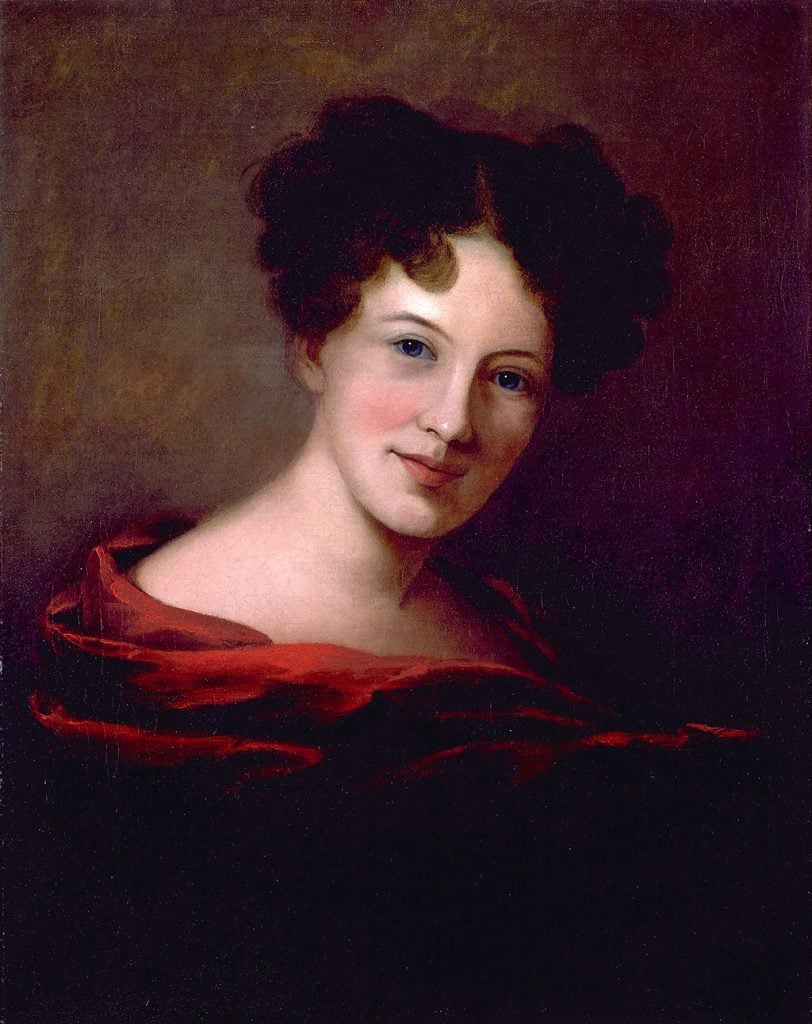
Sarah Miriam Peale, Self Portrait (ca. 1818). Collection of the Smithsonian National Portrait Gallery, Washington, D.C.
“Sarah should absolutely have a show,” Soltis said. “People would be thrilled by looking at her painting. It’s very accomplished.”
“Ms. Americana” is on view at the National Museum of Women in the Arts, 1250 New York Avenue, NW, Washington, D.C., April 3–October 31, 2026.
“A Nation of Artists” will be on view at the Pennsylvania Academy of Fine Art, 118-128 North Broad Street, Philadelphia, Pennsylvania; and the Philadelphia Museum, 118–128 North Broad Street, Philadelphia, Pennsylvania, April 12, 2026–September 5, 2027.
“Becoming Peale” will be on view at the Winterthur Museum, Garden and Library, 5105 Kennett Pike, Winterthur, Delaware, from September 18, 2027.
As the U.S. marks 250 years, we’re diving into the early American art world—and the figures the spotlight missed—who are finally getting their due.