Art History
How Dalí’s Amber Varnish May Have Caused This Painting to Decay
A new study has found the artist's choice of varnish may have degraded "The Temptation of Saint Anthony."

by
Vittoria Benzine
 Share This Article
The Temptation of Saint Anthony (1946) is the only painting Salvador Dalí ever entered into an art contest—to feature in the Hollywood production The Private Affairs of Bel Ami. While his take on the art-historical scene did not make it on to set (Max Ernst‘s did), the work is still notable for bearing Dalí’s Surrealist hallmarks, as well as his undergirding spirituality.
The Royal Museums of Fine Arts of Belgium (RMFAB) has owned the painting since 1965. They’ve since noticed it doesn’t look quite fit for the silver screen. For starters, parts of Saint Anthony have become transparent, or roughly textured. Their experts recently joined an international expert cohort to study whether Dalí created those effects intentionally, and just how they came about.
The crew gathered at the RMFAB to try a wide range of imaging techniques on the artwork. Beyond the figure St. Anthony, areas of inquiry included the rock he’s gripping, an angel in the distance, and the Spanish palace of El Escorial.
In some cases, their efforts were as simple as comparing older photographs of the work with newer ones. From this, the team determined that the work’s degradation transpired predominantly before it entered RMFAB’s collection.
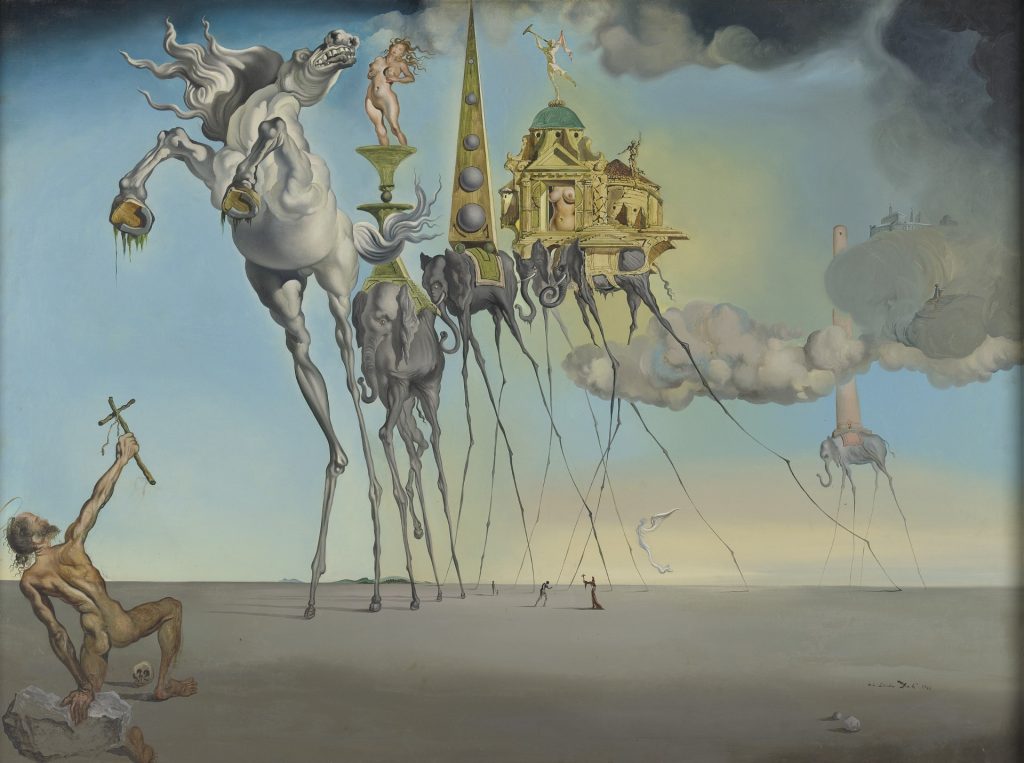
Salvador Dali, The Temptation of Saint Anthony (1946), Royal Museums of Fine Arts of Belgium, Brussels / Photo : J.Geleyns – Art Photography, © Fundación Gala – Salvador Dali / SABAM Belgium.
Macro-X-ray fluorescence spectroscopy revealed that Dalí painted this work using strontium yellow, Ceruleum blue, cobalt blue, various chromium-based greens, carbon black, earthy pigments, lead white combining cerussite and hydrocerussite, and zinc white. The work’s degradation appears to cluster around areas where the zinc white pigment has migrated, as a result of its binder malfunctioning. Digital microscopy confirmed disruptions in the paint films in such areas
“Not all areas containing zinc white are affected,” the new study noted. “Only those zinc-white-rich paint layers that are superimposed over lead white-containing layers display visible signs of deterioration.” In his 1948 book 50 Secrets of Magic Craftsmanship, Dalí prescribes this very method, deeming zinc white the color with which “you will achieve the most absolute whites in your picture.” But chemically speaking, this approach causes problems.
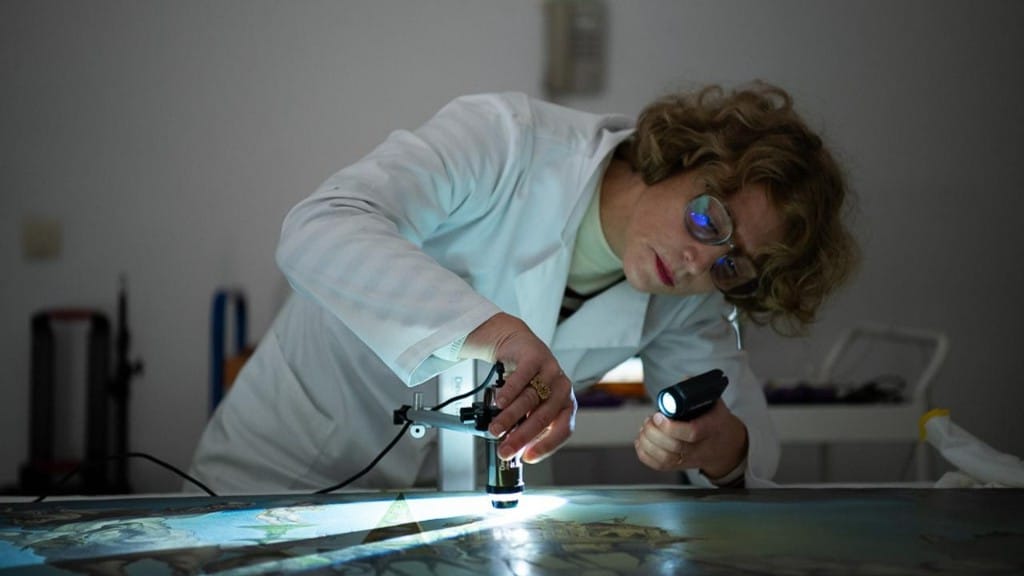
An expert examining The Temptation of Saint Anthony (1946) ©️ ULiège, photo courtesy of ULiège.
Strangely enough, the researchers also detected a layer of chlorine covering the artwork—which, based on its materials, came from elsewhere. The team hypothesizes this happened as Saint Anthony sailed to Europe 1947.
Dalí also extols amber as a varnish in 50 Secrets. Calling the liquid “sublime,” he noted its “unique advantage of integrating itself completely and as by a consubstantial consequence with your last overpainting without ever needing to be removed even if it should become necessary to repaint over it.”
Alas, according to the study: “Natural resins, while offering desirable optical and mechanical properties, are also known to exhibit complex and sometimes problematic aging behavior in the presence of certain inorganic pigments.” That includes zinc white—explaining why areas with the inorganic pigment have proven problematic. Dalí may have even gotten a bad batch.
With the puzzle somewhat solved and the artwork deemed stable, Saint Anthony is back on view at the museum.