Archaeology & History
Rome’s New Colosseum Metro Station Is Stacked With Archaeological Treasures
The Colosseo-Fori Imperiali and Porta Metronia stations are both mass transit hubs and veritable art museums.

by
Alina Cohen
 Share This Article
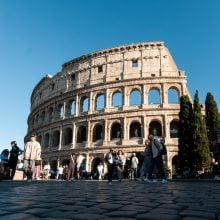
Rome’s new Colosseum metro station opened on Tuesday, featuring archaeological treasures discovered throughout its 11-year construction. The destination will serve tourists and commuters alike as it reduces traffic in a notoriously congested area and displays artifacts that illuminate Rome’s rich history.
The discoveries on view span ceramic fragments and statues, oil lamps and stone vessels, hairpins and knives, per the AP and Reuters. According to the New York Times, archaeologists discovered 28 ancient wells at the site, which connects to the old Colosseum station that opened in 1955. Mayor Roberto Gualtieri, who attended Tuesday’s opening ceremony, lauded how “complex engineering works” could coexist Rome’s “extraordinary historical stratification,” the paper reported.

Archaeological finds at the new Colosseo-Fori Imperiali station on Metro Line C in Rome, December 16, 2025. Photo: Riccardo De Luca/Anadolu via Getty Images
The opening of the station coincided with another inauguration at Porta Metronia, one stop away. Both stations are around 100 feet underground and part of the city’s C line, which is many years in the making. According to the Times, planning began in the 1990s. In 2017, Rome rolled out the first station, San Giovanni, with displays featuring ceramics and a water fountain discovered during its own construction.
The Porta Metronia excavation, scientific director Simona Moretta told the AP, uncovered a nearly 260-foot, early second century military barracks. The team also unearthed a home with frescoes and mosaics. Going forward, the city plans to open a museum in the station. “Thanks to major projects like this, we are… rediscovering layers of the past that we would never have known about,” Mayor Gualtieri said, according to Euronews.

Archaeological finds at the new Colosseo-Fori Imperiali station on Metro Line C in Rome, December 16, 2025. Photo: Riccardo De Luca/Anadolu via Getty Images
Webuild, an Italian construction group, is leading the C line’s development. Construction manager Marco Cervone highlighted how difficult it is to build a subway beneath Rome: Monuments rise above ground, while the earth holds fragile treasures below. Another hiccup, Cervone noted, was “a large amount of groundwater” above the planned subway line. Due to the terrain’s sensitivity, some excavators dug by hand.
“In order to work in the delicate archaeological area, the company has employed techniques including freezing the ground to stabilize soil, as well as so-called sacrificial diaphragms—concrete walls built perpendicular to perimeter walls that are demolished as excavation advances,” Cervone reportedly told journalists.

Archaeological finds at the new Colosseo-Fori Imperiali station on Metro Line C in Rome, December 16, 2025. Photo: Riccardo De Luca/Anadolu via Getty Images
Rome’s unification of state-of-the-art transit with historical preservation follows similar efforts in Greece and China. Last December saw Thessaloniki open its metro system, also executed by Webuild, with stations spotlighting such finds as marble squares, drainage systems, and a Roman-era road. Xi’an has also embraced the archaeological treasures that both enchanted and stymied construction workers. The city broke ground on its first subway line in 2006 and unearthed more than 3,000 artifacts and 260 tombs. Many such finds are now on public display.
Rome, for its part, continues its valiant construction and archaeological efforts. The city plans to open a station near its center, at Piazza Venezia, in 2033, and another near St. Peter’s Basilica in the Vatican, the Times reported.

Related Articles
-