Artists
Robert Rauschenberg at 100: How the Relentless Experimenter Rewired American Art
The Robert Rauschenberg Centennial honors a fearless innovator who forever changed the course of American art.

by
Jo Lawson-Tancred
 Share This Article
The sheer breadth of exhibitions in this year’s Robert Rauschenberg Centennial—a global celebration marking 100 years since the artist’s birth on October 22, 1925—is testament to the constant productivity of his 82 years. Everywhere in contemporary art, Rauschenberg’s influence remains plain to see.
Often cited as the very first postmodern artist, Rauschenberg was instrumental in radically reinventing modernist influences in order to usher in a bold, new era of American art. A legend of the midcentury New York scene, Rauschenberg first made his name for his “Combines,” a series of radical painting-sculpture hybrids constructed from a mass of found objects. These pieces transformed the seminal lessons of Dada, breaking with the then-dominant conventions of Abstract Expressionism to predict the rise of Pop Art.

Robert Rauschenberg, Yellow Body (1968) Solomon R. Guggenheim Museum, New York Gift, the Robert Rauschenberg Foundation, 199898.5219Art © Robert Rauschenberg Foundation/Licensed by VAGA, New York, NY
But Rauschenberg didn’t stop there. He is perhaps best remembered for his relentless pursuit of the new, happily working in all manner of material from metal to glass, silkscreen, cardboard, and fabric.
This fall, the Robert Rauschenberg Centennial bumper program includes shows at the Museum of the City of New York and the Guggenheim in New York, the Walker Art Center in Minneapolis, the Virginia Museum of Fine Arts, Des Moines Art Center, and the Menil in Houston. In Europe, the acclaimed “Five Friends” exhibition celebrating Rauschenberg and his most intimate working relationships is touring to the Museum Ludwig in Cologne. The artist’s work in Asia is also being recognized by a sweeping survey at M+ in Hong Kong.
In celebration of his 100th birthday, here are eight things you need to know about the groundbreaking artist.

Visitors viewing the piece ‘Odalisk’ by Robert Rauschenberg at the Whitechapel Gallery in London, UK, 6th February 1964. The piece is termed a ‘combine’. (Photo by Evening Standard/Hulton Archive/Getty Images)
1. Rauschenberg used the G.I. Bill to go to art school in Paris
Known familiarly as “Bob,” Rauschenberg was in fact born Milton Ernest Rauschenberg in Port Arthur, an industrial town on Texas’s Gulf Coast. His blue-collar Fundamentalist Christian parents encouraged him to enroll at the University of Texas at Austin to study pharmacology in 1943. He dropped out almost immediately because his then-undiagnosed dyslexia made coursework difficult and he was unwilling to dissect a frog.

Robert Rauschenberg, Religious Fluke (1962). Solomon R. Guggenheim Museum, New York. Gift, Andrew Powie Fuller and Geraldine Spreckels Fuller Collection 2000.46. © Robert Rauschenberg Foundation / Licensed by VAGA, New York, NY / Artists Rights Society (ARS), New York.
The following year Rauschenberg was drafted into the U.S. Navy, where he began making portraits of his fellow G.I.s at a bootcamp in Idaho. A lifelong pacifist, Rauschenberg began working as a neuropsychiatric technician in the Navy Hospital Corps at Camp Pendleton in San Diego. During his spare time, he would visit the art collection at the Huntington in San Marino, where portraits by the 18th-century English painters Thomas Gainsborough and Thomas Lawrence excited him enough to start buying art supplies. After receiving an honorable discharge in 1946, he briefly worked as a newspaper illustrator.
Having developed a real determination to become an artist, Rauschenberg used the G.I. Bill to enroll first at the Kansas City Art Institution, in 1947, before moving on to the Académie Julian in Paris the following year. There he got to know fellow student Susan Weil, whom he would eventually marry, and the pair immersed themselves in the work of leading European modernists like Henri Matisse and Pablo Picasso.
2. Rauschenberg rebelled against his teacher Josef Albers
In 1948, Rauschenberg joined Weil in enrolling at the now legendary Black Mountain College in Asheville, North Carolina, a short-lived liberal arts college that became a springboard for many era-defining talents, including John Cage, Merce Cunningham, Ruth Asawa, Cy Twombly, and Willem de Kooning. Though the school was unusually freethinking and non-hierarchical, Rauschenberg’s strange, disorderly experiments did not always impress his teacher, the illustrious German-born modernist Josef Albers.

Josef Albers with students at Black Mountain College, Asheville, North Carolina, late 1940s.(Photo by Genevieve Naylor/Corbis via Getty Images)
“I was Albers’s dunce, the outstanding example of what he was not talking about,” Rauschenberg once recalled. Meanwhile, Albers described him as “erratic,” “sloppy,” and “undisciplined.” Nonetheless, Rauschenberg long cited Albers as his most important teacher. “I’m still learning what he taught me,” he once insisted. Indeed, Albers encouraged his students to incorporate found material, from cigarette butts to fallen leaves, to make “combination” artworks. These ideas that would have an obvious influence on Rauschenberg’s major breakthroughs of the 1950s.
Despite his marriage to Weil, which officially ended in 1953, Rauschenberg entered into a short but intense relationship with fellow student Twombly. The couple travelled to Italy and Morocco in 1952.
3. Rauschenberg once erased an artwork by Willem de Kooning
Inevitably, Rauschenberg was drawn towards New York City, at that time the undisputed center of the art world. After settling there permanently in 1953, the artist began making work that posed a challenge to Abstract Expressionism, a 1940s movement that was still all the rage in New York. The “Black Paintings,” which had been started at Black Mountain in 1951 but were finished that year, might appear to be plain color fields from first glance. In fact, the glossy paint had been thinly applied over a newspaper ground that occasionally showed through, blurring the boundaries between painting and collage. The field’s non-representational purity was thus disturbed by elements derived from the real world.

Robert Rauschenberg, Erased De Kooning Drawing (1953). Courtesy of SF MoMA.
More provocative still was Rauschenberg’s Erased de Kooning Drawing (1953). The artist approached Willem de Kooning, an AbEx heavyweight whom he admired, asking for an artwork he could erase in order to make a new work of art, entirely through the radical act of erasure. The older artist made a particularly densely worked drawing that Rauschenberg later recalled was made using charcoal, oil paint, and crayon. He jokes that he spent a month erasing it.
The work was later framed and labelled in the old fashioned style by the artist Jasper Johns, Rauschenberg’s romantic partner between 1953 and 1961. The couple lived and worked in adjacent studios and developed an intimate creative bond.
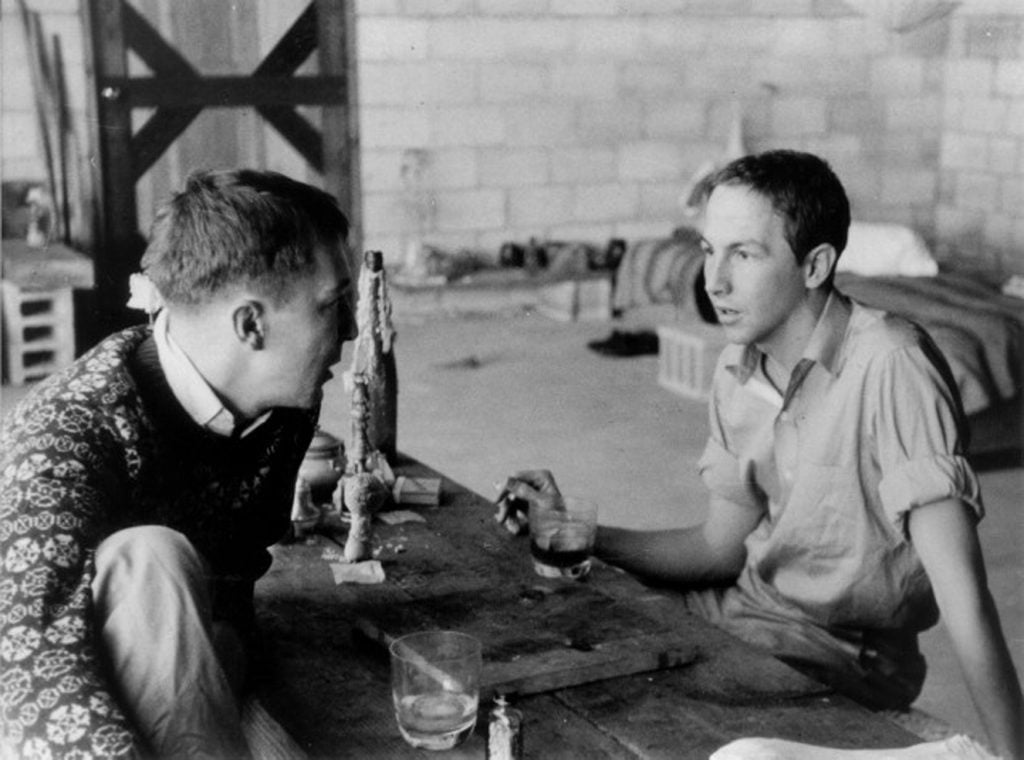
Rauschenberg and Jasper Johns at Louis Stevenson’s home “somewhere up the Hudson”, 1954. Photo: Rachel Rosenthal, Courtesy Robert Rauschenberg Foundation.
4. Rauschenberg had Christmas Day lunch with his hero Marcel Duchamp
In 1953, Rauschenberg visited “Dada 1916-1923” at Sidney Janis Gallery in New York. The show had been curated by Marcel Duchamp, a pioneer of Dadaism whose “readymades” are widely regarded as the first pieces of conceptual art. He became a hero for Rauschenberg, who also greatly admired the German Dadaist Kurt Schwitters, known for collaging detritus like bus tickets and packaging. Taking both European modernists as inspiration, Rauschenberg and Johns began assembling mundane, found material to make work that would come to be described as Neo-Dada.

Robert Rauschenberg. Bed, 1955. Oil and pencil on pillow, quilt, and sheet on wood supports, 75 1/4 x 31 1/2 x 8″ (191.1 x 80 x 20.3 cm).
Gift of Leo Castelli in honor of Alfred H. Barr, Jr. The Museum of Modern Art, New York. © 2025 Robert Rauschenberg Foundation
A major breakthrough came in 1955 when, lacking a canvas, Rauschenberg began painting over an old quilt. Eventually he added a sheet and pillow to create one of his best-known works. Bed, one of the very first “Combines,” confounded critics but, soon enough, Rauschenberg took to the city streets to salvage the debris of urban life. Works from this period are made from taxidermy, old tires, street signs, furniture, and even a photograph of the artist’s young son Christopher. Rauschenberg’s ability to make art out of real life and his rejection of traditional hierarchies between low and high culture has seen the “Combines” regarded as an important precursor to Pop Art in the 1960s.

Robert Rauschenberg,
Music Box (Elemental Sculpture) (ca. 1955). Photo: © Robert Rauschenberg Foundation.
On Christmas Day in 1959, Rauschenberg and Johns had lunch in Chinatown with Duchamp and his wife Teeny, followed by a visit to the younger artists’ downtown studio. Duchamp and Rauschenberg shared a mutual appreciation. When the former bought the latter’s Music Box (Elemental Sculpture) (c. 1955), he quipped, “I think I’ve heard that song,” in reference to his own influence on the work. In turn, Rauschenberg bought one of Duchamp’s readymades, Bottle Rack, first conceived in 1914 but remade in 1959 and signed at Rauschenberg’s studio in 1960.
5. Rauschenberg destroyed his own award-winning work
In 1964, Rauschenberg made history by becoming the first American artist to win the Golden Lion at that year’s Venice Biennale. He was also the youngest artist to have done so, at the age of 39, and was largely recognized for his silkscreen paintings. The award remains, to this day, one of the art world’s greatest accolades. The win proved controversial, even raising suspicions that the jury had been rigged. Rauschenberg recalled “an extraordinary amount of hostility,” including one critic decrying his “rubbish” art. The scandal was the subject of the 2024 documentary Taking Venice.

The Italian contemporary art gallery manager Leo Castelli is sitting in his gallery looking at a picture by Robert Rauschenberg with the title ‘Retroactive I’ in which the figure of John F. Kennedy can be recognized. New York, 1964 (Photo by Mario De Biasi/Mondadori via Getty Images)
Upon clinching the top honor, Rauschenberg did something nobody expected. He instructed his studio to destroy all his silkscreens so that he would never be able to repeat himself. The artist continually embraced new media. In the early 1970s, he became obsessed with making wall reliefs from discarded cardboard boxes that he cut up and bent into new shapes. Many still bore stains, tears, and labels like “handle with care” from their former life as throwaway utilitarian objects.
Another classic series by Rauschenberg is the “Gluts” (1986-94): wall-mounted and freestanding sculptures made from discarded metal objects like car parts or traffic signs. The series was inspired by the huge amounts of auto detritus that littered parts of Texas, and much of the artist’s material was retrieved from junk yards. An exhibition of these works has just gone on view at Thaddaeus Ropac gallery in Paris.

Clocks in the work “Reservoir” by Robert Rauschenberg are supposed to illustrate the production time of the art. The works of Robert Rauschenberg are exhibited during the Berliner Festwochen in the exhibition “Art USA now” (archive picture from 23 September 1963). (Photo by Konrad Giehr/picture alliance via Getty Images)
6. Rauschenberg danced in roller skates
Rauschenberg had been regularly involved in performances since his Black Mountain days, when he befriended the choreographer Merce Cunningham and the composer John Cage. The latter’s most famous work, his groundbreaking 4’33”, which contains no sound, was made in response to Rauschenberg’s blank White Painting. The artist was involved in the collaborative, multi-disciplinary, avant-garde performance Theatre Piece #1 (1952), and continued to produce sets and costumes for Cunningham throughout his life, including XOVER (2007), which premiered just one year before the artist’s death and two years before Cunningham’s in 2009.
In the 1960s, Rauschenberg also began staging his own performances. The first of these was Pelican (1963), for which the artist choreographed a new dance to be performed in a roller skating rink. He and the artist Per Olof Ultveldt spun around on skates with parachutes on their backs while the professional dancer Carolyn Brown performed en pointe. “Since I didn’t know much about actually making a dance, I used roller skates as a means of freedom from any kind of inhibitions that I would have,” Rauschenberg later explained.

Merce Cunningham dancers perform his ‘Summerspace’, with backdrop and costumes designed by artist Robert Rauschenberg, in May 1975. (Photo by Jack Mitchell/Getty Images)
In a rush of activity, the artist went on to produce 12 more performances by 1967. Among the best known is Open Score (1966), for which tennis player Mimi Kanarek and artist Frank Stella played tennis using sound-wired rackets that worked as instruments, sending a reverberating sound through the cavernous 69th Regiment Armory in New York. As each ball was hit, one of 48 lights went out, until the space fell into darkness. At this point, some 500 people came onto the stage as infrared cameras picked up their movements, transmitting them onto large screens. Finally, Simone Forti sang an Italian love song while Rauschenberg moved her around the floor.
7. Rauschenberg (may have) sent art to the moon
The following year, in 1967, Rauschenberg became a co-founder of the nonprofit Experiments in Art and Technology (EAT). The collective was inspired by works like Open Score, which had been part of “9 Evenings: Theatre and Engineering,” a series made in collaboration between 10 artists and 30 engineers from Bell Labs. The works were intended to showcase the possibilities of marrying their skills.

Tate Modern staff views artwork titled Mud Muse, dated 1968-71, by artist Robert Rauschenberg on November 28, 2016 in London, England. (Photo by Ray Tang/Anadolu Agency/Getty Images)
Aiming to encourage cross-disciplinary collaboration, the group was behind many of Rauschenberg’s more technologically-complex works. One example is Mud Muse (1968-71), an aluminum and glass vat containing a mix of clay and water. Sound activates a compressed-air system at the bottom of the vat, releasing air in order to make the pool of “mud” bubble. Meanwhile, the bubbling sound is recorded and used to reactive the system, creating a loop. Audiences today continue to appreciate the work’s eccentricity and irreverence.
In the wake of worldwide excitement over the first moon landing in 1969, Rauschenberg and five more artists, including Claes Oldenburg and Andy Warhol, decided to make drawings they would send to the moon. Rauschenberg’s contribution was a single line. These pieces were transferred to a tiny ceramic chip known as Moon Museum (1969) by an EAT engineer. As legend has it, the chip was secretly attached to the leg of Lunar Module Intrepid and made it to its destination during Apollo 12.
8. Rauschenberg set off on a worldwide humanitarian mission
Rauschenberg spent the 1960s at the center of a vibrant cultural milieu, which included figures like Dorothea Rockburne and Brice Marden who flocked to the many parties hosted at his townhouse and studio at 381 Lafayette Street in downtown Manhattan. The building had previously been an orphanage known as the Mission of the Immaculate Virgin for the Protection of Homeless and Destitute Children, which included a chapel that Rauschenberg had deconsecrated before moving in. With its revolving door of guests, the place became known as “Milton’s Hilton,” a play on the artist’s birth name.

Robert Rauschenberg and guides in Venezuela during a research trip for ROCI VENEZUELA, 1985. Photo: Terry Van Brunt, Photograph Collection, courtesy of Robert Rauschenberg Foundation Archives, New York.
Come 1970, however, and Rauschenberg’s struggles with alcoholism induced “serious psychological dilemmas.” Needing to escape New York, he established a new life on the island of Captiva, off the coast of Florida, where he would live for four decades until his death in 2008.
During this later, more peaceful period of life, Rauschenberg established the Rauschenberg Overseas Culture Interchange (ROCI), which aimed to use art to bring about meaningful social change. Between 1984 and 1991, Rauschenberg visited some ten countries where he believed artistic self-expression had been suppressed, including Venezuela, Cuba, China, Malaysia, and the USSR. There he met with artists and organized exhibitions. The program was self-funded to the tune of $10 million, partly raised by selling works by Twombly and Johns.
Though Rauschenberg became increasingly detached from the mainstream art world in later life, his 1984 mission statement for ROCI insisted that art “is the most non-elitist way to share exotic and common information, seducing us unto creative mutual understandings for the benefit of all.”
Related Articles
-


