There is a devastating beauty to Rebecca Manson’s sculptures of butterfly and moth wings. Plucked from some non-extant body of an insect, they show signs of tattering and decay but retain their mesmeric splendor with kaleidoscopic patterns and highly intricate construction.
The New York-born and -based artist has had a stellar few years. In late 2023 and early 2024, she was included in a major group exhibition at Ballroom Marfa, “Perhaps the Truth,” quickly followed by a solo show at London’s Josh Lilley, “Leave Love Behind.” In May of 2024, she opened “Barbecue,” her first institutional exhibition, which debuted at the Modern Art Museum of Fort Worth and subsequently travelled to the Arsenal Contemporary Art, Montreal.
Now, Manson is the subject of yet another solo, “Rebecca Manson: Time, You Must Be Laughing,” at Jessica Silverman in San Francisco. The show brings together some of the artist’s most ambitious works to date and illuminates her continuing parallel investigations into nature and medium.
The title of the exhibition was drawn from the lyrics of the 1975 Joni Mitchell song “Sweet Bird,” which was playing as Manson considered names for the show. In a video call, Manson said that while she doesn’t listen to Mitchell regularly, she felt herself gravitating toward the singer-songwriter’s work when brainstorming “because such a huge underlying theme of what she so beautifully covers is the phenomena of time and aging and change, and those are important themes in my work.”
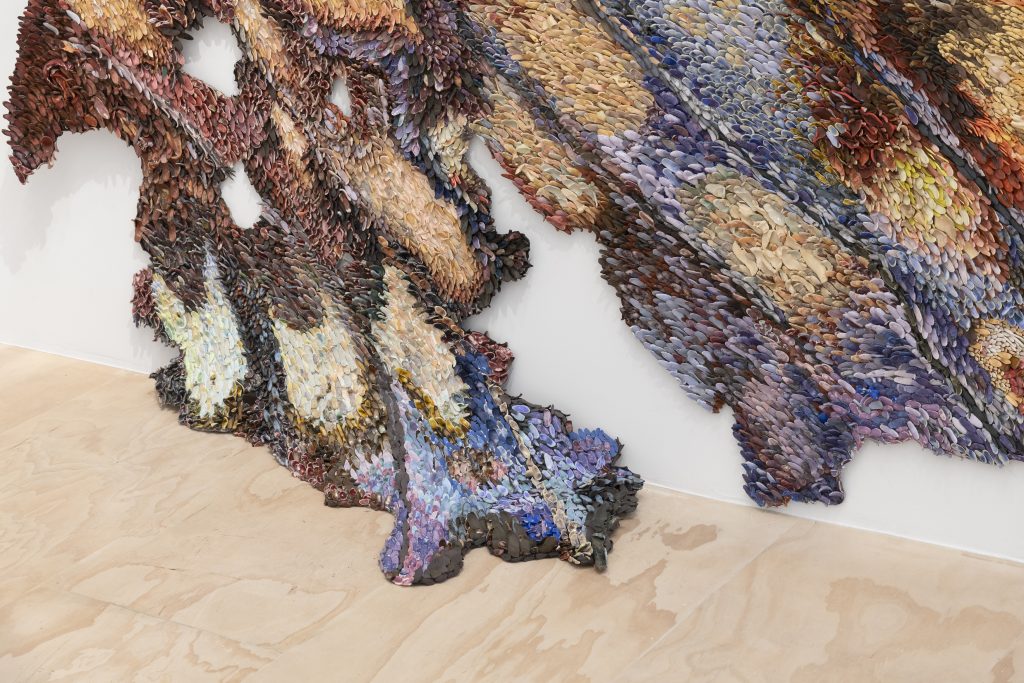
Rebecca Manson, detail of Exploding Butterfly (2025). Photo: Phillip Maisel. Courtesy of the artist, Josh Lilley, London, and Jessica Silverman, San Francisco.
Material Gesture
Manson graduated from the Rhode Island School of Design (RISD) in 2011 with a B.F.A. in ceramics, and her approach to ceramics is anything but traditional. Beginning with a sketch printed onto canvas, she then creates hundreds upon hundreds of what she calls “smushes,” small pieces of clay that are formed by “smushing” them into the palm of her hand.
The act of creating these small pieces heightens the significance of the medium and process in her work. “The materiality and the gesture of smushing clay is really important to my work, the menial quality…creating something physically and visually powerful out of things that are not on their own.”
Once formed, the smushes undergo a bisque fire and glazing—the latter of which presents an opportunity for planning and improvisation in equal measure. “I come up with these usually very complex glaze plans and chemistry around creating different blends of color. Usually, half of them are right, half of them are ‘oh, I thought that would work, but I need something else,’” Manson laughed.
Glass also appears in Manson’s work. First inspired by errant drops of glaze she would find in her kiln, Manson experimented with small kiln-formed glass forms and pieces of sheet glass that are bent and fused. Contrasting the glazed ceramic elements, these glass elements heighten the reflective, luminous quality of her wing sculptures.
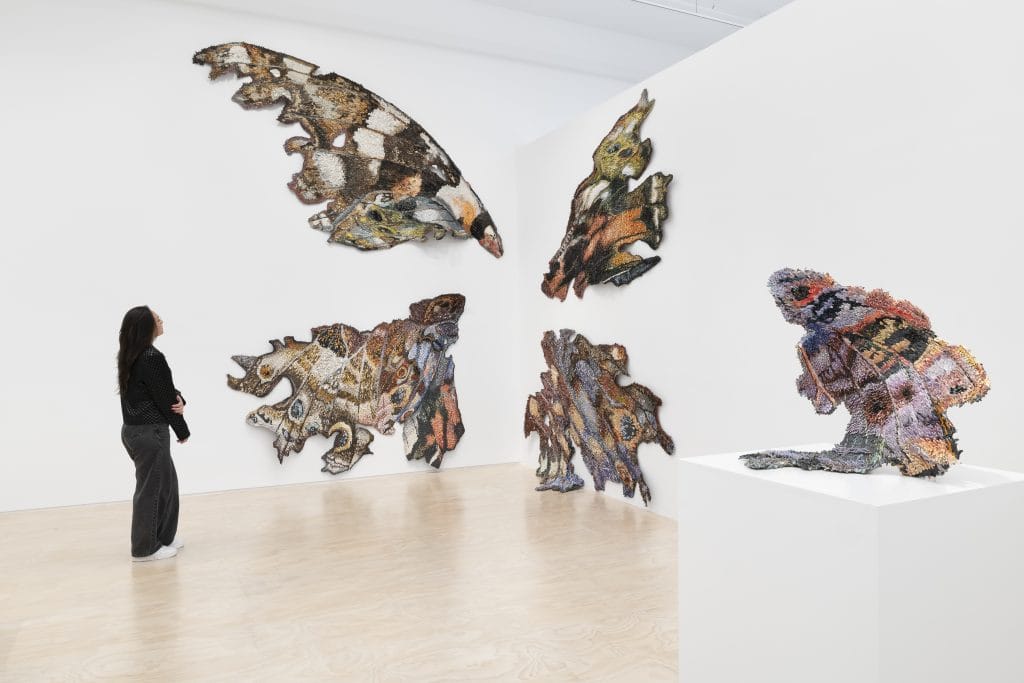
Rebecca Manson, left: Exploding Butterfly (2025), right: Discal Shrapnel (2025). Photo: Phillip Maisel. Courtesy of the artist, Josh Lilley, London, and Jessica Silverman, San Francisco.
Increased Wingspan
One of the largest works in “Time, You Must Be Laughing,” and one of her largest works to date, is the four-piece Exploding Butterfly (2025). Spread across two walls and at the bottom right spilling onto the floor, the tattered fragments of a butterfly’s wings seem to be frozen in time, suspended mid-“explosion.”
Manson noted that she’d changed the title of the work at the last minute, and it had previously been called Roadkill, reflecting the shifting scale of the work. The name change, however, alludes to one of the key themes and motifs in Manson’s practice: movement. Through material and conceptual means, Exploding Butterfly foregrounds its relationship to space—here, the gallery walls that contain it—and the hypothetical trajectory it could take should the suspended moment be unfrozen. This is furthered by its ability to be installed in various arrangements depending on the space it occupies, another form of movement.
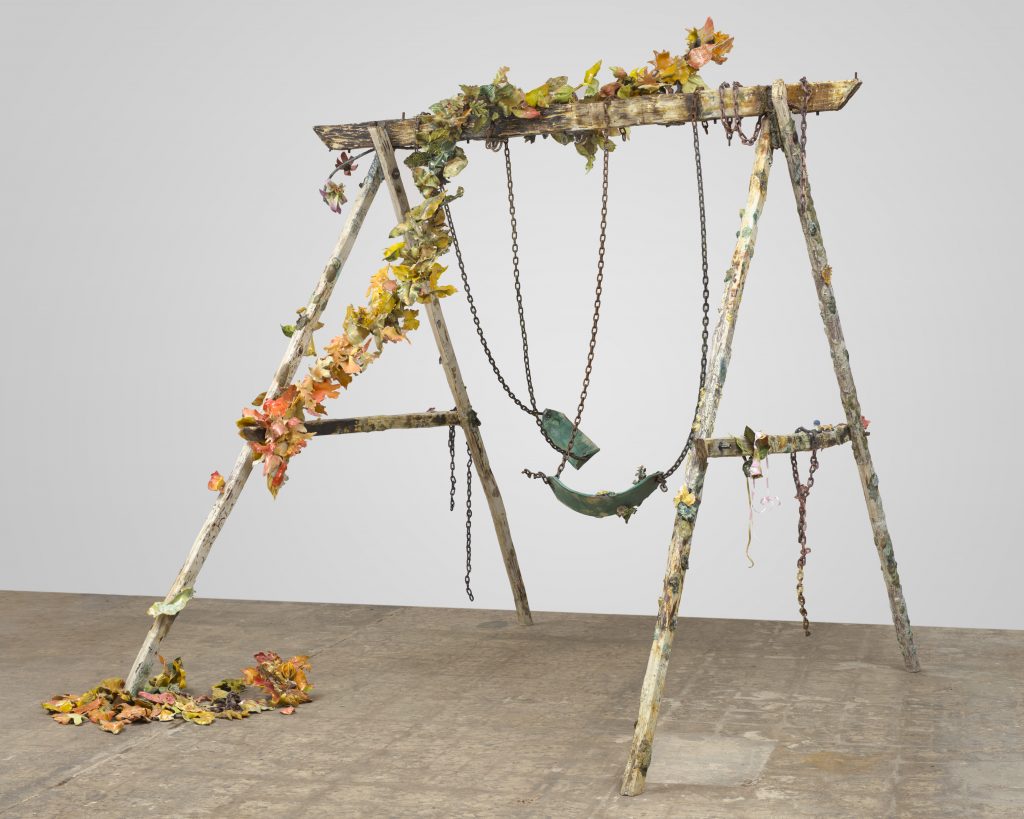
Rebecca Manson, The Swing (2022–2025). Photo: Lance Brewer. Courtesy of the artist, Josh Lilley, London, and Jessica Silverman, San Francisco.
A marked departure from her usual nature-centric work is the monumental The Swing (2022–2025). Produced over a nearly four-year period, the work underwent a process of accumulation and amalgamation, as Manson would routinely add to, rework, or leave the piece dormant for a time. Despite appearing at first glance like an actual steel swing set in the tradition of found objects with organic elements attached, the piece is entirely crafted by Manson. Reflecting the artist’s preoccupation with movement and time stilled, the two seats and sets of chains have been arranged to appear mid-swing.
It is rooted in memory. Manson described a special moment during orientation week at RISD when she went out to explore Providence with a new friend, at one point jumping a schoolyard fence to use an old, rickety swing set. “He was swinging so hard and I [told him] ‘stop, it’s going to bust!’ but he said, ‘just surrender.’ It’s so cheesy, but it was such a core memory.” The work draws from the anxieties and exhilarations of the threshold when “you think you’re a grown-up, but you’re having this childish fun, being a little reckless, and coming of age.” The Swing also harkens back to a childhood memory of a decrepit construction that had amassed “the most beautiful lichen and is just falling apart so beautifully,” said Manson.
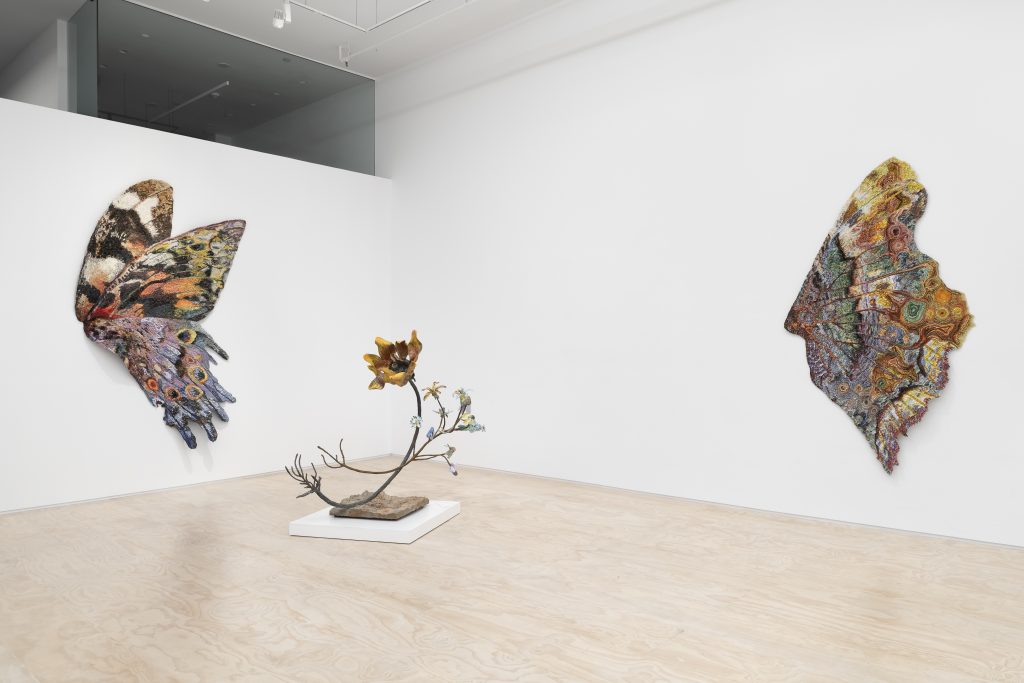
Installation view of “Rebecca Manson: Time, You Must Be Laughing” (2026). Photo: Phillip Maisel. Courtesy of the artist, Josh Lilley, London, and Jessica Silverman, San Francisco.
While the sculptures of butterfly and moth wings are what Manson has become best known for, the artist doesn’t see herself confined to the motif so much as still covering ground. She said she is open to returning to the format of some of her earlier floral works, like Mother’s Day Sunflower (2022) in the show at Jessica Silverman, and The Swing points to possible avenues of future experimentation. Regardless, the underlying themes of Manson’s work remain paramount. Nostalgia, memory, time, and ideas around evolution and change in all its myriad forms are grounded in a type of natural beauty. “It’s about emotion, and I’m trying to create a space that enables some type of emotional connection, especially in relation to nature.”