Art Criticism
At the Met, Raphael’s Beauty Has a Dark Side
Considering the meanings of “Raphael: Sublime Poetry” at the Metropolitan Museum of Art.
by
Ben Davis
 Share This Article
The Met’s grand, once-in-a-lifetime “Raphael: Sublime Poetry” show shouldn’t need any sales pitch. Raphael is one of the shining stars of European art history, even if he has played both hero and heel roles: as standard setter for graceful beauty or symbol of academic over-refinement to be rebelled against.
Because a Raphael show is such a sure thing, I scratch my head when the Met’s opening gallery text introduces Raphael, in its very first line, as “one of the greatest influencers of all time.” I don’t get it. Are we really insecure about this art’s relevance to contemporary eyes? (Don’t worry, most of the show goes in the other direction—it’s very serious.)
What is true is that the modern-day audience for Raphael is, generally speaking, neither devout nor connoisseur. They can be told about Biblical iconography or about what makes an autograph Raphael different than a Giulio Romano. But these are passive not active interests.
I personally don’t need Raphael to align directly with the present; I enjoy a walk in another time. But I also did find a new story through this exhibition to draw me in.
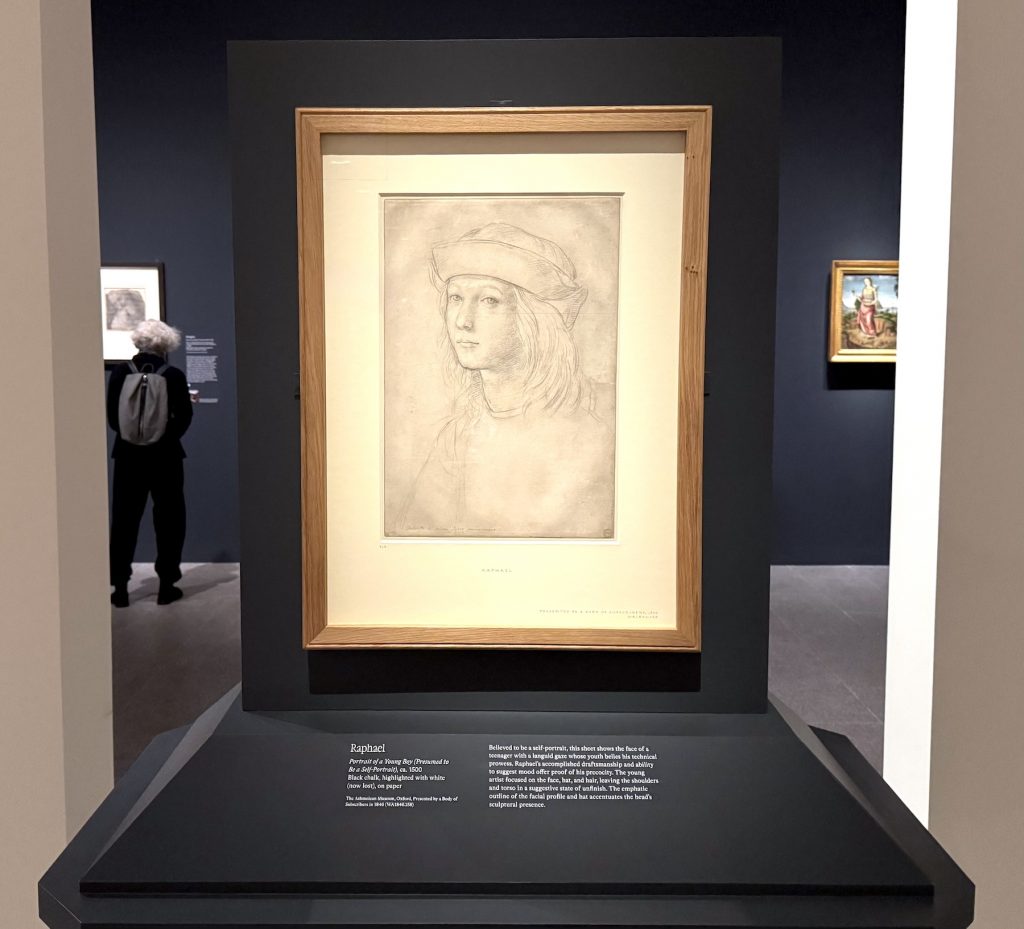
Raphael, Portrait of a Young Boy (Presumed to be a Self-Portrait) (ca. 1500) at the Metropolitan Museum of Art. Photo by Ben Davis.
A Life in Pictures
“Sublime Poetry” opens with a pencil self-portrait of the young Raffaello di Giovanni Santi (his full name), from the Ashmolean Museum. Long haired and sprightly, Raphael cocks his eyes towards you. As Walter Pater once wrote, “there is something of a fighter” in Raphael’s likeness. Well, what was Raphael fighting for?
Above all, to succeed by hungrily synthesizing the new styles emerging in the late 1400s. The first few galleries of the show give you works by his father, the otherwise obscure poet-painter Giovanni Santi (ca. 1439–1494), and then by his first master, the well-regarded Pietro Perugino (1446/50–1523).
Perugino’s image of a seated Saint Augustine (ca. 1500) still shows the residues of the medieval convention that figures be scaled to their symbolic importance. Raphael left this convention behind, favoring more modern, illusionistic space. Then, as he came more into the orbit of the art scene in Florence, he brought in innovations from Leonardo and others to further make figures interact in lively ways within that space.
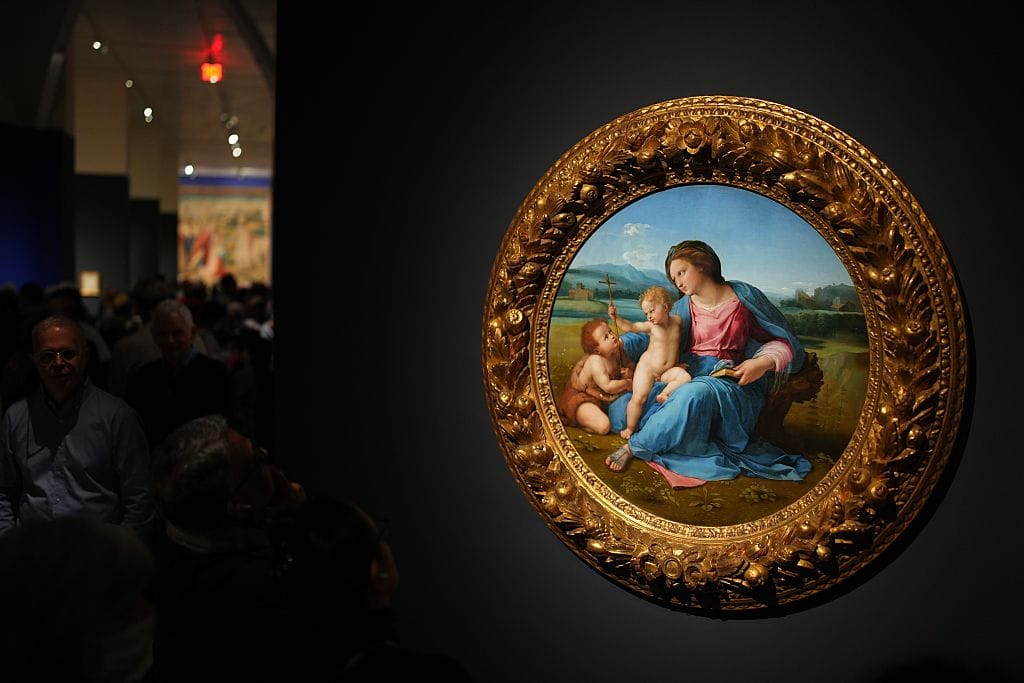
In the middle section of the Met show, you see Raphael hone his successful style to a fine point. You get signature Madonna and Child paintings like the National Gallery of Art’s dreamy Alba Madonna (ca. 1509–11). These pulled off the trick of being vividly realistic in a way that was fresh while also innovating an otherworldly ideal of femininity. Most of these Madonnas are blondes, in keeping with poetic convention but not Italian norm.
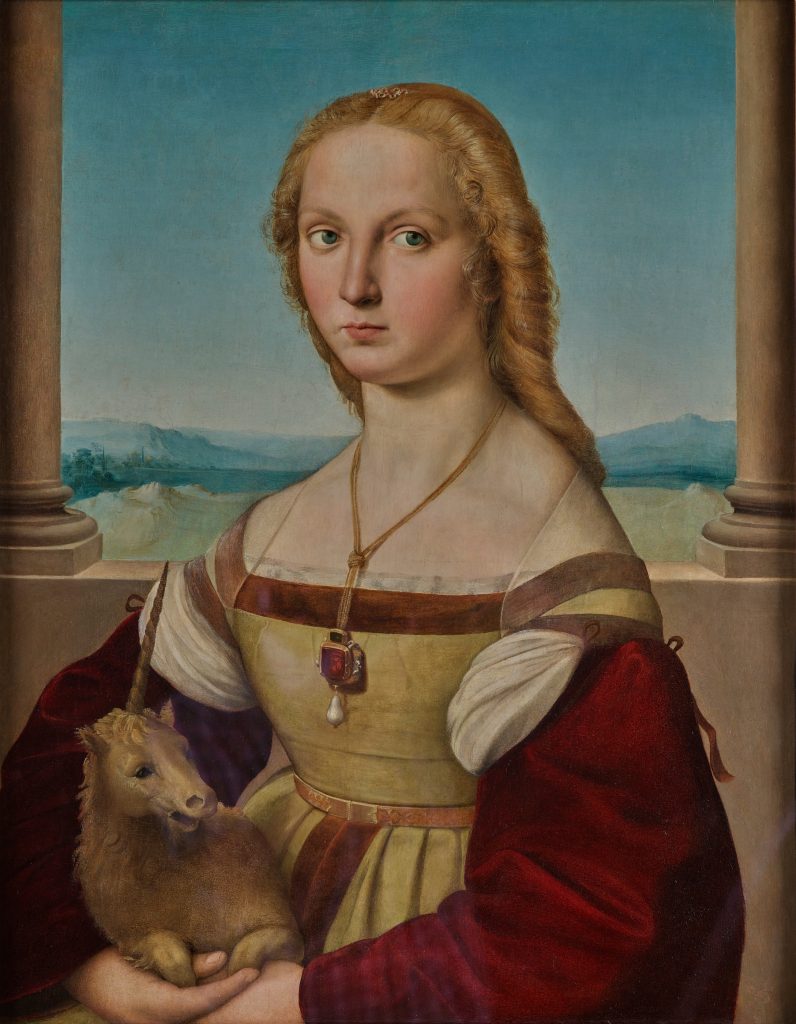
Raphael, Portrait of a Lady with a Unicorn (1505–06). Image © Galleria Borghese, photo: Mauro Coen.
A crowd-pleaser is a small painting of a young woman, a “betrothal portrait” advertising its subject as a desirazble marriage candidate. Clad in colorful finery, her cheeks blushing, the girl cradles a scruffy little pet unicorn in her lap. It’s a symbol of chastity and, if the Met is identifying her correctly as Laura Orsini, also her family crest. (If it is indeed Orsini, the bride-to-be would be 13.)
Near Portrait of Young Woman with Unicorn is Raphael’s stylish portrait of his friend, Baldassarre Castiglione, future author of the Book of the Courtier, an advice manual for men moving in sophisticated circles. Castiglione advised an ideal of “sprezzatura:” behaving artfully without calling attention to it. Among other things, he told men to wear dark colors, and so Raphael paints him, in fine black velvet and furs, framed against a chocolaty brown background—sprezzatura incarnate.
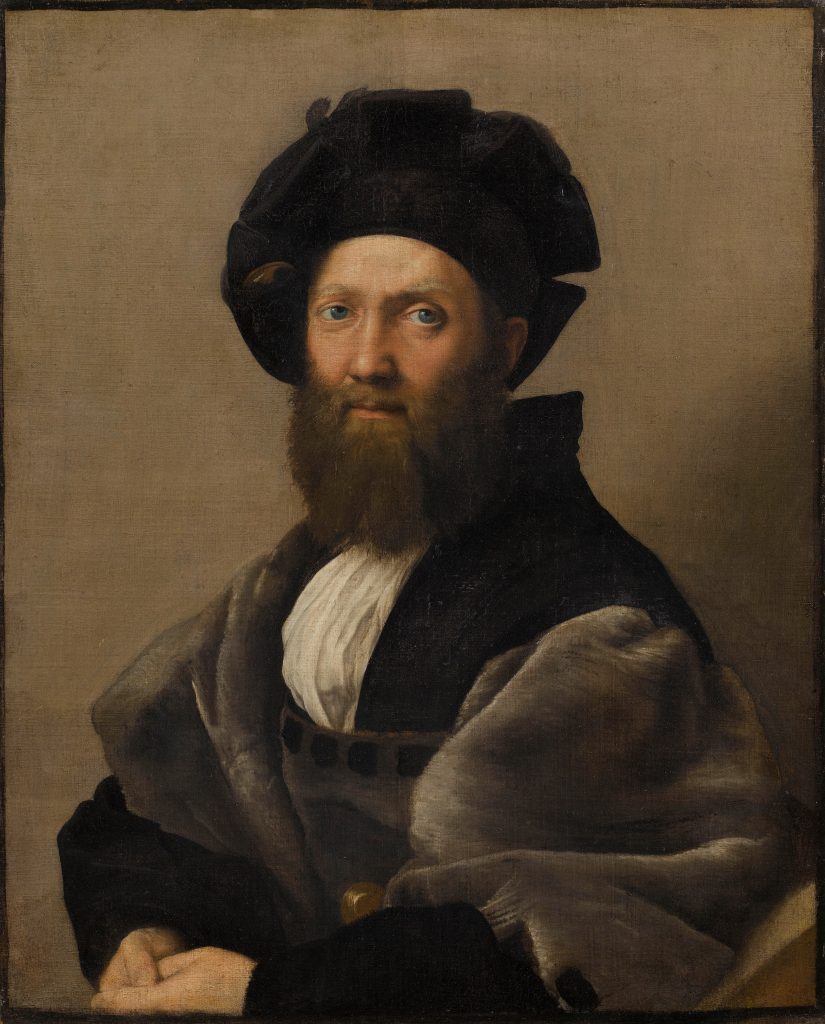
Raphael, Portrait of Baldassarre Castiglioni (1514–16). Musée du Louvre, Paris,
© RMN-Grand Palais / Art Resource, NY.
Skipping past many highlights to the end of the show—past accomplished religious allegories and a passel of fine sketches—you see the ingratiating aura break down a bit. Raphael turns towards a more twisted and exaggerated style. There you find sketches for his turbid, tenebrous Transfiguration (1516–20), considered one of his key achievements, and his small Ezekiel’s Vision (ca. 1518), a tiny prophet in a landscape dwarfed by a feverish revelation of cherubs and beasts writhing in the heavens.
It is wrong to read Raphael’s stylistic moves as psychological—individual expression was not the point of art in this era; he was offering sophistication-for-hire. Mainly, this “late style” points to a change of mood in the Renaissance atmosphere, from values of luxurious harmony to a thirst for voluptuous drama.
In any case, what strikes me overall in the show is how you can observe, just in this one key artist’s life, the entire arc of an ideal of beauty being born, perfected, and mutating into something else. And it was a short life! Raphael was a “master” painter by 17, meaning he could run his own workshop. He was dead at 37.
Artist as Professional and Party Animal
Raphael found little fortune during a four-year stint in Florence, from 1504 to 1508. His epic come-up came when the architect Bramante, who was working on the restoration of St. Peter’s Basilica in Rome, tapped Raphael to come to work in the Eternal City, at the age of 25.
First for Pope Julius II and then for Pope Leo X, the talented young artist would become the favored decorator. His frescos for the Papal Apartments include his most outstanding painting, the one liked even by people who find Raphael cloying, The School of Athens (1509—1511) (at the Met, it’s present via sketches and in an “Immersive Raphael”-style room).
Raphael’s style so delighted these Popes that the artist was soon flooded with work. In short order, he scaled up to run an artistic enterprise of unprecedented scope, employing dozens of painters and assistants across scores of complex decoration projects. In their day, Michelangelo found his rival’s level of delegation distasteful. And later in art history, Raphael did not really fit modern-era ideas of genius as flowing mainly from the “hand of the artist,” a fact that Gilded Age theories of connoisseurship and the Met labels both wrestle with.
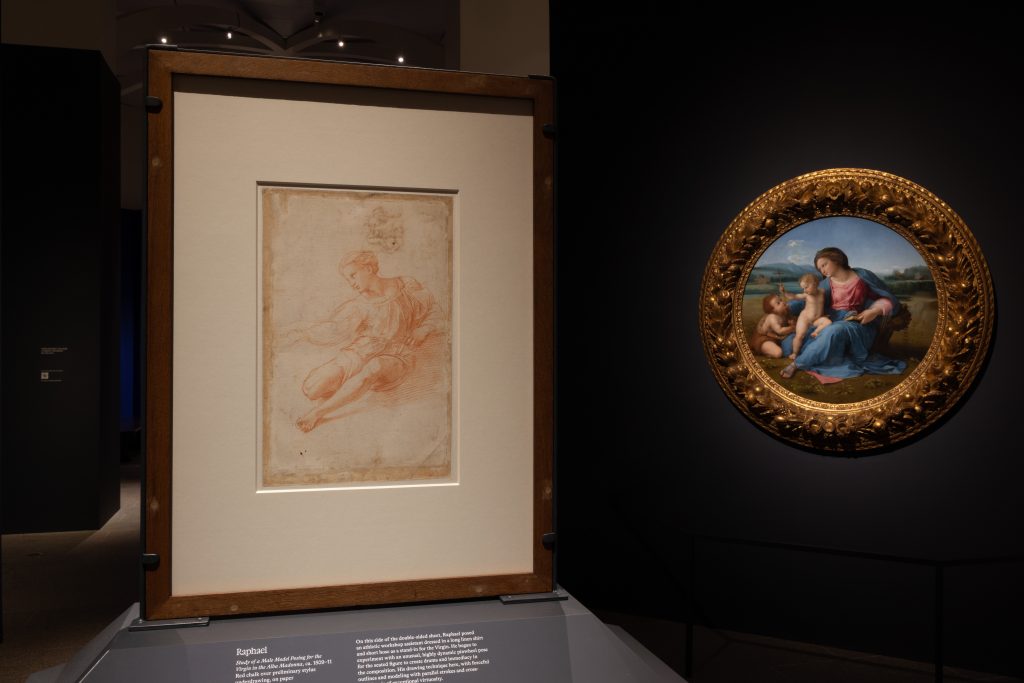
Installation view of “Raphael: Sublime Poetry” at the Metropolitan Museum of Art. Photo: Eileen Travell, courtesy of The Met.
Raphael’s last decade spawned the archetype of the rockstar artist—complete with a version of the final act of every rock-and-roll biopic, when creative success and worldly excess feed each other.
In 1514, when an uncle wrote Raphael to express concern that he was past 30 and yet to marry, he fired back a letter boasting of all the properties he owned and listing out the large sums of money he was raking in for various Papal commissions. “I will not lack for as long as I will live… Furthermore, I am paid for my work however much I wish.”
Unlike both Leonardo and Michelangelo, who preferred men, Raphael loved women—and he really loved women. “He was always indulging his sexual appetites,” Giorgio Vasari wrote in The Lives of the Artists, the gossipy tome that first cemented the Renaissance canon. Vasari added wryly that, on this score, “his friends were probably more indulgent and tolerant than they should have been.”
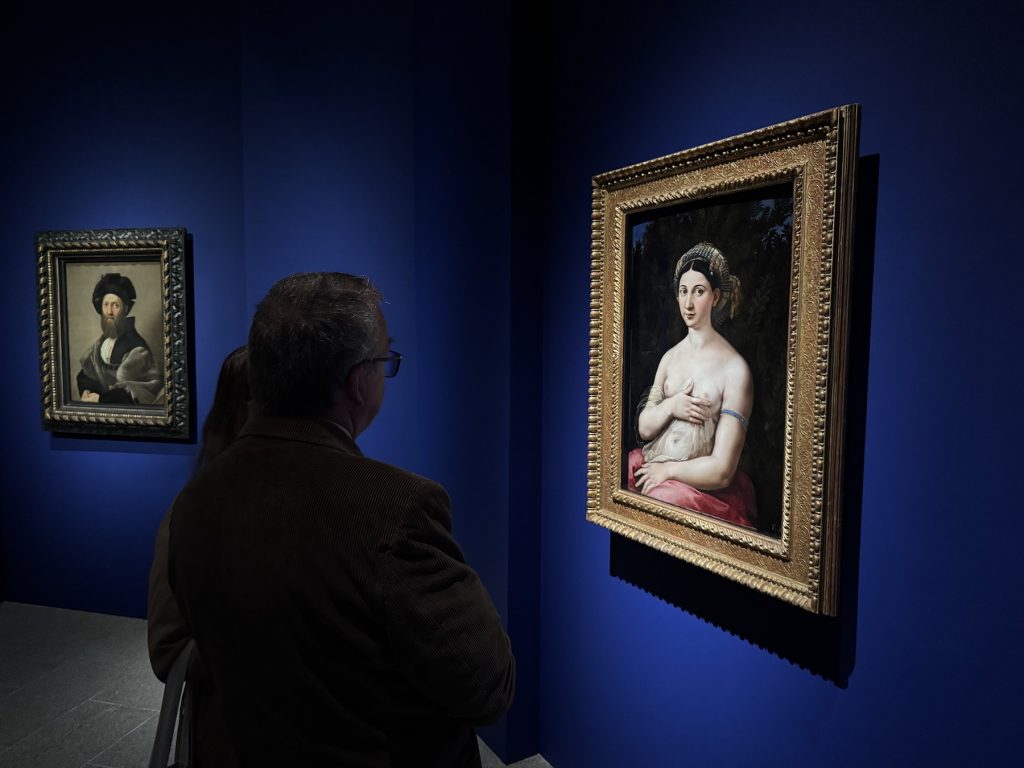
Visitors view Raphael, Portrait of the Nude Fornarina (La Fornarina) (ca. 1520) at the Metropolitan Museum of Art. Photo by Ben Davis.
Key to this facet of Raphael’s legend is Portrait of the Nude Fornarina (La Fornarina) (ca. 1520), which makes the trip from Rome to the Met. It’s a coy semi-nude portrait of a dark-haired woman. She is topless in a see-through garment, one hand stroking a breast, the other at her lap—a conventional “modest Venus” pose. A background of vegetation is made of quince and myrtle, both associated with Venus. She wears an armband with Raphael’s name in gold.
The Met holds to the theory that the work depicts Margherita Luti, Raphael’s favorite mistress; he was engaged, unenthusiastically it seems, to someone else. For centuries, the affair between Raphael and La Fornarina (meaning “Baker’s Daughter”) floated an entire erotic mythology. As art historian Marie Lathers wrote, Luti was to the 19th century the “model of models,” her affair with Raphael romanticized and rendered in paintings by Ingres and Turner.
The Met sticks to the idea that Raphael died of exhaustion from overwork. The account Vasari left behind was more salacious: “Raphael kept up his secret love affairs and pursued his pleasures with no sense of moderation. And on one occasion he went to excess, and he returned home with a violent fever.” At any rate, he died on his birthday, April 10, 1520, was mourned as a fallen hero, and buried in the Pantheon.
The Renaissance-to-Reformation Pipeline
This parable of self-destructive pleasure is fun to revisit to see what a different era saw in Raphael. In terms of what we might see in our more anti-romantic times, it mainly interests me because it parallels another story, one that is not normally part of the legend.
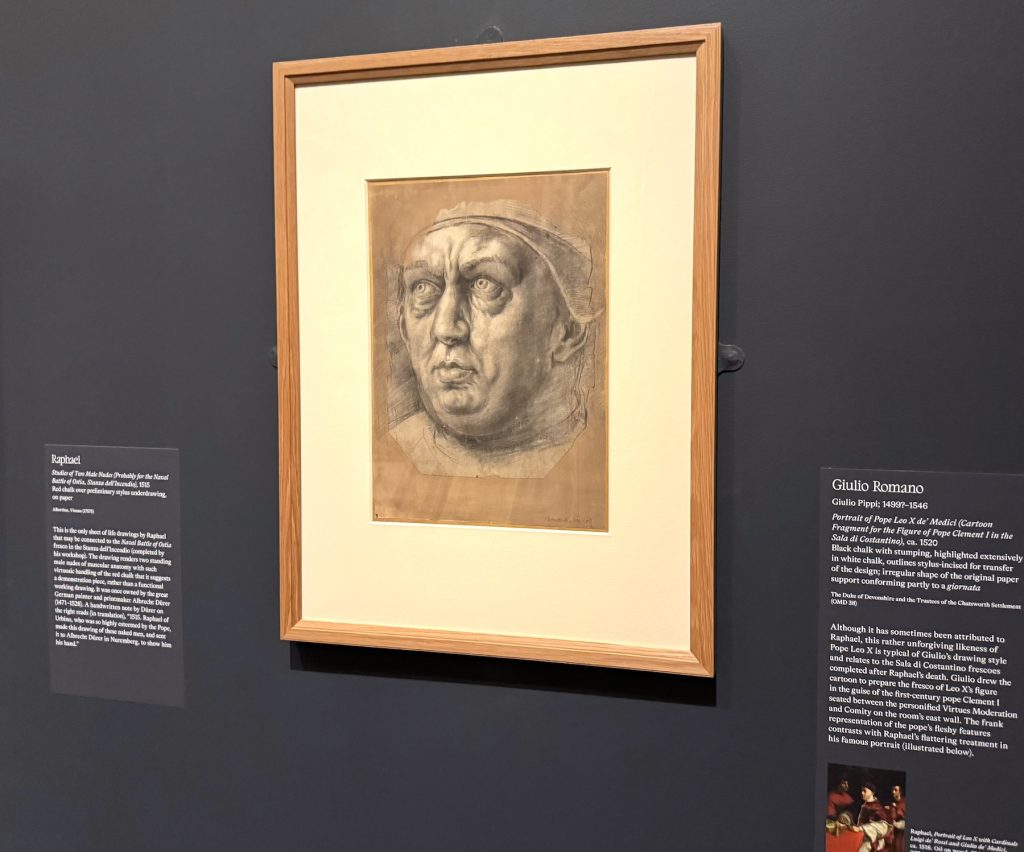
Giulio Romano, Portrait of Pope Leo X de’ Medici (Cartoon Fragment for the Figure of Pope Clement I in the Sala di Costantino) (ca. 1520). Photo by Ben Davis.
Leo X (1475–1521), Raphael’s papal patron, was born Giovanni di Lorenzo de’ Medici, his father being Lorenzo the Magnificent, to this day the image of the visionary art collector. Raphael painted Leo in memorably commanding style. Here, a drawing of his fleshy face by Raphael’s studio foreman, Giulio Romano, captures a more unsettling presence.
Infamously, upon being voted Pope in 1513, Leo X was said to have declared, “God has given us the Papacy, let us enjoy it.” He not only spent lavishly on supporting the arts in office, but lived an opulent life of masquerades and hunting with his enormous entourage. He kept a pet elephant named Hanno. He spent through the church’s coffers and then some.
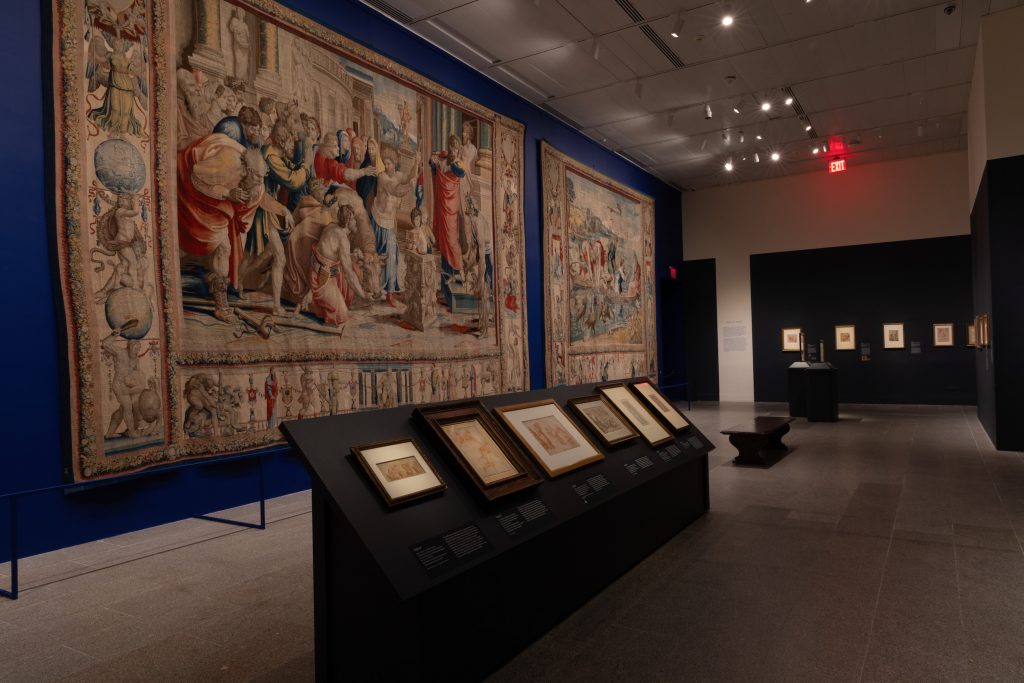
Installation view of “Raphael: Sublime Poetry” at the Metropolitan Museum of Art. Photo: Eileen Travell, courtesy of The Met.
The climax of the Met’s show comes in grand galleries where three brawny copies of the Sistine Tapestries, designed by Raphael, hang. These were dazzling to contemporaries, meant to be hung in the Sistine Chapel during special affairs. Raphael’s complex designs were sent away to be woven by state-of-the-art textile fabricators in Brussels.
The Met laconically notes that these trophies “contributed to the bankruptcy of Leo’s papacy.” When Bramante died in 1514, Pope Leo also put Raphael in charge of completing Saint Peter’s Basilica, another pricey task.
It is at this point where the inexhaustible appetite for beauty fed by Raphael’s industrial-scale enterprise bursts the bounds of art history to become a political force. It was the cash-strapped Leo X’s decision to sell indulgences in Germany—that is, to offer to forgive earthly sin in exchange for gold in his coffers—to fund the Saint Peter’s Basilica project under Raphael that touched off the schism of the Protestant Reformation.
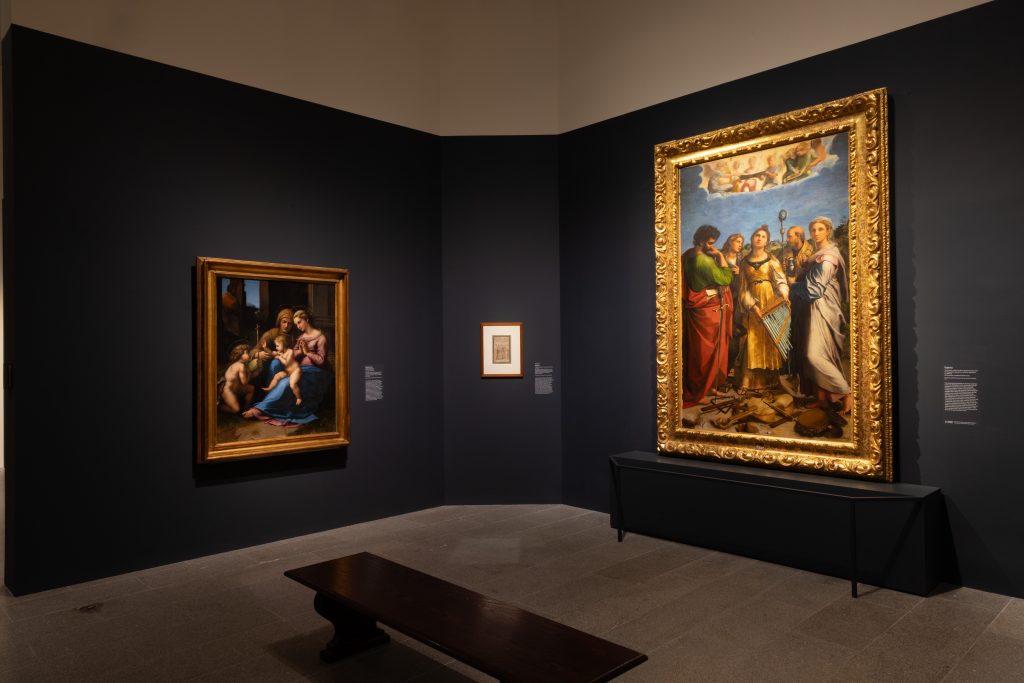
Installation view of “Raphael: Sublime Poetry” at the Metropolitan Museum of Art. Photo: Eileen Travell, courtesy of The Met.
Also born in 1483, Martin Luther was the exact contemporary of Raphael. The year 1517, when Raphael’s workshop approached its frenzied peak of productivity, was also the year that Luther nailed up his “Ninety-Five Theses” in Wittenberg, denouncing the “lust and license” of the Pope. Thus, the moment of cultural patronage remembered to this day as the glory of the Catholic Church, drawing visitors to the Vatican and to the Met, is inseparable from the moment that inspired its most calamitous loss of authority.
I know why the impulse is to keep these thoughts separate. We want to avoid cheap contemporary moralism, and to permit culture a spiritual value that transcends its flawed human origin. But I find the idea that even such enduring artworks touch the darkness as well as the light—that you cannot understand the one without the other—much more compelling. It makes you think about what all this holy beauty means more deeply. It makes the art more haunting. At any rate, it’s better than thinking of him as an influencer.
“Raphael: Sublime Poetry” is on view at the Metropolitan Museum of Art, New York, through June 28.

Related Articles
-