

People used to treat art as a viable way to make money, at scale. There was a window, roughly from 2010 to early 2022, when art was a means of financial speculation: in WhatsApp group chats; around opening night dinner tables. Buyers would throw themselves onto wait lists without even having seen the works. During bidding wars for young and untested artists, the energy would be palpable; the bubble of NFTs added a rush of momentum. And while these moments have passed, gambling energy is peaking in society at large. So, what gives?
We are in an era marked by the financial gamification of everything. With a few exceptions, anything framed as a win-lose proposition is bet on via prediction markets. On these virtual exchange platforms, the public can bet on minor and major election outcomes, geopolitical developments, celebrity behaviors, and the most granular events imaginable. Basically, if an outcome can be split into a yes or no binary, you can wager your money on it.
The prediction-market platform Polymarket, founded in 2020, dominates this highly unregulated space. It even opened a free grocery store in New York City, equal parts marketing stunt and financial power flex. There are alternatives including Kalshi and PredictIt, each processing up to billions of dollars every week. I first started surfing Polymarket during the Trump–Biden election, mostly out of curiosity but also because, in an era of algorithmic media, these bets function like a financialized comment section. I also became interested in them because it is similar to some areas of the art business, where taste is often shaped by boom-and-bust cycles, and where price tags are detached from inherent value.
A quick explainer for the uninitiated: on Polymarket, users buy a “yes” or “no” share, called an “event contract,” around a specific outcome, which costs between a cent and $1. When you buy, it means that someone else on the platform is selling it to you and betting against you. You don’t play against the house. Instead, the exchange holds your money until the event takes place (collecting a fee). In the lead-up, the price is set by supply and demand, so the odds shift in real time. Say you buy a “yes” share at $0.20 and your picked outcome happens, the contract settles at $1, meaning you make $0.80 in profit. If it does not, your share goes to zero. The oversight into insider trading is feather-light, at best. In essence, reality becomes a derivative.
However, beyond the actual bets being placed, what I am most fascinated by are the topics that emerge in these spaces, and what is absent. When I started poking around in the so-called “culture” section of Polymarket, it was surprising how little actual cultural content is on there.
“Culture” on Polymarket is as mundane and lowbrow as you might expect. “Culture,” according to betting markets, is guessing how many tweets Elon Musk will post per day (there is an entire cottage industry for this). It is speculation about what Bad Bunny would open with at the Super Bowl (he opened with “Tití Me Preguntó,” obviously, which 65 percent of bettors smartly put their money on). But what most of us would name as culture—even the most money-addled parts of it, you know, million-dollar paintings, wild auction results, and Bored Ape NFTs—is by and large absent. Even viral news about heists at museums, archaeological finds, etc. None of that is there.
Should we be pleased? Should we be feeling left out? I don’t think the cultural realm is going to be left out for long. The art world’s speculative boom may have cooled, but speculation itself has not disappeared—it has migrated. The relative absence of art from betting platforms is less a sign of moral progress than a temporary lag. If the 2010s financialized the artwork, the next phase may financialize the event around it. In an experience-addicted economy, it does not seem far-fetched.
JUST IN: The odds of Jesus Christ returning this year have surpassed Kamala Harris’s chances of winning the next election.
— Polymarket (@Polymarket) February 19, 2026
Are We Post-Speculation?
In the very recent past, speculation was rife in the art industry. Between roughly 2010 and 2019, art funds, auction guarantees, and speculative flipping turned paintings into quasi-financial instruments. Third-party guarantors began underwriting major auction lots in exchange for an upside. Collectors and dealers openly discussed short-term resale strategies. Works by relatively unknown young artists were doubling or tripling in price between primary and secondary markets within months. People were fractionally buying oil paintings. Art flippers were doing big business. It was a wild time.
In the pandemic times, this boom time was accompanied by the flood of NFT speculators, as the world was stranded online. Different galleries and auction houses rushed to accommodate the apparent demand, trying to figure out how to bottle the action and sudden attention from relative outsiders.
To be fair, some of the art market’s movements have showed up on these new prediction markets already, but given the volume of trading going on at large, it’s spotty at best. In 2022, when there was a wave of gamer attention on the art business, there were several art-adjacent bets on NFTs like Bored Apes and CryptoPunks on Polymarket, though the art connection is tenuous at best. More recently, there was a bet about Beeple, who we have by and large now adopted as one of our own. In fall 2024, right around rapper Diddy’s indictment, users were betting whether one of his “Everyday” paintings would feature both Sam Bankman-Fried and Diddy. It did. That is, by and large, about the extent of the art action over the past few years.

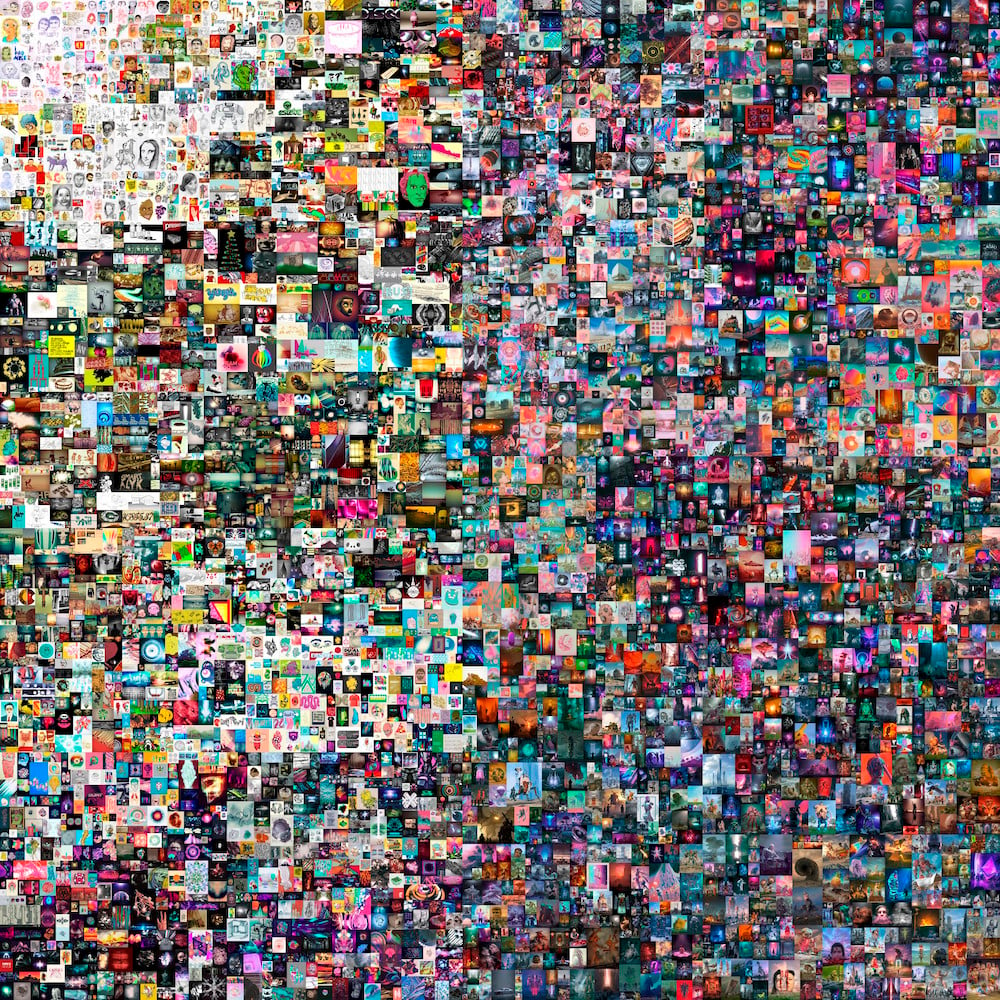
Beeple, Everydays – The First 5000 Days. Courtesy of the artist and Christie’s.
Until recently. In the art market, the moment of 2025 was the Leonard Lauder sale, in November, which caught speculators’ attention on Polymarket, to the tune of $1.4 million in bets. The single-owner auction of the Estée Lauder heir’s collection at Sotheby’s was staged inside its new Breuer headquarters and instantly became a referendum on the top end of the market: Just 24 works brought in more than $527 million in one night, led by Gustav Klimt’s Portrait of Elisabeth Lederer, which sold for $236.4 million—at the time the most expensive modern artwork ever sold at auction.
It was the kind of blue-chip, estate-driven spectacle that reassures the market’s upper crust. It also captured gamblers’ attentions. Some 13 of those paintings were gambled on. “In the last hour, I learned more about paintings and sculptures than I did in 10 years of art classes at school,” said a user named StarMaster. Another user, Sandor, explained the concept of buyer’s premium (it is “incredibly stupid,” they added.)
Given the relative dearth of interest in the art business up until recently on prediction markets, I think the Lauder sale is an early sign of interest from satellite speculators. That it attracted $1.4 million in bets is nothing to sniff at. It also signals that a derivatives market for art auctions is something potentially viable. How do we feel about that? Also, given how members of the art business love to tip each other off about potential artists who are about to go big, the possibility of insider trading would be concerning. This has already proven to be a significant issue on these platforms, to a worrying and macabre degree as flags have been raised about whales betting on political outcomes (like the capture of the former head of Venezuela, Nicolás Maduro), potentially with insider information.


Sotheby’s auctioneer Ollie Barker at the sale of the Leonard Lauder collection. Courtesy Sotheby’s
Betting on a Change
As the big auction houses chase similar single-sale auctions in 2026, I will keep refreshing the page at Polymarket. Will a bet emerge for the Venice Biennale Golden Lion this year? Probably not. But I do not think that the art world is beyond getting ensnared here. What’s more, there are signs that Polymarket is interested in expanding its remit into a more cultural realm of, well, so-called “culture.” Its newest move is a partnership with Substack, a clear signal that the platform has ambitions to be scrapping fees off of more intellectual and elite cultural arenas of the internet.
For an art industry that spent at least a ten years flirting with hyper-financialization, and where semi-affordable (let’s call that art $1 million and under) paintings are now no longer working as speculative tools, the temptation will be real. We know betting energy works well in this space. What I wager, then, is that it will reenter in its purest form: total abstraction.
By that I mean object-less prediction, where the asset is not actually the object being traded but speculation around it. Why would you try to make money off a young painter, or an NFT, when you can create a derivate of, say, the sale of a multimillion-dollar Andy Warhol? The end of art flipping and rampant speculation did not occur on moral or even intellectual grounds. It just needed a new orientation.
There are some already envisioning this. At Andreessen Horowitz, the American privately-held venture capital firm, a recent essay argues that predictions are indeed a new meta-aesthetic, “as significant a concept as modernism and postmodernism,” and, ultimately, the natural successor. “Prediction,” writes Alex Danco, Andreessen Horowitz’s editor-at-large, will help “us break free from postmodern malaise.” We have been talking about ennui for a while now. And the cultural and financial stagnation in art do seem to be connected. Danco thinks prediction will give us all “a new purpose in the world: we create order in the universe by contributing information.”
We talk a lot in the art world about growing audiences, about questions of who gets to participate, and how, about who, effectively, owns the means of the production of culture. There is an answer in prediction markets, even if I’m sure it is not the one we want. But in a society where everything that happens (or could happen) is framed as a derivative that can be invested in, art and true culture will likely not remain out of view from the action for very long. The last decade might have just been a rehearsal.