People
Pope Francis, Who Embraced Contemporary Art at the Vatican, Dies at 88
Francis was the first pope to visit the Venice Biennale.

Francis was the first pope to visit the Venice Biennale.
Sarah Cascone
 ShareShare This Article
Pope Francis, head of the Roman Catholic Church, has died at age 88. A Jesuit priest known for championing the poor and migrants, the environment, and, to a certain extent, the LGBTQ community, Francis was also progressive in his views on art, welcoming contemporary artists to the storied Vatican Museums in Rome.
Hailing from Argentina, Francis was the first pope from North or South America, and the first from outside of Europe since the 8th century, when Gregory III of Syria was named pontiff. At 76, Francis was elected by the papal conclave in 2013 after Pope Benedict XVI resigned—the first pope to do so voluntarily since 1294. Born Jorge Mario Bergoglio, he took his papal name after St. Francis of Assisi, founder of the Franciscans.
On Easter Sunday, the day before he died, Francis met with U.S. Vice President J.D. Vance and appeared in St. Peter’s Square to bless the crowds from his window.
“Dear brothers and sisters, happy Easter,” the pope said to the assembled masses. An aide then read his Easter message, which called for an end to war, especially a ceasefire in Gaza, and continued his support of migrants, many of whom are facing deportation under the new U.S. presidential administration. Amid a worldwide rise on nationalism, Francis consistently spoke out in favor of social justice, serving as a global conscience.
This past Christmas, the Vatican chose to display a nativity scene designed by Palestinian artists Johny Andonia and Faten Nastas Mitwasi, both from Bethlehem, and carved from the wood of a single olive tree by Bethlehem artist Peter Khano.
The display became the source of controversy because the artists installed it with the baby Jesus lying on a keffiyeh, a traditional Middle Eastern headdress that has become a symbol of Palestinian solidarity. The Vatican later removed the keffiyeh.
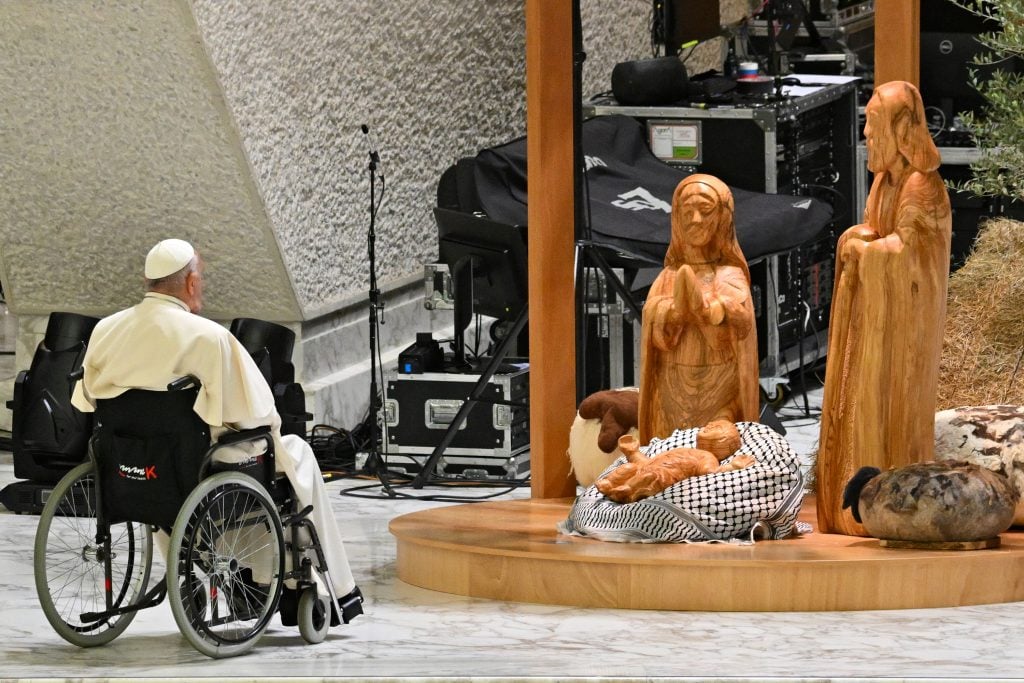
Pope Francis prays before the “Nativity of Bethlehem 2024” during its inauguration in the Paul VI Hall, during the private audience to donors of the Nativity Scene and the lighting of the Christmas tree ceremony at St Peter’s Square in the Paul-VI hall at the Vatican on December 7, 2024. Photo: Andreas Solaro/AFP via Getty Images
The pope is also head of the Vatican City state, and indirectly oversees the Vatican Museums. The papal art collection traces its origins to 1506, with the acquisition of one of its most famous works, the ancient marble sculpture Laocoön and His Sons.
Francis continued to steward those historic holdings, including the 2015 restoration of the Hall of Constantine in the Vatican’s Apostolic Palace. That was the last of the four rooms in the former apartments of Pope Julius II featuring frescoes by Raphael (1483–1520) to undergo contemporary restoration, and work was just completed in December.
For the 500th anniversary of the artist’s death in 2020, the Vatican also reunited in the Sistine Chapel the 10 Brussels tapestries featuring scenes from the Acts of the Apostles designed by Raphael to complement the space’s Michelangelo (1475–1564) frescoes, but normally housed in the Vatican’s Pinacoteca museum.
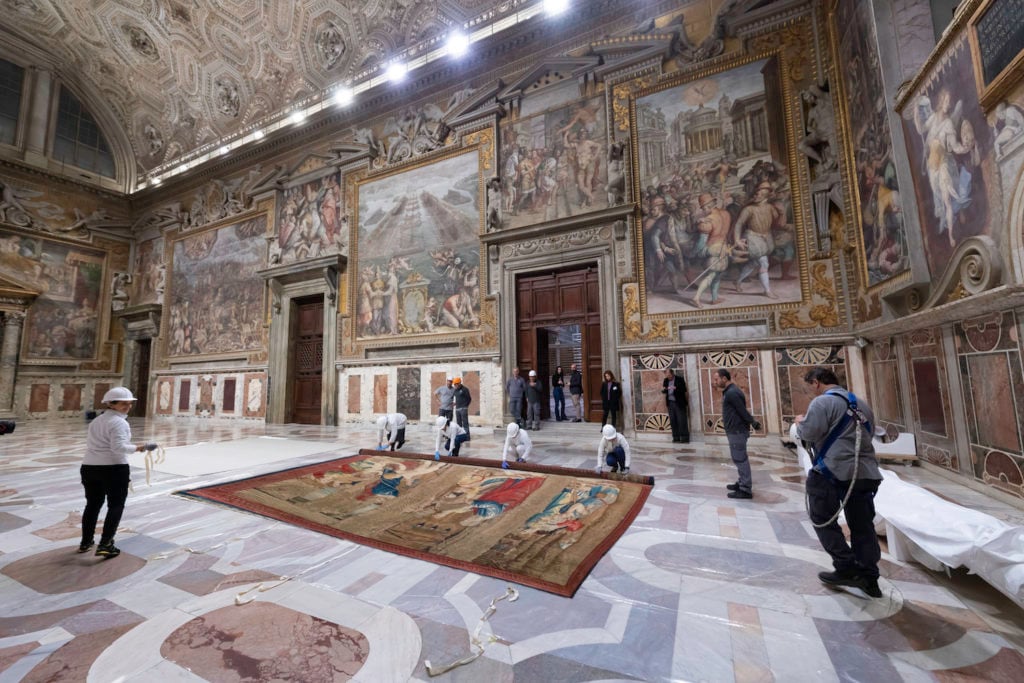
Installation of Raphael’s tapestries at the Sistine Chapel. Photo courtesy of the Vatican Museums.
And while the British government has for years resisted calls to restitute the Parthenon marbles from the British Museum, the pope took the radical step of ordering the Vatican Museums to return three Parthenon marble fragments to Greece. Vatican officials said the decision was “a concrete sign of [the pope’s] sincere desire to follow in the ecumenical path of truth”.
But the pontiff also looked to the future, and the role that today’s artists can continue to play in the Catholic faith.
In Francis’s first year as pope, Vatican City staged its first-ever pavilion at the Venice Biennale. In 2018, it did the same at the architecture biennale. And just last year, Francis became the first pope ever to visit the famed exhibition. He went to see the Vatican pavilion at the Giudecca Women’s Prison, which featured works by the late Corita Kent (1918–1986), a former Catholic nun, among other artists.

Pope Francis views the Vatican Pavilion installation at the Venice Art Biennale in the Church of La Maddalena in the Giudecca’s women’s prison facility on April 28, 2024 in Venice, Italy. Photo: Vatican Media via Vatican Pool/Getty Images.
“I hope with all my heart that contemporary art can open our eyes, helping us to value adequately the contribution of women, as co-protagonists of the human adventure,” Francis said of the exhibition.
It was Francis who appointed the first female head of the Vatican Museums, current director Barbara Jatta, in 2016. In 2021, the museum opened its first dedicated contemporary art gallery, at the Vatican Apostolic Library,
And in 2023, Francis celebrated the 50th anniversary of the Vatican’s contemporary art collection by welcoming some 200 living artists to the Sistine Chapel. Those assembled included Andres Serrano (b. 1950), whose infamous 1987 photograph Piss Christ, of a crucified Jesus immersed in the artist’s own urine, had become a political flashpoint in the U.S. for its perceived sacrilegiousness.
“You want to reveal reality also in its contradictions and in those things that it is more comfortable and convenient to keep hidden,” Francis said at the time. “Like the biblical prophets, you confront things that at times are uncomfortable; you criticize today’s false myths and new idols, its empty talk, the ploys of consumerism, the schemes of power.”
The pope also spoke of his views on art in journalist Tiziana Lupi’s 2015 book La Mia Idea di Arte, or My Idea of Art, which later became the basis for a documentary of the same name.
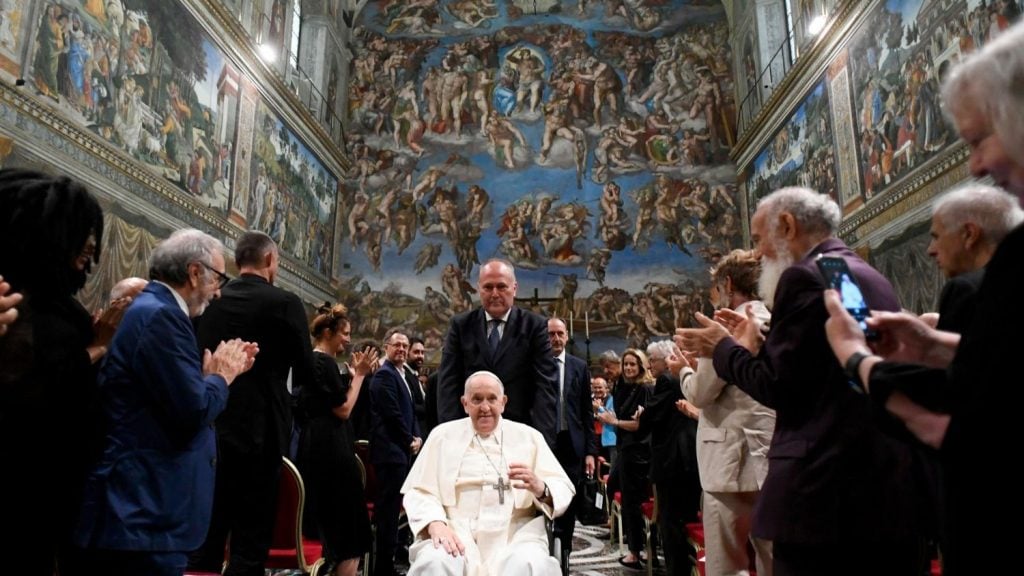
Commemorating 50 years of the Vatican Museums’ Modern and Contemporary Art Collection, Pope Francis meets artists in Sistine Chapel. Courtesy Vatican Media.
“[The Vatican Museums] must embrace new forms of art,” Francis said in the book. “They must throw open their doors to people from around the world and serve as an instrument for dialogue between different cultures and religions, an instrument for peace. They must be alive! Not dusty repositories of the past reserved for the select few… but a vital [institution] which looks after the objects in its care to tell their stories to people today, starting from the most disadvantaged of its visitors.”
The pope’s death followed his return to public appearances after he was hospitalized from February 14 to March 23 for bronchitis that later developed into pneumonia. Doctors had recommended a two-month period of rest and convalescence, but Francis seemed determined to resume his duties.
Among the pope’s final public appearances was inside St. Peter’s Basilica on April 11, where he spoke with the conservators who were finishing work on the tomb of Pope Urban VIII by the Baroque master Gian Lorenzo Bernini (1598–1680). (The work also included the tomb opposite, containing the remains of Pope Paul III and completed in 1577 as the first tomb in the then-new basilica.)
“It was just us, the pope, and the people with him, so it was an extraordinary thing, unique,” Michela Malfanti, who had restored the 17th-century tomb with Lorena Araujo Piñeiro, told the New York Times. (The work included removing a prudish sculpted addition covering the bare breast of the figure of Charity, who was nursing two babies.)

Andrea Mantenga, Deposition of Christ. Image courtesy of the Vatican Museums.
The restored monument was unveiled to media the following day, ahead of Holy Week and the influx of religious pilgrims and other tourists for the associated religious observations.
The year 2025 is a jubilee year for the Catholic church, typically celebrated every 25 years. There are several exhibitions at the Vatican Museums—which are offering extended hours all year, staying open two hours late each day—marking the occasion.
The newly renovated Raphael frescoes in the Hall of Constantine are joined by shows featuring rare documents from the Vatican collections, a pairing of two works featuring the passion of Christ by Giovanni Bellini (ca. 1440–1516) and Giovanni Antonio “il Sodoma” Bazzi (1477–1549), and the unveiling of a rediscovered painting by Renaissance master Andrea Mantegna (1431–1506) from Pompeii that was until recently thought to be lost.