Opinion
Painting Has Entered Its Performance Era
Painting has joined the attention economy and surrendered the studio to the algorithm.

Painting has joined the attention economy and surrendered the studio to the algorithm.
Kate Brown
 ShareShare This Article
Much of Instagram’s video content is organized around transformation—the virtual magic of the before-and-after and clips that show cause and effect. A person makes pasta from scratch in 20 seconds via edits that compress time-intensive labor. We experience a sense of revelation as time-consuming processes—like gym workouts or analyzing films and books—are compressed into instant, digestible moments.
Somewhat surprisingly, painters have gained traction online with this visual grammar. I say it is surprising because JPEGs are at a serious disadvantage in the era of videos and reels, and unlike performance art, video art, or kinetic art, paintings tend to be quite static. In order to survive social media’s algorithmic preference for transformation, spectacle, and time compression, artists—especially amateur ones with an interest in influencer culture—have turned their studios into a stage. In our new age of A.I.-generated images and blurred reality, handmade work carries new urgency—proof that a human hand was there and time was spent.
There are two modes of painting being shared online that reflect a broader shift in taste toward traceable art-making, and our collective impatience: speed painters and artists sharing via the hashtag trend of an “art reveal.”
Art-reveal videos typically take up a consistent format: artists stand in their studios and hold their canvases backside facing the camera. There is overlaid text, and often it reads something like, “sharing my art until I reach my target audience.” Slowly, they turn the work around, showing a painting. Even if the work is deeply underwhelming, the effect works.
Meanwhile, speed painters—who, you guessed it, paint really fast—have become megastars on social media, and have been filling stadiums. Virtual or physical crowds watch these artists develop finished paintings in a matter of minutes, often to a dramatic score.
They’re disparate styles, but both introduce the notion of painting as alchemy. It is also a bid to interface with audiences in an intimate way.
The reveal trend in particular has become the dominant language of painting online among the non-establishment art world and there are more than a million videos with this tag on Instagram alone, as of writing, and hundreds of thousands more on TikTok. What these videos share is a sense of earnestness, and that sense of vulnerability is where their true value lies.
Faye Greenman, a 27-year-old British artist with around 23,000 followers on Instagram, has been selling paintings from her bedroom since she was 20. She follows the script of many painters like her, but with her own tailoring: she stands in her resplendent apartment, peering at the camera and holding her canvas away from viewers.
This is where Greenman’s bespoke storytelling begins: a Lana Del Rey audio track plays as text overlays the video, reading: “What do you mean this painting came to you in a dream?” Slowly, Greenman flips the work around, revealing a pair of butterflies and a pair of poppies in black and white. If you click the link in her bio, her website includes 5-star Yelp-style reviews from her collectors.
Australian artist Kristen Rose, who also paints flowers, and mostly lilies, has a dedicated Instagram following of nearly 18,000 fans with whom she openly discusses prices for her works—a work on paper sold for more than $3,000, she noted, flipping it toward the camera as she stands in her Gold Coast kitchen.
There are the masses of artists who have not yet made painting a full-time career, like Rose and Greenman, who are instead making deals with their publics, however large or small: they will show a painting a day until they go viral; they will keep revealing work until they have 10,000 followers; they will keep painting until they can afford to quit their day jobs; they thank their audiences for keeping them motivated to keep going, to keep painting.
This is a space where intention, earnestness, and vulnerability are valuable, where sharing processes as well as hopes and dreams are all fair currency. If followers and interactions are a success metric, and some of the artists’ sale claims are to be believed, it is going well, regardless of how cringey the establishment art world might find the performativeness of it all.
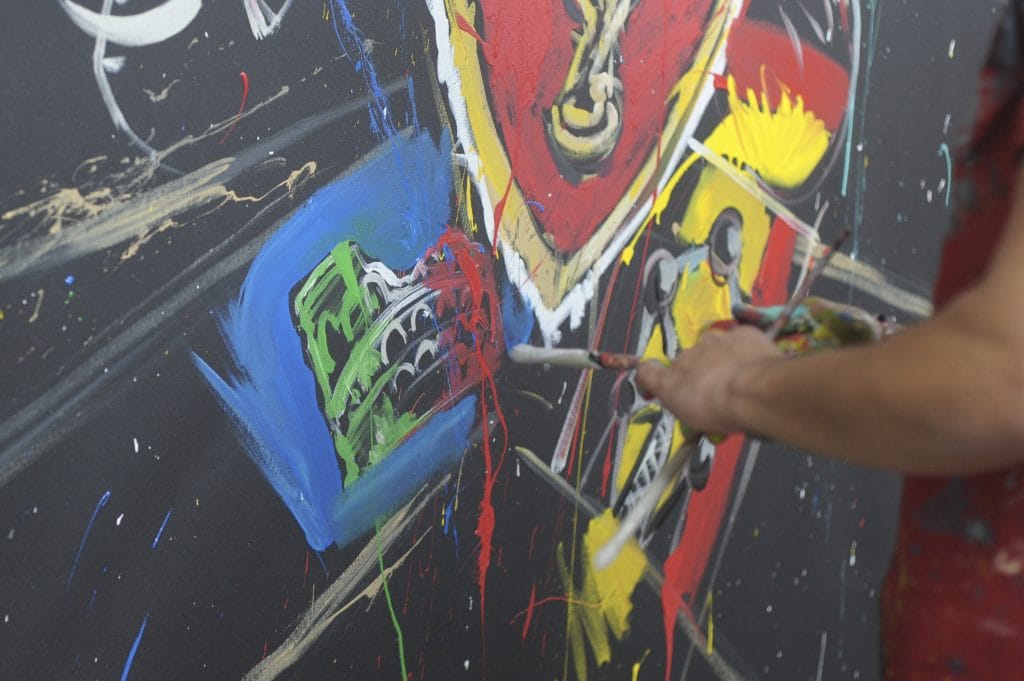
World-renowned speed painter David Garibaldi at a Budweiser-sponsored painting event for the 2014 FIFA World Cup Brazil. Photo: Kris Connor/Getty Images for Budweiser.
Social media’s preponderance of short videos has also transformed performance art, which I wrote about a few years ago. I am convinced it is doing the same to painting, bringing the two forms, in effect, closer together. Painting as a kind of theatrical self-presentation, which was once antithetical to the private and hallowed studio practice, is now acceptable. That is because the image—as in the outcome, which is the painting—has gradually been supplanted by the process, which is now an image itself and has become the font of social value.
This is spilling out into real institutional spaces of the art world. In 2024, painter Sophie von Hellermann was painting people’s dreams at Art Basel Paris, at Pilar Corrias‘s booth. This year, painter Norbert Bisky has a painting event in the works with the Karajan Academy, the Berlin Philharmonic‘s music academy, with details to be revealed soon.
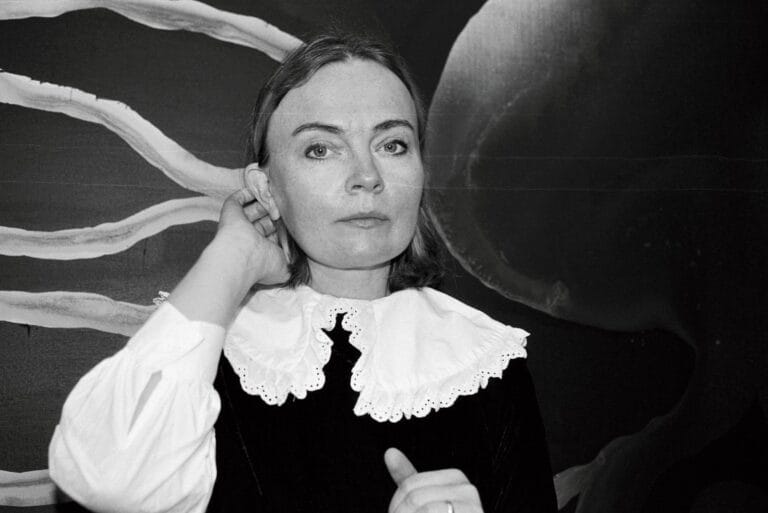
Merike Estna. Photo: Marta Vaarik.
At the 2026 Venice Biennale, opening in May, Merike Estna, who is representing Estonia, will be painting daily in public view for the entirety of the exhibition, which runs until November. Starting with 22 blank canvases totaling nearly 20 feet, she is turning painting into a durational performance and the exhibition space into a studio.
While it is perhaps some of the same underlying impulse that drives the art-reveal genre and speed painters, it is in a completely different register. Here, the insistence on evidence of process is filtered through a keen awareness of feminist art history and institutional critique. Estna is puncturing myths of the venerable solo male painter as genius, and bringing invisible labor into the fold. It pushes at the limitations of the biennale’s pavilion structure by occupying it in an entirely different way.
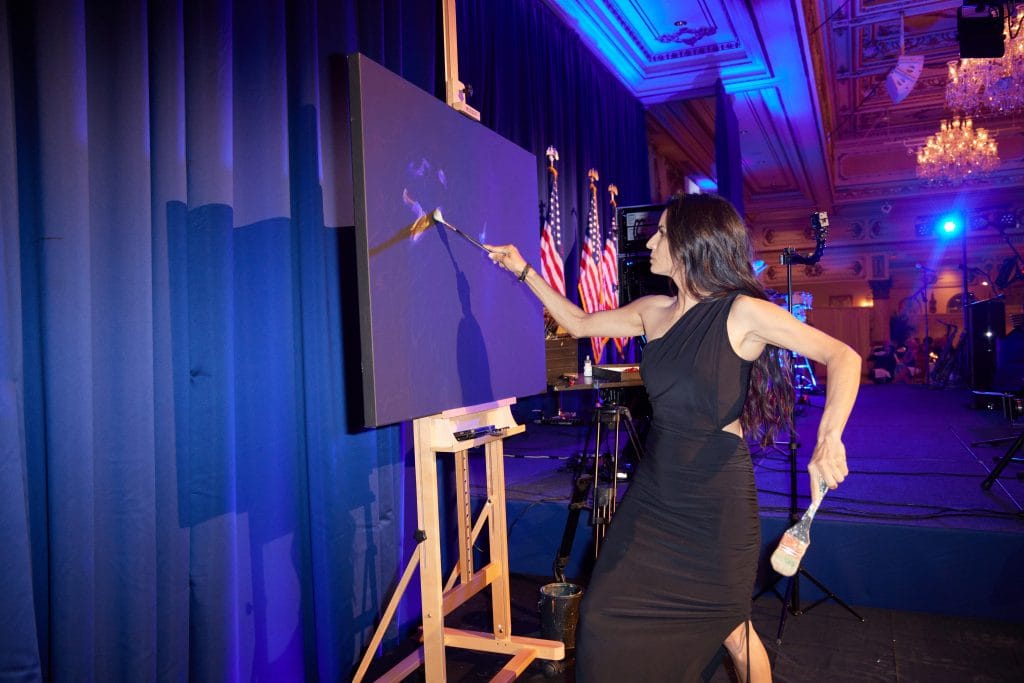
Vanessa Horabuena performs as Haute Living supports our veterans at America First gala at Mar-a-Lago on April 11, 2024 in Palm Beach, Florida. Photo: Romain Maurice/Getty Images for Haute Living.
There is something truly profound about witnessing something becoming—one could even say there is a spiritual element in witnessing an act of creation.
It helps explain why the most visible node in the speed-painting trend is Christian content. The Shroud of Turin—linen bearing what believers hold to be a miraculous imprint of Christ—is a powerful touchstone for a culture that has always wanted proof of the divine hand. Speed painters return to that well constantly, the face of Jesus among their most repeated subjects. Like stunt artists, they often paint canvases upside down, then flip them right side up, thereby creating an a-ha moment, of sorts. A face is revealed.
Vanessa Horabuena is one of the most famous of these speed painters, and she deals in largely Christian themes. She also paints President Donald Trump and he is a huge fan. It was a big news story when he sold one of her paintings for $2.75 million in a charity auction earlier this year. Horabuena, who describes herself as a Christian Worship Artist, has 830,000 followers on Instagram and can fill stadiums, inducing some of her viewers into euphoric states as her contemporary takes on the shroud are revealed.
The age-old idea of the artist as a hand of god—something that Renaissance artists like Leonardo and Michelangelo played into—is alive and well in the Christian art world, but it goes well beyond it, too. Speed painters like David Garibaldi, who paints “art you can feel,” depicts minds like Bob Marley, Albert Einstein, and John Lennon.
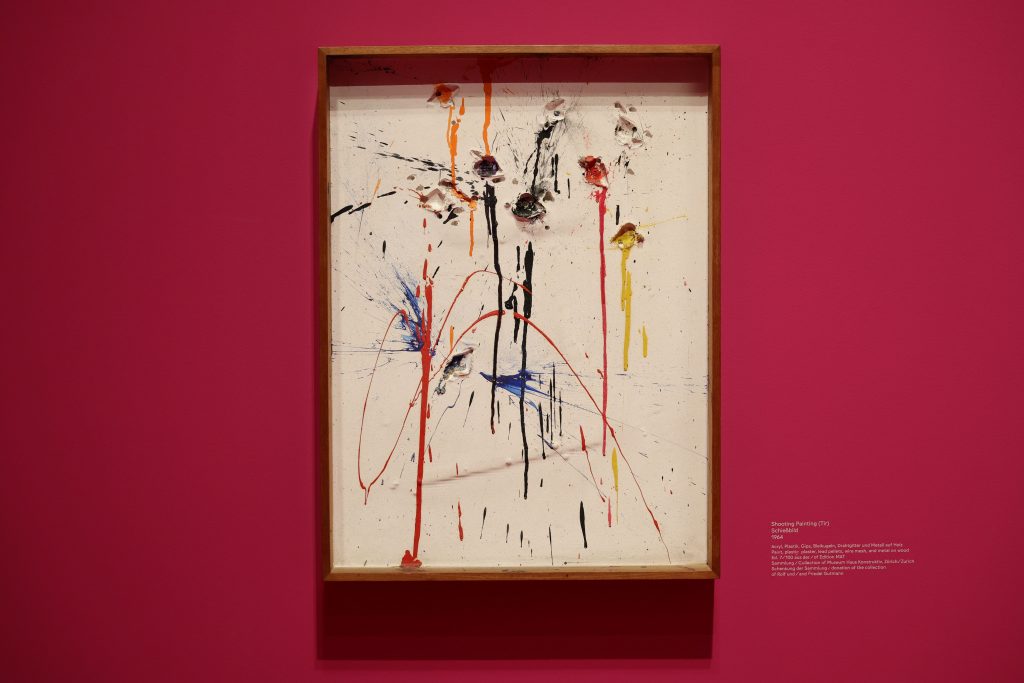
Niki de Saint Phalle, Shooting Painting, on view at Schirn Kunsthalle in Germany, 2023. Photo: Andreas Rentz / Getty Images.
In some ways, we have been here before. Painting survived endless claims of its death, especially during the early 1960s and into the ’70s, when happenings, performance art, minimalism, and conceptual art were the prevailing trends. During that time, painting became extra experimental, incorporating performance, sometimes becoming installation. Yves Klein had women bump up against canvases, their bodies covered in blue. Niki de Saint Phalle held a rifle up to her paintings and shot pigment bullets at them. Hermann Nitsch‘s bloody painting performances helped blaze the trail for more Fluxus “happenings.”
Art is tapping into the wider bench of the senses again, a reasonable response to our disquiet with so much life lived on-screen. The visual language of the reveal and the edit allows painters to meet their viewers in our ongoing need for intimacy, whether virtual or physical. And, tech pressures aside, it makes sense that after the market-induced euphoria for painting in the 2000s and 2010s, painters face a familiar pressure to break with the coda.
But is it breaking with the current coda? Not at all, I would say. In a time of so much A.I. imagery, where so much feels untrustworthy and ultimately unreal, we all have a growing desire for on-site community experiences, sure, but social media is two steps ahead, capitalizing on that, and pairing it with our dopamine addiction to posting and sharing those moments.
Painting didn’t break through the attention economy, it joined it. The desire for truth, real experiences, something devoutly human, makes sense—but the performative turn is still captured and formed by digital platforms and the attention mechanics they breed, the ones that threatened to make painting obsolete. The studio is a stage now, and the audience gets to be in the room again, but this time they have their phones out.