Museums & Institutions
The Most Anticipated Museum Openings in 2026
From the Guggenheim Abu Dhabi to the Lucas Museum of Narrative Art in L.A.—the museum landscape is set to swell in 2026.

by
Alina Cohen &
Richard Whiddington &
Vittoria Benzine
 Share This Article
Despite ongoing concerns about funding, government pressure, and cultural relevance, museums around the world continue to expand their footprints and seek out new audiences. To do this, a number of international institutions are launching new outposts, rebuilding their old homes or taking over historic or industrial buildings and adapting them for cultural use. Some have been in the works for decades, many have turned out to be more expensive than expected, but all are highly anticipated projects that are sure to draw crowds and critical takes when they open. Here, we’ve compiled the top museum openings of 2026, so mark your calendars and strap on your gallery walking shoes.
Guggenheim Abu Dhabi

Rendering of the Guggenheim Abu Dhabi. Photo: Gehry Partners.
New York’s Guggenheim Museum announced plans for this high-profile, 320,000-square-foot outpost in 2006—nine years after late starchitect Frank Gehry unveiled his sensational Guggenheim Bilbao. The Guggenheim stuck with Gehry for this location, too. Rather than Bilbao’s twisting forms, however, Gehry’s vision for Abu Dhabi consisted of nine metallic cones that are inspired by Abu Dhabi’s architecture and strategically suited to its desert climate.
At long last, the Guggenheim Abu Dhabi is slated to open next year, after decades of delays and protests. Recent photos show construction drawing to a close. Several major museums have sprung up throughout the burgeoning art capital’s Saadiyat Island cultural district since it started, including the Louvre Abu Dhabi (which opened in 2017) and the Zayed National Museum (which opened December 3). Snippets from the Guggenheim Abu Dhabi’s collection have already been the focus of several shows. The museum reportedly plans to exhibit Western figureheads like Dan Flavin and Jean-Michel Basquiat alongside lesser-known talents from Asia, Africa, and the Gulf. —Vittoria Benzine
Lucas Museum of Narrative Art

Aerial view of the Lucas Museum under construction, September 2025. Photo: Pedro Ramirez, courtesy of Hathaway Dinwiddie, © 2025 Lucas Museum of Narrative Art. All rights reserved.
Across his four-decade career, George Lucas revolutionized the film industry, channeling an openness for new technology into movies that created the Hollywood blockbuster we know today. A similar pioneering spirit hovers around his $1 billion namesake museum, which is set to open in Los Angeles in September 2026.
Lucas is a storyteller and his museum intends to do the same by elevating narrative art forms long overlooked by traditional institutions, from comic art to children’s illustration. Fifteen years of repeated setbacks have at least provided ample time to amass a collection fit for the purpose. It numbers more than 40,000 works, spanning comic giants Frank Frazetta and Robert Crumb, American icons N.C. Wyeth and Norman Rockwell, contemporary painters like Robert Colescott and Kerry James Marshall, and, of course, an emporium of Star Wars artifacts.
Appearing for the first time at San Diego’s Comic-Con in July, Lucas called the museum “a temple to the people’s art.” Time will judge these populist claims, but for now the temple designed by MAD Architects’ Ma Yansong wouldn’t look out of place drifting above a city in a far-off galaxy. —Richard Whiddington
Dataland
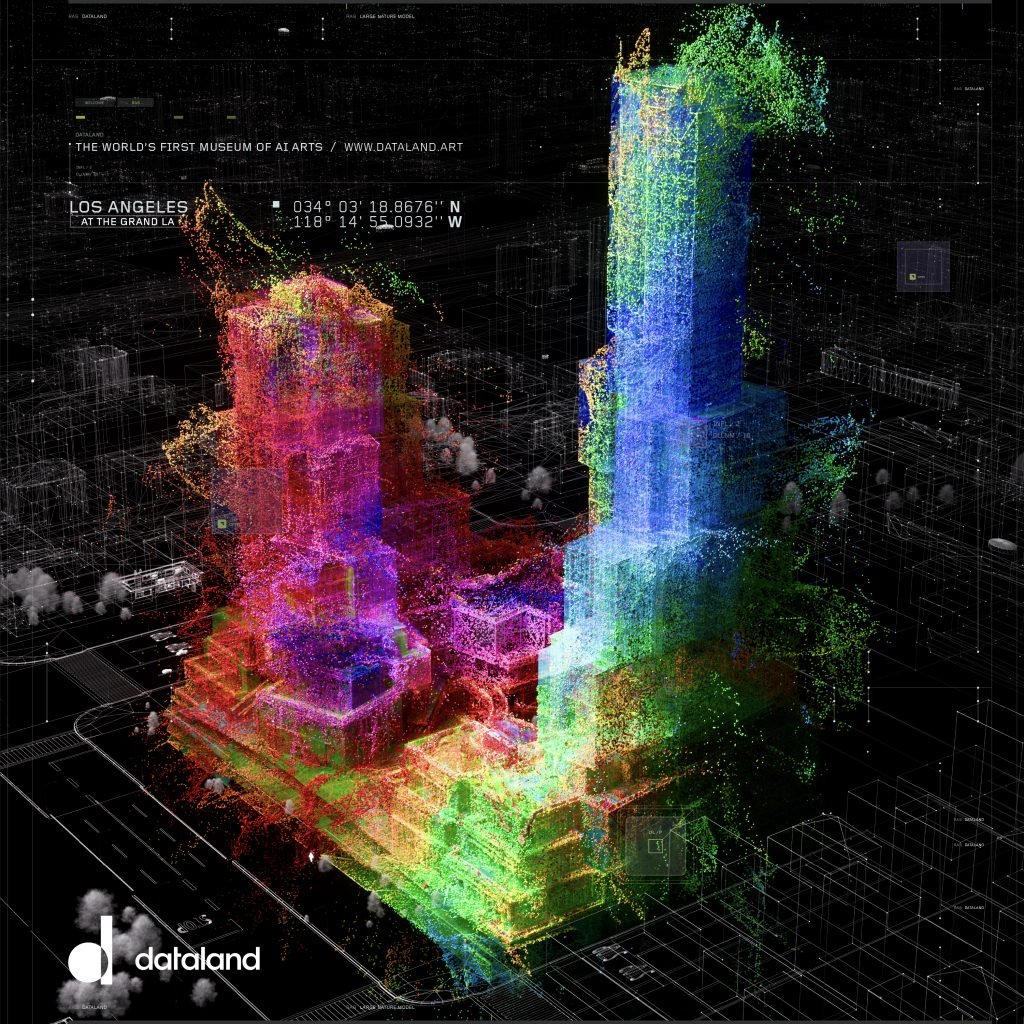
A.I. interpretation of a building rendering by Refik Anadol’s studio. Photo: Dataland.
Amid mounting concerns over A.I.’s environmental costs, data misuse, and financial precarity, the art world’s A.I. emperor is keen to say he’s doing things the right way. At Refik Anadol’s Dataland, which will join a blossoming cultural corridor in downtown Los Angeles in Spring 2026, all datasets are permissioned and research is conducted on servers that use renewable energy.
All the same, Anadol is equally prone to the tech boosterism of his less aesthetically minded peers. Dataland, which will occupy 25,000 square feet of a Frank Gehry-designed mixed-use complex, promises to be a place that “operates at the intersection of human imagination and the creative potential of machines.” Precisely what this means isn’t clear.
What is known is that Dataland will host tech-forward artists through a residency program and that one of its five galleries will feature a signature Anadol Infinity Room, beguiling immersive spaces of mirrors and projectors that he has been creating since 2014. This one was trained on half a million scent molecules and has “an olfactory dimension,” making it one of many “perspective-altering experiences” Dataland promises. —Richard Whiddington
David Geffen Galleries at LACMA

David Geffen Galleries at LACMA; exterior view of exhibition level with reflection of LACMA’s Pavilion for Japanese Art. Photo: © Iwan Baan.
In April 2026, LACMA will officially open its decade-in-the-making, Peter Zumthor-designed David Geffen Galleries, named for the eponymous record executive, who gave $150 million to the museum. The institution soft launched the space this past summer and is in the process of installing thousands of permanent collection artworks.
The city of Los Angeles contributed $125 million for the new building, which straddles Wilshire Boulevard, one of the city’s major arteries. The north wing is named for the late trustee Elaine Wynn, while the south wing is still looking for a patron. Artists including Shio Kusaka, Thomas Houseago, Liz Glynn, Pedro Reyes, and Diana Thater are all slated to contribute outdoor artworks on museum grounds. Mariana Castillo Deball is creating Feathered Changes, a site specific work that honors the campus’s history, while Sarah Rosalena is making a monumental textile piece for one of the museum’s new restaurants. In celebration of the new galleries, LACMA is also pulling out an Alexander Calder sculpture they commissioned for their 1965 opening, as well as large-scale works by Auguste Rodin. —Alina Cohen
Crystal Bridges Expansion

Guests admiring Georgia O’Keeffe’s record-breaking painting Jimson Weed/White Flower No 1 (1932) in the new Foundations of American Art gallery at Crystal Bridges. Photo: Tom McFetridge, courtesy of Crystal Bridges Museum of American Art.
This ambitious Arkansas-based institution celebrated its 10-year anniversary in 2021 by announcing a massive expansion led by Safdie Architects, the same firm that designed its original facilities atop the waters of Crystal Spring. Although the addition was initially scheduled to open in 2024, its hard launch is now officially set to take place on June 6, 2026, timed to America’s 250th birthday.
The endeavor increases Crystal Bridges’s footprint by nearly 50 percent with 114,000 more square feet of galleries, studios, dining options, event halls, and more. The museum certainly needs all the extra space it can get. Its founder, Walmart heiress Alice Walton, has become one of America’s most ravenous art collectors. Furthermore, in September Crystal Bridges also received its largest-ever gift of 200 artworks by more than 100 acclaimed American artists from Elizabeth Catlett to Nicholas Galanin, courtesy of Dallas-based collectors Candace and Michael Humphreys. In the meantime, the museum’s new Foundations of American Art gallery opened this summer, providing a taste of what’s to come. —Vittoria Benzine
Kanal Pompidou

Aerial view of the Kanal Pompidou under construction. Photo: courtesy of Kanal Pompidou.
For years, there’s been a contradiction at the heart of Brussels’s art world. The city boasts some of the best private collections in Europe and an art fair renowned for uncovering emerging talent, but lacks a contemporary art museum of international pedigree. In 2018, the regional government addressed the void, putting €150 million (then $177 million) towards converting a modernist Citroën garage into Brussels’s riposte to London’s Tate Modern or Bilbao’s Guggenheim.
When Kanal opens in November 2026, it will rank among the continent’s largest museums, with the cavernous former car showroom stripped back and ready to host “monumental projects.” For the first five years of operations, the museum will lean on the guidance (and voluminous collection) of Paris’s Centre Pompidou, with the inaugural displays pulling up to 300 works from the French institution. Beyond that, the focus will very much be local and Kanal’s director Yves Goldstein said the museum “will do everything it can to support Belgian and Brussels artists and make their work shine on the international stage.” —Richard Whiddington
Memphis Art Museum

Rendering of the Memphis Art Museum, courtyard entry. Photo: courtesy of the Memphis Art Museum.
The oldest and largest art museum in Tennessee will reopen in Memphis in December 2026, between Front Street and the Mississippi River. The Memphis Art Museum, currently known as the Memphis Brooks Museum of Art and located in Overton Park, will feature a 122,000-square-foot building designed by Pritzker Prize-winning firm Herzog and de Meuron and Memphis-based archimania. The space will house the institution’s permanent collection of 9,000 artworks spanning 5,000 years. Landscape design by OLIN will include a 10,000-square-foot community garden and a 50,000-square-foot rooftop sculpture garden. This is a major year for culture in the city: The National Civil Rights Museum and the National Ornamental Metal Museum will open new or expanded buildings, while music, dance, performance and botanical organizations will all celebrate major anniversaries. —Alina Cohen
New Museum Expansion

Rendering of the expanded New Museum. Photo: courtesy OMA/bloomimages.de.
When New York’s New Museum announced plans to double its space in 2016, it expected to finish in time for its 40th anniversary the following year. Alas, delays ensued and the budget ballooned from $63 million to $125 million. Construction on the 60,000 square foot addition only started in 2022.
In 2019, the New Museum scrapped its initial plan to renovate the neighboring Bowery building that housed NEW INC and Rhizome, instead asking architects Shohei Shigematsu, Rem Koolhaas, and Cooper Robertson to devise an entirely new structure. Three of its seven floors will integrate seamlessly with galleries throughout the museum’s original SANAA-designed space. There will be new venues for residencies and programs, an expanded bookstore, and a restaurant. NEW Inc will get a permanent home, too.
The New Museum closed for the project in March 2024. In February, they planned to reopen this fall. That’s become “early 2026.” Eventually, the New Museum will reopen with “New Humans: Memories of the Future,” a 150-artist show exploring technology’s impact on humanity. —Vittoria Benzine
Fondazione Dries Van Noten

Fondazione Dries Van Noten at Palazzo Pisani Moretta. Photo: Camilla Glorioso.
The Palazzo Pisani Moretta on Venice’s Grand Canal has enjoyed many lives. Built in the mid-15th century, it has nursed forbidden trysts, hosted Holy Roman Emperors, held the most exclusive of masquerade balls, and collapsed in a James Bond movie. Beginning in April 2026, it will start a new chapter as a cultural center founded by the fashion designer Dries Van Noten.
In May, Van Noten, together with his partner Patrick Vangheluwe, acquired the palazzo for a rumored €36 million ($40.9 million) and immediately announced plans to turn it into a foundation focused on supporting craftsmanship. What constitutes craftsmanship for a third-generation tailor? Anything one does with hands and some soul, from cooking to glassmaking. Fondazione Dries Van Noten will host exhibitions, residencies, and talks both at the palazzo and a second gallery-like space.
“It will be a platform for contemporary work,” Van Noten said. “The project is about Venice, history, craft, and culture.” It’s also about ensuring his legacy extends well beyond the world of fashion. —Richard Whiddington
Canyon

Rendering of the exterior of Canyon. Photo: New Affiliates Architects.
In June, news broke that an 18,000 square-foot museum devoted to video, sound, and performance art will soon land in New York’s Lower East Side. By November, guests got their first glimpse inside the innovative institution, which digital artist Ian Cheng has dubbed Canyon, when it hosted Ayoung Kim’s Performa commission.
New Affiliates Architecture has big plans for the raw former retail space’s renovation, which is set to start next month and conclude before 2026 is up. Canyon won’t have a permanent collection, but its spacious, semi-subterranean central hall will offer a cafe, restaurant, and bars meant to foster community—plus a 260-person performance space, and smaller screening rooms where guests can savor libations. Canyon’s financier, the Whitney board vice president Robert Rosenkranz, and its director Joe Thompson, formerly of MASS MoCA, both hope this future date night spot will engage new audiences. Canyon will host three exhibition cycles annually, starting with a retrospective of Japanese new media artist Ryoji Ikeda alongside curator Hans Ulrich Obrist’s “Worldbuilding” exhibition exploring art and gaming. —Vittoria Benzine
The New York Historical’s Tang Wing for American Democracy

Rendering of the 76th Street Façade of the Tang Wing for American Democracy at The New York Historical, designed by RAMSA (Robert A.M. Stern Architects). Photo: RAMSA/Alden Studios.
The Robert A. M. Stern-designed Tang Wing for American Democracy will open June 2026 at the New York Historical—just in time for the country’s 250th anniversary. Philanthropists Agnes Hsu-Tang and Oscar Tang have given $20 million for the 71,000-square-foot space. The wing will house five major facilities: the Klingenstein Family Gallery exhibition hall, the Stuart and Jane Weitzman Shoe Museum, storage for the Patricia D. Klingenstein Library, a conservation lab, and the American LGBTQ+ Museum’s new home (opening 2027). Visitors to the rooftop garden terrace will have access to views of Central Park.
The New York Historical’s 2026 slate of celebratory exhibitions include “House Made of Dawn: Art by Native Americans, 1880–Now,” which will draw from the Tangs’ promised gift of more than 100 artworks, artifacts, and rare books made by Native American Artists. The Klingenstein Family Gallery will open in June with “Democracy Matters,” which tells the story of American democracy via objects from the New York Historical’s collection. —Alina Cohen


Related Articles
-


