Collectibles
Rare Letter Reveals Cash-Strapped Monet Once Put His Paintings Up as Collateral
The letter, wherein Monet asked Gustave Manet for 1,000 francs, could sell for six figures.

by
Vittoria Benzine
 Share This Article
- A rare 1875 letter shows Monet secured a 1,000-franc loan using 35 paintings as collateral.
- The document highlights the financial struggles faced by early Impressionists during economic downturns and public skepticism.
- The letter is up for sale at International Autograph Auctions, alongside dozens of other Monet missives.
Claude Monet may be one of the market’s most bankable artists, but the pioneering painter faced persistent poverty during his ascent. One letter immortalizing a loan Monet secured from the brother of his fellow Impressionist Édouard Manet will headline an online auction of 1,600 autographs, manuscripts, and letters that International Autograph Auctions is hosting on March 25. It’s expected to command €80,000–€120,000 ($92,100–$138,200).
The letter itself revolves around a comparatively paltry 1,000 franc loan from Gustave Manet, the lawyer and manager who notably married his brother’s rumored lover. In this nearly pristine document, dated October 18, 1875, Monet confirms that he’s received Manet’s money, adding that it “shall be repayable from the proceeds of the sale of thirty-five of my paintings, to be conducted in the course of next February under the direction of Mr. Charles Oudart, auctioneer.”
There, Monet also notes that he’s already sent eight works to Oudart, and that he’ll deliver the other 27—including “one depicting a Japanese woman,” which became the infamous La Japonaise (1876)—upon their completion.

Monet’s letter securing his loan from Gustave Manet. Courtesy of International Autograph Auctions Europe S.L.
“I think that what makes this particular document signed by Claude Monet so important historically is the light it sheds on the financial struggles of the early Impressionists,” the auction platform’s CEO Francisco Piñero told me over email. “More than just a list of figures, it captures Monet’s resolve in the face of the movement’s unstable beginnings.”
Impressionism was already far too avant-garde for the public at first blush. The Panic of 1873, a financial crisis that impacted France nearly until the 1880s, certainly didn’t help. “All the bourgeois are unwilling to spend,” Paul Cézanne reportedly complained in September 1874.
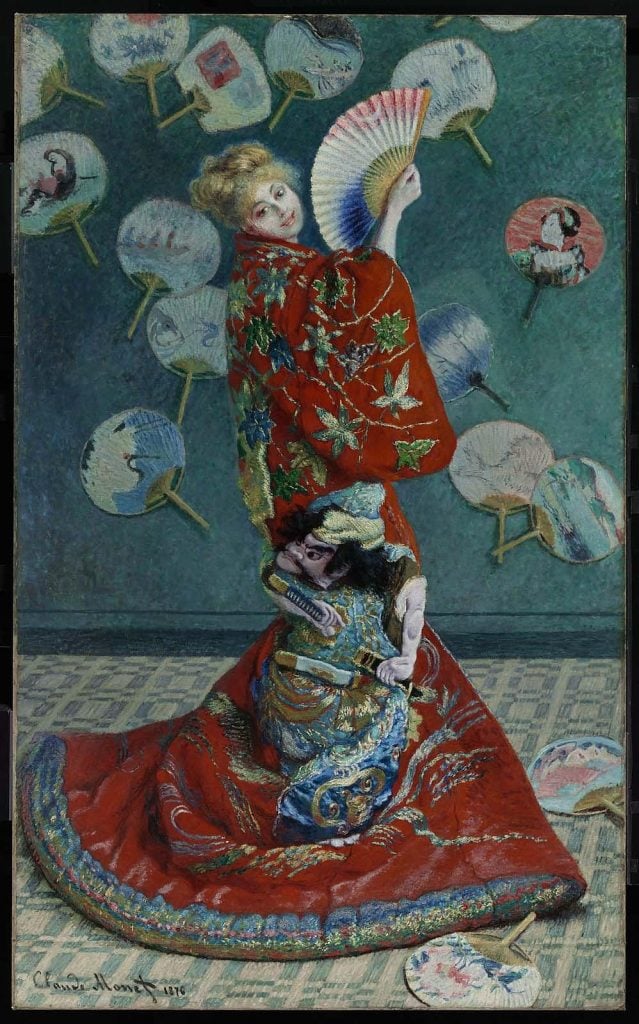
Claude Monet, La Japonaise (Camille Monet in Japanese Costume) (1876). Collection of the Museum of Fine Arts, Boston.
At 1,000 francs, this was one of Monet’s larger asks. Letters he wrote to Manet between 1874 and 1875 show the artist begging for 20 to 100 francs at a time.
Luckily, Manet definitely got his money back. La Japonaise alone went for 2,020 francs when it hit the block at the Hôtel Drouot on April 14, 1876—a startling sum that still sparks rumors of market manipulation by Monet, who’s believed to have rather covertly organized the sale alongside his leading patron, Ernest Hoschedé. “I’d be very grateful if you wouldn’t repeat to anyone what I told you about La Japonaise,” Monet cryptically entreated Gustave Manet in another letter, after the fact.
As far as Piñero knows, this 1875 letter has never come up for auction—though it did appear in a 2018 exhibition celebrating handwritten relics from the collection of Pedro Corrêa do Lago at the Morgan Library & Museum in New York. Piñero couldn’t confirm whether the Brazilian author and publisher is the consignor bringing this piece of art history to the market, but he did note that the 31 other letters from Monet set to feature alongside it hail from various European collectors.

Related Articles
-


