Art History
Michelangelo’s ‘Last Judgement’ to Undergo Major Restoration
Urgent repair work is needed to protect the Renaissance masterpiece from the impact of overtourism.
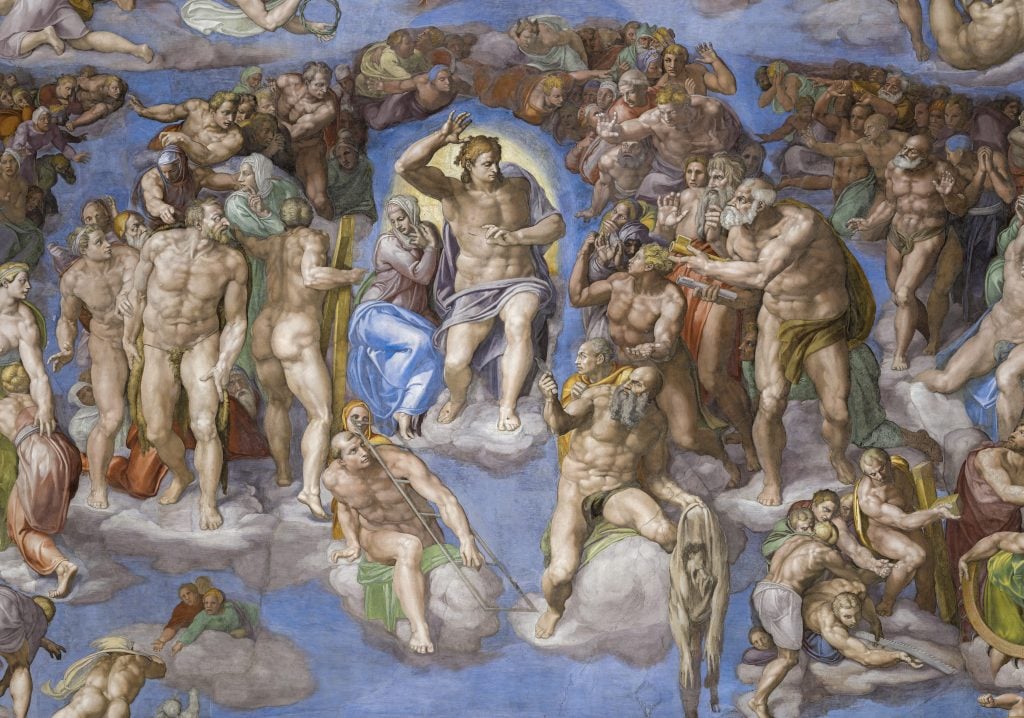
Urgent repair work is needed to protect the Renaissance masterpiece from the impact of overtourism.
Jo Lawson-Tancred
 ShareShare This Article
The Vatican Museums have announced a major restoration of Michelangelo’s Last Judgement in 2026. Considered one of the Renaissance master’s greatest feats, the monumental fresco covers the altar wall of the Sistine Chapel, which will remain open during the urgent repair works. A five-year restoration of Raphael’s Loggia is also underway.
The Last Judgement, painted by Michelangelo between 1536 and 1541, is an epic mural measuring 48 by 44 feet. It depicts a busy dramatization of the second coming of Christ, who hovers at the image’s center, his arm lifted in a commanding pose as he prepares to cast judgement on the entire human race. To the upper left are the inhabitants of heaven, soon to be joined by the newly saved that ascend from below. To the right, the damned convey their utter despair as they must descend into the fiery depths of hell.
According to Paolo Violini, head of the Vatican Museum’s painting and wooden materials restoration lab, the new conservation work is needed to protect the fresco from the impact of high levels of tourism. It will be carried out at the beginning of 2026, he told Vatican News, with the aim that it is completed in time for Holy Week, which begins in late March.

A service in Michelangelo’s Sistine Chapel, in Vatican City. Photo: Franco Origlia/Getty Images.
Though small repairs are made annually to the Last Judgement, using a simple mechanical lift, this effort will be considerably more extensive. A temporary scaffold with be erected around the entire fresco with an elevator to move a team of some 10 to 12 conservators across about a dozen floors.
Violini, who assumed his role earlier this month, is wasting no time in protecting the Vatican’s many Renaissance treasures. Before work on the Last Judgement commences next year, Violi is also overseeing restoration work on Raphael‘s Loggia, a stately corridor in the Papal Palace that was decorated by a team of the artist’s assistants according to his designs. It contains fourteen bays of magnificent stucco and fresco work.
Explaining the loggia’s significance, Violini described it as “a world heritage site” that “gave rise to the decorative genre of the ‘grotesque,’ revived from Roman antiquity and widespread throughout the 16th century.”
He went on to elaborate on the unique responsibility of coordinating conservation of the Vatican’s extensive art collection. “More than in other institutions, here, there is a particular attention to the intangible value of the work of art.” The museum’s restoration lab, which was established in 1923, seeks to restore not only an artwork’s physical state but its sacred meaning.
The Vatican curator cut his teeth as a project manager on two previous efforts to give the famed Raphael Rooms a much-needed polish. Earlier this summer, the Vatican Museums unveiled the Hall of Constantine, painted by Raphael’s assistants according to his designs and returned to its former glory after a monumental 10-year conservation. The extensive project even uncovered two new works that can be attributed to Raphael, prompting the museum’s director Barbara Jatta to proclaim, “with this restoration, we rewrite a part of the history of art.”