Collectibles
Largest-Known Martian Meteorite Rockets to $5.3 Million at Auction
The rock smashed its low presale estimate twice over.

by
Richard Whiddington
 Share This Article
The mission to land humans on Mars may remain tantalizingly elusive, but pieces of the red planet have been crashing into planet earth for millions of years. The largest-known chunk, a meteorite called NWA 16788, just cleaned up at Sotheby’s with a $5.3 million haul against a $2 million–$4 million estimate.
The meteorite was part of the auction house’s natural history sale, which also saw a 150 million-year-old mounted Ceratosaurus skeleton, selling for a whopping $30.5 million.
“These stellar results underscore a deep and enduring fascination and respect for the natural world—from the farthest reaches of space to the ancient depths of the Earth,” Cassandra Hatton, the vice chairman of science and natural history at Sotheby’s, said in a statement. “What draws collectors is more than just a passion for science; it’s a deep-seated curiosity about the forces that have shaped our planet and beyond.”
Weighing 54 pounds, roughly that of a car tire, the meteorite is 70 percent larger than any other Martian fragment that has been discovered on Earth and accounts for six percent of all Martian material ever found. It’s rare too: of the nearly 80,000 officially recognized meteorites, only 400 hail from Mars. NWA stands for Northwest Africa and the reddish-brown stone was found in July 2023 by a meteorite hunter in Kefkaf region of Niger, the first meteorite to have been discovered in the area.

Close up of the meteorite from Mars. Photo: courtesy Sotheby’s.
NWA 16788 was approved as a Martian meteorite in June 2024 and included in the Meteoritical Bulletin, the official source for information on new meteorites, which noted that “a small piece of the rock was sent to the Shanghai Astronomy Museum for identification.” It is classified as a shergottite meteorite, the most abundant type of Martian meteorite which is believed to originate from the planet’s volcanic regions and is named after the Shergotty meteorite which fell in India in 1865.
Research showed the meteorite contains large magnesium-rich crystals that become more iron-rich towards their edges. Some of its minerals have been turned to glass, likely the result of being ejected from the surface of Mars by the impact of an asteroid. Parts of the meteorite’s surface displays patches of glassy fusion, evidence of its violent passage through Earth’s atmosphere before landing in Niger’s Sahara Desert.
“NWA 16788 is a discovery of extraordinary significance—the most valuable of its kind ever offered at auction,” Hatton said before the sale. “Its immense size and unmistakable red color set it apart as a once-in-a-generation find. This remarkable meteorite provides a tangible connection to the red planet—our celestial neighbor that has long captured the human imagination.”
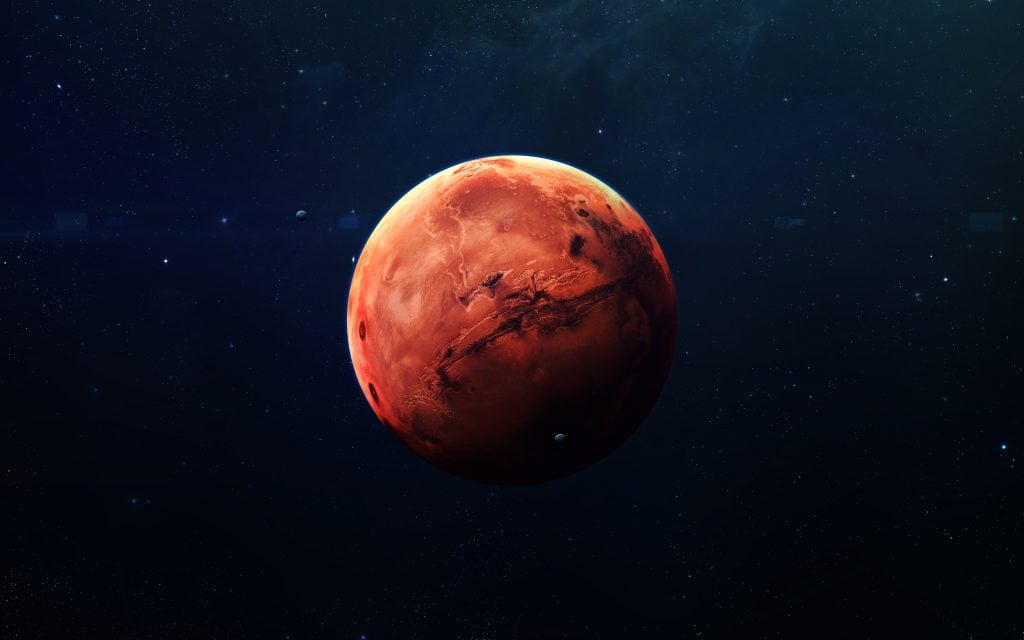
There are only 400 known fragments of Mars on Earth. Photo: Shutterstock.
Although distinct from the problem facing paleontologists of the disappearance of dinosaur specimens into private hands, there is mild concern among scientists who study meteorites about extraplanetary rocks being sold at auction.
“Meteorites are unique specimens that carry information about the history of the Solar System that cannot be learned any other way,” Paul Asimow, a geologist at Caltech, said over email. “This is mitigated by the scale at which we can study meteorites, and a sub-sample is likely to contain all the information that the whole stone contains. Ideally, if a collector buys a 1 kg stone then they might consider donating 1 g to science. ”
While several meteorites offered at auction have sold for hundreds of thousands of dollars, sales of Mars specimens have been more modest. In 2021, a 0.05-ounce sample from Mars sold for $13,750 at Christie’s and a chassignite Martian meteorite fragment sold for $16,380 at the same auction house in 2022.
This story was originally published on July 2, 2025. It was updated on July 16, 2025, at 2.10 p.m. ET, with the auction results.

Related Articles
-


