Law & Politics
$25 Million Modigliani Goes to Jewish Heir in Landmark Restitution Case
The decision comes at the end of an 11-year-long legal battle between the Nahmad family and the heir of Oscar Stettiner.

The decision comes at the end of an 11-year-long legal battle between the Nahmad family and the heir of Oscar Stettiner.
Sarah Cascone
 ShareShare This Article
The heir of Jewish art dealer Oscar Stettiner has won a major victory in an 11-year-old Amedeo Modigliani restitution case. A New York Supreme Court judge found last week that Stettiner’s estate is the rightful owner of the 1918 painting Seated Man With a Cane, ruling on a case filed by his grandson, Philippe Maestracci, in 2015.
“The ruling was a wonderful turning point in this 17-year journey from the time that we began working on this historic claim,” said James Palmer, founder of looted art recovery firm Mondex Corporation. “Sharing the news with Mr. Maestracci was a moment of incredible joy, pride, and closure.”
The work, valued at as much as $25 million, currently belongs to billionaire art dealer David Nahmad, the head of a family of international art dealers. But before World War II, the court found, it was the property of Stettiner, an art dealer who made the wise choice to flee Paris ahead to the Nazi occupation.
“Oscar Stettiner owned or at a minimum had a superior right of possession of the painting prior to its unlawful seizure,” Judge Joel M. Cohen wrote in his decision, and “he never voluntarily relinquished it.”

David Nahmad attends the FIAC 2018 – International Contemporary Art Fair: Press Preview at Grand Palais on October 17, 2018 in Paris, France. Photo: Bertrand Rindoff Petroff / Getty Images.
The Nahmads’ lawyer, Aaron Richard Golub, declined to offer comment or to say whether he planned to appeal. News of the verdict was first reported by the New York Times.
A British national, Stettiner fled Paris in 1939, leaving behind his art gallery. The Nazis seized his valuable art holdings, and hired an administrator, Marcel Philippon, to sell the works off. A man named John Van der Klip purchased the Modigliani at auction in 1944.
Stettiner, who died in 1948, sought the work’s restitution after the war, and even won a 1946 case in a French court ordering its return. He proved his case by producing records showing he had lent the Modigliani portrait to the 1930 Venice Biennale. But by the time the courts got involved, Van der Klip claimed he had already sold the painting, and that it had been sold again to a U.S. military officer.
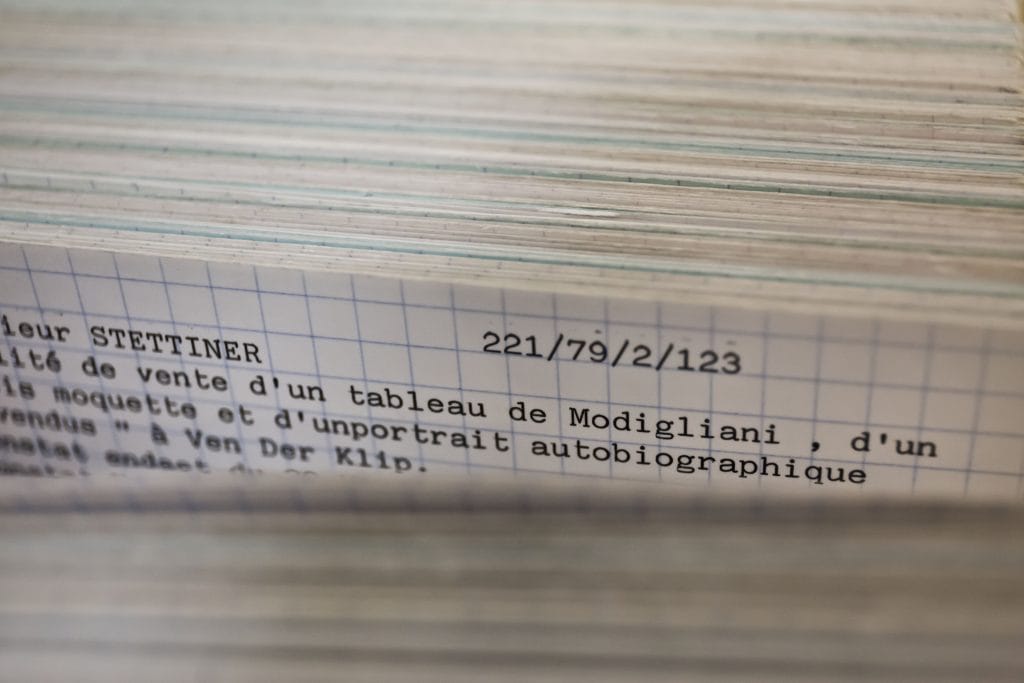
An index card at the Paris Archives referencing Oscar Stettiner’s claim to a stolen Modigliani. Photo by Lucas Oleniuk/Toronto Star via Getty Images.
The work would only resurface at Christie’s London in 1996, where Nahmad bought it through his holding company International Art Center. The provenance listed the collector Roger Dutilleul and a “J. Livengood” as having purchased the work between 1940 and 1945. But in truth, Livengood was the work’s consignor, and Van der Klip’s heir and grandson. It would seem he lied to the court about having sold the painting to avoid returning it to Stettiner.
The Nahmads later offered the work for sale at Sotheby’s New York in 2008, with an estimate of $18 million to $25 million. (It failed to sell.) At that time, Elizabeth Gorayeb, a Sotheby’s researcher, contacted the Wildenstein Institute in Paris to learn more about the work’s provenance. The institute provided a photograph of the painting from its archives that included notes reading “Famille Stettiner” and “volé,” which means “stolen.”
It was an unproven accusation, but also a red flag—and one that the Nahmads initially failed to disclose during discovery, according to Palmer.
When Mondex first sought restitution for Maestracci with a 2011 lawsuit, the Nahmads denied owning the painting. A new lawsuit followed in 2015, and the 2016 Panama Papers leak finally confirmed the Nahmads’ ownership of the work, prompting Swiss authorities to raid a storage facility in Geneva in search of it.
A Manhattan appeals court allowed the case to proceed in 2017, as the first case under the expanded statute of limitations under the Holocaust Expropriated Art Recovery Act.
The Nahmads argued in court that there was no proof that the painting was Nazi loot. The family has long denied that Man With a Cane was the same Modigliani that had belonged to Stettiner. The defense claimed instead that the restitution case Stettiner won was about a Modigliani self-portrait, and that while he had possession of Man With a Cane, he was not his owner.
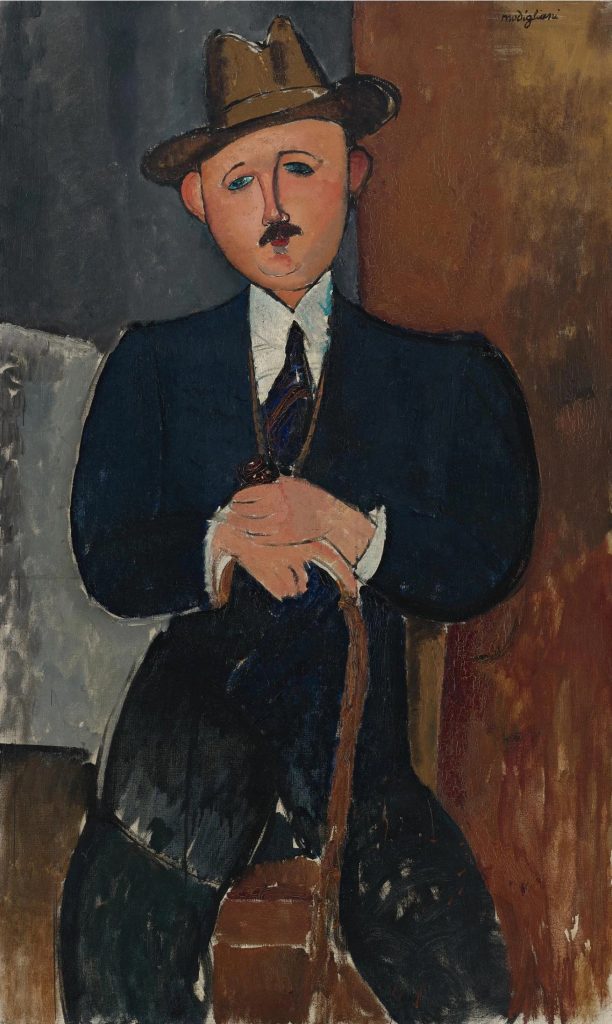
Amedeo Modigliani, Seated Man With a Cane (1918).
But Man With a Cane has a Stettiner label on the back, and its loan to the Venice Biennale by the gallery was well-documented with photos and archival records. The art dealer was also a known friend of the sitter, a chocolate merchant named Georges Menier.
Cohen acknowledged that the Nahmads were good faith buyers, but dismissed “speculation about an undescribed and never-before-catalogued self-portrait of Modigliani.” He also determined there was “no evidence” that anyone other than Stettiner owned the painting. Rather, “the evidence shows a straightforward and persuasive chain of ownership/right of possession flowing directly from Mr. Stettiner to Nazi seizure to a forced sale.”
“The defendants were relying on conjecture, and we were relying on evidence and facts, and that’s what the judge found,” Palmer said. “It’s an important decision. It’s difficult to get a victory in restitution claims in the United States—they are pretty rare, so it’s wonderful to see this.”
In 2016, David Nahmad told the New York Times that “if it’s proven that this painting is looted by the Nazis, I will give it back.” Now is his chance.