Art History
America’s First Black Professional Artist Has Been Hiding in Plain Sight
Joshua Johnson forged a path as a professional painter and left a legacy that continues to reshape how we think about American art history.

Joshua Johnson forged a path as a professional painter and left a legacy that continues to reshape how we think about American art history.
Annikka Olsen
 ShareShare This Article
As the U.S. marks 250 years, we’re diving into the early American art world—and the figures the spotlight missed—who are finally getting their due. Read about the 19th-century pottery star Nampeyo, the women artists of the American West, and the forgotten woman artist Sarah Miriam Peale.
In the shadow of the American Revolutionary War and at the dawn of the new republic of the United States of America, against all odds a man by the name of Joshua Johnson became the earliest documented Black professional artist in the country’s history.
Johnson was born into slavery around 1763 in or near Baltimore, Maryland. He was the son of a white man, George Johnson, and a woman, whose name remains unknown, who was enslaved by a William Wheeler Sr.
Johnson’s story was all but lost to history until the late 1930s, when his work was rediscovered by J. Hall Pleasants, an art historian and genealogist who specialized in early Maryland painters. Through his research, he identified Johnson as the painter behind a number of 19th-century portraits of prominent Baltimoreans. Still, it was not until the mid-1990s that more information was discovered about Johnson, unearthed in manuscripts from the Maryland Historical Society.
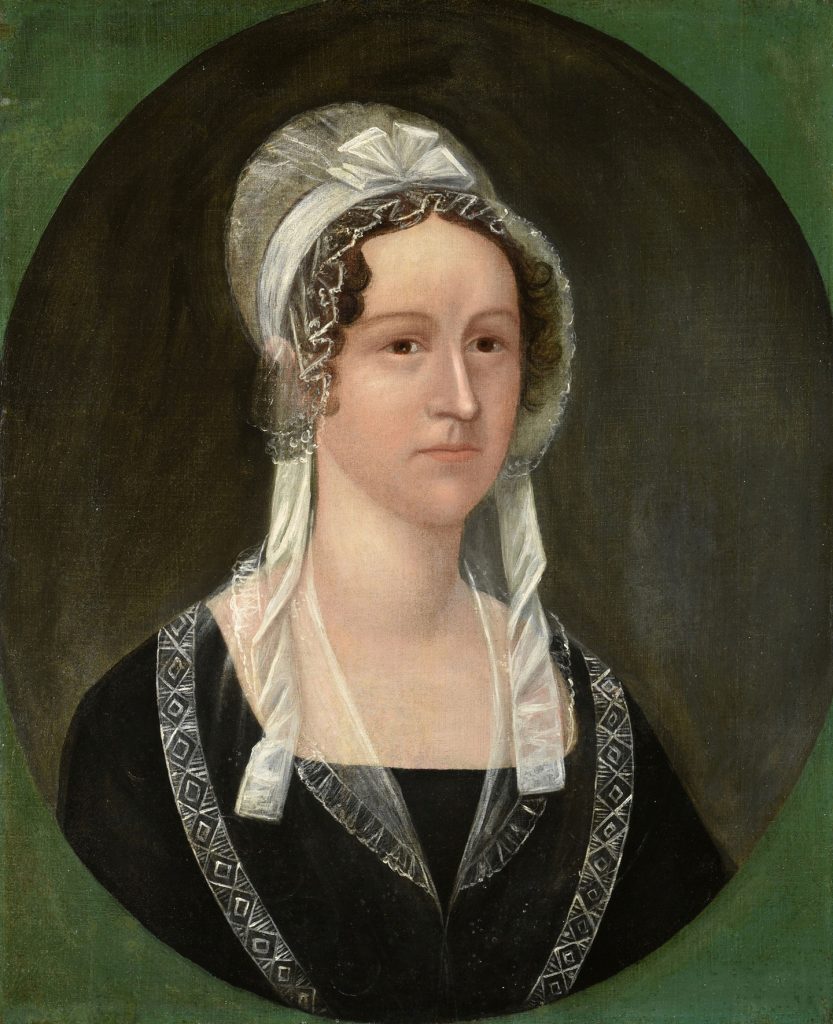
Joshua Johnson, Rachel Schumacher (ca. 1808–10). The Johnson Collection, Spartanburg, SC.
Baltimore County records indicate that George purchased Joshua in 1764 from Wheeler Sr. for £25, roughly half the cost of an enslaved adult field hand at the time. Records also contained a manumission—an official release from slavery—dated to 1782 wherein George recognized Joshua as his son and granted him his freedom once he had turned 21 or completed a blacksmithing apprenticeship, whichever came first.
Little is known about the artist’s life in the more than a decade following 1782. His apprenticeship would have ended in 1784, but it is not until 1796 that his name surfaces once more in archival documents, this time as a professional painter.
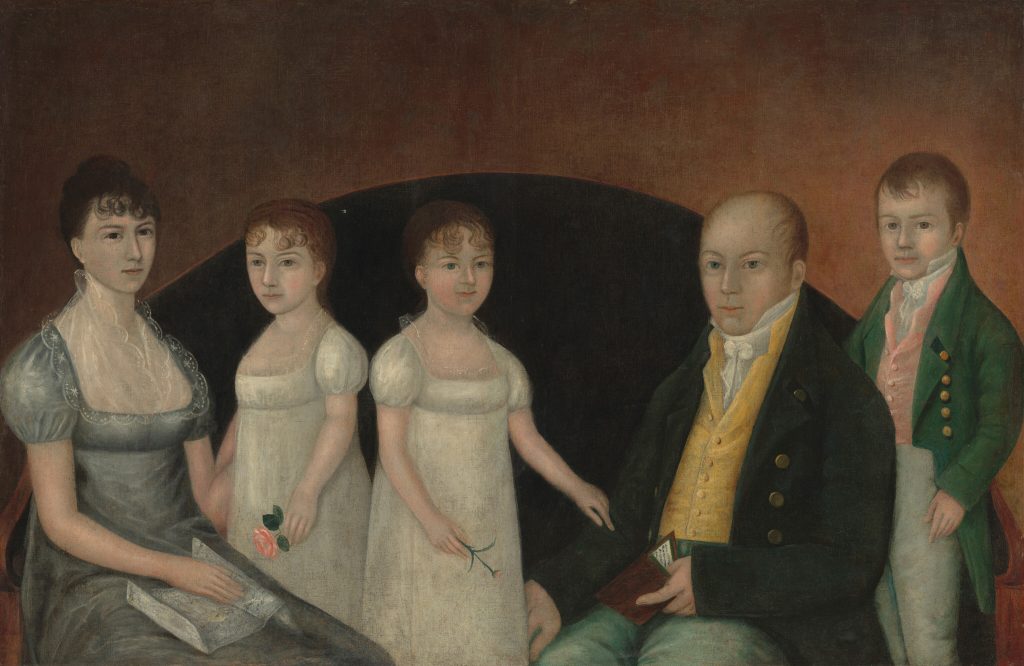
Joshua Johnson, Family Group (ca. 1800). Collection of the National Gallery of Art, Washington, D.C.
While manuscript listings of the population of Baltimore emerged in the mid-18th century, the first formally printed directory Baltimore City Directory was published in 1796. In this first edition, Johnson is listed as a painter and portraitist. And in a 1798 advertisement placed in the Baltimore Intelligencer, he writes:
As a self-taught genius, deriving from nature and industry his knowledge of the Art; and having experienced many insuperable obstacles in the pursuit of his studies, it is highly gratifying to him to make assurances of his ability to execute all commands with an effect, and in a style, which must give satisfaction.
Given the gap in historical records between 1782 and 1796, it is possible, even likely, that Johnson was painting during this period. What is known is that he moved frequently, and may have taken advantage of local furniture makers, assisting with painting on decoration.
There is a chasm between the categories of fine art today and fine art of the 18th century. During this period, painting would have been considered a craft or trade, like furniture painting or blacksmithing, so the barrier between genres and mediums was less distinct, which would have made the transition from one or the other less dramatic by 18th-century standards.
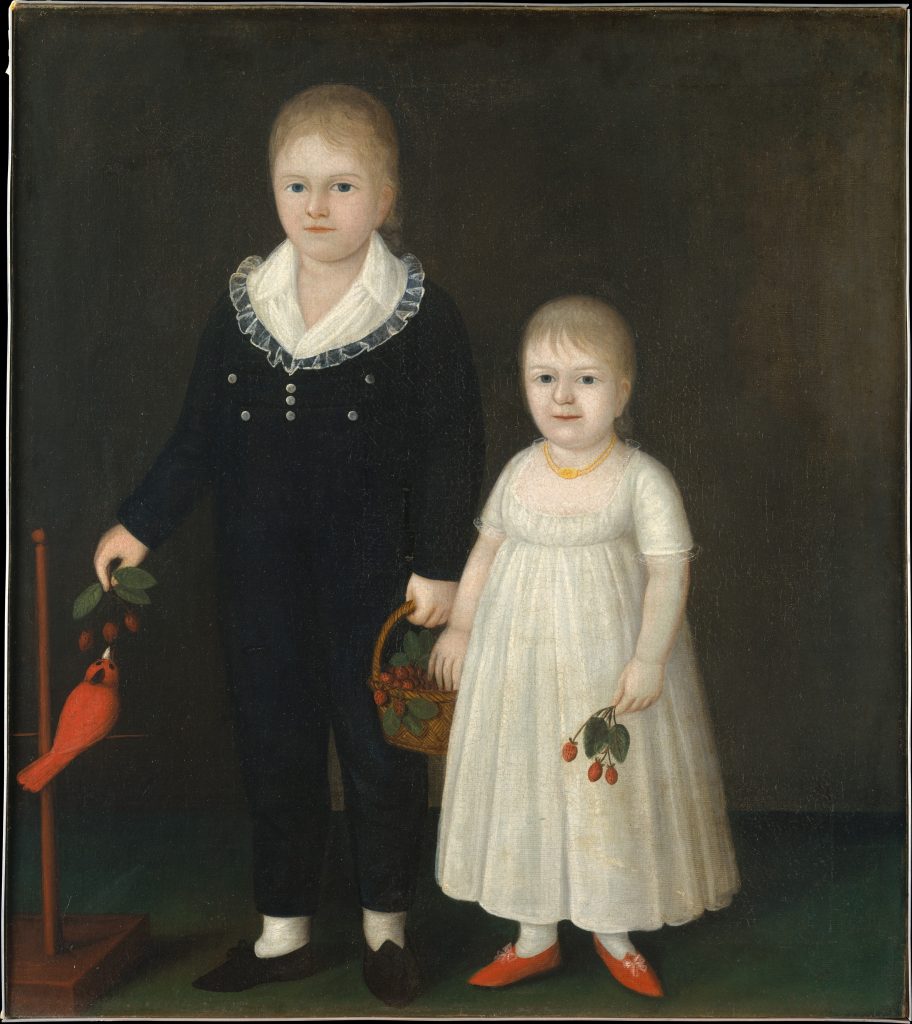
Joshua Johnson, Edward and Sarah Rutter (ca. 1805). Collection of the Metropolitan Museum of Art, New York.
Johnson’s style is emblematic of early American painting, and across the roughly 83 works attributed to him (with only one that is signed), the evolution of his skill and ongoing refinement of his approach to composition is evident.
Specializing in both individual and family portraits, his figures are nearly always rendered in three-quarter profile, and modeling of the faces is kept to a minimum. There is a distinct flatness to his subjects and the surrounding setting—if one is shown at all beyond a monochrome background—but where Johnson excelled was in the details, such as the rendering of delicate lace, sheer fabric, the fall of each strand of hair, individual flower petals, or, as can be found in many of his paintings, the seedy surfaces of strawberries.
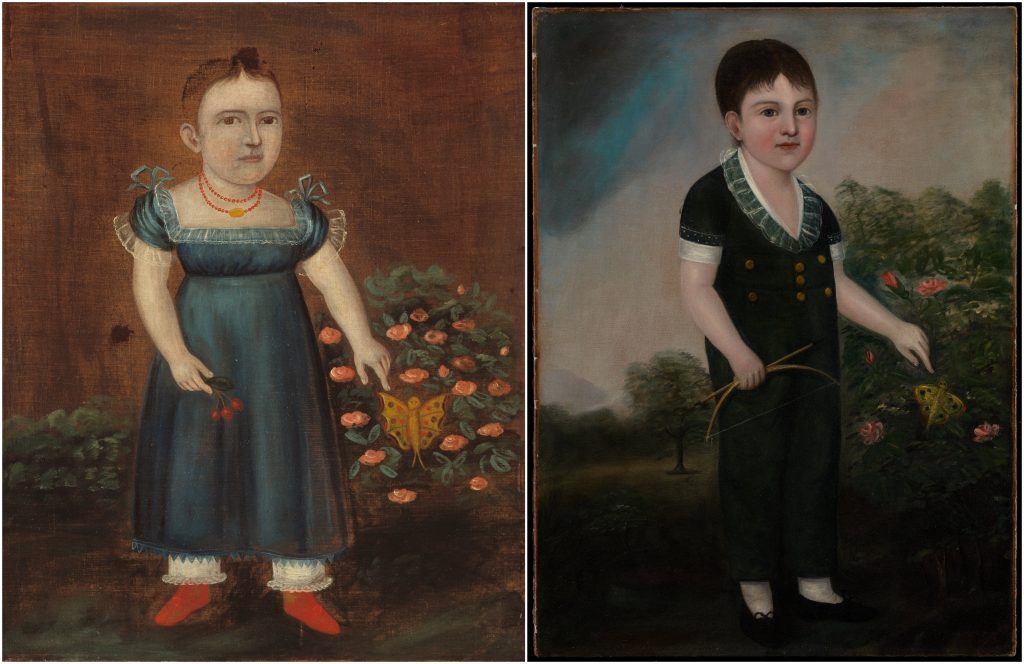
Joshua Johnson, left: Portrait of Adelia Ellender (ca. 1803–05). Collection of the Smithsonian American Art Museum, Washington, D.C. Right: Portrait of Richard John Cock (ca. 1817). Collection of the Minneapolis Institute of Art.
By today’s standards, early American painting has a formulaic quality, and Johnson’s work is no exception, but this harkens back to art serving a very different function. Nevertheless, his evolution and experimentation with various elements—props held by his sitters, settings, decoration—are fascinating to trace throughout his oeuvre. Dated to between 1803 and 1805, his Portrait of Adelia Ellender shows a proclivity for more ornate composition, but the background is still left a traditional flat monochrome.
Comparing this to his later Portrait of Richard John Cock (ca. 1817), even though both are full-length portraits of children and sharing similar details like a butterfly, rosebush, and ornate attire, here the level of meticulous detail and fully attended to natural landscape points to a growing mastery. It also points to a tradition of memorial portraiture; the sitter, Richard, died at the age of nine in 1817.
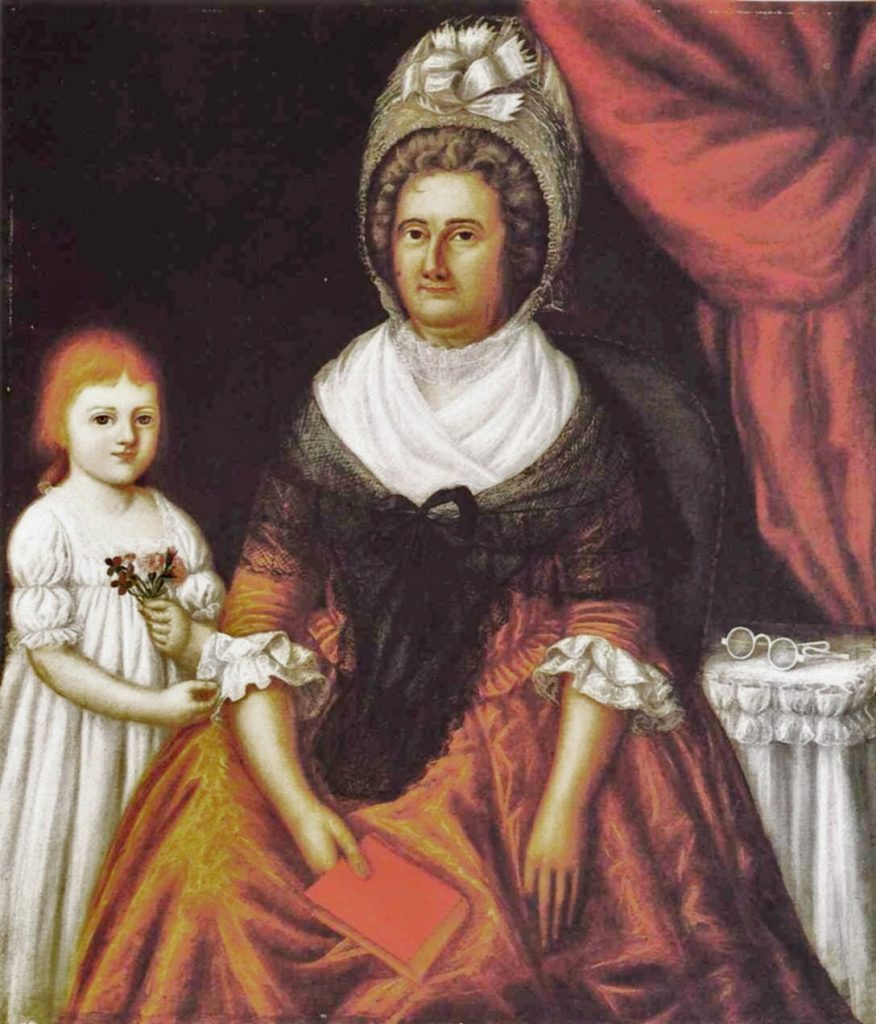
Joshua Johnson, Portrait of Ellin North Moale (Mrs. John Moale) and Her Granddaughter, Ellin North Moale (ca. 1798–1800). Collection of Colonial Williamsburg.
The subjects Joshua portrayed in his paintings were part of Maryland’s upper class, comprising prominent businessmen and their families. The Westwood Children (ca. 1807) features three of the children of a prosperous stagecoach manufacturer; Portrait of Sea Captain John Murphy and Portrait of Mrs. Barbara Baker Murphy (Wife of Sea Captain (both ca. 1810); and, arguably most pertinent to Johnson’s biography, Ellin North Moale (Mrs. John Moale) and Her Granddaughter, Ellin North Moale (ca. 1798).
It is one of Johnson’s earliest works. Moale was the wife of John Moale, who served as a Justice of the Peace, and was the official who presided over the artist’s manumission. The connection between Johnson and the sitter of this portrait compels questions about the nature of Baltimorean society at the time Johnson worked. At the time, several of the people who commissioned portraits from Johnson were owners of enslaved people.
Decades prior to the ratification of the 13th Amendment to the U.S. Constitution that abolished slavery, the population of Baltimore reflected a significant population of free Black people who were an integral part of a society of slave holders.
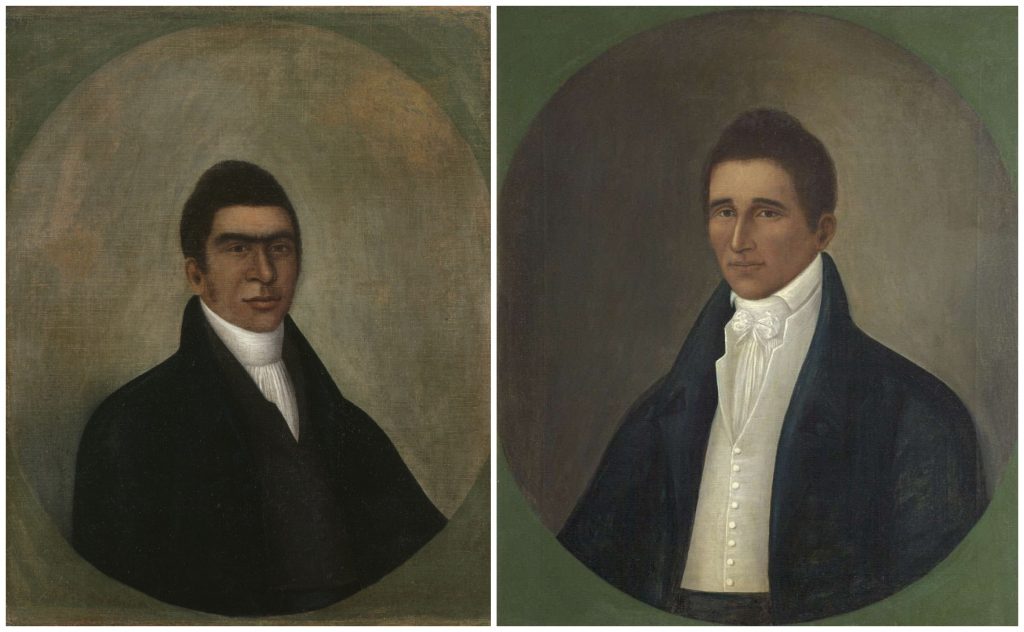
Joshua Johnson, left: Portrait of a Man (Abner Coker) (ca. 1805–1810). Collection of Bowdoin College Museum of Art, Brunswick, Maine. Right: Portrait of a Gentleman (Daniel Coker) (ca. 1796–1824). Collection of the American Museum and Gardens, Bath, U.K.
Historians have mapped the addresses of Johnson’s sitters and deduced by proximity that the artist painted many of his neighbors. How he felt within these interactions; where the painting sessions took place; what, if any, interactions he had with or proximity to the enslaved people owned by his sitters was; if he had any fears of losing his freedom; these are just a few of the myriad questions that are still unanswered, and we can only speculate upon today.
Of the numerous portraits he completed, only two were of Black individuals, thought to both be from the city’s free Black community, which was one of the biggest in the country at the time. Portrait of a Man (Abner Coker) (ca. 1805–10) portrays a minister of the local African Methodist Episcopal Church. The other, Portrait of a Gentleman (ca. 1796–1824) is believed to be of Daniel Coker, a minister and prominent abolitionist.
The body of work Johnson left behind is not only a testament to his self-developed talent and skill, but to the insurmountable barriers he overcame to pursue his art—alluded to by his description of “many insuperable obstacles.” Born in a time and place where recognition of him as a human being let alone an artist was not guaranteed, his life and paintings offer a cogent glimpse into the early years of the American republic.
As the U.S. marks 250 years, we’re diving into the early American art world—and the figures the spotlight missed—who are finally getting their due.