People
Jaune Quick-to-See Smith, Trailblazing Native American Artist and Activist, Has Died
She was 85.

She was 85.
Min Chen
 ShareShare This Article
Jaune Quick-to-See Smith, the pioneering artist and activist who for five decades mapped the Native American experience in dynamic and complex artworks, has died. She was 85.
Smith’s death was confirmed by Garth Greenan Gallery, which has long represented the New Mexico-based artist and citizen of the Confederated Salish and Kootenai Nation.
“Jaune’s loss is deeply felt and indescribably significant. She was a beloved mentor and friend and truly one of the most thoughtful and talented human beings I have encountered,” said Greenan in a statement. “She was one of the very brightest lights in contemporary American art. If a more generous person ever existed, I’d like to meet them.”
The past few years have seen a reawakening to Smith’s distinct abstractions, collages, and sculptures, which unpack the historic injustices against Native American peoples, while shattering dominant cultural narratives.

Installation view of “Jaune Quick-to-See Smith: Memory Map” at the Whitney Museum of American Art. Photo: Ron Amstutz, courtesy of the Whitney Museum of American Art.
In 2023, her largest retrospective, “Jaune Quick-to-See Smith: Memory Map,” opened at the Whitney Museum of American Art, exploring her use of Pop and Abstract Expressionist elements and her own visual motifs to address issues from land rights (as in Survival Map, 2021) to the commodification of Indigenous culture (Spam, 1995). In works such as Trade Canoe: Making Medicine (2018), which confronted environmental destruction, and Trade (Gifts for Trading Land With White People) (1992), on colonial acquisition, emerge Smith’s provocative critiques as much as her dark humor.
“I want [visitors] to leave thinking, ‘She’s an American artist’—not as something other,” Smith told Apollo Magazine of her Whitney exhibition. “Because, you know, I’m an amalgam—I’m taking newspapers to use in collages, and then using my icons like the canoe or the bison to tell my stories from a Native worldview. And that’s just as American as any European that resides here.”

Jaune Quick-to-See Smith at the 2023 Whitney Gala and Studio Party at the Whitney Museum of American Art in New York City. Photo: Dia Dipasupil / Getty Images.
Smith was born in 1940 at the St. Ignatius Indian Mission on the Flathead Reservation in Montana. Her rural upbringing—working on crops with migrant workers in Washington State, living in a cabin with other families—fostered in her a love and respect for the land, she recalled in 1990.
At age eight, she had her first experience with tempera paints, an encounter she remembered as “explosions going off in my head and my body.” When she turned 16, she spent money she had saved from her farm work on an art correspondence course, where she learned the basics of drawing. She even started smoking, she said, after seeing images of the course instructors, Norman Rockwell among them, brandishing cigarettes: “I took up smoking, thinking that would help me!”
Smith earned her BA in art education from Framingham State College in Massachusetts in 1976, then her MA in visual arts from the University of New Mexico in 1980. The years in between, she said, were a scramble to “work jobs and go to school, and stop and work jobs, and then go to another school.”
“It’s just that I wanted to go to school so badly,” she added. “You have no idea what books meant to me. I think a good deal of my learning is self-taught just from books. I think that’s why I place such value on education because I know how difficult it was to get.”
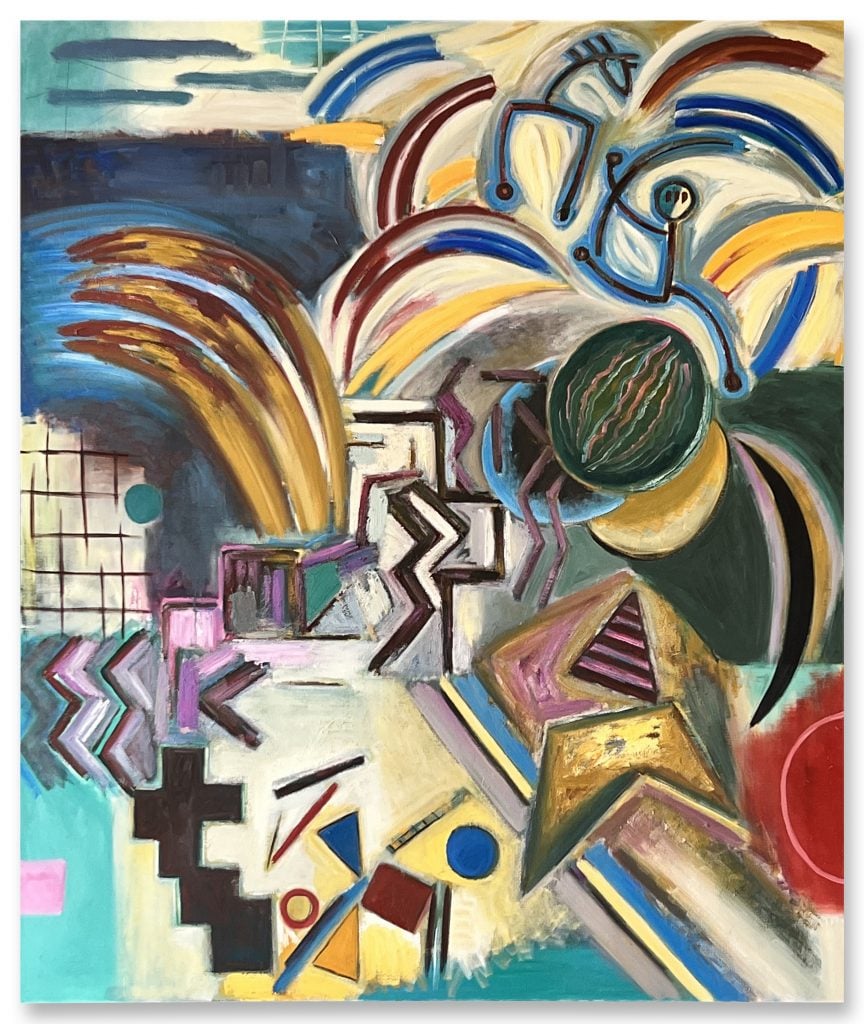
Jaune Quick-to-See Smith, Playground (1987). Courtesy of Sotheby’s.
At the same time, Smith’s art began to take shape. Hers were paintings and mixed-media works that juxtaposed newspaper clippings, found imagery, and corporate logos with her own iconography, populated by maps, horses, and canoes. Gestural washes of paint offered textural layers. All were tools with which the artist sought to resist the erasure of her heritage.
The 11-foot-tall I See Red: Target (1992), for instance, while nodding to Jasper Johns’s own “Target” series, assembled clippings from newspapers and comic books, and a Washington Redskins pennant in searing, red-toned indictment of the commercialization of Native imagery. “Destroy the myth” reads a phrase at the top of the canvas, just underneath a dartboard encircled by darts to mimic a feathered headdress.

Jaune Quick-to-See Smith, Target (1992). © Jaune Quick-to-See Smith. Photo courtesy of the National Gallery of Art, Washington, D.C.
In 2020, Target became the first work by a Native American artist to be acquired by the National Gallery of Art (NGA) in Washington, D.C. But entering a national collection, Smith told the Guardian at that time, evoked “mixed emotions”—about the length of time it took the NGA to acquire work by a Native American artist, about whether the purchase simply “helps assuage the government’s guilt about an undocumented genocide, as well as stealing the whole country.”
The artist’s work has also been collected by institutions not limited to the Metropolitan Museum of Art, the Whitney Museum of American Art, and the Museum of Modern Art in New York; the Smithsonian American Art Museum and National Museum of Women in the Arts in Washington, D.C.; the Denver Art Museum; and Modern Art Museum of Fort Worth. She’s shown in more than 120 solo shows and some 650 group exhibitions.

Installation view of “Jaune Quick-to-See Smith: Making Medicine” at Garth Greenan Gallery, 2018. Courtesy of the Estate of Jaune Quick-to-See Smith and Garth Greenan Gallery.
Smith’s career was also marked by her avid support of other Native artists. She eagerly brought their work to the attention of art historians and curators, invited them to participate in talks, and organized group shows including the traveling 1985 exhibition “Women of Sweetgrass, Cedar, and Sage” with fellow artist and activist Harmony Hammond.
“I want people to know we’re alive!” she said of her peers in 1983. “Collectors only want the old stuff. They don’t buy the contemporary stuff… They keep talking about the vanishing Americans, but we’re everywhere, and we find one another.”
The artist’s efforts, her gallery noted, were key in ensuring her and her contemporaries’ inclusion in Mixed Blessings (1990), critic Lucy Lippard’s landmark tome on Latino, Native, African, and Asian American artists. In 2023, she curated the NGA’s “The Land Carries Our Ancestors,” which brought together a stunning array of art by 50 living Native artists, among them Emmi Whitehorse, Will Wilson, and Rose B. Simpson.
To keep alive Smith’s mission of elevating Native American artists, the Institute of American Indian Art is establishing a memorial scholarship in her honor.

Jaune Quick-to-See Smith and Neal Ambrose-Smith (fourth and fifth from left), with Kelly Frye, David Beams, and Matthew Eaton, in their studio in the Village of Corrales in New Mexico, 2023. Photo: © Jon Austria / Albuquerque Journal via ZUMA Press Wire.
Around 2018, Smith commenced a collaboration with her son, artist Neal Ambrose-Smith, on sculptures of canoes, each crafted out of wood and piled high with foodstuffs and artifacts to expose how trade with the U.S. has disrupted Native American lives. But as Smith once told Lippard, the canoe—one of her key motifs—is as much a vessel for “piling my dreams on for a journey across the land.” It was a journey to which she saw no end.
“When we have political and racial motivations for improving justice, animal rights, women and children’s rights, and our endangered planet, we need to keep talking, teaching, painting, writing, and staying engaged,” she said in 2020. “We can never retire.”