Art & Tech
How This A.I. Image Became the First to Snag Copyright Protection
The U.S. Copyright Office ruled generally last month that work created from A.I. text prompts could not be copyrighted.
by
Adam Schrader
 Share This Article
Invoke, a generative artificial intelligence platform, has been granted the first copyright protections for an A.I. image since new guidelines were handed down by the U.S. Copyright Office last month that generally ruled art created with text prompts cannot be copyrighted.
The Copyright Office had made its ruling in the context of existing laws that provide limited protections for such work. But they noted a range of human-A.I. collaboration can exist, indicating there is a threshold where an A.I. artwork could be considered human-made. The agency determined that such a threshold would come down to a case-by-case basis.
Led by founder and chief executive Kent Keirsey, Invoke has been trying to find that thin line to offer a product that would help artists create works that may be eligible for copyright protection. He called it “massive” that the copyright protections were granted for the customers of his product who need to be able to copyright their works.
“Stable Diffusion came out in 2022. I was one of the earliest people diving in to play with it,” he said. “We then built Invoke which took off in 2023 as a company. We started really looking at building tools for professional creatives, people who are not satisfied with ‘put a prompt in, get an output.’”
Keirsey first requested copyright protections for another image he made with Invoke back in 2023. “I was like, ‘Wow, we’ve gotten so much control over this. I want to show the Copyright Office that we have this control now and that artists really in the driver seat.’ And we got denied,” he said in an interview. “I got this blanket refusal.”
Keirsey said he was offended by officials determining there was no human authorship in the work. So, he tried again in August 2024 with another, A Single Piece of American Cheese, with the help the major international law firm Cooley. That request was initially denied too, but he petitioned the Copyright Office for reconsideration, and it was granted on January 30—the first to receive protections after the Copyright Office’s new guidelines.
“We doubled down on the exact reasoning. We explained where copyright precedent had demonstrated this would merit a copyright and we showed exactly how it was composited and composed,” he said. In fact, Invoke has released a timelapse of Keirsey’s computer screen as he made the image.
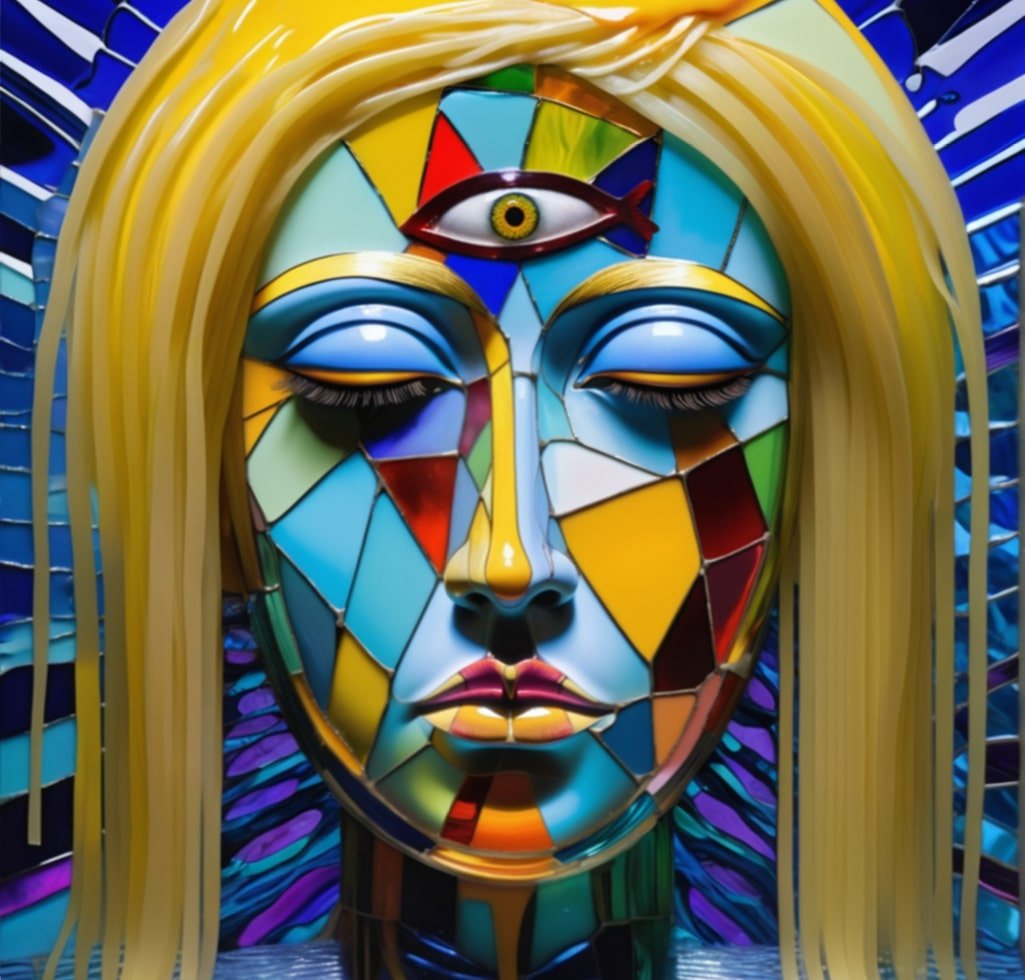
The image features a portrait of a woman with three eyes, one of which is opened and positioned in the center of her forehead. On top of her blonde, noodle-like hair sits a slice of melted American cheese. Stylistically, it mimics a stained-glass look for her mostly blue skin. Surrounding the figure are intricate blue and purple patterns.

Screenshot of the Invoke control panel. Photo courtesy of Invoke.
The video shows that Keirsey generated an early draft of the image from a prompt calling for “fractured glass, faces in the facets, surreal pattern of glazed brushstrokes, spaghetti noodle hair” and a series of commands. It had two eyes and no cheese.
Next, Keirsey could be seen using tools to select and in-paint the background, then part of the head, before adding in the cheese through various trial-and-error generations. He then refined the hair using the A.I. to give it dimension, before adding the third eye and cleaning it up using Invoke’s tools.
Such edits continued, adjusting everything from the eyelashes to the face’s bone structure until Keirsey was satisfied with the image, the video shows.
“The way that Invoke works is that you can generate images from nothing, just like any other image generator, but after the fact you have this kind of A.I.-first Photoshop-esque tool where you can go select regions and regenerate those with high degree of control,” he said.
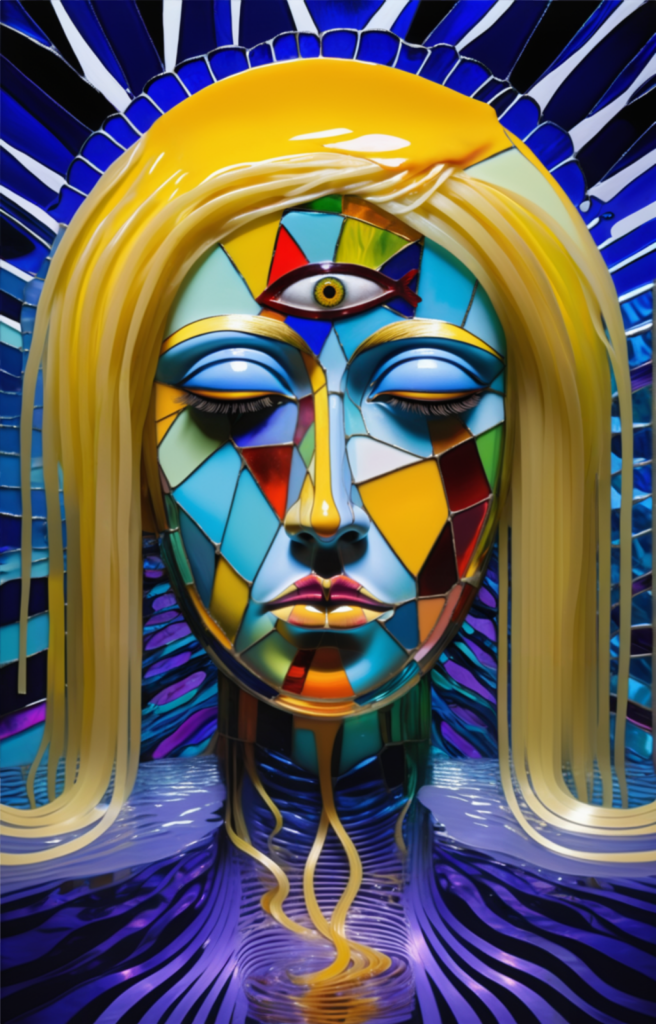
Kent Keirsey, A Single Piece of American Cheese (2024). Photo courtesy of Invoke.
Keirsey said he believes the first work for which he had sought copyright protections was denied because it was too early in the lifespan of the technology. He said it was harder to make a well-articulated legal argument at the time for why it merited a copyright.
But ultimately, he said he was able to get the copyright protection for A Single Slice of American Cheese because “that piece was fought for.”
“The intent and purpose was to show that there is a threshold, and if you cross that, human creativity can merit the copyright,” he said. “The Copyright Office doesn’t really provide great guidance because it doesn’t have any examples. It says there is a threshold. But the challenge right now is we need good examples, we need demonstration.”
Keirsey said it is “certainly the hope” that the copyright process becomes easier now that it has been done. Invoke has developed a tool it calls “Provenance Records” that track changes an artist has made to an image and embeds that information into the metadata.
He aims to continue improving that tool to ensure it aligns with documentation the U.S. Copyright Office requires for A.I.-assisted copyright claims.
Related Articles
-