Archaeology & History
The Secrets Behind the Roman Colosseum’s Enduring Engineering
Rome’s Colosseum not only hosted gladiatorial games, but also animal hunts, mock-up naval battles, and even a few plays.

by
Tim Brinkhof
 Share This Article
In a city filled to the brim with iconic buildings of both the ancient and not-so-ancient variety, the Colosseum of Rome stands apart from the rest. The ancient stadium, an arched, elliptical arena, was even more impressive in imperial times than it is today. In fact, a study from Deloitte concluded that if we were to put a price tag on the structure, one that takes into account both its historic and economic value, the Colosseum would be worth a whopping €77 billion, or nearly $90 billion. Still, that’s hardly the most interesting or impressive thing about it.
Just How Big Is the Colosseum?
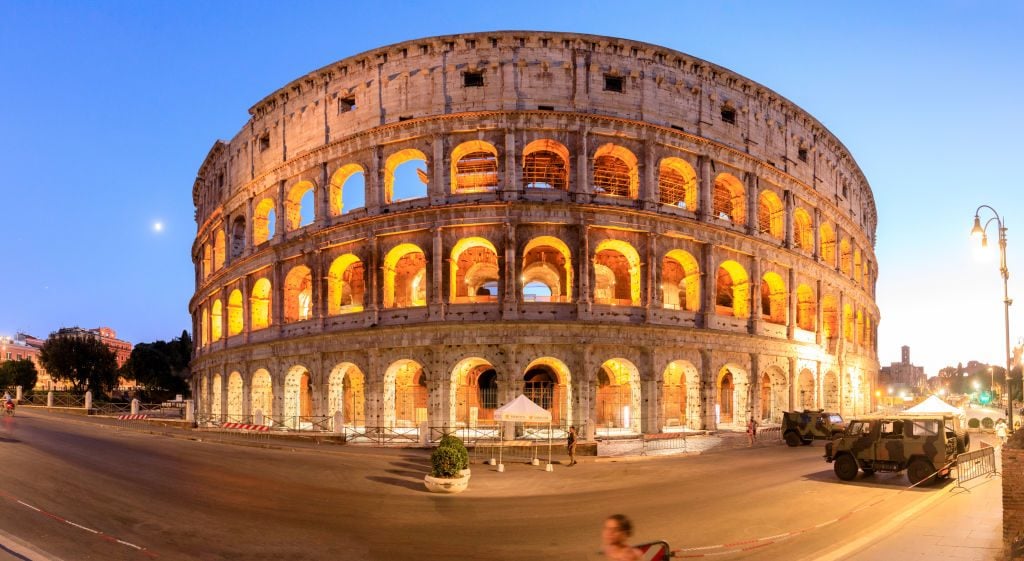
The Colosseum in Rome. Photo by Thierry Monasse/picture alliance via Getty Images.
Measuring roughly 615 feet in length, 510 feet in width, and 157 feet in height, the Colosseum was the largest amphitheater anywhere in the Roman Empire. Its capacity rivals that of modern stadiums; it can seat as many as 90,000, on par with London’s Wembley Stadium. Its size was reflected in its construction costs, which are thought to have amounted to around 100 million sesterces. By comparison, at that time, a male slave cost 2,000 sesterces, an apartment cost from about 200 to 1,150, and a soldier in the army of Julius Caesar earned an annual salary of 900 sesterces.
Why Was the Colosseum Built?
Construction of the Colosseum, also known as the Amphitheatrum Flavium or Flavian Amphitheater, was initiated by Emperor Vespasian and completed by his son Titus. The family was part of imperial Rome’s Flavian dynasty.
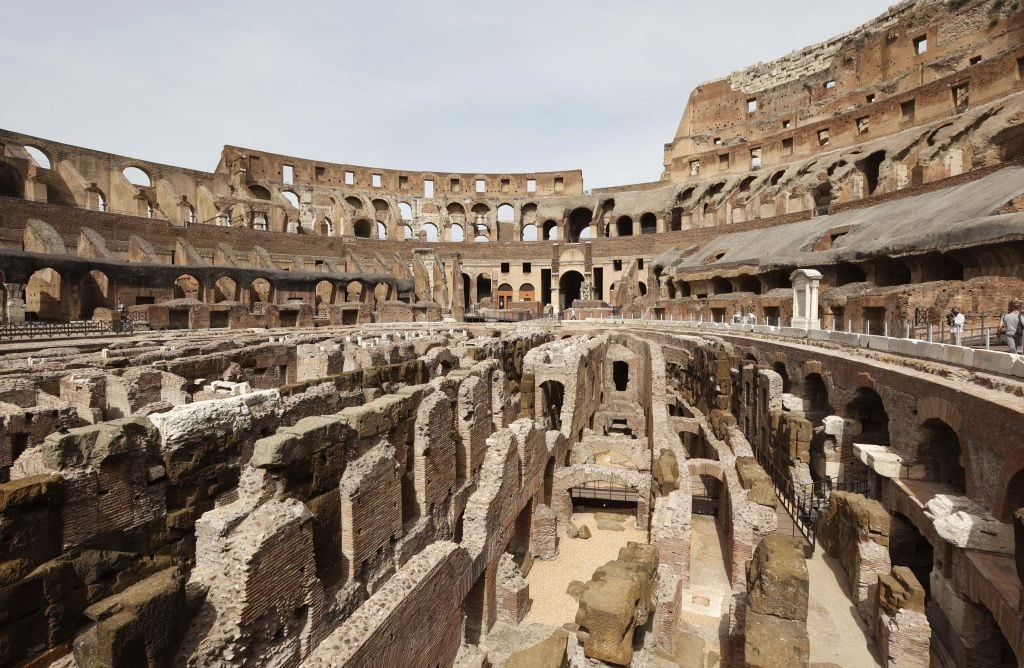
A view of the Colosseum ahead of a press conference to present the end of the second stage of the monument’s restorations regarding the Hypogea area, in Rome, Italy, on June 25, 2021. Photo: Riccardo De Luca/Anadolu Agency via Getty Images.
In part, the Flavians built the Colosseum to provide a venue for large-scale gladiatorial games, a sport that was inherited from Rome’s neighbors, the Etruscans, and had been a well-documented part of Roman culture since the 3rd century B.C.E. They also hoped to gain the love of the Roman people and secure their legacy as benevolent leaders, a popular practice among Roman elite dating back to the Republican era.
How Was the Colosseum Built?
Ancient texts and archeological studies both indicate that the construction of the Colosseum, which lasted from 72 to 80 C.E., was a meticulously planned and highly coordinated affair. Its architect, Rabirius, aimed not just for expediency, but also for posterity, paying close attention to the firmitas or structural integrity of his design.

Giovanni Ambrogio Brambilla, Section and elevation of the Colosseum in Rome, 1581. Photo: Heritage Art / Heritage Images via Getty Images.
The Colosseum’s skeleton, made from a concrete that was mixed using water, limestone, and volcanic ash, was covered with a façade of travertine, a limestone renowned for both its beauty and durability, and used throughout ancient Roman architecture. Hidden beneath the Colosseum were storage facilities, preparation areas, animal holding pens, elevators, and drainage systems.
What Happened at the Colosseum?
The Colosseum hosted not only gladiatorial games, but also animal hunts, mock naval battles, public execution of criminals, and theatrical performances. Inside, seating was divided by social class, with the emperor and senators seated in the front rows and the plebeians, or common people, farther back.
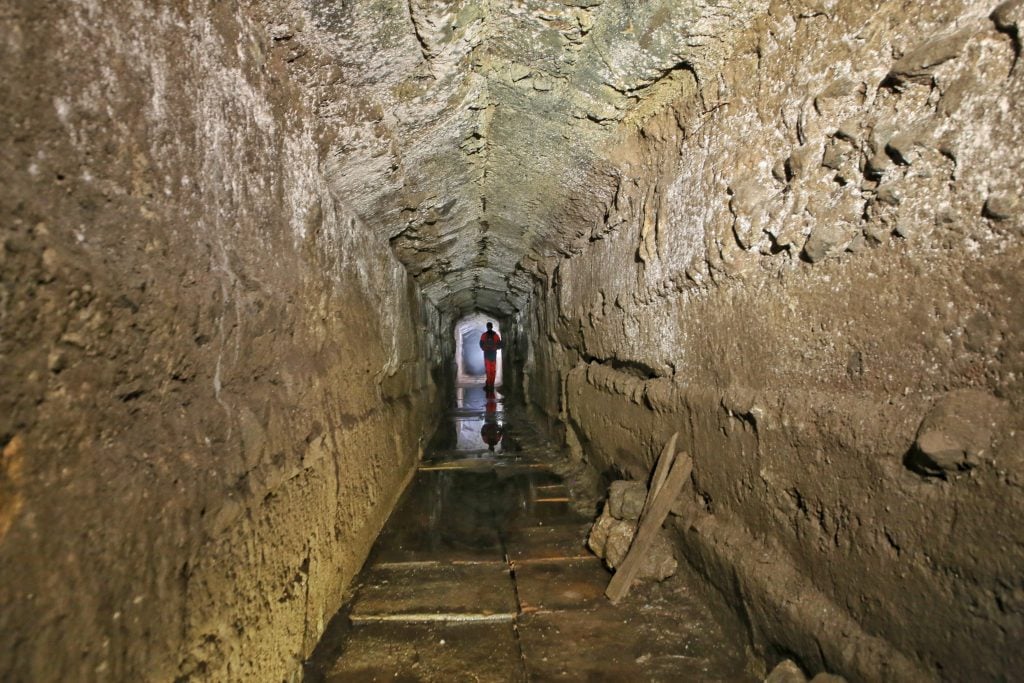
The south sewer beneath the Colosseum. All photos courtesy of the Colosseum Archaeological Park.
Seeds and nuts found in the drainage systems indicate that, like a modern stadium, the Colosseum might have hosted concession stands selling food. On hot or rainy days, a contraption called a velarium, a series of giant, retractable awnings, provided cover from the elements.
When Did the Colosseum Fall Out of Use?
The Colosseum fell into disuse during the 5th century C.E. as a result of waning interest in gladiatorial games and animal hunts—a development which some sources say resulted partly from discontinued state funding and partly from the rise of a Christian code of ethics that denounced the pastime as barbaric and ungodly.
Although the structure survived the test of time, the Colosseum we know today is but a shadow of its former self. During the Early Middle Ages, following the fall of the Western Empire, almost all of its moveable interior furnishings, including statues, wooden scaffolding, and marble seats, were removed and sold—an unceremonious end to a monumental history. In the year 1349, a major earthquake caused part of the southern exterior wall to collapse, and the rubble was carted off and used in various other buildings throughout the city.
Of course, even in its current, compromised state, the historical monument is said to be Italy’s most popular tourist site, drawing, according to different sources, five million or six million visitors a year. And, while the interior no longer hosts large events, major performers including Paul McCartney and Elton John have performed outside it, its massive structure serving as a photogenic backdrop.
Sometimes, archaeology gets big. In Huge! we delve deep into the world’s largest, towering, most epic monuments. Who built them? How did they get there? Why so big?

Related Articles
-