Artists
Unveiling Hiba Schahbaz’s Painted Paradise, Where Women Meet Mythical Beasts
Schahbaz has opened her first major retrospective, "The Garden," at the Museum of Contemporary Art, North Miami
by
Katie White
 Share This Article
“She’s always been here,” said artist Hiba Schahbaz, describing the female figure who populates her phantasmic and lush painted world.
“I come from a very traditional family, but I drew nudes even when I was younger. I would just be sitting and drawing myself as a teenager. All over my bedroom walls were these drawings of me naked. No one said to me: ‘This is great, honey. This is what you should be doing.’ So I really tried to give it up, but I just couldn’t.
The Brooklyn-based, Karachi-born artist creates this figure, a version of a self-portrait, across a xylophone of scales, from handheld figures in her Indo-Persian miniatures to larger-than-life paper cut-outs that animate her studio walls like goddesses.
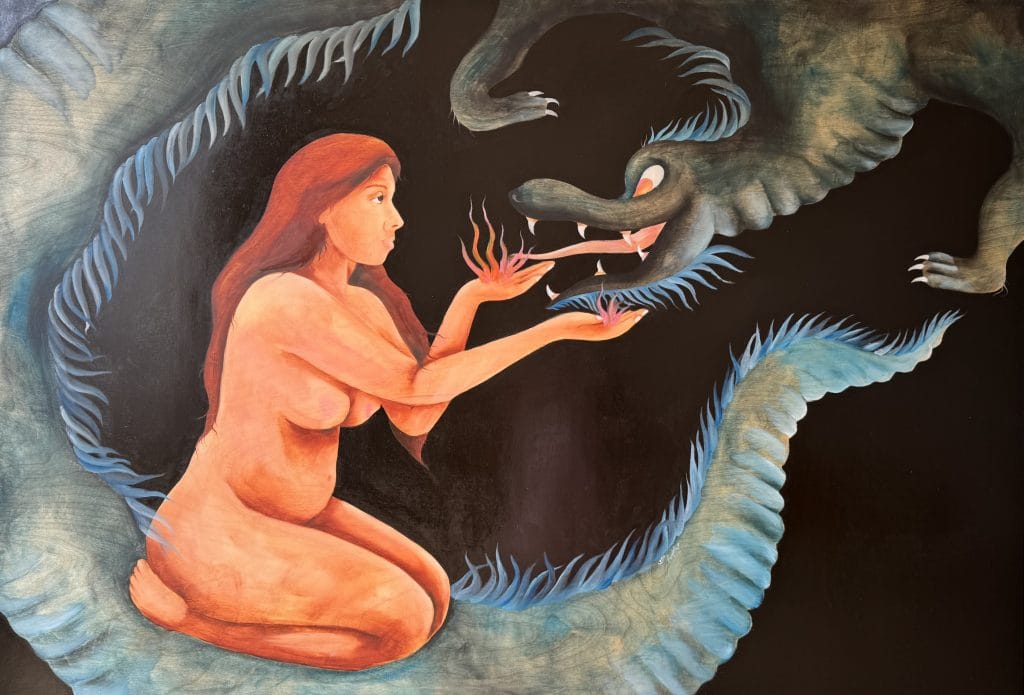
Hiba Schahbaz, Fire Breather (2024). Courtesy of the artist.
Now, many of these women are reunited again in the artist’s first major retrospective, “Hiba Schahbaz: The Garden,” at the Museum of Contemporary Art, North Miami. Curated by Jasmine Wahi, founder of Project for Empty Space, the exhibition brings together 80 works made across 15 years (in a full circle moment, Wahi gave Schahbaz her first exhibition in Miami some years back).
Schahbaz, who trained in Indo-Persian miniature at the National College of Arts in Lahore, moved to New York to study at Pratt Institute in 2010. In this show, that decade-and-a-half of creativity is presented as a slow wind that carries viewers through a dreamy world of gardens, Sufi poetry, and mysticism, where women become angels and others commune with lions, unicorns, and dragons.
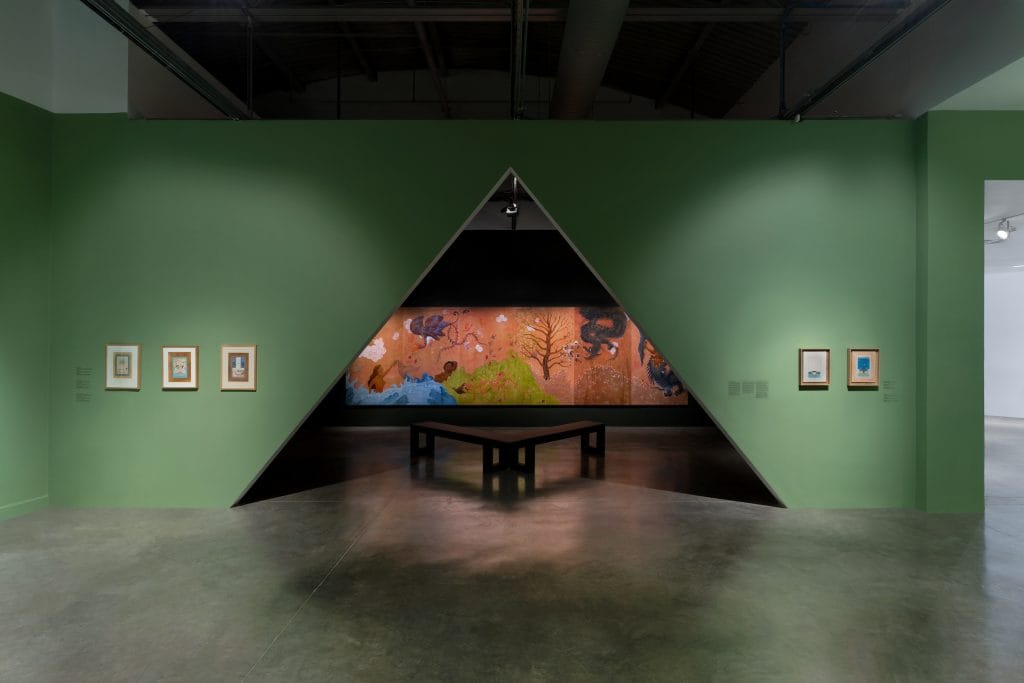
Installation view “Hiba Schahbaz: The Garden” at the Museum of Contemporary Art, North Miami, 2026.
The exhibition also marks a culmination after career-building recent years. Schahbaz had back-to-back solo exhibitions with “Summer of Dragons” at Almine Rech London in 2024 and “Love Songs” at Almine Rech Paris in 2023. Her works have also been included in group exhibitions at the Brooklyn Museum, FLAG Art Foundation, Santa Monica Art Museum, and ICA Miami. In 2021, she orchestrated a large-scale public art commission at Rockefeller Center in collaboration with Art Production Fund.
Schahbaz speaks of these artworks like old friends. “It will be so nice to see her,” she said when speaking of a work borrowed for the exhibition.
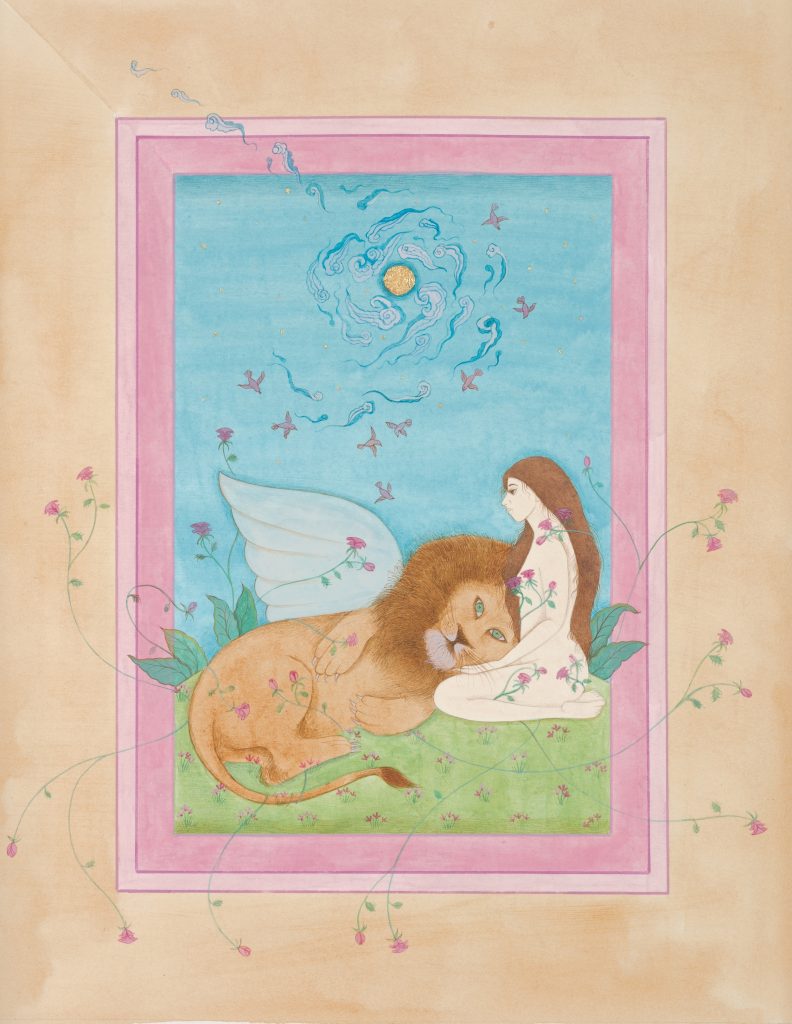
Hiba Schahbaz, In My Heart (2020). Courtesy of the artist.
The Goddess and the Self
Asked whether the women in her works are self-portraits, Schahbaz said they both are and aren’t.
“There are paintings that are most definitely self-portraits, titled Self-Portrait as Leda or so and so, but sometimes the really small miniatures don’t necessarily look like me at all,” she said.
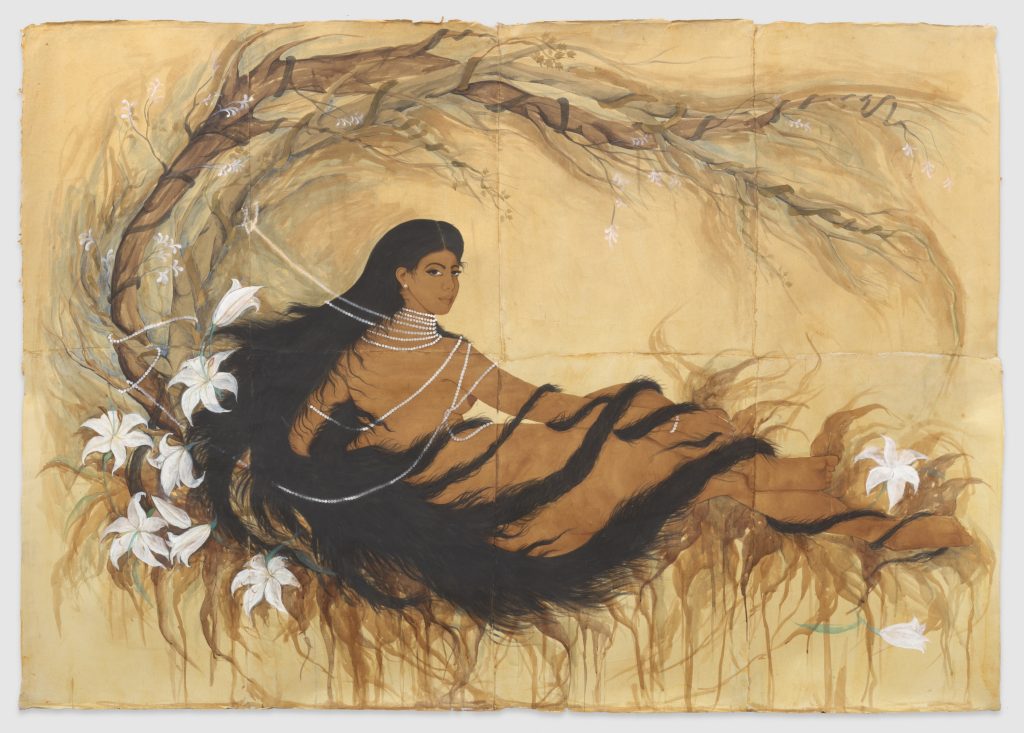
Hiba Schahbaz, Self-Portrait as Grand Odalisque (2016). Courtesy of the artist.
Throughout the exhibition, visitors may spot allusions to powerful women from myth and art history. In one work, Schahbaz appears as La Grande Odalisque (1814), an iconic Neoclassical painting by Jean-Auguste-Dominique. The work was painted with tea on earth-stained paper from India. Schahbaz injured herself trying to hold the pose.
“In miniature, we make everything unrealistic, but when I started studying Western art, I thought, all the women look like women and had these faces and personalities and are painted so lusciously. I was trying to sit like the Odalisque, and I totally sprained my neck,” she recalled. “That was misconception number one. Those bodies are not necessarily real.”
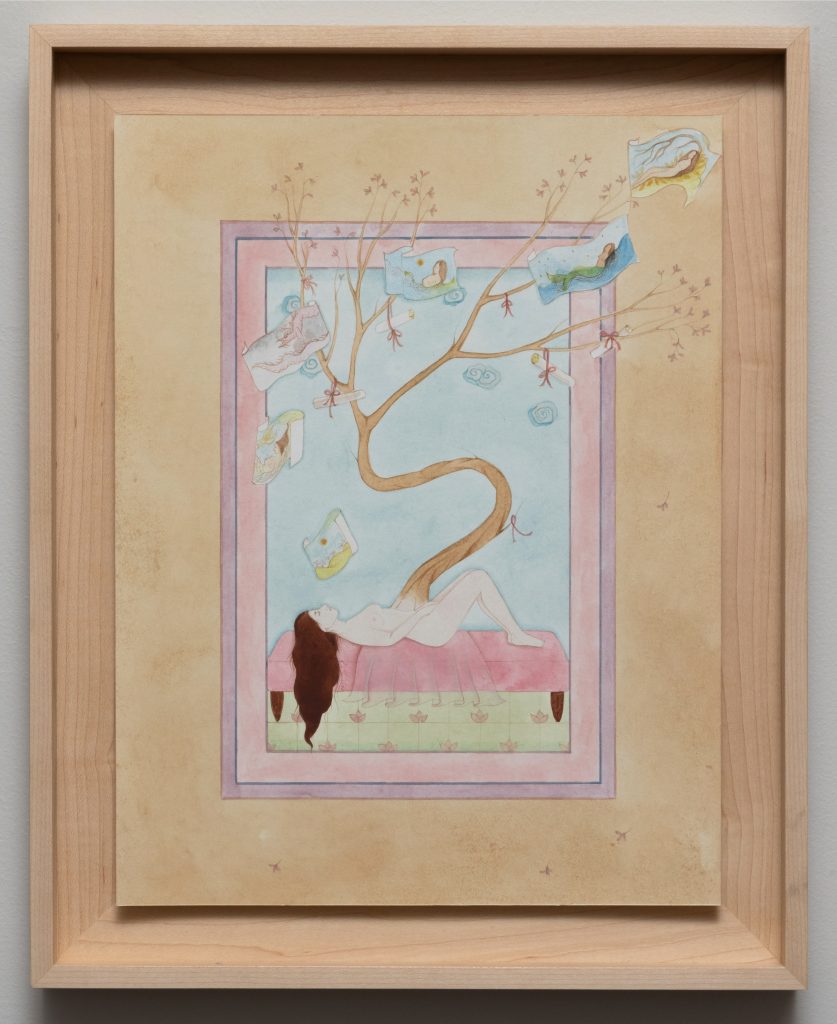
Hiba Schahbaz, The Artist’s Studio (Mystical Tree) (2025). Courtesy of the artist.
Édouard Manet’s Olympia is another frequent reference; in the watercolor The Artist’s Studio (Mystical Tree), a nude female figure appears with a tree growing from her stomach, an image reminiscent of Frida Kahlo’s self-portraits with roots, vines, and trees.
There is an Alice in Wonderland quality to these shifting sizes and mediums. Her Indo-Persian miniatures, an intensive process that includes making the papers, brushes, and tea-based pigments, are more narrative in some ways than her more monumental works.
“The process of making really tiny work and then zooming in on it is so meditative. Whatever is coming out at that time is usually coming from a very interior space,” she said. At a larger scale, and especially when painting with oil, Schahbaz finds the process freeing, but with different stakes. “In the large paintings, often the woman becomes an avatar. I’m 5’2, but the women are really tall, and the energy does shift.”
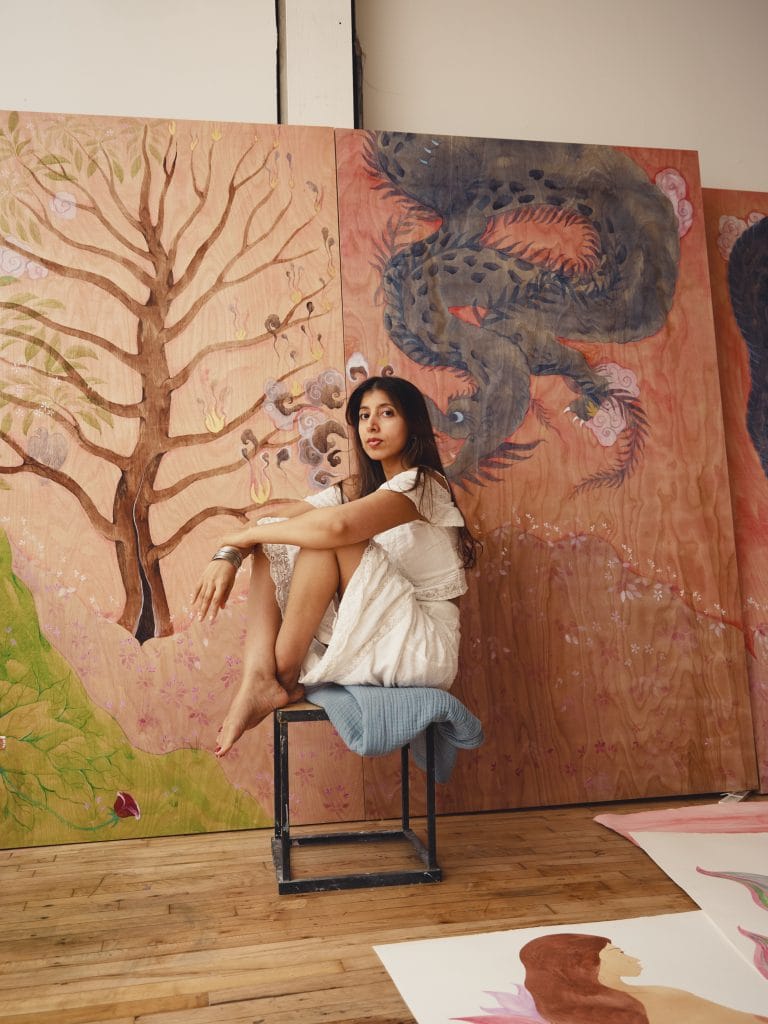
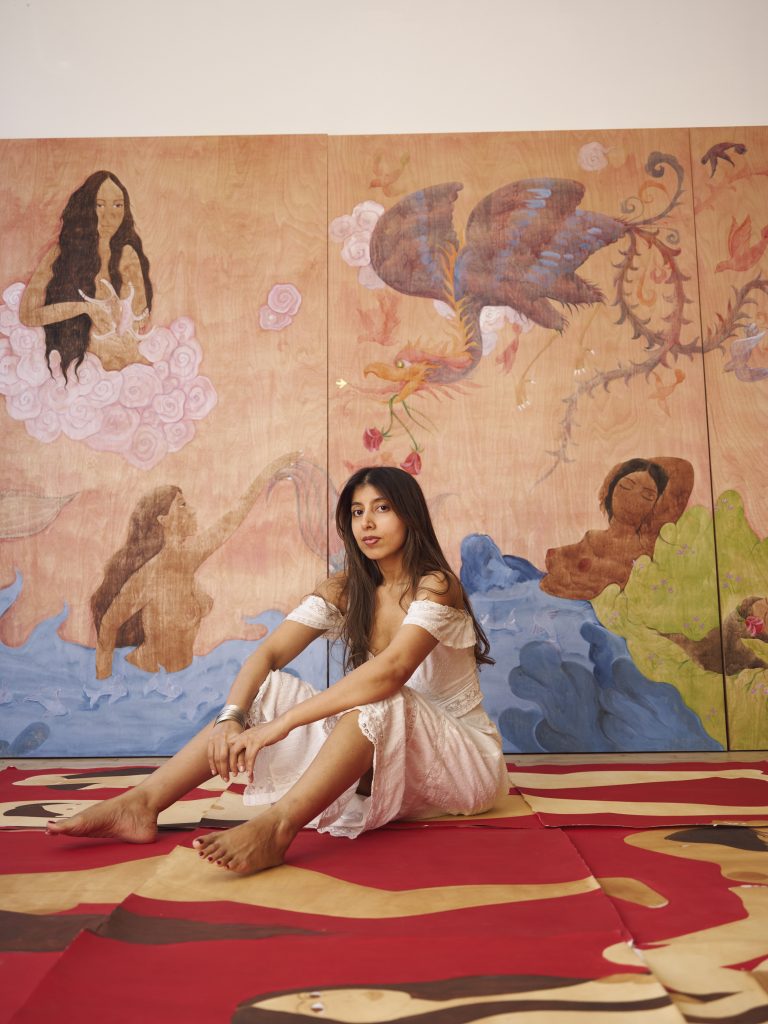
Hiba Schahbaz. Photo by Charlie Rubin 2025
The artist points to the differences between the two miniatures of the goddess Daphne in the exhibition and another monumental depiction of the goddess, measuring eight feet tall. “I feel her ethos in the miniatures,” said Schahbaz, while “in the large Daphne, she becomes a stand-in for all women.”
Now, for the first time, the artist is moving off the walls and into sculptural space, debuting two freestanding wood panel sculptures of women. “One is of a Venus, and one is of this woman coming out of this dragon’s mouth. I’m really excited to see how those fit into the gallery space because they haven’t been exhibited before. I want to see how they engage with everything else.”
Schahbaz said that “men are a far-off thought” to her artistic universe. Instead, she said her creations ask: “Who am I? Am I allowed to be a woman? Connecting to my own sensuality and femininity—all these questions come so far before anyone on the outside.”
Edens and Ecologies
The exhibition thesis, “The Garden,” draws from the idea of the Paradise Garden, or jannat, a blissful and serene final abode alluded to in Persian and Islamic traditions and poetry. The exhibition’s design is inspired by the charbagh, a quadrilateral Indo-Persian garden format, and Schahbaz’s works have been loosely organized into themes of air, earth, water, and fire.
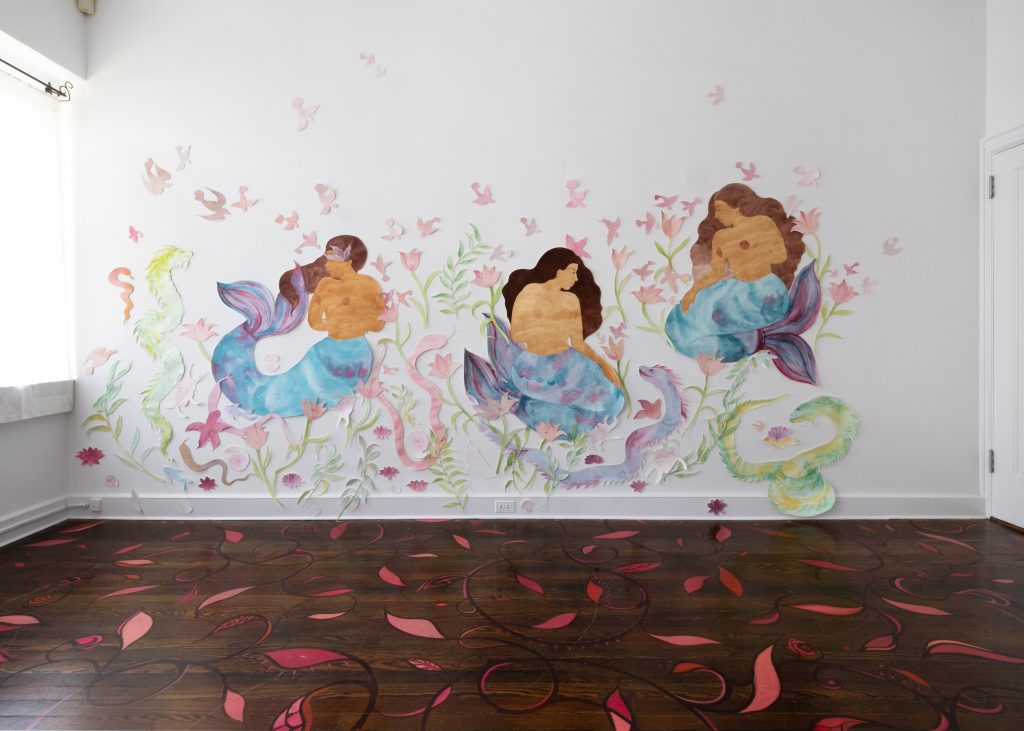
Hiba Schahbaz, Mermaids (2025). Courtesy of the artist
Such elemental motifs, common throughout her work, are both ecological and personal. Schahbaz’s father, who was a set designer, was also an avid gardener, and she finds resonances between the tropical coastal climates of Karachi and Miami. These polarities appear in her contrasting palette, where cool blues and greens meet with bright pinks and reds.
But these environmental fascinations also manifest through the preponderance of mythic beings—angels, mermaids, dragons, and unicorns. In one commission for the museum, entitled Mermaids, Schahbaz created a “40-foot wall of mermaid cut-outs,” an intensive project that “took over” her life. In another, Fire Breather, a woman caresses a dragon as though a loyal companion. These beings, Schahbaz supposes, aren’t imaginary at all, but hiding away from the human world. For the artist, these works and worlds are real but open to interpretation.
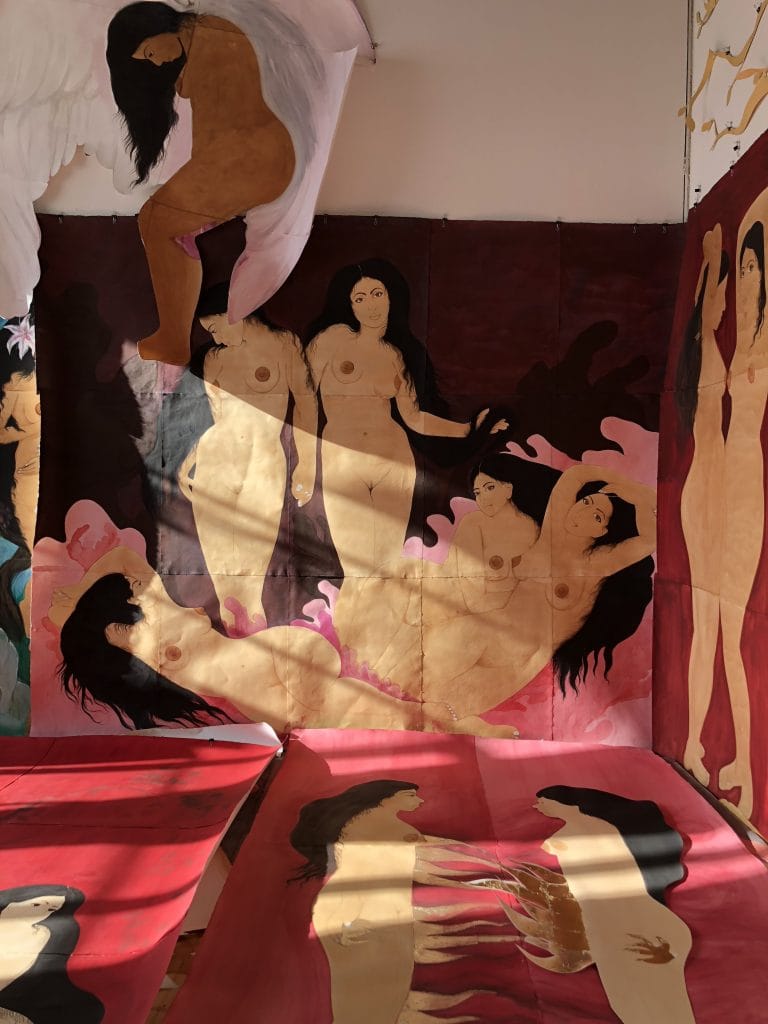
Hiba Schahbaz, Untitled (pink landscape) (2016). Courtesy of the artist
“I don’t guide people too much,” she said. “I feel like everyone can take something from a painting. I’m always afraid that if I set a narrative for who I am, I’ll have to stick to it.”
“Hiba Schahbaz: The Garden” is on view at the Museum of Contemporary Art, North Miami, 770 NE 125th St, North Miami, Florida, through March 16.