

For a man who lived in near obscurity, Henry Darger has had a remarkably long afterlife. The Chicago janitor’s vast body of work—hundreds of drawings and thousands of manuscript pages created in isolation—have inspired biographies, documentaries, and exhibitions, even decades after his death. Now, Darger’s unlikely story has made its way to the stage.
Bughouse, now on at New York’s Vineyard Theatre, explores the life and work of the outsider artist, in his own words. The play was masterminded and directed by theater giant Martha Clarke, with a script by Pulitzer Prize-winning playwright Beth Henley who adapted Darger’s writings. Stepping into Darger’s shoes is John Kelly, the performance artist who saw a kindred spirit in the reclusive man.
“As an artist, I understand artists and what they do and what they aim for, whether it’s out of strategy or desperation,” Kelly told me over a video call. “With him, there was no strategy. He had such a challenging life that his art and his writing were really the only ways that he could wind up prevailing. That allowed me to develop a lot of compassion for him.”
Darger Onstage
The 80-minute show lands us directly in Darger’s one-bedroom apartment, its walls tacked with his collages and its corners filled with old newspapers and balls of twine. It’s here that the artist spent the most of his life from the 1930s after fleeing a psychiatric facility as a child, creating and stashing away countless drawings and manuscripts that were only discovered after his death in 1973.

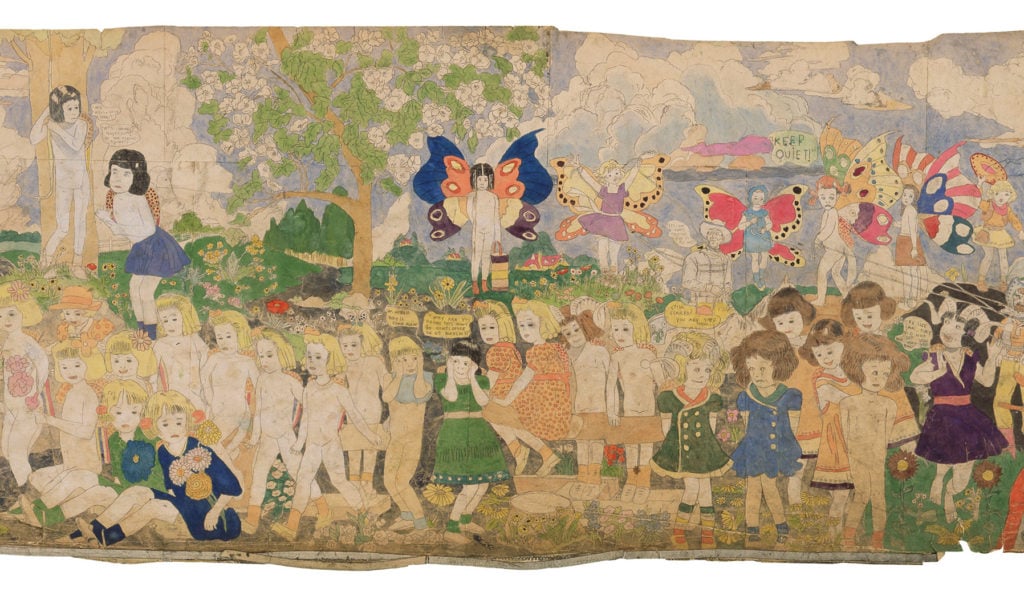
Henry Darger, Keep Quiet!. Courtesy of Galerie St. Etienne.
Onstage, Darger unravels a long monologue that winds through his biography and his elaborate fantasy world, populated by a rebel children’s army led by the so-called Vivian Sisters. He discusses the weather, grouses about the nuns at the hospital where he works, and constantly bemoans the loss of a newspaper clipping about the kidnapping of Elsie Paroubek.
The picture that emerges is one of an “oddball,” as Kelly described him, but also a man who found relief from childhood trauma in his creative imagination. Darger’s paintings of the Vivian Girls are animated and projected across the apartment walls at moments of heightened emotion, highlighting how his rage found an almost childlike expression.
“The way he expresses anger and at the same time, whimsicality and innocence—the contrast between the two elements are unique in my experience,” Henley said over a video call.


John Kelly in Bughouse (2026). Photo: Carol Rosegg.
Henley was recruited to work on the script by Clarke. The theatrical director—who was behind the 1984 dance piece The Garden of Earthly Delights, on Hieronymus Bosch’s masterpiece—had spent nearly a decade gestating Bughouse, according to Kelly. Michael Bonesteel, a Darger scholar, served as art-historical consultant for the production.
Henley’s task was to “fashion what [Clarke’s] vision might be,” she told me, by channeling both Clarke and Darger. To do so, she pulled from Darger’s autobiography, a 5,000-page tome titled The History of My Life, as well as his novels including the multi-volume In the Realms of the Unreal. She was struck by his unusual lexicon, strange word choices, and penchant for veering through random topics—his autobiography, for one, actually only fills the first 200 pages of My Life; the rest of it is about a tornado he named Sweetie Pie.


Henry Darger’s double-sided artwork, 148 At Jennie Richee During fury of storm are unsuccessfully attached by Glandelinians / 149 At Jennie Richee narrowly escape capture but Blengins come to rescue on view at Christie’s New York, 2019. Photo: John Angelillo / Alamy Stock Photo.
The upshot is a script that Kelly characterized as a “Cubist painting,” full of shifts and sharp edges, but not without a coherent trajectory and insight. Darger’s preoccupation with the mislaid newspaper clipping, for instance, reveals his obsessive nature; the loss even made it into In the Realms of the Unreal, in a scene where Darger’s stand-in is questioned about misplacing the item by the father of a Vivian Girl. “It’s one of those things that makes zero sense,” Henley conceded.
Even Darger’s constant talk of the weather is telling, laying bare his emotional life, his need for control that extended to “correcting the weatherman,” Kelly said. It gave him “that regular thing to come back to,” he added. “It was an anchor in his life, some type of assurance.”
The Artist Playing the Artist
Kelly is fresh off an exhibition at PPOW, which gathered 182 panels he illustrated as part of a graphic memoir. Created from 2016 to 2025, A FRIEND GAVE ME A BOOK chronicles a grave neck injury he suffered in 2004 and his survival of the AIDS epidemic, probing themes of isolation, death, and persistence in spare poetry and drawings. “I feel like I have the soul of a painter,” he told me.
It’s the kind of self-reflection that Kelly has long explored in a practice that has also seen him embody the likes of Caravaggio, Egon Schiele, and the Mona Lisa in various studies of identity. “I can only go into their psyche and their body if I bring my own psyche and body into it as well,” he said. In ways, his work in performance and visual art—he trained at the American Ballet Theatre School and Parsons School of Design—are intimately entwined.

John Kelly in Bughouse (2026). Photo: Carol Rosegg.
“I realized that when I started doing self-portraits, I was engaging with the mirror,” he explained. “The mirror of the dance studio, which is about scrutiny, morphed into the mirror of the self-portrait, which is again about scrutiny, but with something left over.”
Inhabiting Darger, perhaps, offered him another glance inward. Like the Chicago artist, Kelly sees himself as something of an “outsider.” As a gay kid growing up in New Jersey, he recognizes the loneliness and abuse Darger suffered at the psychiatric hospital. He understands Darger’s art of survival. But he’s also taking a page from the artist’s book.
“I’m a Virgo and I’m all about rigor and technique—not correctness, but excellence,” he said. “Now I just want to loosen up. I want to paint and I want to be a bit of a mess. Henry has reminded me that you don’t need to be technically skilled to be effective.”
Bughouse is playing through April 3 at Vineyard Theatre, 108 E 15th St, New York.